A triangle, as the name suggests, is a three-sided polygon made of three sides. Each side of a triangle intersects with the other two sides of the triangle forming three angles at the points of contact.
For centuries, mathematicians have been intrigued by triangles. In geometry, triangles serve as a building block for many shapes and concepts.
If you are tackling the Pythagorean theorem, you’ll apply it to right triangles. Not to forget how crucial triangles are when studying trigonometric ratios.
The importance of triangles extends beyond the math class. As simple as the shape might seem, if you look around you, you’ll find triangles everywhere.
From roof trusses to some leaves to pizza slices, you’ll see different variations of triangles. Even the ancient Egyptian pyramids are a silent testament to the mathematical beauty of triangles.
As such, let us embark on an exploration of the unique properties of different triangles, especially, the acute-angled scalene triangle, a triangle that doesn’t conform.
If you are looking for resources or an expert math tutor to guide you or your kid through your Geometry class, look no further. You can get mathematicians to guide you on the construction of triangles and calculations based on triangles.
Basics of Triangles
Before you discover the joys of different types of triangles, understanding the basics is crucial.
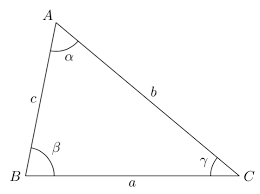
Sides: The sides of the triangle are the lines that make the edges of the triangle. Traditionally, the three sides are represented by capital letters. In the above diagram, the three sides are AB, BC, and CA.
Vertices: These are the points where the sides of the triangle intersect. In triangle ABC, the vertices are A, B, and C.
Angles: A triangle has three angles, formed at the vertex where the three sides meet. These angles are denoted by Greek letters α, β, and γ. Angle measurements are usually expressed in degrees, ranging from 0֯ to 180֯.
Types of Angles in Triangles: An acute angle is less than 90 degrees like a small piece of pie. An obtuse angle resembles an open book, being greater than 90 degrees but less than 180 degrees. Like the corner of a square table, a right angle measures exactly 90 degrees.
Interior Angles: These are angles inside a triangle formed by the three sides.
According to the Angle Sum Property, the sum of all three interior angles of a triangle is 180 degrees. This law can be expressed as α + β + γ = 180֯. The angle sum property helps us understand how angles relate to each other. It is a powerful tool for solving more advanced geometric calculations.
Different Types of Triangles and Their Key Features
Have you ever wondered why triangles don’t look the same? That’s because triangles have different side lengths and different angle sizes.
Based on Sides
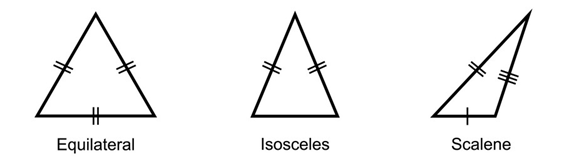
Equilateral triangles: An equilateral triangle is very symmetrical. It has three sides of equal length and three angles of equal measure. Each angle measures 60 degrees.
Isosceles triangles: The isosceles triangle has two equal sides and a base that is of a different length. It has two angles at the base that are congruent and thus have an element of symmetry.
Properties of a scalene triangle: A scalene triangle boasts of three sides of different lengths and three non-congruent angles.
Based on Angle
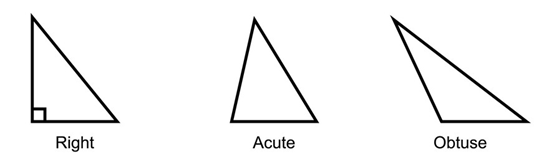
Acute Triangle: All three angles of an acute triangle measure less than 90 degrees, that is, they are acute angles.
Obtuse Triangle: This triangle always has one obtuse angle.
Right triangle: One angle a right angle measuring exactly 90 degrees.
The Pythagorean Theorem applies only to right triangles, allowing us to solve for unknown side lengths. In a right triangle, the square of the hypotenuse is equal to the sum of the squares of the other two sides. c2 = a2 + b2 where c is the length of the hypotenuse, a and b are the lengths of the other sides.
Exploring Subtypes of Scalene Triangles
Scalene triangles are captivating because no two sides or angles are alike. Due to the diversity of scalene triangles, there are further subdivisions, each with different properties. Let's look at the different types of scalene triangles.
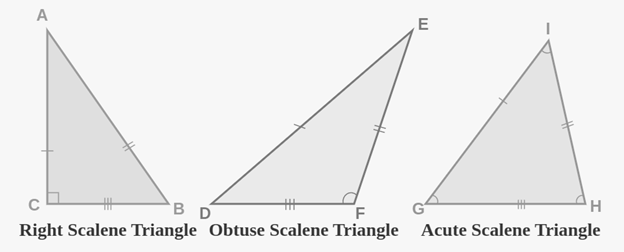
What Is a Right-Scalene Triangle?
It combines the properties of a right triangle and a scalene triangle. One of the angles in the right angle scalene triangle measures 90 degrees and it has unequal sides.
An Obtuse Scalene Triangle
An obtuse scalene triangle can be identified with one angle that is greater than 90 degrees but less than 180 degrees. The obtuse angle is opposite the longest side of the triangle. It is vital to remember that is still a scalene triangle and thus, all the sides are unequal.
What Is an Acute Scalene Triangle?
To understand the properties of acute scalene triangles, you must first recognize that they combine the characteristics of acute triangles and scalene triangles. Its acute triangle properties include having three angles measuring less than 90 degrees. None of its three sides have the same length, this gives its scalene triangle identity.
Strategies for Identifying Acute Scalene Triangles
In your Geometry course, one of the learning objectives has to be identifying acute scalene triangles. To be accurate in your choice, you need to recognize their important properties. Let us delve into the unique world of acute scalene triangles.
Three acute angles: The first criterion has to be the presence of three interior angles that don’t measure 90 degrees. The angle sum rule applies to acute scalene triangles, the sum of all interior angles must be equal to 180 degrees.
Lack of Symmetry: Unlike the isosceles triangle which has at least one axis of symmetry, and the equilateral triangle with multiple axes of symmetry, the acute scalene triangle lacks symmetry.
Three Unequal Sides: Any acute scalene triangle will have sides of different lengths. This contrasts with isosceles and equilateral triangles which have at least two sides of equal measure.
No opposite angles are equal: The acute scalene triangle is characterized by inequality in all the three angles.
Short side, small angle: The shortest side is always opposite the smallest angle. Conversely, the largest angle in an acute scalene triangle is always opposite the longest side.
Different Measurements for the Acute Scalene Triangle: Angles and Sides
We’ve seen that there are different types of scalene triangles. While our eyes can roughly estimate the lengths of the side of the triangle, you can’t be accurate. This leads to inaccurate calculations and thus a failing grade in your assignments.
That’s why mastering how to get precise angle measurements and accurate measurements of lengths is crucial in an acute scalene triangle's geometry work. Follow along to get a step-by-step guide to perfection. Let’s get cracking!
Angle Measurements Using a Protractor
When measuring the angles of an acute scalene triangle, precision is key. A protector is the ultimate tool to measure angles of a scalene triangle. To measure an angle:
-
Align one side of the triangle with the baseline (the line marked 0֯) ensuring the center of the protractor is at the vertex of the triangle.
-
Trace the other side of the triangle until it meets the scale. The reading is the angle measurement.
-
Repeat for the remaining two angles.
Remember, for it to be an acute scalene triangle, all the angles have to measure less than 90 degrees and none of them can be equal.
Measuring Sides of a Triangle Using a Ruler
For linear measurements, a ruler comes in handy. Ensure that you have a ruler with clear markings and a straight edge. You must familiarize yourself with the common units; inches and centimeters.
-
Lay the ruler on the side you want to measure.
-
Start measuring from the zero mark on the ruler.
-
Use the smallest markings to be precise.
For the inches scale, the long lines represent an inch, and the smaller lines are fractions of an inch. For centimeters, the longer lines represent whole centimeters, and the smaller lines are millimeters. Use the smallest markings to be precise.
Acute Scalene Triangle Formula
How to Find the Perimeter and Semi-Perimeter of a Scalene Triangle?
The perimeter of a scalene triangle represents the total length of its sides. Calculating the perimeter is pretty straightforward. Add up the lengths of all three unequal sides.
Perimeter = a + b + c
Semi-perimeter, denoted as s, is half of the perimeter. It plays a crucial role when calculating the area of a scalene triangle using Heron's formula.
s = (a + b + c)/2
Calculating the Area of a Scalene Triangle
Due to their properties of unequal sides and angles, scalene triangles present a unique challenge to math students when it comes to calculating their area. There are several methods we can use to do geometric calculations of the area of an acute scalene triangle.
To calculate the area of a scalene triangle, there are two methods:
1. Base and Height Method
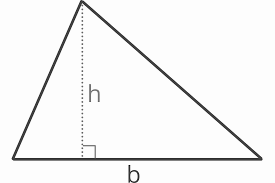
If you know the base length; any side, its height; and perpendicular distance from the base to the opposite vertex, you can use the formula, Area = ½ × base × height.
2. Applying Heron’s Formula to Calculate the Area of a Scalene Triangle.
When you know the measurements of all the sides of a scalene triangle, you can apply Heron's formula to find its area.
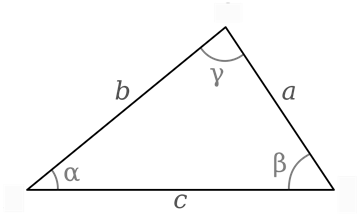

Where a, b, and c are sides of a scalene triangle and s represents the semi-perimeter. The area is given in square units.
Solved Example Questions on Acute Scalene Triangles
Question 1: Calculate the area of the scalene triangle ABC. The sides of the triangle measure 8, 5, and 6 units.
Solution: Calculate the semi perimeter, s = (8 + 5 + 6)/2 = 9.5 units
Apply Heron's formula, Area = √(9.5(9.5 - 8)(9.5 - 5)(9.5 - 6)) ≈ 14.8 square units.
Question 2: Classify each given triangle as either acute, obtuse or right scalene triangle.
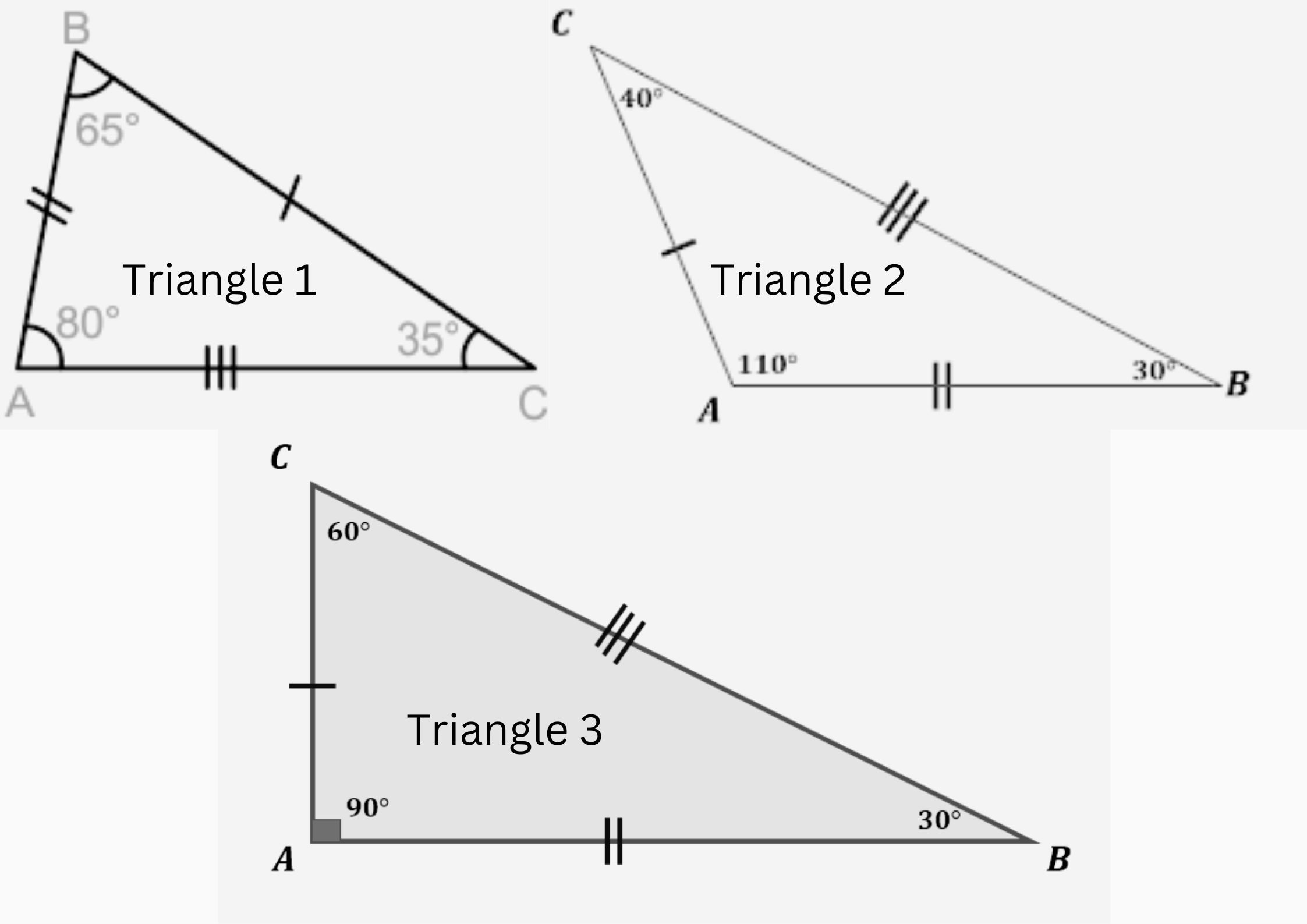
Solution: All the triangles are scalne triangles because of different lengths and interior angles.
Triangle 1: Acute scalene triangle. All angles are acute measuring less than 90 degrees.
Triangle 2: Obtuse scalene triangle. One of the angles measures greater than 90 degrees but less than 180 degrees. Angles opposite the longest side of an obtuse scalene triangle is the obtuse angle.
Triangle 3: Right scalene triangle. This triangle has one right angle.
Frequently Asked Questions on Acute Scalene Triangles
Does the Scalene Triangle Obey the Angle-Sum Property?
Yes. Every triangle follows the angle-sum property.
How Do You Construct an Acute Scalene Triangle?
Using a ruler and a protractor. Draw three line segments of different lengths that intersect forming three vertices. Use the protractor to measure the angles at the vertices to ensure they measure less than 90 degrees.
Which Characteristics Best Describe an Acute Scalene Triangle?
The sides of a triangle are unequal and the angles are acute while lacking symmetry.
How Do You Tell If a Scalene Triangle Is Obtuse or Acute?
Measure or calculate the angles of the triangle. If all three angles are less than 90 degrees, it is an acute scalene triangle. If one of the angles is greater than 90 degrees, it’s an obtuse scalene triangle.
Can You Apply Trigonometric Ratios to Acute Scalene Triangles?
Yes. You can use trigonometric ratios, sine, cosine, and tangent to calculate unknown lengths or angles.
How Is an Acute Scalene Triangle Different from an Acute Isosceles Triangle?
An acute isosceles triangle will have two congruent sides and two equal angles. The acute scalene triangles have different lengths and angle sizes.
Get Resources and Activity Ideas for Acute Scalene Triangle Lessons
If you consult the Common Core State Standards, students will learn about different types of triangles in grades four to six. To improve your performance in these lessons, you need relevant PowerPoints, posters, and activities.
You can use PowerPoint to showcase how triangles are used in everyday life. The PowerPoint could also include explanations of acute scalene triangle formulae for area and perimeter. You could have posters guiding you on how to geometrically construct the triangles.
If you need tailor-made content that suits your learning style, reach out to our expert tutors. They are passionate about making geometry exciting. If acute scalene triangles are a threat to your GPA, let AceMyHomework show you how to impress your teachers and ace your Geometry exam!