You open Bluebook, stare at your last practice score, and feel that familiar panic. Maybe you're juggling school, sports, a job, or family responsibilities. Maybe you've watched a dozen SAT videos and still don't know what to do first. Most students aren't short on advice. They're short on a plan.
That's why the best way to prepare for SAT isn't "study more." It's study with a system. You need a clear baseline, a realistic schedule, a way to sort mistakes, and a method for deciding what deserves your time first.
I've seen the same pattern over and over. One student spends weeks rereading grammar notes and barely moves. Another student takes one solid diagnostic, finds the exact question types that keep costing points, practices those on purpose, and starts feeling in control. The difference isn't talent. It's strategy.
If you're trying to build a smarter routine, resources on effective SAT preparation can help you see what a structured plan looks like. Pair that with practical study habits like these exam preparation strategies for students, and the test starts looking less like a mystery and more like a checklist.
Your Strategic SAT Prep Journey Begins Here
The student I worry about most isn't the one with a low starting score. It's the one doing a little bit of everything and trusting that effort alone will somehow add up.
That student usually looks prepared from the outside. Notes are color-coded. Tabs are open. A prep book sits on the desk. But underneath all that activity is confusion. Should you review algebra? Do more reading passages? Take another full test? Memorize grammar rules? If you don't know which move matters most, even motivated studying can turn into wasted hours.
A strong SAT plan feels different. It starts with a clear picture of where you are right now. Then it narrows your attention to the concepts that are most likely to improve your score. After that, it builds stamina and timing so you can perform under pressure, not just understand content in a calm bedroom on a Tuesday night.
The SAT gets less intimidating when you stop treating it like one giant problem and start treating it like a series of small, solvable ones.
Students often think top scorers are "good at tests." In reality, many of them are just better at diagnosing patterns. They know which mistakes are random and which mistakes repeat. They know when to do untimed work and when to practice under the clock. They don't review everything equally.
That last point matters. Broad review feels productive because it's busy. Targeted review works because it's selective. The rest of this guide follows that logic from the beginning: find your baseline, identify your most valuable weak spots, build a timeline you can keep, and practice in a way that improves both accuracy and pacing.
Establish Your Starting Point and Set Score Goals
The first move is simple, but students skip it all the time. Take a full-length diagnostic test in one sitting.
Not half a math module today and some reading tomorrow. Not a casual attempt while checking your phone. A real diagnostic only works if it reflects how you perform when you're mentally tired, time-aware, and forced to switch between tasks.
Take your diagnostic the right way
Use an official SAT-style test and copy real conditions as closely as you can. That means quiet, timed work, no extra breaks, and no answer checking in the middle.
The most useful rule here comes from Kaplan's SAT guidance: the optimal SAT prep method begins with a full-length diagnostic test followed by a review period as long as the test itself. This approach targets concepts where a student has 50% accuracy but not mastery, which yields higher score gains per hour (Kaplan SAT study guidance).
That review period is where most score gains begin.
Separate score data from emotion
When students finish a diagnostic, they usually react in one of two ways. They either spiral because the score feels low, or they relax because the score feels decent. Neither reaction helps much.
Instead, sort every miss into categories:
Concept gap
You didn't know the rule, formula, or method.
Process mistake
You knew the skill but made an execution error, like a sign mistake in math or missing a transition word in writing.
Timing issue
You rushed, guessed, or left yourself too little time.
Unstable correct answer
You got it right, but only by guessing or weak elimination.
That last category matters more than students think. A lucky correct answer often hides a real weakness.
Find your Zone A topics
The fastest score growth usually doesn't come from your weakest topic in the entire test. It comes from topics you partly know.
I call these Zone A topics. They're the skills where you're getting some questions right, but not enough to trust yourself. Maybe you understand linear equations but keep slipping on systems. Maybe your punctuation is decent, but commas with clauses still trip you up. Maybe you can read the passage, but inference questions feel shaky.
Here's one way to view it:
| Topic type |
What it looks like |
Priority |
| Zone A |
Some accuracy, not full mastery |
Highest |
| Too easy |
Nearly always correct |
Low |
| Too unfamiliar |
Almost no understanding yet |
Medium, later |
If a topic sits in Zone A, every hour you spend there tends to pay off faster because you're building on partial understanding instead of starting from zero.
Practical rule: Don't ask, "What am I worst at?" Ask, "What am I close to turning into a strength?"
Set a score goal that changes your decisions
A vague goal like "do better" won't help when you're planning your week. A useful goal should guide choices.
Try this three-part version:
- Current score from your diagnostic
- Target score based on the schools or programs you're considering
- Section priority based on where the easiest points are likely to come from
For example, if your math is already steadier than your Reading and Writing, your target plan might focus more heavily on grammar rules, rhetorical questions, and passage timing. Another student may need the opposite.
A score goal isn't there to pressure you. It's there to keep you from drifting. Once you know where you stand and which topics belong in Zone A, the best way to prepare for SAT becomes much clearer. You're no longer guessing what to study. You're making choices from evidence.
Build a Realistic SAT Study Timeline
It is Tuesday night. You meant to study after dinner, but homework ran long, your phone kept buzzing, and now you have 40 minutes left before you need sleep. A good SAT timeline has to survive nights like that.
That is why the best way to prepare for sat is not to build an ideal schedule. It is to build a schedule that still works on busy weeks, low-energy days, and weekends that do not go as planned. Students keep improving when the plan is small enough to repeat and specific enough to trust.
Your timeline should follow your diagnostic data. If Micro-Concept Prioritization showed that punctuation, transitions, and linear equations are your highest-payoff topics, those topics should appear in your week first. Time is limited. A realistic plan protects your best score gains from getting crowded out by random review.
Some students need a short runway because the test date is close. Others need more time because they are rebuilding skills while juggling school, activities, or a job. The same planning habits that help students keep up with competing responsibilities also show up in strong prep routines. If your schedule already feels crowded, these strategies for managing college and work responsibilities can help you create study blocks you can keep.
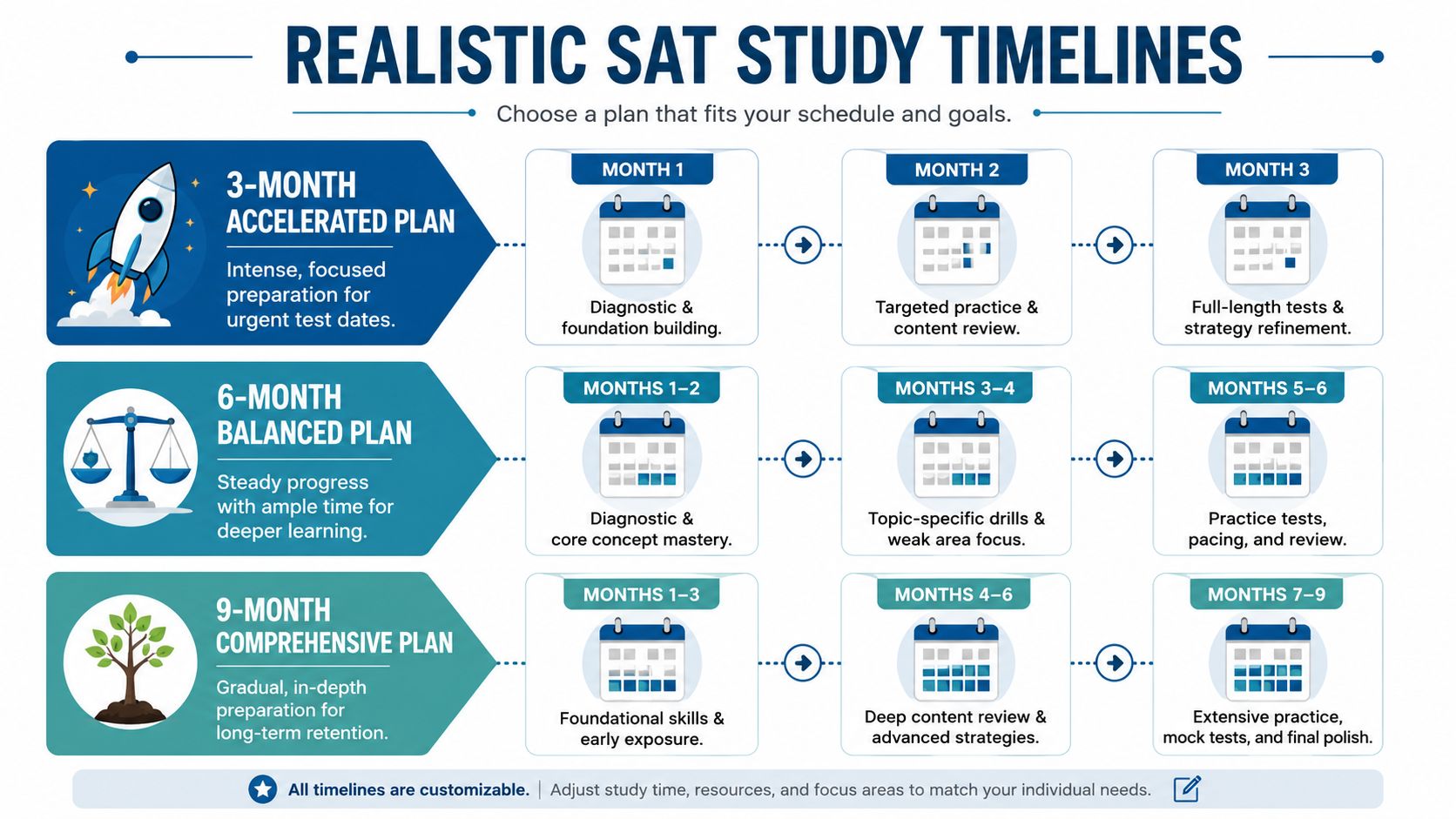
The shortest useful timeline
If your test date is close, selectivity matters more than volume. You do not have time to reopen every topic. You need to work the way a good coach reviews game film. Find the mistakes that keep showing up, then train those patterns on purpose.
One concrete schedule from Superprof's SAT study guide suggests one hour every other day starting three months before the test. The point is not the exact number of minutes. The useful lesson is that steady practice beats occasional marathon sessions.
For a shorter window, use triage:
- Retakers should center the plan on recurring misses, not full reteaching
- Students with uneven section scores should spend more time where the cleanest point gains are available
- Busy students should assign fixed study blocks to specific days and times
Three timeline styles that fit different students
A timeline works like a training plan for a race. The distance is the same for everyone, but the schedule changes based on your starting fitness and your deadline.
| Timeline |
Best for |
Main focus |
| Accelerated |
Retakers or students near test day |
Tight review of recurring weak spots |
| Balanced |
Students with some base knowledge |
Steady mix of review and testing |
| Long-term foundation plan |
Students building from the ground up |
Skills first, then pacing and stamina |
The label matters less than the design. A shorter plan should be narrower. A longer plan should give you room to build missing skills without rushing past them.
What your week should look like
Students often say, "I know I should study. I just do not know what a normal SAT week is supposed to look like." That confusion is common. A clear weekly structure fixes it.
If you're on an accelerated plan
Your week should stay narrow and repeatable.
- Start with one review block for the highest-priority error types from your last test
- Add short drills on those same micro-concepts
- Use one longer session for a mini-section or full module under timed conditions
- Finish with analysis so you know why each miss happened
If punctuation, transitions, and linear equations are your biggest leaks, your schedule should keep returning to those skills until accuracy rises.
If you're on a balanced plan
This fits students who already have some base knowledge and need a steady rhythm.
A balanced week might include:
- Two concept sessions on Zone A topics
- One short daily habit for a frequent skill, such as grammar or vocabulary-in-context
- One timed practice session
- One review session focused only on mistakes and uncertain answers
Each session has one job. That keeps the plan from turning into a pile of half-finished tasks.
If you're on a long-term foundation plan
Choose this route if your diagnostic showed real skill gaps, not just test-taking issues. Slower is fine if the work is organized.
Use phases:
Foundation phase
Rebuild core math skills and grammar rules. Work untimed so you can learn the method, not just race the clock.
Accuracy phase
Raise the difficulty a bit and clean up predictable errors.
Performance phase
Add timed sets and longer practice blocks.
Integration phase
Mix question types so switching tasks feels normal.
A realistic plan is one you can picture yourself completing on a tired Wednesday.
How much official practice belongs in the timeline
Official SAT material should sit near the center of your plan because it keeps your timeline honest. Third-party questions can help, but official practice shows whether your Micro-Concept Prioritization is working on the test format that matters.
You do not need endless random sets. You need enough official practice to spot trends, confirm progress, and update your priorities. If one micro-concept improves, another may move into the top spot. That is how a smart timeline stays flexible without becoming chaotic.
If you tend to overbuild schedules, use a simple rule: every week should answer two questions before Monday starts. What am I targeting? When am I doing it? If those answers are clear, your timeline is probably realistic.
Execute Targeted Content Review and Practice
Most SAT prep falls apart here. Students know they need content review, but they don't know how to choose what to review first. So they default to broad studying. They watch videos on every grammar rule. They reopen old algebra chapters. They do random mixed sets and hope repetition alone will fix things.
That approach feels safe, but it spreads your effort too thin.
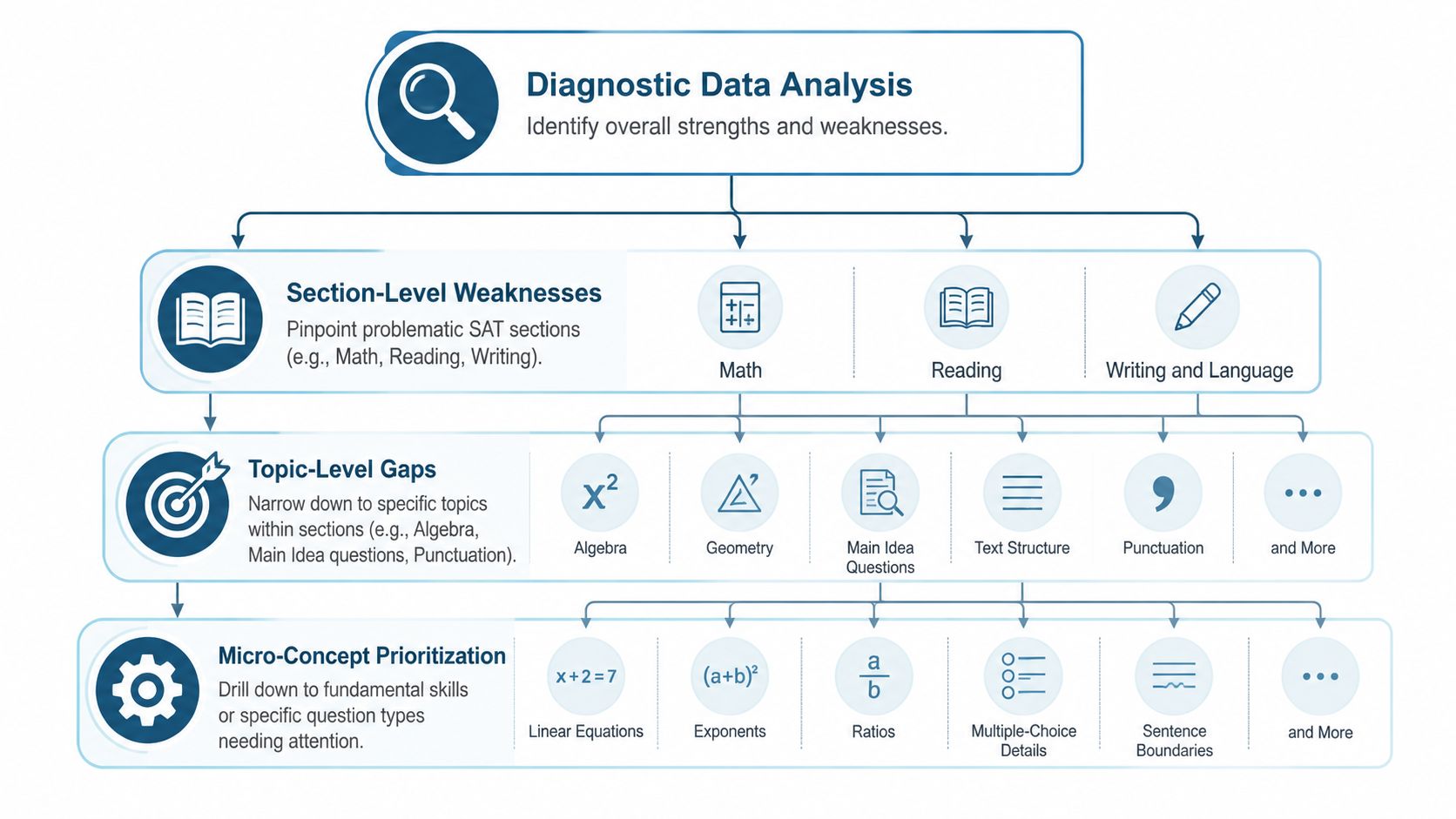
Use micro-concepts, not broad subjects
The smarter move is Micro-Concept Prioritization. Instead of saying, "I'm weak at math," you get specific. Are you missing systems of equations, function interpretation, percent word problems, or geometry setups inside the calculator? Instead of saying, "Writing is hard," ask whether the issue is punctuation, transitions, sentence boundaries, or precision and concision.
That level of precision matters because Khan Academy's SAT prep planning guidance states that 85% of score gains for students in the 1000-1200 range come from mastering just 12 specific high-frequency micro-concepts, making targeted review far more effective than broad-based studying.
That's the heart of the best way to prepare for SAT. Not more content. Better targeting.
Build your own priority list
After your diagnostic review, create a list of the question types that appear repeatedly in your mistakes. Then rank them.
A simple ranking system works well:
Priority A
You recognize the skill, but your accuracy is unstable
Priority B
You understand the general idea but need more repetition
Priority C
You barely know the concept and should save it for later unless it appears often
Students often get confused here because they think the hardest concept deserves first attention. Usually it doesn't. A familiar concept that keeps costing you points is often a better investment.
Here's one way to organize it:
| Section |
Broad topic |
Micro-concept example |
Priority |
| Math |
Algebra |
Systems setup from word problems |
A |
| Math |
Advanced math |
Function notation translation |
B |
| Reading and Writing |
Grammar |
Commas with independent clauses |
A |
| Reading and Writing |
Rhetoric |
Transition word logic |
A |
What targeted review looks like in math
Math improvement usually comes from two shifts. First, you stop treating every miss as unique. Second, you start solving by pattern.
For math, target your review around recurring structures:
Algebra and equation work
Look for repeat issues with rearranging equations, setting up systems, interpreting variables, and translating word problems into expressions. Students often know the arithmetic but miss the setup.
When you drill these, don't just check whether your final answer is right. Ask:
- What clue in the wording told me which equation to build?
- Where did I introduce the mistake?
- Could I solve it a second way?
Geometry and visual setup
Geometry errors often come from incomplete diagrams or weak attention to relationships. If a problem includes shapes, proportions, or angles, redraw or annotate before solving. Slow setup usually prevents rushed errors later.
Desmos use
The Digital SAT rewards students who know when the calculator can speed up testing ideas. Use Desmos to check intersections, visualize equations, or confirm behavior. But don't let it replace understanding. If you're guessing what to graph, the calculator won't rescue the concept.
What targeted review looks like in Reading and Writing
Students often think Reading and Writing improvement is vague. It isn't. The section is highly pattern-based once you sort your misses well.
Grammar rules
Create a short personal list of the grammar rules you repeatedly miss. Keep it narrow. If punctuation and verb agreement cost you points, master those before chasing every rare rule.
The strongest grammar review is active:
- redo missed questions without looking at answers
- explain why each wrong option is wrong
- create mini-sets of one rule at a time
Question pattern recognition
For rhetorical questions, transitions, and sentence placement, your job is to notice the test's logic. Ask what job the sentence is doing. Is it contrasting, concluding, adding evidence, or clarifying a point? Once you identify the function, the right choice becomes easier to defend.
When a student says, "I don't know, this choice just sounded better," that usually means the underlying concept still needs work.
Move from untimed accuracy to timed control
Students should not start by racing. First, learn the concept cleanly. Then increase speed.
A useful benchmark from SAT prep guidance collected in Khan Academy's prep-plan article is to aim for about 1 minute per Reading and Writing question and 1.5 minutes per Math question, while building toward 90% accuracy on hard-level problem sets before moving on.
That means your practice should progress like this:
Untimed concept work
Learn the rule or method.
Focused drill sets
Do several problems of the same type in a row.
Timed mini-sections
Practice speed after your reasoning becomes reliable.
Mixed application
Blend question types so you can identify them under pressure.
If you want a side skill that helps with all of this, focused work on how to improve critical thinking skills can sharpen the exact analysis the SAT rewards. The key is still specificity. Critical thinking on this test means recognizing patterns, weighing choices, and explaining your reasoning under time limits.
Perfect Your Pacing with Full-Length Practice Tests
A practice test is not just a score check. It's a performance lab.
Students who only use practice tests to ask, "Did my score go up?" miss most of the value. A full-length test shows much more than that. It reveals whether your pacing is stable, whether your concentration fades, whether certain question types feel harder late in the exam, and whether your strategy survives pressure.
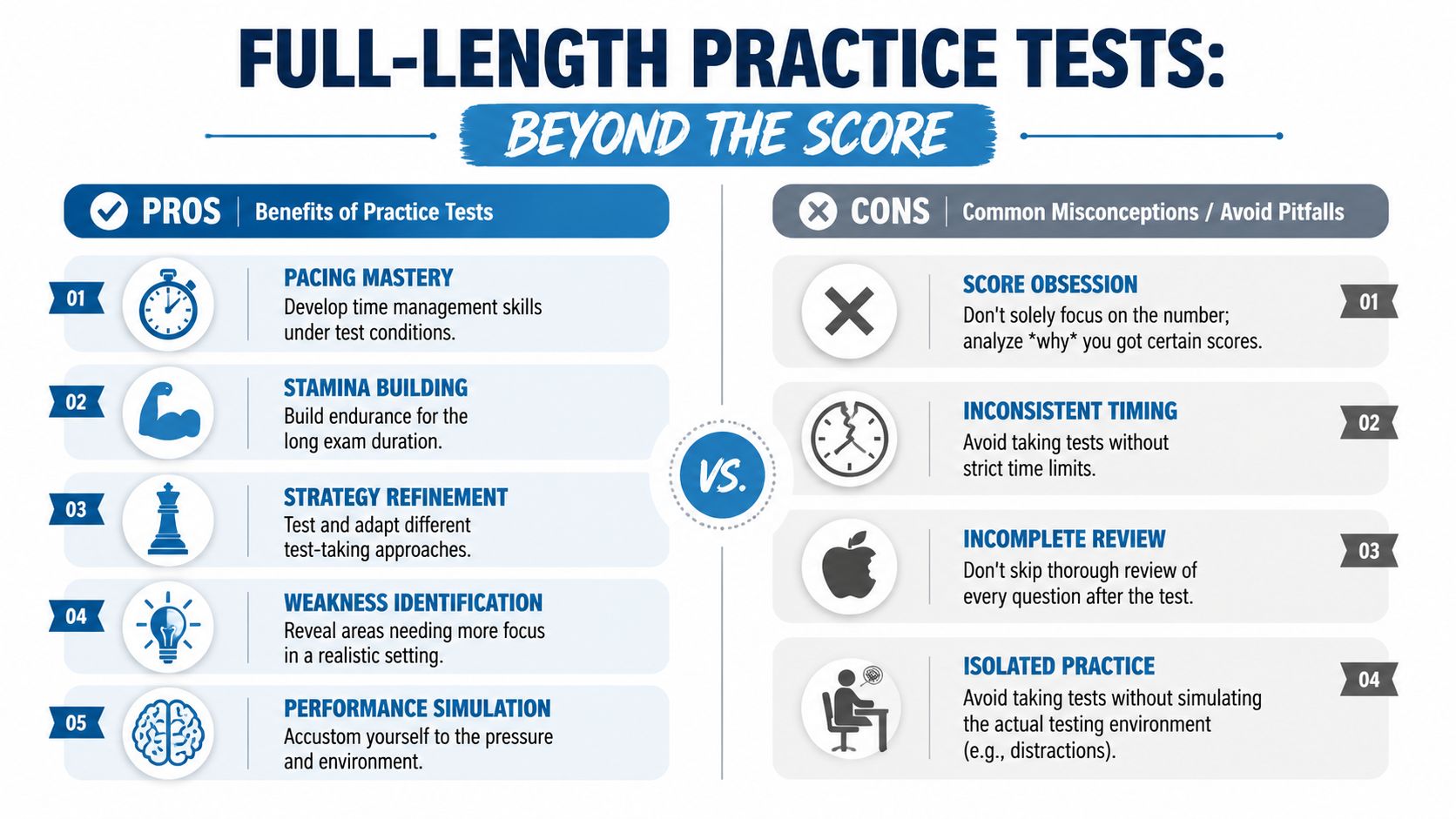
Start with concept-building tests, then shift to performance tests
Many students jump into timed testing too early. If you don't yet understand the concepts, speed work only teaches rushed confusion.
A more effective progression comes from College Essay Guy's self-study SAT guidance, which recommends that students complete at least two full-length untimed practice tests to master concepts, followed by two to four full timed practice tests to build performance stamina and pacing before the official exam.
That sequence makes sense. Untimed tests show whether you can solve problems when pressure is reduced. Timed tests show whether you can still do it efficiently.
Use timing targets instead of vague urgency
Students often tell me, "I need to go faster." That's too vague to fix.
Use a pacing model:
| Section |
Time target per question |
What to watch for |
| Reading and Writing |
About 1 minute |
Overreading, indecision, trap answers |
| Math |
About 1.5 minutes |
Setup delays, algebra slips, overchecking |
If you're consistently falling behind, don't just blame speed. Ask what is causing the slowdown. Sometimes it's weak content. Sometimes it's perfectionism. Sometimes it's spending too long trying to rescue one bad question.
Build an error log that actually teaches you something
After each full test, create an error log. Not a list of wrong answers. A record of patterns.
Your log can be simple. Include:
- Question type
- Why you missed it
- What you should have noticed
- What you'll do next time
For example:
| Question type |
Miss reason |
Better move next time |
| Transition question |
Chose based on tone, not logic |
Name the relationship before reading choices |
| System of equations |
Built wrong first equation |
Label variables before translating words |
| Inference question |
Picked a plausible answer not supported by text |
Point to exact line evidence |
Reviewing this log before your next test is often more useful than doing another random problem set.
A student improves faster when every missed question becomes a rule for future behavior.
Practice under realistic conditions
Test-day performance depends partly on familiarity. If every practice session happens in ideal silence, the actual environment can feel much more disruptive.
Your full-length tests should include realistic conditions:
- Use the same calculator you'll bring on test day
- Sit for the full session without casual pauses
- Use your planned snacks and break habits
- Try some practice in mildly distracting conditions so outside noise doesn't feel shocking
This doesn't mean making your study environment chaotic every day. It means some of your practice should prepare you for imperfect conditions.
Use mark and review carefully
The mark-for-review tool helps, but only if you use it with discipline. If you mark too many questions, you create a stressful backlog. If you never mark questions, you waste time fighting uncertainty.
A simple approach works well:
- If you can eliminate to two choices but still aren't sure, make your best selection and mark it
- If you're stuck early in the solve and time is slipping, move on
- Return only after you've protected easier points elsewhere
The Process of Elimination is especially useful on Reading and Writing. Often the fastest route is not spotting the perfect answer immediately. It's identifying the choices that clearly don't fit.
Review should happen soon after the test
Students remember their thinking best when they review soon after finishing. If you wait too long, you lose the most useful part of the analysis, which is remembering why the wrong answer looked tempting in the moment.
So after each test:
- Rest briefly
- Review every incorrect answer
- Review every uncertain correct answer
- Update your error log
- Pull out the top repeat patterns for next week's drills
That final step matters most. Practice tests don't improve your score by themselves. The review changes your score.
Supplement Your Plan with Targeted Tutoring
You sit down to review another practice set, and the same kind of question misses you again. You understood the explanation yesterday. Today, the trap answer still pulls you in, or the math setup still falls apart halfway through. That pattern usually means you do not need more general studying. You need a faster way to fix one specific crack in the foundation.
That is where targeted tutoring can help, especially if you use it through the same Micro-Concept Prioritization lens as the rest of your plan. Broad tutoring often feels productive but changes very little. Focused tutoring is different. It starts with your data, finds the few concepts that keep costing you points, and works on those first.
A good tutor is like a skilled mechanic diagnosing a car that makes one strange noise. You do not ask them to rebuild the whole engine if the problem is one worn part. SAT tutoring works best the same way. If your error log shows repeated misses on linear equations from word problems, rhetorical synthesis questions, or transitions, those are the places to spend tutoring time.
When tutoring helps most
Tutoring tends to pay off in a few clear situations:
One concept keeps resisting review
You have read the explanation, watched a lesson, and tried fresh questions, but you still cannot reproduce the method on your own.
Your score has flattened for a specific reason
Your overall work ethic is fine, yet the same micro-concepts keep showing up in your misses.
You can spot wrong answers but not your faulty thinking
You know which question you missed, but you cannot explain what decision went wrong in the moment.
You need outside structure
Some students know exactly what to study and still struggle to follow through consistently each week.
The common thread is precision. Tutoring helps most when the problem is narrow enough to identify and important enough to fix.
Keep tutoring tied to official practice and your own data
Tutoring should support your study plan, not replace it. Your practice tests, question-bank work, and error log still provide the raw material. The tutor helps you interpret that material faster and more accurately.
As noted earlier, official SAT prep tools and steady mistake review should remain your base. Tutoring adds value when it turns vague frustration into a specific correction. Instead of saying, "I'm bad at math," you can say, "I lose points when multi-step algebra questions hide the variable relationship in words." That kind of clarity changes the session from general help to score-focused coaching.

Choose support that matches the problem you actually have
Students often waste money on help that is too broad. A tutor who assigns more homework may not help a student whose real issue is misreading graphs. A center with strong scheduling and progress tracking may help a student who falls behind without structure. If you are comparing organized programs, Tutorbase for test prep centers can help you review how centers handle tutoring, scheduling, and student progress.
Before you hire anyone, bring evidence. Show your recent scores, your error log, and a short list of repeat misses. Then listen to the response.
A strong tutor should be able to say what pattern they see, why it is happening, and how they would fix it over the next few sessions. If they cannot get specific, the help is probably too generic to produce meaningful score gains.
Your Final Checklist for Test Day Success
By the week of the SAT, your main job is not to cram. It's to protect the work you've already done.
Students often get restless right before the test. They suddenly want to review everything, fix every weakness, and squeeze in one last marathon session. That urge is understandable, but it's usually counterproductive.
According to this Reddit SAT self-study guide, spending more than 30 minutes studying the night before the SAT has negligible impact, while consistent, spaced practice with deep review over several weeks leads to measurable score gains. Trust the long-term work.
Your final-week priorities
Keep the last few days simple and controlled.
Review your error log
Focus on repeat patterns, not entire textbooks.
Do light practice only
Choose a few representative questions rather than a huge grind session.
Keep your sleep steady
Don't try to "catch up" with one giant night of sleep at the last minute.
Prepare materials early
Have your calculator, ID, ticket, snacks, and anything else you need ready the day before.
The night before
The best night-before routine is boring on purpose.
Use a short checklist:
- Pack what you'll bring
- Choose comfortable clothes
- Set alarms
- Do light review only if it helps you feel calm
- Stop studying and let your brain settle
A brief look at key formulas or grammar reminders is fine. A long panic session is not.
You've already built your score through repeated practice. The night before is for preserving focus, not creating miracles.
The morning of the test
Keep your routine predictable. Eat a solid breakfast that sits well for you. Leave early enough that you're not starting the day rushed and flustered. Once you sit down, your first job is to begin calmly.
During the test:
- read the question being asked before solving
- use elimination aggressively
- move on when a question starts stealing too much time
- trust the habits you've built in practice
The best way to prepare for SAT is the same way to walk into test day confidently. Diagnose first. Study the right concepts. Practice under the right conditions. Review thoroughly. Get help if you stall.
That process won't make the test feel tiny. But it will make it manageable, and that's what students need.
If you want extra academic support while balancing SAT prep with schoolwork, Ace My Homework can connect you with verified tutors for step-by-step help across math, writing, science, and more. Used wisely, that kind of support can free up time, reduce stress, and help you stay consistent with your SAT plan instead of falling behind in everything else.





-card.webp)