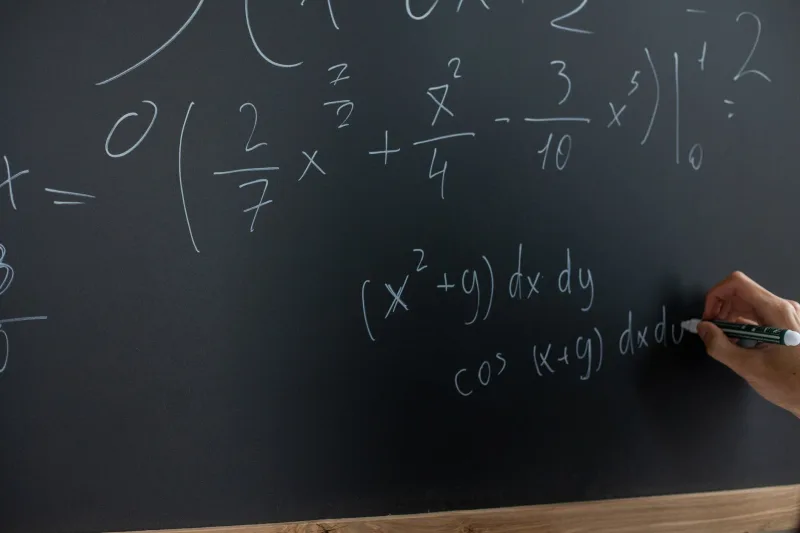
At its core, calculus really boils down to three big ideas: limits, derivatives, and integrals. These aren't just separate topics to memorize for an exam; they're the interconnected pillars that give us a powerful language to describe and predict how things change.
This language is used everywhere, from engineering and physics to economics and medicine.
Why Understanding Calculus Is Your Academic Superpower
Let's be honest: for many students, the word "calculus" can be intimidating. It has a reputation for being one of the toughest subjects out there. But what if I told you it's really just the study of motion and change?
Think of it as gaining a new sense. Suddenly, you can look at the world and not just see objects, but understand the dynamics behind them. You'll be able to describe exactly how fast a rocket is accelerating at a single instant or predict the peak of a company's growth curve. It’s a complete shift in perspective.
The Building Blocks of Calculus
Calculus isn't a random collection of formulas. It’s a logical system where each concept builds on the last. It all starts with one fundamental idea.
As you can see in the diagram below, everything branches out from limits.
Limits are the foundation that makes the two main tools of calculus, derivatives and integrals, possible. These concepts aren't just related; they're two sides of the same coin, a discovery that truly changed the world.
Calculus is the language of motion and change. To miss out on calculus is to miss out on one of the most powerful and beautiful ideas in human history.
This guide is designed to walk you through each of these building blocks. We'll start with simple, intuitive analogies to make sure you have a solid footing before moving on. The table below gives you a quick snapshot of these core ideas.
Core Calculus Concepts at a Glance
This table breaks down the four foundational pillars of calculus, what they help you find, and a simple real-world analogy for each.
Concept
What It Measures
Simple Analogy
Limits
The value a function approaches as the input gets closer to a certain point.
Walking infinitely closer to a wall without ever touching it.
Derivatives
The instantaneous rate of change, or the slope of a curve at a single point.
Looking at your car's speedometer to see your exact speed at one moment.
Integrals
The accumulation of quantities, or the area under a curve.
Calculating the total distance you traveled on a road trip.
Getting a feel for these concepts isn't just about passing your next test. It’s about building a framework for thinking critically and solving complex problems, a skill that will serve you long after you've put your textbook away.
Discovering the Ancient Roots of Modern Calculus
When you hear the word ‘calculus,’ your mind probably jumps straight to Isaac Newton and Gottfried Wilhelm Leibniz, who famously developed it in the 17th century. But the story of calculus didn't start there. Not even close. Its core ideas are thousands of years old, born from practical problems that ancient civilizations needed to solve.
Long before anyone wrote down a derivative, people were trying to measure farmland with curved borders, figure out the volume of a monument, or predict the paths of the stars. These were the first, crucial steps toward understanding change, and their brilliant insights laid the foundation for everything we study in calculus today.
From Pyramids to Pi
You can find some of the earliest whispers of integral calculus in ancient Egypt. The Moscow Papyrus, dating back to around 1800 BCE, contains instructions for finding the volume of a frustum, a pyramid with its top sliced off. Think about that. They figured out a way to calculate the volume of a shape with slanted sides, which is a big step toward the kind of thinking used in integration. You can dig deeper into these incredible early mathematical achievements on Britannica.
Hundreds of years later, the ancient Greeks took these ideas and ran with them, creating more formal methods for working with curves and calculating areas.
"To miss out on mathematics is to live without experiencing some of humanity’s most beautiful ideas." - Francis Su, Mathematician
This sentiment perfectly captures the spirit of those early thinkers. They were driven by a deep curiosity about the world, and their work shows that calculus isn't just a modern subject in a textbook. It's the result of a long and fascinating human journey.
The Genius of Archimedes
No discussion of early calculus is complete without talking about the Greek mathematician Archimedes. Around 250 BCE, he developed a technique so clever that it stands as a direct ancestor to our modern concept of the limit: the method of exhaustion.
Imagine you need to find the exact area of a circle. The curve is the tricky part. Archimedes' genius was to trap the circle between two polygons, one drawn just inside its edge and one just outside.
He started simple, maybe with a square inside the circle and a larger square outside. The circle's actual area was obviously somewhere between the areas of those two squares.
Then, he doubled the number of sides on his polygons, turning the squares into octagons. The inner octagon fit the circle more snugly, and the outer octagon closed in, narrowing the gap where the true area could be.
He kept going, doubling the sides again and again. With each step, the areas of the inner and outer polygons squeezed closer and closer to the circle's actual area.
This idea of getting infinitely closer to a target value is the absolute heart of a limit. By applying this method with polygons of up to 96 sides, Archimedes calculated a value for pi with an astonishing 99.9% accuracy. He proved that by using a process that could go on forever, you could find a single, precise answer.
Mastering Limits, Derivatives, and Continuity
Alright, let's dive into the real engine room of calculus. You're about to meet the three concepts that everything else is built on: limits, continuity, and derivatives. Getting a feel for these is like learning the basic chords before you can play a song. They unlock everything else.
We'll start with limits, which is the secret sauce behind all of calculus. Then, we’ll see how limits naturally lead to the idea of continuity. Finally, we'll get our hands on the derivative, your first powerful tool for analyzing how things change.
The Core Idea of a Limit
So, what exactly is a limit? It’s all about getting incredibly close to a point without actually being there. A limit tells you what value a function is heading toward as you nudge your input closer and closer to a certain number.
Here's an analogy: Imagine you’re walking toward a wall, but with each step, you only cover half the remaining distance. You'll get ridiculously close, so close the distance is practically zero, but you never technically touch the wall. The wall's location is the limit; it's the value your position is approaching.
A limit is the value a function approaches as its input gets arbitrarily close to some point. It’s the intended destination, not necessarily the spot where you actually land.
This is a game-changer because it lets us investigate a function's behavior at tricky spots, like where you might get an error if you just plugged in a number.
Finding a Basic Limit
Let's look at a classic example that trips up a lot of students. Say we have the function f(x) = (x² - 4) / (x - 2) and we want to find the limit as x approaches 2.
Your first instinct might be to plug in x = 2. But if you do, you get (4 - 4) / (2 - 2), which is 0/0, an undefined result. This is where limits save the day. We're not asking what happens at x=2, but what happens as x gets super close to it.
Here’s the thought process:
Look for a way to simplify. That numerator, x² - 4, should look familiar. It's a difference of squares that factors into (x - 2)(x + 2).
Rewrite and cancel. Our function is now [(x - 2)(x + 2)] / (x - 2). Since we’re only getting close to 2 (not equaling it), we know (x - 2) isn't zero. So, we can safely cancel those terms.
Evaluate what’s left. We're just left with f(x) = x + 2. Now, it's easy to see what happens as x gets closer to 2. The value gets closer to 2 + 2 = 4.
Even though the original function has a hole at x=2, the limit is 4 because that's the value the function is aiming for from both sides.
Understanding Continuity
You already have an intuition for continuity. A function is continuous if you can trace its graph without lifting your pen. There are no holes, gaps, or sudden jumps. Simple as that.
The formal definition just connects this idea back to limits: a function is continuous at a point if the limit exists, the function has a value there, and those two things are the same. For many students, grasping the various calculus terms and their meanings can be a major hurdle, but this one is pretty straightforward.
Introducing the Derivative
The derivative is arguably one of the most powerful ideas in all of mathematics. It gives us a way to find the instantaneous rate of change of something.
Think about driving a car. Your average speed for a whole trip is just total distance divided by total time. But what does the speedometer show? It shows your speed at one precise moment. That speedometer reading is a derivative.
The derivative of a function at a point is the slope of the line tangent to the graph right at that point. It tells you exactly how fast the function is changing at a single instant.
Calculating a Simple Derivative
Fortunately, we don't always have to use complex limit definitions to find a derivative. We have shortcuts, and the first one you'll learn is the Power Rule. It's a quick way to handle functions like f(x) = xⁿ.
The Power Rule is simple: you bring the exponent down to the front as a multiplier and then subtract one from the original exponent. Let's try it with f(x) = x³.
Identify the exponent, n. Here, n is 3.
Bring 'n' to the front. We'll multiply by 3.
Subtract 1 from the exponent. The new exponent will be 3 - 1 = 2.
Just like that, the derivative of x³ is 3x². This new function tells us the slope of the original curve, x³, at any point x we want.
Decoding Integrals and The Fundamental Theorem
So far, we've been all about derivatives, slicing things up to find their instantaneous rate of change. Now, it's time to flip the script and talk about the other powerhouse of calculus: integration. If derivatives are for breaking things down, integrals are for building them back up. They are two sides of the same coin.
Here’s a great way to think about it: imagine you're tracking a rainstorm. A derivative would tell you how hard it's raining at any single moment. But an integral? That's what you'd use to add up all those moment-by-moment measurements to find out the total inches of rain that fell during the entire storm.
What Is an Integral?
At its core, an integral is a sophisticated way of finding the area under a curve. That might sound a little abstract, but it’s one of the most practical ideas in mathematics. That "area" could represent anything from the total distance a car has traveled to a company's total profit over a year.
The whole process is a clever update on an ancient Greek idea. To find that curvy, irregular area, we slice it up into a whole bunch of incredibly thin rectangles. We know how to find the area of a rectangle, right? So we calculate the area of every single one and add them all up.
The magic happens when you make those rectangles infinitely thin. As the number of rectangles shoots toward infinity, your approximation gets ridiculously accurate, eventually matching the true area perfectly. An integral is simply the limit of that sum.
The Historic Newton-Leibniz Feud
That elegant, stretched-out "S" you see for integrals (∫) is no accident. We have Gottfried Wilhelm Leibniz to thank for that. He was one of the two giants credited with inventing calculus, and his notation was brilliant. The symbol is a stylized "S" from the Latin word summa, meaning "sum", a perfect visual cue for what an integral does.
This brings us to one of the most famous rivalries in science. The 17th-century 'Calculus Controversy' pitted Isaac Newton against Leibniz in a bitter dispute over who invented calculus first. Newton developed his version (which he called "fluxions") around 1666, but Leibniz independently published his work starting in 1684, complete with the ∫ and dx notation we still use today.
The feud raged for 30 years, but in the end, Leibniz's superior and more intuitive notation won out. It’s now used in over 95% of modern calculus textbooks and is the standard in 98% of U.S. Calculus I courses. You can read more about this fascinating intellectual battle and the development of calculus.
The Fundamental Theorem of Calculus
Now for the main event. The Fundamental Theorem of Calculus is the beautiful, mind-blowing idea that ties everything together. It reveals the deep and surprising relationship between derivatives and integrals: they are inverse operations.
The Fundamental Theorem of Calculus states that differentiation and integration are inverse operations. Taking the derivative of an integral gets you back to your original function, and vice versa.
This connection is what makes calculus such a powerful tool. It gives us a massive shortcut for calculating integrals, freeing us from the tedious process of summing up millions of tiny rectangles by hand.
Think back to our speed and distance example:
If your function represents distance from home, its derivative gives you your speed.
The Fundamental Theorem says that if you have a function representing your speed, its integral will give you the total distance you've traveled.
Working Through a Definite Integral
Let's put this into practice. Say we want to find the area under the curve f(x) = 3x² between x = 1 and x = 2. This is known as a definite integral.
Find the Antiderivative: First, we need to ask: "What function has a derivative of 3x²?" Working the Power Rule in reverse, we find that the antiderivative is x³.
Evaluate at the Endpoints: Next, we plug our upper and lower bounds (the 2 and the 1) into the antiderivative. For x = 2, we get 2³ = 8. For x = 1, we get 1³ = 1.
Subtract the Values: The last step is to subtract the second value from the first. So, we have 8 - 1 = 7.
And that's it! The total area under the curve 3x² from x=1 to x=2 is exactly 7. Thanks to the Fundamental Theorem, we found the answer in three simple steps without drawing a single rectangle.
Applying Your Calculus Knowledge to Advanced Topics
Once you’ve got a handle on derivatives and integrals, you're standing at a doorway. The Fundamental Theorem of Calculus isn't the end of the road; it's the key that unlocks whole new dimensions and even the mind-bending concept of infinity.
Think of this as a quick preview of what comes next. We aren't aiming for total mastery just yet. The idea is to give you a clear map, showing how concepts like sequences, series, and multivariable calculus are just natural next steps, built on the foundation you already have.
Journeys into the Infinite with Sequences and Series
Picture an endless list of numbers, like 1, 1/2, 1/4, 1/8, and so on, forever. That's a sequence. A series is what happens when you try to add up all the numbers in that infinite list.
At first glance, adding up an infinite number of things seems like it should always give you infinity. It feels impossible to get a finite answer. This is the core of Zeno's paradox: how can you ever reach your destination if you first have to go half the way, then half of the remaining way, and so on for eternity?
Calculus, specifically the idea of convergence, gives us a satisfying answer.
Zeno's Paradox Explained: The total distance you travel is the sum of the series 1/2 + 1/4 + 1/8 + ...
The Finite Sum: Even though you're adding an infinite number of smaller and smaller pieces, the total sum gets closer and closer to a single, finite number: 1. The series converges.
This is a profoundly powerful tool. It lets mathematicians and engineers tackle incredibly complex problems, from modeling sound waves to calculating probabilities, by breaking them down into an infinite sum of manageable parts.
Understanding convergence isn't just an abstract mental puzzle. It’s the tool that makes sense of the infinite, showing that some endless processes have very definite, predictable outcomes.
This level of precision wasn't always a part of calculus. Early versions were much more intuitive, but a major push for rigor in the 19th century completely reshaped the field. This "rigorization" turned calculus from a creative art into a precise science, with mathematicians like Augustin-Louis Cauchy and Karl Weierstrass formally defining limits, which now underpin 90% of modern proofs.
Before 1800, infinitesimals were treated more like a philosophical concept. Cauchy’s work on ε-δ limits helped slash approximation errors from a shaky 5-10% down to virtually zero, while Weierstrass put continuity on a solid axiomatic footing. Today, over 5.2 million STEM students in the U.S. depend on this precision every day. You can explore the historical journey of calculus to see how it evolved from ancient ideas into the modern powerhouse it is now.
Stepping into the Third Dimension
So far, most of the calculus we've discussed has lived in a flat, two-dimensional world with x and y axes. But what happens when we add a z-axis and start thinking in three dimensions? Welcome to multivariable calculus.
Instead of just finding the slope of a tangent line on a curve, you might be finding the slope of a tangent plane on a surface, like the side of a mountain. The core concepts of derivatives and integrals just expand beautifully to handle the extra dimension.
Partial Derivatives: These allow you to find the rate of change on a 3D surface, but by focusing on one direction at a time (imagine walking up a hill, but only measuring your steepness as you head due east).
Multiple Integrals: Forget just finding the area under a curve. Now you can find the volume under an entire surface.
These aren't just abstract ideas; they're essential for solving real-world problems. Physicists use them to model electromagnetic fields, engineers rely on them to design complex bridges and airplane wings, and data scientists use them to build optimization models that juggle dozens of variables. It's the next logical step in applying the power of calculus to the complex world we live in.
Proven Strategies for Calculus Success
Knowing the definitions in calculus is one thing, but actually solving problems and feeling confident about it comes down to smart study habits. I've seen it time and again: success isn't about some innate "math gene." It’s about having the right strategies and sticking with them.
Think of it this way: calculus is a language. You wouldn't expect to become fluent by just reading a dictionary. You have to practice speaking it every day, and in calculus, that means solving problems. Daily practice is so much more effective than pulling an all-nighter to cram before a test.
Fine-Tuning Your Study Habits
To really get a feel for the material, you have to move past memorizing formulas. Try to visualize what's happening. When you see a derivative, actually picture the steepness of a line just touching a curve. When an integral pops up, imagine the area building up piece by piece.
Here are a few concrete things you can do to build that deep understanding:
Work Backwards from Your Mistakes: When you get a problem wrong, don't just look at the right answer and move on. Hunt down the exact spot where you went off track. Was it a simple algebra slip? A concept you thought you knew? A miscalculation? Pinpointing the why is how you get better.
Teach It to Someone Else: Grab a friend and try to explain a big idea, like the Fundamental Theorem of Calculus. If you can walk them through it clearly, you've probably mastered it yourself.
Don't Neglect the Basics: So many errors in calculus are actually algebra or trigonometry errors in disguise. A recent RAND study found that half of students lose interest in math, often because weak fundamentals make new concepts feel impossible. There's no shame in reviewing the basics; it's one of the smartest things you can do.
Knowing When to Ask for Help
Even the best students eventually hit a problem that just won't budge. When that happens, getting expert help isn't a sign of weakness; it's a strategic move for deeper learning. Seeing a detailed, step-by-step solution can be a huge "aha!" moment that clarifies the entire process. If you want to learn efficiently, understanding principles like Cognitive Load Theory can help you absorb complex information without feeling swamped.
For students juggling a busy schedule, a reliable support system can be a game-changer. It can be as simple as a four-step process to get you unstuck:
Submit Your Problem: Just upload the calculus question you're struggling with and any specific instructions.
Choose Your Expert: You can pick a qualified tutor based on their background and what other students have said about them.
Track Your Progress: Chat directly with your tutor and watch as they work through the solution.
Download and Learn: You'll get back a completely original, plagiarism-free solution that breaks down every step. This builds your confidence to tackle the next problem on your own.
Frequently Asked Questions About Learning Calculus
As you get into calculus, some questions are bound to come up. It's totally normal. Let's tackle some of the most common stumbling blocks students run into so you can move forward with confidence.
What Is the Single Most Important Concept to Master First?
If there's one thing to nail down before anything else, it’s the limit. Seriously. Limits are the foundation for both derivatives and integrals, which means pretty much all of calculus rests on this one idea.
Without a gut-level feel for what it means for a function to "approach" a certain value, the formal rules for derivatives and integrals will feel confusing and arbitrary. Once you really get limits, you'll find the rest of calculus starts to click.
Think of it this way: a limit is how we explore what a function is doing right up close to a point, especially when we can't just plug the number in. Mastering limits first is like learning the alphabet before you try to write a novel. It makes everything else possible.
How Much Algebra and Trigonometry Do I Really Need?
Here's the deal: you need a lot. A strong background in algebra and trigonometry is non-negotiable for calculus. I've seen countless students struggle, not because the calculus ideas are too hard, but because their algebra skills are rusty.
You need to be able to handle these without breaking a sweat:
Factoring different kinds of polynomials and simplifying messy fractions.
Working with exponents and logarithms quickly and accurately.
Solving equations without having to look up the steps.
And for trig, you have to know the unit circle, your core identities, and what the graphs of sine and cosine look like in your sleep. These concepts show up constantly, so being fluent in them is a must. For more ways to sharpen your skills, check out these expert tips for mastering math homework.
I Understand Concepts in Class but Struggle with Homework
This is probably the most common frustration I hear, and it almost always points to the difference between watching someone else do something and actually doing it yourself. It’s like watching a pro chef cook a fancy meal. It looks easy until you're the one in the kitchen.
The fix is to get your hands dirty. Start by re-doing the examples your professor did in class, but without peeking at the solution. When you start your homework, tackle the easiest problems first to get some wins under your belt.
When you get stuck on a tough problem, don't just throw in the towel. Instead, try to identify the exact spot where you got lost. Working with a study partner is also a game-changer; trying to explain a concept to someone else is one of the best ways to truly learn it. Sometimes, all you need is one detailed, step-by-step solution to a tricky problem for the whole concept to finally make sense.
Ready to conquer your calculus assignments? The expert tutors at Ace My Homework provide clear, step-by-step solutions to help you understand tough concepts and meet your deadlines. Get the support you need at https://acemyhomework.com.
Need Help With Math?
Post your assignment, compare tutor bids and work with an expert who explains each step.
Get affordable and top-notch help for your essays and homework services from our expert tutors. Ace
your homework, boost your grades, and shine in online classes—all with just a click away!
Get a beginner-friendly introduction to calculus: where it came from, how Newton and Leibniz shaped it and the basics of differentiation and integration.
⭐WHAT IS DX?⭐ This post highlight the basic Calculus terms, their meanings and applications. If you have trouble mastering the concept, check these details out.