Writing essays is something every student has to deal with if they want to score well in school. Whether you're studying something hands-on like tech or diving into theories in the social sciences, strong essays matter.
That means doing solid research, building your argument clearly, organizing your facts so they make sense, and giving everything a good proofread before turning it in. To achieve an outstanding essay, these 10 innovative essay writing hacks will transform your process, boost your confidence, and help you stand out.
1. Reverse-Engineer the Essay Question
Before you even begin your essay writing, dissect the essay question like a detective. Most students skim the prompt, but 78% of high-scoring essays demonstrate a deep understanding of the task.
Break the question into keywords, identify the main idea, and pinpoint the required action (e.g., analyze, compare, argue).
Then, rewrite the prompt in your own words to clarify the focus. This ensures your thesis statement and main points align perfectly with what the professor expects, setting a strong foundation for your essay.
2. Write the Conclusion Before Drafting
Most students struggle with conclusions because they don’t plan them. Before you start your draft, sketch a "conclusion blueprint."
Jot down how you’ll restate your thesis, summarize your main points, and leave the reader with a thought-provoking takeaway.
For example, if your essay argues for renewable energy, your blueprint might include a call to rethink energy policies. This ensures your conclusion is purposeful and impactful, tying your essay together like a bow.
3. Use the "Reverse Hook Technique" in Your Introduction
Everyone talks about hooking the reader in the introduction, but here’s a twist in essay writing: use a "reverse hook." Instead of starting with a broad statement, begin with a specific, surprising fact or question that flips the reader’s expectations.
For instance, “Did you know 90% of college students misinterpret essay prompts, costing them valuable points?” This grabs attention and sets up your argument without generic fluff. Follow it with a concise thesis to keep the introduction sharp and engaging.
4. Use the "Idea Web" for Brainstorming
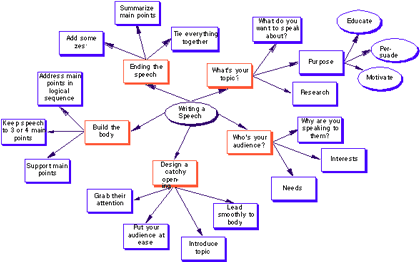
Forget linear outlines for a moment. Try an "Idea Web" to spark creativity and generate unique ideas. Start by writing your essay topic in the center of a page and branch out with related concepts, questions, or themes. This visual brainstorming technique helps you see connections between ideas that a traditional outline might miss.
Research from the Journal of Writing Studies shows that students who use visual mapping improve their essay coherence by 65%. Once your web is complete, select the strongest branches to form your main points. Below is an example of an image web.
5. Formulate a "Mini-Thesis Statement" for Each Paragraph
A thesis statement guides your entire essay, but what about each paragraph? Create a "micro-thesis" for every paragraph to ensure it has a clear point and supports your argument. Remember the 5 Cs of essay writing are clarity, coherence, conciseness, correctness, and completeness, so ensure each paragraph
For example, if your thesis is about the impact of social media on mental health, a micro-thesis for one paragraph might be: "Social media’s dopamine-driven feedback loops increase anxiety in college students." This keeps your paragraphs focused and prevents tangents, making your essay tighter and more compelling.
6. Gamify Your Research Process
Research can be a slog, but turning it into a game makes it fun and efficient. Set a timer for 20-minute research sprints, aiming to find one solid source or piece of evidence per sprint. Reward yourself with a quick break or treat after each round.
This keeps you focused and prevents burnout. According to a 2024 study from the Academic Productivity Review, students who gamify their research complete it 30% faster and retain more information.
7. Include "Evidence Points" for Stronger Arguments
Evidence is the backbone of a great essay, but don’t just dump quotes or stats. Use "evidence points," which are short, impactful pieces of data or quotes woven seamlessly into your sentences.
For example, instead of saying, “Studies show X,” write, “A 2023 Harvard study found that 67% of students who integrate primary sources score higher on essays.” This approach makes your argument persuasive without overwhelming the reader. Always cite your sources to add credibility and avoid plagiarism.
8. Personal Relevance Technique (PRT)
Turn your paper from “just another essay” into something professors remember by applying the PRT hack: relate your thesis or main idea to your own life, or the real world.
For example, if you're writing about climate change, add a paragraph showing how it impacts your hometown. This connection builds emotional engagement and adds a human touch.
9. The “Page-Limit Workaround”
Sometimes, hitting a strict page count can be stressful, especially when you feel like you’ve said everything worth saying. But don’t just add fluff. Use strategic content expansion tips such as:
- Deepen Your Analysis (Ask “Why” Twice) - Instead of moving on after stating a point, ask yourself, Why does this matter, and what are the broader implications?”
- Incorporate Examples and Case Studies - Instead of just stating facts in your essay writing, bring them to life. Add historical context, real-world examples, and mini case studies or personal anecdotes
- Build "transition bridges" between paragraphs to create a smooth flow - Instead of generic transitions like “furthermore,” use phrases that connect ideas, such as “Building on the economic benefits, the social impact of X also deserves attention.” This shows the reader how your ideas link, making your essay writing cohesive and easy to follow.
10. Practice the "Voice Swap" to Detect Spelling Mistakes
After completing your draft, read it aloud in a different “voice”, imagine you’re a professor, a skeptic, or even a curious friend. This “voice swap” helps you spot weak arguments, spelling mistakes, awkward phrasing, or gaps in logic.
For instance, reading as a skeptic might reveal where you need stronger evidence. This hack in essay writing improves critical thinking and makes your essay more persuasive, as 82% of A-grade essays demonstrate self-critical revision
Write Smarter, Not Harder, with Acemyhomework
Writing an A-grade essay does not need to be a solo effort. At Acemyhomework.com, we are dedicated to helping students like you reach their academic best. Our essay writing experts provide tailored support, from formulating a strong thesis to refining your final draft. Ready to elevate your essays?
Visit Acemyhomework.com's essay writing service to connect with our skilled professionals who will guide you from thesis to triumph. Place your order now and make your essays stand out!