The ALEKS Initial Knowledge Check is the short adaptive quiz ALEKS gives you the first time you open a course, before you see a single lesson. In ALEKS Chemistry, it decides which topics start out as mastered and which ones you'll have to work through, so it makes sense that you'd want the answers ahead of time. This guide explains why that search goes nowhere, what the check covers in general chemistry, how to prepare for it honestly, and what to do if your score came back lower than you hoped.
The rules below come from McGraw Hill's own ALEKS documentation and from instructions that college chemistry departments publish for their students. Instructors control a lot of ALEKS settings, so your syllabus is the final word for your course.
What Is the ALEKS Initial Knowledge Check?
The ALEKS Initial Knowledge Check is an adaptive quiz that maps what you already know in your course, what you don't know yet, and what you're ready to learn next. ALEKS gives it right after the short tools tutorial that shows you how to enter answers, and your whole learning path is built from the result.
Here is how it works, according to McGraw Hill's explanation of ALEKS Knowledge Checks:
- Length: roughly 20 to 30 questions.
- Adaptive questions: each question is generated by an algorithm based on how you answered the one before.
- No feedback: you aren't told whether an answer is right or wrong while the check is running.
- An I Don't Know option: you can select it when you have no idea how to solve a question.
Because the check is hunting for the edge of your knowledge, it will hand you problems you can't solve. The Indiana University chemistry department's ALEKS instructions warn students to expect this. ALEKS is looking for the outer limits of what you know, and the only way to find them is to ask a few questions you'll miss. Hitting a wall partway through is normal.
How Long It Takes and What You Can Use
Plan on about an hour to an hour and a half, and check your course's rules on pausing and tools first, because schools set them differently. Here is how two chemistry programs describe it:
| Rule | Montgomery College (CHEM 131 prep module) | Indiana University (C117 prep course) |
|---|
| Expected time | 45 to 90 minutes | About an hour to an hour and a half |
| Pausing | Must be finished in one continuous session | Not timed; you can log out and pick up where you left off |
| Calculator | Your own calculator is allowed | Not stated |
| Periodic table | Use the one built into ALEKS | Not stated |
| Outside help | Not allowed | Not allowed |
The Montgomery College details come from its getting-started guide for the ALEKS CHEM 131 preparation module. McGraw Hill's student module guide also notes that the ALEKS calculator button shows up only when it's available, so don't count on it for every question. If your instructor hasn't said which calculator you can use, ask before you start.
How the Initial Knowledge Check Builds Your ALEKS Pie
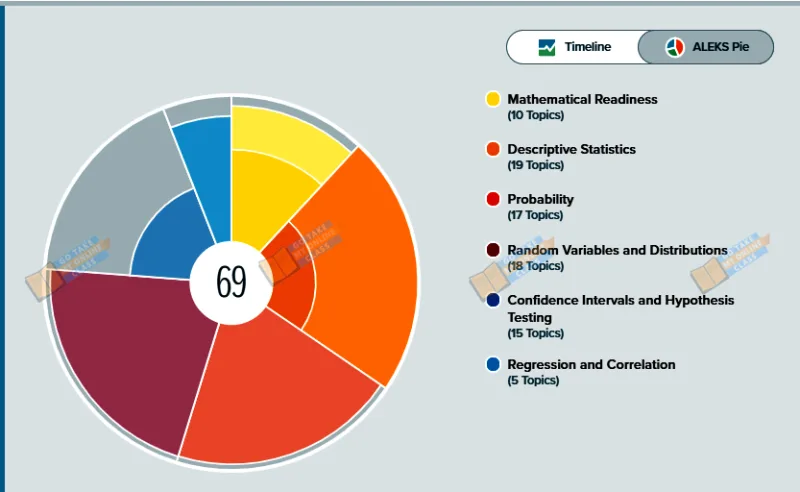
When you finish, ALEKS turns your results into the ALEKS Pie, a chart of every topic in your course divided into slices by subject area. McGraw Hill's ALEKS student orientation describes three shades in each slice:
- Dark: topics you mastered on a Knowledge Check.
- Light: topics you learned in Learning Mode but haven't been retested on yet.
- Grey: topics you haven't learned or mastered.
Right after the Initial Knowledge Check, everything shaded is dark, because all of it came from the check. ALEKS then fills your learning path with topics you're ready to learn, meaning topics whose prerequisites you already have. Topics that depend on skills you're missing stay locked until you learn those skills.
Initial vs. Progress Knowledge Checks
The Initial Knowledge Check is only the first of several. ALEKS keeps giving you Progress Knowledge Checks to see whether you've held on to what you learned. According to McGraw Hill's FAQ on why Knowledge Checks keep appearing, one is triggered after you learn 20 topics and spend 5 hours in Learning Mode, after 10 hours in Learning Mode, or after a stretch with no Knowledge Check at all, which is 30 days for higher education chemistry. Instructors can also schedule extra checks.
| Initial Knowledge Check | Progress Knowledge Check |
|---|
| When it happens | Your first time in the course, after the tools tutorial | Periodically, based on topics learned, hours worked, days passed or your instructor's schedule |
| What it measures | Your starting knowledge across the whole course | Whether you kept what you learned recently |
| What it changes | Sets your first pie and learning path | Turns learned topics into mastered ones, or sends forgotten topics back to your learning path |
That second kind of check is why a padded first score doesn't last. The same McGraw Hill FAQ says a topic can drop from mastered or learned back to remaining if you select I Don't Know or answer a related question incorrectly on a later check.
What the Initial Knowledge Check Covers in ALEKS Chemistry
In ALEKS Chemistry, the initial knowledge check samples the whole course your instructor set up, so the content depends on which ALEKS course you're in and how it was customized. The ALEKS for Chemistry table of contents listed the default first-semester General Chemistry course at 233 topics in its 2022 edition, spread across these sections:
| Section | Topics |
|---|
| Math and Physics | 41 |
| Measurement and Matter | 41 |
| Atoms, Ions and Molecules | 27 |
| Chemical Reactions | 42 |
| Thermochemistry | 17 |
| Electronic Structure and Chemical Bonding | 46 |
| States of Matter | 15 |
| Acids and Bases | 4 |
Introductory and preparatory courses lean harder on the basics. ALEKS's Introductory College Chemistry curriculum (231 topics) opens with what reads like a checklist of skills you need before stoichiometry: scientific notation, SI prefixes and unit conversions, counting significant digits, density, element names and symbols, naming ionic and covalent compounds, molar mass and balancing equations. Its Reaction Stoichiometry group includes topics such as using a chemical equation to find moles of product from moles of reactant, solving moles-to-moles limiting reactant problems, and understanding theoretical, actual and percent yield.
Some schools build their own prep course on top of ALEKS. Indiana University's C117 prep course splits its initial assessment into seven sections: Math and Algebra Review, Measurement, Matter, Atoms, Ions and Molecules, Stoichiometry, Simple Reactions, and Gases. IU South Bend's ALEKS chemistry placement page describes its Initial Knowledge Check as covering about 130 fundamental chemistry topics.
Why Stoichiometry Decides So Much of Your Score
Stoichiometry sits on top of almost everything else in early chemistry, so a single problem can expose gaps from several sections at once. To get from grams of a reactant to grams of a product, you need a correct formula, a correct molar mass, a balanced equation, the right mole ratio and clean unit conversions. A slip at any one of those steps gives a wrong final answer, and since the check doesn't tell you, you can't catch it mid-quiz.
Prerequisites shape what happens next, too. If the check concludes you haven't learned molar mass, the stoichiometry topics that depend on it stay locked until you do. That's why reviewing the building blocks often moves your pie more than drilling stoichiometry problems on their own.
Why ALEKS Initial Knowledge Check Answers Don't Exist
There's no answer key for the Initial Knowledge Check because there's no fixed set of questions to write one for. McGraw Hill says each question is generated from your previous response, and Indiana University's chemistry instructions put it plainly: it's impossible to say ahead of time how many questions you'll get or what they'll look like, because ALEKS chooses new, randomized questions based on your earlier answers.
In practice, that means:
- Two students in the same class can get different questions in a different order.
- The same topic can show up with different compounds, numbers and units.
- One different answer changes which question comes next, so a list built from someone else's session stops matching almost at once.
So pages promising ALEKS answers or a full set of ALEKS chemistry answers for the check can't deliver. At best you get answers to someone else's numbers. At worst you pay for a list that was never real.
Looking Answers Up Gives You a Pie You Can't Keep
Even if you found the right answer to every question, a padded check works against you. The check exists to place you. If outside help marks topics as mastered, ALEKS skips the lessons for them, and you meet those skills again on homework, quizzes and exams without having learned them. Progress Knowledge Checks then retest those topics and send any you miss back to your learning path, so the work returns anyway, usually closer to a deadline.
It can also break your school's rules. IU South Bend tells students not to consult friends, family, internet searches or textbooks during its ALEKS Assessment, and Montgomery College tells students not to look for any external help on the Initial Knowledge Check. Where a school uses ALEKS for course placement, help on the check can put you in a class you aren't ready for, which IU South Bend points out wastes both time and tuition.
Low-Balling the Check Backfires Too
The opposite trick fails as well. Some students click I Don't Know on everything, hoping for an easier start. All that does is turn your pie grey and hand you hours of review on material you already know. Montgomery College warns that overusing the button can make ALEKS assign review you don't need, and Indiana University notes that careless mistakes lead ALEKS to conclude you know less than you do, which sends you back to simpler problems.
When to Click I Don't Know
Click I Don't Know only when you have no idea how to start a problem. McGraw Hill's guidance is that if you have a partial idea, you should work the problem and submit your best answer. Use this as a quick guide:
| Situation | What to do |
|---|
| You've never seen the topic, such as a reaction type your class hasn't covered | Click I Don't Know |
| You know the method but aren't sure about one step | Work it through and submit your best answer |
| You recognize the problem but can't recall a formula right away | Try to rebuild it from units or a related fact before giving up |
| You're tired and starting to make careless errors | Take a break if your course lets you pause; if it requires one sitting, slow down and recheck units and signs |
How to Prepare for the Initial Knowledge Check
The best preparation is a short, honest review of the skills the check samples most, done before you open ALEKS. You're not trying to inflate your score. You're making sure it reflects what you can do on a good day, not what you forgot over the summer.
Before You Start
- Read your syllabus. Find out whether the check is graded, used for placement or practice only, whether you can pause, and which calculator you can use.
- Refresh the math. Scientific notation, exponent rules, fractions and rearranging simple equations all appear in the Math and Physics and Measurement sections.
- Practice dimensional analysis. Write every unit out and cancel units on paper. The OpenStax Chemistry 2e section on measurement math is free and walks through the method.
- Review naming and formulas. Element symbols, common ions and the rules for naming ionic and covalent compounds are quick to relearn and easy to miss cold.
- Rework a few stoichiometry problems. OpenStax's reaction stoichiometry section has worked examples you can cover up and solve yourself.
- Block out the time. Set aside 90 minutes without distractions, with scratch paper and an allowed calculator.
During the Check
- Read what the answer box asks for, including units and how to round.
- Keep extra digits until the last step, then round once.
- Use the periodic table ALEKS provides if your instructor asks you to.
- Take your time. Indiana University suggests at least 2 or 3 minutes per problem, sometimes 5 or 10, plus a final look for typos, sign errors and unit errors.
Worked Example: Dimensional Analysis
Practice problem: How many moles of ethanol (C2H6O) are in 25.0 mL of ethanol? Its density is 0.789 g/mL.
- Convert volume to mass with density: 25.0 mL × 0.789 g/mL = 19.725 g. The mL units cancel.
- Find the molar mass: 2(12.011) + 6(1.008) + 15.999 = 46.069 g/mol, or 46.07 g/mol.
- Convert grams to moles: 19.725 g × (1 mol / 46.07 g) = 0.42815 mol.
- Round at the end. Both measured values have three significant figures, so the answer is 0.428 mol.
If molar mass still feels shaky, our walkthrough on calculating the molecular mass of C6H6 shows the same steps with benzene.
Worked Example: Stoichiometry
Practice problem: For the reaction N2 + 3H2 → 2NH3, how many grams of ammonia can form from 10.0 g of hydrogen gas if nitrogen is in excess?
- Grams of H2 to moles: 10.0 g × (1 mol / 2.016 g) = 4.960 mol H2.
- Apply the mole ratio from the balanced equation: 4.960 mol H2 × (2 mol NH3 / 3 mol H2) = 3.307 mol NH3.
- Moles of NH3 to grams: 3.307 mol × 17.03 g/mol = 56.3 g NH3.
The most common mistake here is skipping the mole ratio. Treat H2 and NH3 as one to one and you get 4.960 mol × 17.03 g/mol = 84.5 g, an answer that looks reasonable and is wrong. On the check, that slip tells ALEKS you haven't learned mole ratios, even if you have.
| Common slip | What it looks like | Quick fix |
|---|
| Skipping the mole ratio | Using one to one for every reaction | Write the ratio from the balanced equation as a fraction before you multiply |
| Rounding too early | Rounding 19.725 g to 20 g halfway through | Carry extra digits and round once at the end |
| Unbalanced equation | Reading coefficients from a skeleton equation | Balance first, then read the coefficients |
| Unit mismatch | Giving grams when the question asks for kilograms | Reread the question before you submit |
| Wrong formula | Writing NaCl2 for sodium chloride | Check ion charges before you write a formula |
What to Do If You Scored Low on the Initial Knowledge Check
A low score on the initial knowledge check usually means a longer learning path, not a failing grade. In many courses the check only sets your starting point, and your grade comes from finishing topics or objectives by their due dates. IU South Bend even labels its Initial Knowledge Check "for practice only." Check your syllabus to see how your course counts it.
Steps That Help
- Work a little every day. Indiana University suggests about an hour or two a day instead of cramming everything into two or three days.
- Use Explain on every problem you miss. Read the explanation, then do the next practice problem without it.
- Start with grey Math and Physics or Measurement topics. They feed nearly everything else in the pie.
- Take Progress Knowledge Checks seriously. They're how light topics turn dark.
- Ask for help early. Office hours, a campus tutoring center or a tutor who explains the method will save you hours later.
For tactics on working through the learning path once you're past the check, see our guide on how to finish ALEKS topics faster without losing progress.
Getting the Check Reassigned
If a technical problem or a rushed attempt gave you a misleading start, ask your instructor. A McGraw Hill instructor guide explains that instructors can reassign the initial knowledge check to reassess a student, for example under a proctor, through the student's Assignments menu. Explain what went wrong and keep your request specific.
Placement programs often run their own retests instead. IU South Bend offers an ALEKS Assessment about every two weeks during its subscription period, counts 51% or higher as a pass, and treats mastering 68 or more topics as a sign you're ready. Its own example is a student who mastered 37 of 134 topics on the Initial Knowledge Check and was advised to keep reviewing before attempting an Assessment.
Where to Get Legitimate Help with ALEKS Chemistry
The most useful ALEKS chemistry help explains the method so you can solve the next problem yourself. ALEKS already gives you a lot: Explain pages in Learning Mode, an eBook in courses that include one, and ALEKSPedia, which IU South Bend describes as a chemistry encyclopedia built into ALEKS. Beyond the platform, you have:
- Your instructor and TA. Office hours are the quickest way to find out what counts toward your grade.
- Campus tutoring. Many colleges offer free chemistry tutoring through a learning center or the chemistry department.
- Free textbooks. OpenStax Chemistry 2e covers the topics above with worked examples and practice problems.
- One-on-one tutoring. A tutor can watch where your setup goes wrong, which no list of answers will ever do.
If you'd like a second set of eyes, our chemistry homework help tutors work through practice problems with you, and our page on ALEKS answers explained step by step covers how we support ALEKS learning topics. When you're ready, you can book a tutoring session or get feedback on your own practice work. We don't take Knowledge Checks for anyone, and we won't hand you graded answers, because neither would help you pass the course.
Frequently Asked Questions
How Many Questions Are on the ALEKS Initial Knowledge Check?
McGraw Hill says an ALEKS Knowledge Check asks roughly 20 to 30 questions, and Montgomery College tells its chemistry students to expect between 20 and 30. The exact number varies because the check adapts: each question depends on how you answered the last one, so two students rarely see the same set. Montgomery College suggests setting aside 45 to 90 minutes for it.
Can You Fail the ALEKS Initial Knowledge Check?
In many courses you can't fail it in the usual sense, because it sets your starting point rather than a grade. A low result just means more topics in your learning path. Some schools do use ALEKS for chemistry placement, though, with cutoffs such as IU South Bend's 51% on its separate Assessment. Your syllabus tells you whether your score counts toward anything.
Where Can I Find ALEKS Chemistry Answers?
You won't find reliable ALEKS chemistry answers for the Initial Knowledge Check, because ALEKS generates each question from your earlier responses. Lists online match someone else's numbers, not yours, and outside help on the check breaks many schools' rules. For Learning Mode topics, the Explain pages, ALEKSPedia, your instructor and a tutor will get you further than any answer list.
Can I Retake the ALEKS Initial Knowledge Check?
Ask your instructor. A McGraw Hill instructor guide says instructors can reassign the initial knowledge check to reassess a student, for example under a proctor. Some placement programs run their own retests instead; IU South Bend offers an ALEKS Assessment about every two weeks. Even without a retake, Progress Knowledge Checks keep updating your pie as you learn.
Does Clicking I Don't Know Hurt Your Score?
Clicking I Don't Know tells ALEKS you haven't learned that topic, so it stays in your learning path. That's the right choice when you truly can't start a problem. Overusing it costs you time, because ALEKS will assign review on material you already know. If you have a partial idea, McGraw Hill advises working the problem and submitting your best answer.
Can I Use a Calculator on the ALEKS Chemistry Initial Knowledge Check?
It depends on your course. ALEKS shows its own calculator button on problems where one is available, and some schools also allow a personal calculator. Montgomery College, for example, lets students use their own calculator but asks them to use the periodic table built into ALEKS. If your instructor hasn't said, ask before you start instead of guessing partway through.