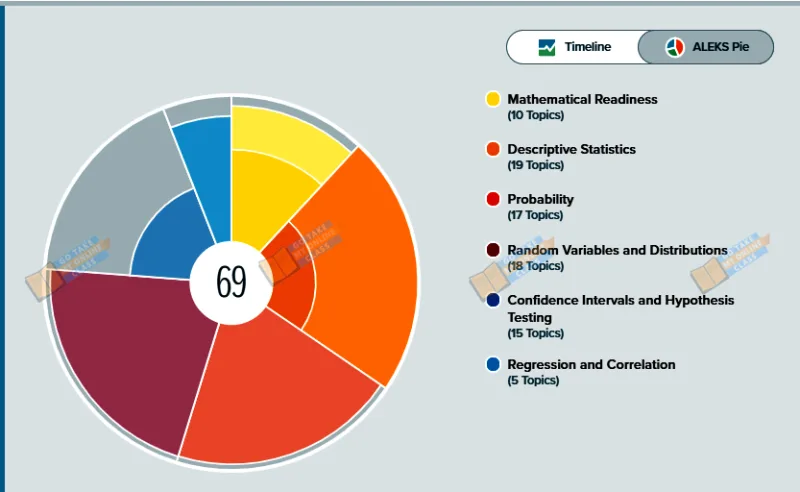
Your topics disappeared because an ALEKS Knowledge Check moves a topic out of your pie when it suggests you no longer know it. If you miss a question related to a topic you had learned, or click "I don't know" on it, that topic can move from Learned or Mastered back to Remaining, and topics linked to it can go with it. It feels like lost work, but the system is doing what it was built to do: checking that you retained the material, not just that you practiced it once. The good news is that lost topics are flagged for review and take fewer correct answers to win back than they did the first time.
This guide explains what happens during an ALEKS Knowledge Check, why the drop can be bigger than the number of questions you missed, what you will see afterward, and a practical plan to recover your progress and protect it next time. Everything here is based on McGraw Hill's own ALEKS documentation and the published research behind the system.
The Short Answer: Why ALEKS Removed Your Topics
- Learned topics are provisional. A topic you complete in the Learning Path counts as Learned until a Knowledge Check confirms it. Only then does it become Mastered.
- A missed or skipped question can send a topic back. McGraw Hill's ALEKS student FAQ says that if you select I Don't Know or answer a related question incorrectly, "that topic may move from the Mastered or Learned category to the Remaining category."
- Linked topics can go too. The same FAQ notes that the missed topics "and perhaps others that are linked to them" return to your Topic Carousel for more practice.
- Lost topics come back faster. They are tagged Needs More Practice, and ALEKS requires fewer correct answers to restore them than it did to learn them.
- The goal is retention. According to McGraw Hill, the assessment cycle "ensures that students not only learn new concepts but also retain that knowledge."
Learned vs. Mastered: What Your Pie Was Really Showing
Many students are surprised by a Knowledge Check because they read their pie as a running total of finished work. It is not quite that. ALEKS tracks three groups of topics:
| Category | What it means | Can it change after a Knowledge Check? |
|---|
| Learned | Topics you practiced successfully in the Learning Path but have not yet been assessed on | Yes. Retained topics become Mastered; missed ones can return to Remaining |
| Mastered | Topics a Knowledge Check has confirmed you know | Yes. A missed related question can still send one back |
| Remaining | Topics you still need to learn, including any you lost | Yes. Strong answers can move some into Mastered |
McGraw Hill defines Learned as "the number of topics that a student has practiced successfully in the Learning Path but has not yet been assessed on through a Knowledge Check." In other words, the Learned slice was always waiting for confirmation. A Knowledge Check is that confirmation step, and it can go either way.
When ALEKS Gives You a Knowledge Check
If you have already taken the ALEKS Initial Knowledge Check, the checks that follow are Progress Knowledge Checks. They focus mostly on material you learned recently. The student FAQ lists the usual automatic triggers:
- after you learn 20 topics and spend 5 hours in Learning mode,
- after 10 hours in Learning mode, or
- after 60 days without a Knowledge Check.
These hours count active work in ALEKS, not clock time since you logged in, and each new check resets the count so checks don't arrive back to back. The exact numbers can vary slightly by course and product, so treat them as typical defaults rather than fixed rules.
Your instructor can also schedule extra checks, such as a progress check of roughly 20 questions on recently learned topics or a comprehensive check near the end of a unit. Students cannot request a Knowledge Check themselves, but you can ask your instructor to schedule one. When a check is waiting, you normally have up to 24 hours to start it unless your instructor changes that setting.
How the ALEKS Knowledge Check Works
A Knowledge Check is adaptive. Each question is chosen based on your previous answers, and every answer updates ALEKS's estimate of which topics you know. The system is built on a model called knowledge space theory, which treats topics as connected: knowing one topic makes certain others more or less likely. That design explains the three things that confuse students most.
Why You Can Lose More Topics than You Missed
Because topics are linked, a wrong answer is evidence about more than one topic. If you miss a question on solving two-step equations, ALEKS lowers its confidence in that topic and in topics that depend on the same skills. That is why you might miss four questions and see ten or more topics leave your pie. McGraw Hill's instructor report for each check even has a section titled "What Student Lost During this Knowledge Check," which lists every topic added back to the pie.
Why One Slip Doesn't Always Cost a Topic
ALEKS does not follow a simple "one mistake, one lost topic" rule. A 2021 paper on ALEKS by the company's own researchers explains that the scoring "cannot be very aggressive given that there is a non-negligible chance for a careless error." The final result can even include a question you answered incorrectly if the rest of your responses show you know that material. A single typo is less likely to cost you a topic than a pattern of wrong answers on related questions.
Why Your Pie Can Also Grow
Knowledge Checks are not only about removal. If you show solid mastery of what you learned, ALEKS can reach into your Ready to Learn topics and credit you with some you never practiced. McGraw Hill's older student guide puts it plainly: after a check, "students may gain or lose topics from their mastery count." Students who keep up with review often see a small net gain.
Should You Click "I Don't Know" on a Knowledge Check?
Only when you truly cannot attempt the problem. ALEKS counts I Don't Know as an incorrect answer, and the research paper notes that selecting it produces "a substantial increase" in the likelihood that you do not know that item. McGraw Hill's advice to students is to "try their best on Knowledge Checks and only choose I Don't Know for problems they truly do not know how to solve."
That said, I Don't Know is not something to fear. You will almost always see a few questions on topics you have not learned yet, because the check is adaptive. Clicking I Don't Know on genuinely new material is honest, and it keeps your learning path accurate. Guessing wildly on everything, or deliberately skipping questions to lower your starting point, tends to backfire because ALEKS then sends you back to topics you already know.
What You Will See After the Knowledge Check
ALEKS screens differ a little between courses and between the newer and classic versions, but after a Progress Knowledge Check you will usually notice the following:
- Your pie updates. Mastered and Learned counts change, and the slices containing lost topics look less complete.
- Some topics are tagged Needs More Practice. McGraw Hill states that "the topics lost in Knowledge Check are tagged as Needs More Practice," and the Topic Carousel has a filter that shows only those topics.
- Your instructor sees the details. The progress report lists exactly which topics you retained and which were added back to your pie, so your teacher can see whether the drop came from a few weak areas or across the board.
If your course grade includes ALEKS progress, check how your instructor counts it. Some instructors grade topics mastered by a deadline; others give a periodic grade based on how much learned material you keep at the next Knowledge Check. Knowing which one applies tells you how urgently to rebuild.
An Example of a Knowledge Check Drop
Here is an illustration of how the numbers can move. The figures are made up to show the pattern, not taken from a real account.
| Before the check | After the check |
|---|
| Mastered | 48 | 75 |
| Learned | 40 | 0 |
| Total in pie | 88 | 75 |
| Tagged Needs More Practice | 0 | 15 |
In this example the student had 40 Learned topics going in. The check confirmed most of them and they moved to Mastered. Fifteen topics, mostly from a unit the student rushed through on one weekend, were sent back, and two new topics were credited from Ready to Learn. The pie shrank by 13 topics overall, but 75 topics are now confirmed Mastered, and the 15 lost ones will take less work to win back than they did the first time.
How to Get Your ALEKS Topics Back: A Recovery Plan
- Look at what you lost before doing anything else. Open the Topic Carousel and filter by Needs More Practice. Note which slices the topics come from. A cluster in one area usually points to one skill you need to relearn, not fifteen separate problems.
- Start with the lost topics. ALEKS puts them near the front of your queue anyway, and they are worth more of your time than new topics right now.
- Take advantage of the shorter path back. McGraw Hill says "it takes fewer correct answers to gain topics back than it did to 'learn' them." The ALEKS research paper describes this as a target of 3 correct answers instead of the usual 5 for a topic that was removed after a progress assessment.
- Work every problem on paper. Most lost topics come from small errors that never got fixed: sign mistakes, skipped steps, or answer-entry problems. Writing out each step shows you where it goes wrong.
- Keep a short mistake log. For each lost topic, write one line on what tripped you up. Read the log before your next check.
- Use Review before the next check. Review mode does not change your Mastered, Learned or Remaining counts, so it is a safe place to practice. McGraw Hill recommends reviewing regularly, "especially before a Progress Knowledge Check."
- Talk to your instructor if the drop affects your grade. Explain what you lost and your plan. If something went wrong technically, such as a disconnection, ask whether a reset is possible. Resets go through ALEKS support, usually at the instructor's request.
How to Avoid Losing Topics in the Next Knowledge Check
Spread Your ALEKS Work Across the Week
McGraw Hill's own instructor training warns against students "trying to add 50 topics in a weekend." Cramming topics into one or two sessions fills the Learned slice quickly, triggers checks sooner, and leaves you little time to retain anything. Short daily sessions of 30 to 60 minutes produce learning that survives the next check. Our guide on how to finish ALEKS topics faster shows how to keep a steady pace without shortcuts that backfire.
Review Recently Learned Topics
Progress checks mostly assess the topics you learned recently. Before a check is due, spend a session in Review on the topics from your last few days of work. ALEKS researchers describe the learn-then-assess cycle as "a form of retrieval practice," and reviewing before the check is the same idea applied deliberately.
Take the Check When You Can Concentrate
A Knowledge Check usually takes about 30 to 45 minutes, and you have a window to start it. Do not start one late at night, on your phone, or between classes. If you need to stop, you can log out and continue from where you left off.
Get Answer Entry Right
Some wrong answers are not math errors at all: a fraction left unsimplified, a missing negative sign, a rounding instruction ignored, or the wrong unit selected. Read the instructions on every question and use the ALEKS calculator only when it appears on screen.
Knowledge Checks Are Annoying, but They Help You
Losing topics is frustrating, especially before a deadline. Still, the mechanism behind it is the same one that makes ALEKS useful: it keeps checking whether you can still do the work later, which is exactly what your exams will ask. Students who treat each check as a progress report rather than a penalty usually find the next one goes better.
If you are behind on ALEKS and need a tutor to work through the topics with you, our ALEKS homework help connects you with subject experts who can explain each step, and our math homework help covers the algebra and precalculus skills most ALEKS courses build on. Use any outside help in line with your school's academic integrity policy.
Frequently Asked Questions
Why Did My ALEKS Pie Go Down After a Knowledge Check?
Your pie went down because the Knowledge Check found evidence that you had not retained some topics. Topics you missed, or answered with I Don't Know, along with some linked topics, moved back to Remaining. The topics that remained were confirmed as Mastered.
How Many Questions Do I Need to Miss to Lose a Topic?
There is no fixed number. ALEKS weighs all your answers together and allows for careless errors, so one slip does not automatically remove a topic, while several misses on related questions can remove a whole group of linked topics.
Do Lost Topics Take as Long to Relearn?
No. Topics lost in a Knowledge Check are tagged Needs More Practice and take fewer correct answers to regain than they did originally.
Can My Instructor Reset an ALEKS Knowledge Check?
A reset is possible in some cases, but it is handled by ALEKS support, usually at your instructor's request. Ask your instructor first, especially if a technical problem interrupted the check.
Can I Pause an ALEKS Knowledge Check and Finish It Later?
Yes. If you log out during a Knowledge Check, ALEKS lets you continue where you left off the next time you log in. You can't skip a Knowledge Check, but you usually have up to 24 hours to start one.
How Many Questions Are on an ALEKS Knowledge Check?
It varies because the check is adaptive. McGraw Hill describes instructor-scheduled progress checks as about 20 questions and comprehensive checks as about 25, focused mostly on topics you learned recently.
How Long Does an ALEKS Knowledge Check Take?
McGraw Hill's chemistry training material estimates 30 to 45 minutes. There is no single official time limit for course Knowledge Checks, but take it in one focused sitting if you can.
Is the ALEKS Knowledge Check Graded?
That depends on your instructor. Some count the topics you master by a deadline, others grade how much learned material you retain at each Knowledge Check, and some don't grade the checks at all. Check your syllabus.
Does Review Mode Affect My ALEKS Progress?
No. Review lets you practice without changing your Mastered, Learned or Remaining counts, which makes it the best way to prepare for a Progress Knowledge Check.