Realize Your Potential in the Virtual Classroom
Online learning looks simple from the outside. You open a laptop, click into class, and tell yourself you'll catch up later if your focus slips. Then later turns into missed discussion posts, half-watched lectures, and a growing stack of tabs you meant to revisit. If you're struggling with distractions, motivation, or retention, you're in very good company.
The good news is that strong online learners rarely rely on willpower alone. They build systems that make attention, follow-through, and understanding easier. The best practices for online learning are less about working nonstop and more about making smart choices about environment, pace, feedback, and support.
That matters because online education is now normal, not niche. More than half of college students took at least one online course in fall 2022, and 85% of online learners reported that distance learning was better or equally satisfactory compared with traditional classroom learning. Online learning can work very well. But it works best when you stop treating it like a passive content stream and start treating it like a structured skill.
Below are the habits that consistently separate students who stay afloat from students who steadily improve.
1. Establish a Dedicated Learning Environment
Your study space does part of the cognitive work for you. If you attend class from bed, answer quiz questions from the couch, and switch between coursework and entertainment in the same browser window, your brain gets mixed signals. A dedicated learning environment creates a clear cue. When you sit there, it's time to work.

A good setup doesn't have to be expensive. A corner desk, library carrel, dorm study room, or kitchen table used only during class hours can work. What matters is consistency, decent lighting, a comfortable chair, headphones if your home is noisy, and all course materials within reach before you start.
Build a space that removes friction
Students often underestimate tiny interruptions. Hunting for a charger, opening five folders to find one reading, or realizing your Wi-Fi is unstable right before a live session can break momentum fast. Fix those problems before they repeat.
- Use one primary location: Repeating the same setup helps focus become automatic.
- Keep tools visible: Notebook, charger, calculator, water bottle, and course login details should be ready before class starts.
- Create a household signal: A closed door, desk lamp, or message to roommates can stand in for “do not disturb.”
- Test your tech early: Check audio, webcam, and connection before a quiz, presentation, or office hours call.
Practical rule: If your study setup takes more than a minute to “get ready,” it's still too complicated.
A working professional might convert a spare room into a home office. A dorm student might book quiet hours in a common study lounge. An international student dealing with a crowded apartment might use a public library during peak coursework hours. Different setups can work equally well. The common factor is that the space supports attention instead of competing with it.
2. Set Clear, Measurable Learning Goals
Monday night, a student logs in planning to “work on chemistry” and signs off two hours later unsure what got done. Online courses make that problem common because there is no classroom bell, no teacher watching the clock, and no built-in stopping point. Clear goals fix that. They give each study session a finish line.
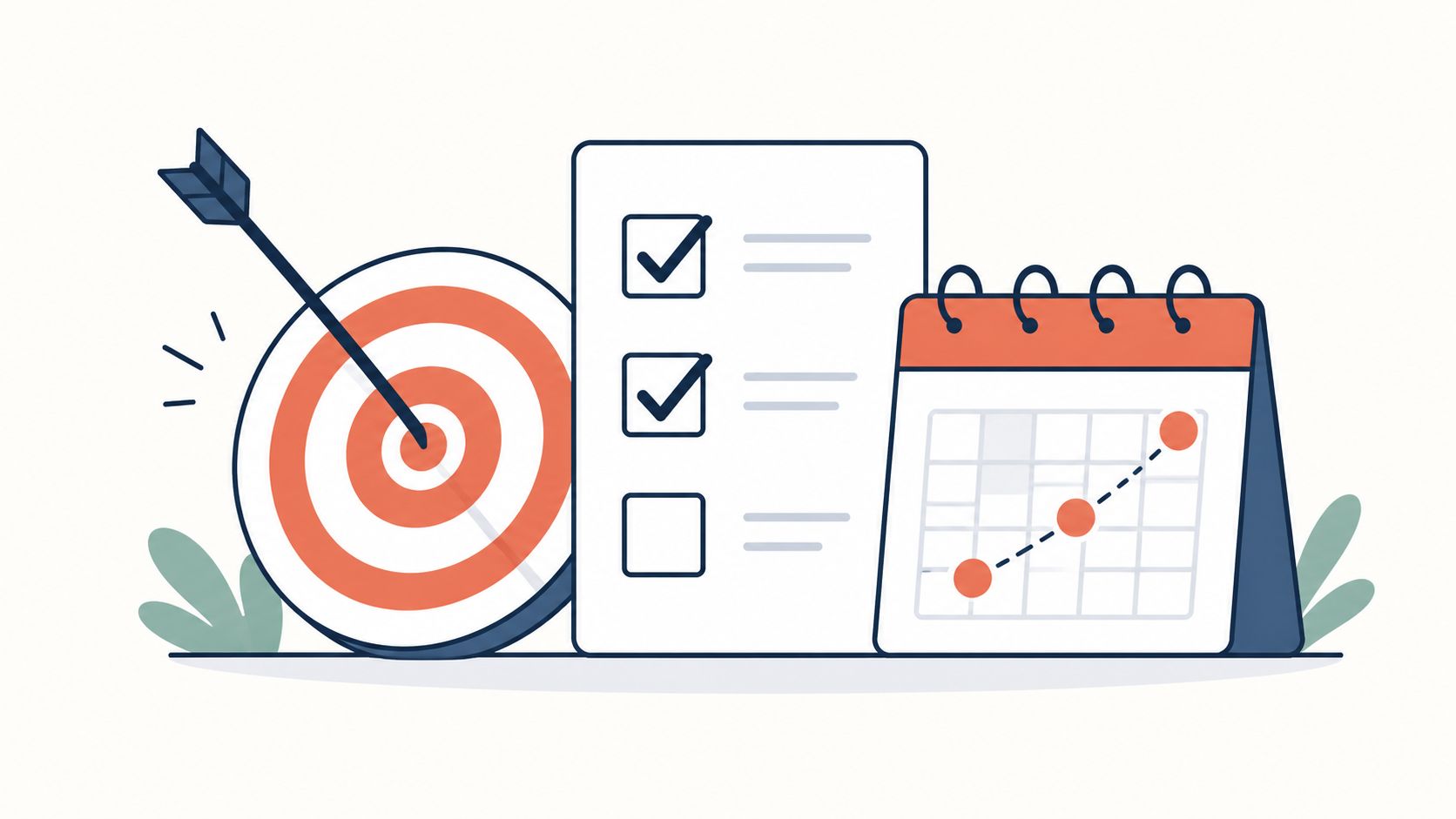
The best goals are specific enough to judge at a glance. “Review Chapter 3” is weak. “Answer 15 Chapter 3 practice questions and correct every missed dosage formula” works because you can complete it, check it, and decide what needs more work. In practice, students stay more consistent when goals answer three questions: what will I do, how much will I finish, and by when?
A simple way to start is to define outcomes at two levels. Set one weekly target tied to the course, then break it into session goals you can finish in 30 to 60 minutes. If you are behind, keep the target realistic. Ambitious plans feel productive on paper and fail by Thursday.
Turn broad ambition into work you can verify
Use goals that produce evidence, not just good intentions. A checklist, draft, quiz score, solved problem set, or recorded explanation all count because they show whether learning happened.
Try targets like these:
- For math: Solve 10 problems on one topic, mark every error, and redo the missed ones without notes.
- For writing: Draft the thesis, build the outline, and submit one paragraph to peer review before the full essay is due.
- For coding: Finish one feature or bug fix in a small project each week instead of only watching tutorials.
- For exam prep: Follow a structured plan such as these exam preparation strategies for college students.
- For science-heavy courses: Build goals around recall and diagrams, which you can see in this biology study method that uses active practice.
I have seen students improve quickly once they stop measuring effort and start measuring output. “I studied for three hours” sounds disciplined. “I finished one case brief, corrected six accounting errors, and scored 8 out of 10 on a quiz” is better because it tells you what the time produced.
This matters with outside help too. Tutoring platforms, including Ace My Homework, are most useful when they support a defined learning goal. Ask for a worked example, feedback on your outline, or an explanation of the step you keep missing. Do not hand off the whole assignment and call that progress. Used ethically, tutoring shortens confusion. It does not replace the learning you still need to do yourself.
If cramming is your default, build goals around retention instead of urgency. This guide for students to stop cramming offers a practical framework for breaking study work into smaller, trackable targets.
Write your goals down where you will see them. A notes app, paper planner, calendar block, or spreadsheet all work. The tool matters less than the habit. If the goal is visible before you start, you are far more likely to finish with proof instead of a vague sense that you were busy.
3. Implement Active Learning Techniques
Watching isn't the same as learning. Reading isn't the same as remembering. One of the strongest best practices for online learning is to do something with the material right away.
That's not just a preference. In an online statistics course study, nearly all instructional strategies were helpful, but case studies were rated the most effective method, followed by video demonstrations, then instructor notes, while 25 out of 39 participants rated the online discussion forum as effective. The pattern is clear. Students learn more when they apply, observe, compare, and discuss rather than just consume content.
Replace passive review with action
A literature student should write interpretations, not only highlight passages. A finance student should build spreadsheet models, not only rewatch lectures. A biology student should explain a process out loud, draw it, and answer questions from memory. If you need a subject-specific example, this breakdown of the best way to study biology shows how quickly active methods outperform passive review.
Here are practical swaps that work:
- Instead of rewatching solutions: Solve the problem first, then compare your method.
- Instead of rereading notes: Summarize the concept from memory in plain language.
- Instead of scrolling discussion boards: Answer one classmate and challenge one idea respectfully.
- Instead of last-minute memorizing: Use a guide for students to stop cramming and spread application over time.
Working with other people often sharpens motivation. One online learning source points to Stanford research indicating that group work fuels intrinsic motivation more effectively than studying alone.
That doesn't mean every session needs a group. It means your learning should produce output. Solve, draft, explain, discuss, test, revise. Passive review feels easier. Active learning works better.
4. Utilize Spaced Repetition for Long-term Retention
You finish an online lecture, the material feels familiar, and by the next week half of it is gone. That pattern is common in online courses because recognition fades fast if you do not revisit the material on purpose.
Spaced repetition solves a specific problem. It helps you remember what you studied after the lecture ends, not just during the hour when everything still feels fresh. The method is simple. Review key ideas shortly after learning them, then revisit them at wider intervals as recall gets stronger.
This works especially well for material you need to retrieve quickly and accurately: formulas, vocabulary, definitions, anatomy terms, accounting rules, dates, and core frameworks. It also works for conceptual courses if you build prompts that force recall, such as “What caused this shift?” or “How would I explain this theory in plain language?”
Build review into your week
Students often treat review as something to do if there is extra time. That usually means it never happens. Put it on the calendar instead.
A practical schedule looks like this:
- Review within 24 hours: Spend 10 to 15 minutes recalling the main ideas without looking at your notes first.
- Revisit in a few days: Test the same material again. Keep the session short.
- Review again the next week: Bring back older material so it stays active.
- Increase the gap after correct recall: If you remember it easily, wait longer before the next review.
- Shorten the gap after errors: If you miss it twice, bring it back sooner and use a better prompt.
Tools like Anki and Quizlet can help, but software is not the strategy. Good spaced repetition depends on the quality of your prompts. A weak card such as “Chapter 3 terms” is too broad. A better card asks one question with one clear answer or one application step.
For example, a nursing student might review drug classifications for ten minutes each morning, then test herself on side effects at the end of the week. A finance student might rotate through valuation formulas, then solve one fresh problem from memory. A history student might review causes, dates, and consequences separately instead of stuffing an entire unit into one late-night session.
The trade-off is real. Spaced repetition asks for consistency, and consistency can feel less satisfying than a long cram session before an exam. But cramming trains short-term familiarity. Spaced review trains recall you can use on a quiz, in a discussion post, or during a cumulative final.
The same principle shows up outside academic settings. Teams focused on boosting corporate training engagement also get better retention when practice is active and spread out over time.
If you use tutoring support, keep the method ethical and student-led. Ask a tutor to help you turn weak topics into stronger review questions, check whether your flashcards are too vague, or explain why you keep missing the same concept. Do not hand off the learning process. Use support to sharpen your review system so you can recall the material on your own.
5. Maintain Regular Communication with Instructors and Tutors
You miss one instruction in week two, assume you understood it, and build the rest of the assignment on the wrong premise. By the time the grade comes back, you are fixing a chain of mistakes instead of one small issue. Regular communication prevents that.
Strong online students do not wait until they are overwhelmed. They contact instructors early, ask narrow questions, and use tutoring as ongoing academic support rather than last-minute rescue.
Specific questions get better answers. “I'm confused about chapter four” gives your instructor very little to work with. “I understand the formula setup, but I keep losing points when I isolate the variable in the second step” gives them something they can correct quickly.
Set a communication rhythm that fits the course. Check announcements on a schedule. Use office hours before major deadlines. If email replies in your program tend to take a day or two, build that delay into your plan instead of hoping for an immediate answer.
Ask for help while the work is still in progress.
Tutoring works best the same way. Show your attempt, identify the step where your reasoning broke down, and ask for explanation instead of answers. That matters if you use outside support such as Ace My Homework. The right use is ethical and student-led: get help with draft feedback, worked examples, concept review, or recurring errors. Keep the thinking, writing, and final decisions in your hands.
I have seen the difference this makes. A statistics student who brings two failed problem attempts usually improves faster than one who says only, “I don't get hypothesis testing.” A literature student who asks whether a thesis is arguable gets more useful feedback than one who asks whether the paper is “good.” A working parent may need recurring evening sessions and a tighter communication routine just to keep momentum through a demanding term.
Tools can help you stay consistent here. Calendar blocks, reminder systems, and browser tools from TimeTackle's recommended student extensions can reduce the chance that office hours, follow-ups, or tutoring sessions slip past you.
The trade-off is time. Writing a clear question, attending office hours, or preparing for a tutor session takes effort up front. It also saves hours of rework later, which is usually the better deal.
6. Use Multiple Learning Modalities and Resources
If one format isn't clicking, don't keep forcing it. A textbook explanation, a short video, a diagram, a podcast, a worked example, and a discussion thread can all teach the same concept differently. Strong online learners use that variety on purpose.
This isn't about collecting random resources. It's about matching the format to the task. For a complex process, video or a visual walkthrough might help. For precise terminology, reading and note-taking may be better. For skill-building, practice and feedback usually matter more than either.
Choose the right medium for the right problem
One clear example comes from guidance on educational video. Short videos of 3 to 5 minutes work best for engagement, the ideal micro-lecture focuses on a single concept for 3 minutes, attention has to be captured in the first 15 to 30 seconds, visuals should change every 10 to 15 seconds, and each short lecture should stay under four key points. That tells you something important. More video isn't always better. Better-designed video is better.
Use a layered approach like this:
- Read first for structure: Get the definitions, sequence, and terminology.
- Watch second for process: Use video when you need to see a method performed.
- Practice third for ownership: Turn input into output as quickly as possible.
- Organize tools well: A few useful apps beat a cluttered browser. Some students build a focused toolkit using TimeTackle's recommended student extensions.
A programming student might read official documentation, watch a short tutorial, then code the feature alone. A chemistry student might use diagrams, simulations, and tutoring to view the same reaction from multiple angles. Variety works when each resource does a different job.
7. Practice Effective Time Management and Study Scheduling
Monday starts well. By Wednesday, you are already behind, two lectures are still unwatched, and the assignment due Sunday now needs a full weekend. That pattern is common in online learning because flexibility hides delay until the backlog is large enough to create stress.
A workable schedule fixes that by turning vague intentions into planned study blocks with a clear job. Put coursework on your calendar before everything else claims the time. Then decide what each block is for: lecture notes, problem sets, reading, quiz prep, or revision. A calendar entry that says “study” is too loose to protect your attention.
Build a routine you can repeat under real-life pressure
Use a time structure that matches your attention span. Some students do well with 25 minutes of focused work and a short break. Others can hold concentration for 45 to 50 minutes before they need to reset. The point is not to copy a perfect system. The point is to choose a repeatable cycle, test it for a week, and keep the version you will follow. If you want a practical overview of this method, the University of California, Irvine explains how to use the Pomodoro Technique to work in focused intervals and protect concentration.
Good scheduling also means accepting trade-offs. If you work part time, care for family, or commute, you may not have long quiet stretches every day. Build around reality instead of planning for an imaginary week. Students balancing several responsibilities often do better with a few fixed anchor sessions and smaller backup blocks. This guide to managing college and work at the same time is a useful example of planning around real constraints.
A schedule that holds up usually includes:
- Anchor blocks: Keep the same study windows each week so starting takes less effort.
- Task matching: Put demanding work in your best mental hours and lighter review in lower-energy periods.
- Buffer time: Aim to finish early enough to recover from a bad day, tech issue, or difficult assignment.
- Weekly reset: Spend 10 to 15 minutes each weekend checking deadlines, adjusting blocks, and cutting tasks that no longer fit.
I have seen students improve by separating maintenance work from deep work. Maintenance work includes checking announcements, downloading readings, and organizing files. Deep work includes solving problems, writing, coding, or practicing recall. Mixing those together creates the feeling of productivity without much progress.
One example: a full-time employee in an evening program might reserve Tuesday and Thursday from 7 to 9 p.m. for lectures and notes, then use Saturday morning for assignments. A student athlete might rely on short weekday review sessions and one longer Sunday block for concentrated work. The best study schedule is not the one that looks ambitious on paper. It is the one you can keep for ten straight weeks.
8. Seek and Act on Detailed Feedback Regularly
You submit an assignment, see the grade, and move on to the next deadline. That habit costs students more than they realize. The grade tells you the result. The comments show you what to fix.
Strong online learners build feedback into the way they study, not just the way they submit work. They review rubric notes, compare instructor comments across assignments, and ask targeted follow-up questions while the material is still fresh. The goal is simple. Turn every returned assignment into a better approach on the next one.
Use feedback as a pattern tracker
One weak paragraph in an essay is a local problem. Repeated comments about weak evidence, rushed analysis, or unclear structure point to a skill gap that needs practice. The same applies in technical courses. If a tutor keeps correcting unit conversions in chemistry, setup errors in finance, or missing edge cases in code, write that pattern down and work on it directly.
A simple mistake log works well. Record three things: the error, what caused it, and the correction you will use next time.
One habit worth stealing: Keep a running “mistake log” with the error, why it happened, and what you'll do differently next time.
This also helps you use tutoring platforms ethically. A service such as Ace My Homework should help you understand feedback, review a draft, or explain why an answer fell short. It should not replace your own thinking or your course requirements. Used well, outside support gives you clearer feedback faster. Used poorly, it hides the very weaknesses you need to see.
Course design can reinforce this process too. Instructors often structure online courses so students must show progress before moving into harder material, and many use staged assignments, question pools, originality checks, or revision cycles to keep assessment fair and learning cumulative. Students benefit most when they treat those checkpoints as signals to adjust, not hurdles to clear.
A coding student might track repeated notes about variable naming and missed edge cases. A writing student might collect instructor comments on organization and evidence quality. A nursing student might compare weak case-study reasoning with stronger examples from later submissions.
Feedback stings less when it becomes specific. Once you can name the pattern, you can correct it.
9. Build a Supportive Learning Community
Online classes can feel oddly silent. You're surrounded by people in theory, but still doing most of the work alone. That isolation drains motivation fast, especially when a course gets difficult.
Community changes that. It adds accountability, explanation, encouragement, and a reason to keep showing up. One online learning source notes that discussion forums work better when prompts require critical thinking and invite students to respond directly to one another, rather than posting isolated answers into a void. The same source also recommends regular weekly announcements to keep students aligned with deadlines and the course rhythm, and stresses mobile compatibility and chunked content for smoother participation on smaller screens, including Android and iOS devices.
Make interaction useful, not performative
A good study group is small enough that everyone contributes and structured enough that the meeting produces something. Four students reviewing calculus by solving problems together works. Ten students sitting on Zoom half-muted usually doesn't.
Strong online communities often share a few habits:
- They meet consistently: Same day, same time, same expectations.
- They divide responsibility: One person explains a concept, another brings practice questions.
- They use discussion well: Members respond, challenge, and clarify instead of posting once and disappearing.
- They balance peer support with solo study: Group work should sharpen individual understanding, not replace it.
A psychology student might find a partner for weekly case analysis. A computer science cohort might review code together before submission. An international student might use peer discussion to practice course vocabulary and gain confidence before speaking in live sessions. Community matters because motivation grows when other people can see your effort and you can see theirs.
10. Monitor Your Progress and Adapt Your Strategy
Not every study technique deserves loyalty. If a method isn't improving your understanding, speed, or confidence, change it. Strong online learners keep checking whether their system is working.
That's especially important in digital environments because it's easy to confuse activity with progress. Watching lectures, highlighting readings, and filling a planner can feel productive while your weak areas stay weak. Monitoring helps you separate motion from improvement.
Audit your method, not just your grades
One under-discussed issue in online education is that generic engagement advice often misses students with more complex needs. A piece on underserved learners notes that 34% of students with documented disabilities have enrolled in online programs, and argues for more thoughtful design tied to universal access and clearer career pathways. That's a useful reminder that strategy should fit the learner, not the other way around.
Another equity-focused perspective makes a harder point. Guidance from IDRA argues that asynchronous-first design matters for students with unstable internet, and that requiring even one synchronous version can push some students toward failure, while recorded lectures and offline-capable resources such as PDFs and paper books improve access for many learners facing connectivity barriers. If that describes your situation, adaptation isn't optional. It's basic survival in the course.
Review your system every couple of weeks:
- Check output: Are your quiz scores, drafts, or practice results improving?
- Check friction: What keeps getting delayed or avoided?
- Check fit: Does your plan work with your job, caregiving, bandwidth, or disability needs?
- Change one variable at a time: Shift the schedule, study method, resource type, or support structure and watch what improves.
Some students need more live accountability. Others need fewer live sessions and more downloadable materials. Some need shorter videos and tighter routines. Others need a tutor, a peer group, or a different note-taking method. Effective learners keep adjusting until the process matches the person.
10-Point Comparison of Online Learning Best Practices
| Strategy |
Implementation complexity |
Resource requirements |
Expected outcomes |
Ideal use cases |
Key advantages |
| Establish a Dedicated Learning Environment |
Medium, upfront setup and maintenance |
Ergonomic furniture, quiet space, reliable tech, organization tools |
Improved focus, reduced distractions, higher productivity |
Remote learners, professionals, intensive study periods |
Consistent focus cues; better ergonomics; organized workspace |
| Set Clear, Measurable Learning Goals |
Low–Medium, requires planning and periodic review |
Time to define goals, tracking tool (app or planner), accountability partner |
Clear direction, measurable progress, increased motivation |
Exam prep, project-based courses, certification paths |
Prioritizes tasks; enables progress measurement and accountability |
| Implement Active Learning Techniques |
Medium–High, design and practice intensive |
Time for practice, instructor/peer interaction, problem sets |
Deeper comprehension, better retention, transferable skills |
STEM labs, coding, essay writing, applied learning |
High engagement; immediate feedback; skill application |
| Utilize Spaced Repetition for Long-term Retention |
Low–Medium, consistent scheduling required |
Spaced-repetition app or flashcards, regular review time |
Strong long-term retention, less last-minute cramming |
Vocabulary-heavy subjects, medical/law studies, formulas |
Time-efficient retention; scientifically validated method |
| Maintain Regular Communication with Instructors and Tutors |
Low–Medium, proactive outreach needed |
Communication platform, scheduled sessions, tutor access |
Clarified misunderstandings, personalized guidance, accountability |
Complex courses, remote learners needing support |
Tailored feedback; faster issue resolution; mentorship |
| Use Multiple Learning Modalities and Resources |
Medium, curation and integration effort |
Videos, texts, simulations, podcasts, interactive tools |
Reinforced understanding, alternative explanations, greater accessibility |
Learners with varied preferences; complex or abstract topics |
Flexibility; reduces single-source bias; maintains engagement |
| Practice Effective Time Management and Study Scheduling |
Medium, planning and discipline required |
Calendar/planner apps, time-blocking tools, self-discipline |
Consistent progress, reduced stress, better work–life balance |
Learners balancing work, courses with heavy workloads |
Prevents procrastination; builds sustainable habits |
| Seek and Act on Detailed Feedback Regularly |
Medium, requires solicitation and follow-through |
Access to graders/tutors, time to revise, feedback log |
Targeted improvement, fewer repeated errors, faster skill growth |
Writing, coding, clinical skills, project assessments |
Specific corrective guidance; accelerates learning curve |
| Build a Supportive Learning Community |
Medium, coordination and upkeep |
Peers or mentors, communication platforms, scheduled meetings |
Increased motivation, accountability, diverse perspectives |
Cohort programs, group projects, isolated online learners |
Peer teaching; emotional support; shared resources |
| Monitor Your Progress and Adapt Your Strategy |
Medium–High, ongoing reflection and adjustment |
Tracking tools, time for analysis, baseline metrics |
Optimized study strategies, efficient resource use, improved outcomes |
Long-term programs, self-directed learners, iterative projects |
Enables course correction; promotes continuous improvement |
Your Blueprint for Academic Excellence Online
It is 8:40 p.m. A quiz opens at 9, three tabs are already competing for your attention, and you are still not sure which concepts will appear. Students who handle online learning well usually do not rely on last-minute effort. They build study systems that hold up on busy weeks, low-energy days, and difficult courses.
That is the main takeaway from these best practices for online learning. Strong results come from reducing friction and making good decisions early. A consistent study space protects focus. Clear goals make progress visible. Active recall, spaced review, feedback, and regular communication keep confusion from piling up until it shows up in grades.
Support matters, too. Online learning is flexible, but it can also hide problems for longer than a face-to-face class would. A missed concept can go undetected for two weeks before it turns into a poor test score or a weak project. Students who ask for help early usually spend less time recovering later.
Ethical tutoring has a place in that process. Use outside support to check your reasoning, review worked examples, get comments on drafts, and sort out methods you still need to apply on your own. That approach helps you learn faster without handing off the learning itself. The trade-off is simple. Shortcuts may save an hour today, but they usually cost understanding, confidence, and performance later.
Do not rebuild your entire routine at once.
Start with the problem that keeps hurting your work. If distractions keep breaking your focus, fix your environment first. If you study and forget, add spaced repetition. If deadlines keep surprising you, put study blocks and assignment checkpoints on your calendar. If you stay quiet when you are confused, get help before the next deadline compresses your options.
Progress in online learning usually looks ordinary while it is happening. One better study session leads to one stronger submission. One stronger submission makes the next session easier to start. Repeated often enough, those small corrections turn into a dependable system.
If you need extra support without compromising academic integrity, Ace My Homework can help you study smarter. You can connect with verified tutors across subjects, get step-by-step explanations, receive feedback on drafts, and use expert guidance to strengthen your own work before you submit it.