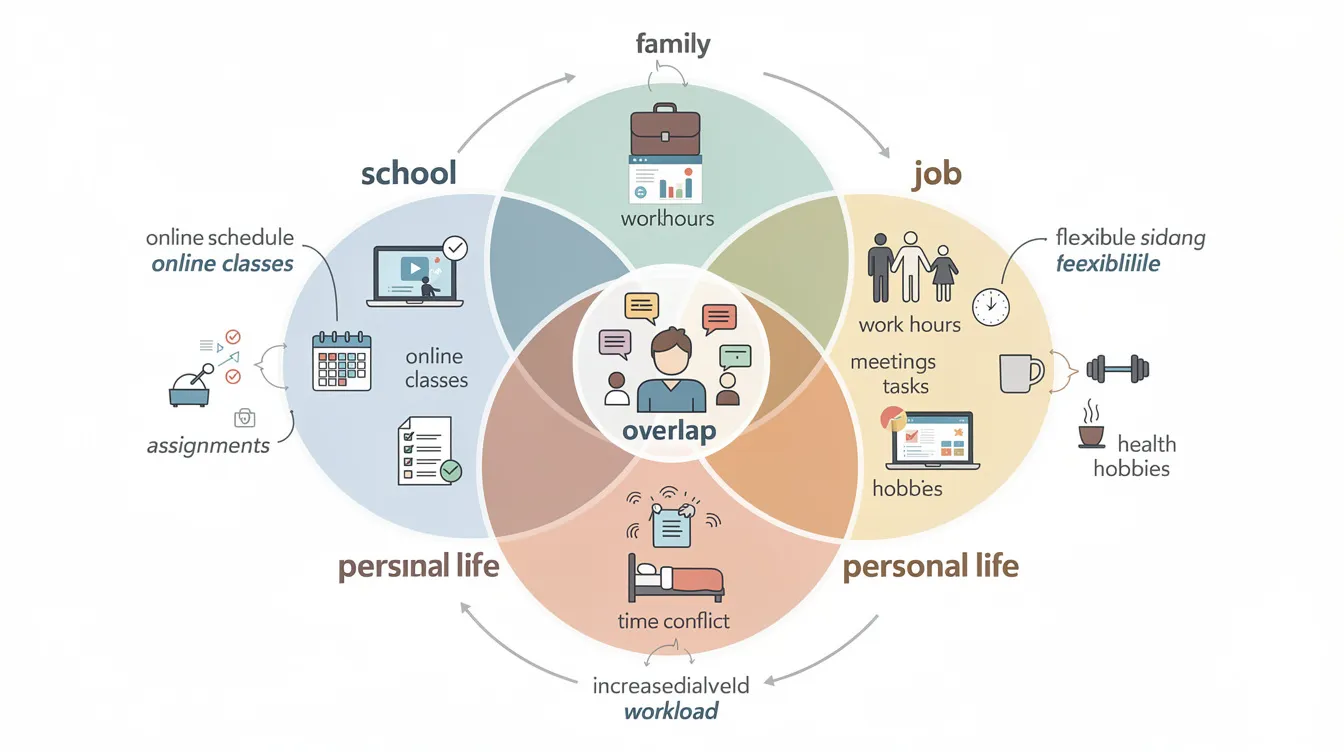
Online classes have changed how students approach education, especially in higher education where flexibility matters more than ever. For many college students, online courses make it easier to continue school while handling a job, family responsibilities, and personal goals. At the same time, online classes can make balancing work and life harder when the schedule becomes too loose, the workload grows, and the line between school and home starts to disappear.
The impact of online classes on work-life balance is not simple. On one side, online learning gives students more control over when and how they study. Many online courses allow learners to move at their own pace, reduce commuting time, and fit individual courses into a busy week. On the other side, students may struggle with stress, poor sleep, weak routines, and difficulty separating course tasks from family or work and school obligations.
This article looks at both sides of the issue. It explains how online classes can support academic performance and flexibility, how they can affect mental health, and what students can do when balancing work and school starts to feel overwhelming. It also covers practical strategies that help working students, full time college students, and part time students build a healthier routine.
If you are trying to stay on top of school while handling a busy schedule, it may also help to read practical resources on how to manage college and work while building a routine that still protects your own goals and responsibilities.
Why Online Classes Matter in Modern Education
Online education has become a major part of modern institutions because it gives learners more access to programs they may not have been able to complete in a traditional format. Students can now explore certificate options, undergraduate courses, graduate study, and even master's degrees without always having to relocate or attend class at one specific time.
This matters because students today are not all in the same situation. Some are full time students who want more flexibility. Some are part time students with family or work and school demands. Others are working students trying to advance in a current job or prepare for a future career. In all these situations, online classes can open doors by giving learners more control over their course schedule and degree path.
Still, flexibility alone does not guarantee balance. A flexible program can improve life for one student and increase stress for another. The difference often depends on time management, support systems, and whether the student has a realistic plan for balancing work, school, and personal life.
Online Classes and the Promise of Flexibility
One of the biggest reasons students choose online classes is flexibility. Unlike traditional classes that happen at a specific time and place, many online courses allow students to complete lectures, readings, and assignments from anywhere with internet access. That gives learners more freedom to build school into the rest of their life rather than stopping everything else to attend class.
For college students with a job, this flexibility can be a major advantage. A student who works long hours during the day may be able to study at night. Another student may use lunch breaks, weekends, or early mornings to complete a course. In self-paced or partially flexible programs, learners can move at their own pace and spend more time on difficult material without feeling pressure to keep up with a physical classroom.
This type of access can reduce commuting time, lower transportation costs, and help students stay in education while meeting family responsibilities. It can also help learners continue a degree program when moving, changing job schedules, or caring for others makes campus attendance difficult.
However, flexibility works best when students know how to manage it. Without a structure, flexible online classes can quickly become another source of stress rather than support.
The Positive Impact of Online Courses on Work-Life Balance
Online courses can improve work-life balance in several ways. First, they make it easier to fit education into a busy routine. A student does not always need to leave a job, move near a university, or attend class at one fixed hour. This makes online courses especially useful for people who want to grow their skills, complete a degree, or advance professionally without stepping away from existing responsibilities.
Second, online courses often support better use of time. Instead of spending hours commuting, students can put that time into learning, rest, family, or other tasks. For some learners, that change alone improves mental health and reduces daily pressure. Having more control over the schedule can also help students create a realistic plan for the week.
Third, online learning may support academic performance when the student has the right environment. Some learners focus better at home or in a quiet personal space than in a crowded classroom. Others benefit from replaying lectures, reading at their own pace, or reviewing materials more than once. Individual courses in an online program may therefore feel more manageable because the student can control the setting and timing.
Online courses also frequently have lower tuition rates and remove expenses tied to commuting, housing, and physical textbooks. For students trying to manage school costs while keeping up with a job and family needs, that financial difference can make a program more realistic. Lower daily costs do not eliminate all pressure, but they can reduce some of the strain that comes with staying enrolled.
For working students, these benefits are significant. They can keep earning an income, continue school, and build toward a future career at the same time. That is one reason online education has become so important across many institutions.
The Financial Reality Behind Balancing Work and School
Money plays a major role in work-life balance for students. About half of all full time college students have jobs outside of school, and that number rises to 80% for part time students. That means a large share of learners are not only trying to pass a course or complete a degree, but also trying to pay for school, manage bills, and maintain daily stability at the same time.
This financial pressure affects how students experience online learning. A flexible online program may allow someone to keep working, but it can also create a packed week where every hour feels assigned to school, work, or family responsibilities. Managing both work and school responsibilities can lead to significant stress, and many students report that finances are one of the biggest reasons they feel under pressure.
Because of this, students should not only think about schedules. They should also think about financial support. Many schools and other organizations encourage students to apply for grants, scholarships, or stipends to reduce educational costs. These options can ease part of the burden, and in many cases the application process is simpler than students expect. Looking for this kind of support is not a side task. It is part of building a healthier plan for staying in school.
The Hidden Challenges of Online Classes
Even though online classes offer flexibility, they also come with real challenges. Many students assume online learning is easier simply because it happens at home. In reality, the course demands can feel just as heavy as traditional school, and sometimes harder, because the student must manage everything independently.
One common difficulty is procrastination. Without classmates nearby or professors physically present, students may delay tasks until the deadline gets too close. That affects academic performance and increases stress. Another challenge is distraction. Family members, phones, housework, friends, and other daily interruptions can make it harder to focus during study hours.
Online classes can also blur the boundaries between school and life. When the same room is used for sleeping, studying, working, and relaxing, the brain never fully switches off. A student may answer messages late at night, study during meals, or keep thinking about assignments during family time. Over time, that can make balancing work and life much harder.
Some learners also struggle with isolation. In a physical classroom, students can connect more easily with peers and professors. In a fully online program, that support may feel distant unless the student actively engages in discussion boards, virtual meetings, or study groups.
Mental Health and the Emotional Side of Online Learning
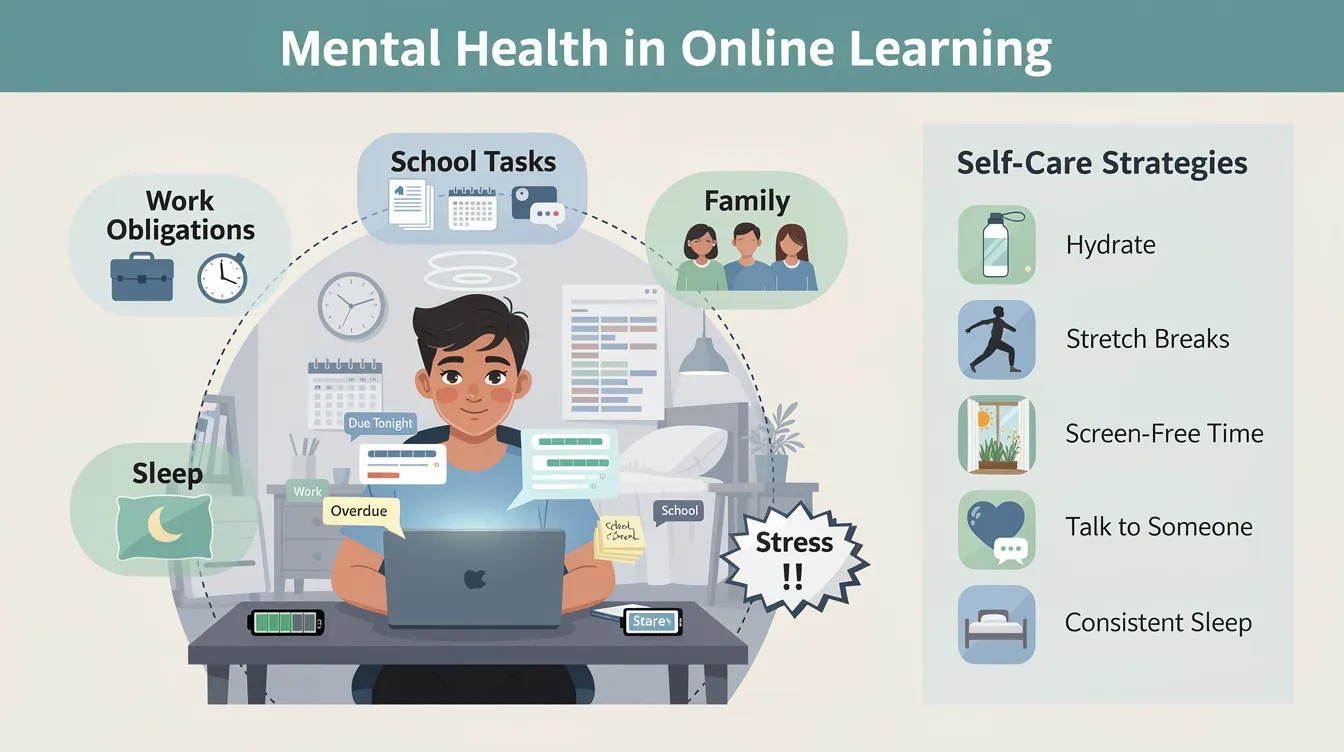
Mental health is one of the most important parts of this topic because work-life balance affects far more than productivity. When students are constantly switching between school, work and school duties, family needs, and personal tasks, the pressure can build quietly. A student may begin feeling overwhelmed without realizing how much strain has accumulated.
Online learning can support mental health when it reduces commuting, gives students more control, and makes education more accessible. But it can harm mental health when the student lacks structure, spends too many hours on a screen, or feels isolated from classmates and professors. Stress often grows when deadlines pile up, sleep gets worse, and there is no clear break between study time and personal time.
Managing both work and school responsibilities can intensify this pressure. Many students already worry about pay, living costs, and whether they can complete their program on time. Financial stress adds another layer to academic stress, and when both build at once, the result can be exhaustion, low motivation, and reduced focus.
That is why self care matters. Taking care of mental health is not separate from academic success. It directly affects focus, memory, motivation, and long term academic performance. Students who never pause, never rest, and never create boundaries often end up less productive, not more.
Simple habits can make a difference. Enough sleep, a healthy diet, regular movement, and time away from screens all support better learning. Taking care of yourself also means speaking up when the pressure is too high. Seeking support from friends, family, professors, advisors, or a writing center is often a smart academic decision, not a weakness.
Balancing Work and School in an Online Program
Balancing work and school is one of the biggest reasons students choose online classes, but it is also one of the hardest things to sustain. A student with a job may feel grateful for the flexibility of online courses while still struggling to complete reading, attend meetings, and submit assignments on time. This is especially true when the work schedule changes every week or when family responsibilities are unpredictable.
Balancing work and school becomes harder when students underestimate how much time a course really needs. A three credit class may only show a small number of scheduled contact hours, but the full time needed for reading, projects, and studying is usually much greater. In a demanding program, several classes at once can create pressure quickly.
Working students need to treat online education like a serious commitment rather than something that can always be squeezed into leftover hours. The best results usually come when students look at the full week, count work hours honestly, and decide whether the program load is realistic. In some cases, taking fewer individual courses leads to stronger results and better mental health than trying to complete too much at once.
School administrators often recommend that students work about 10 to 15 hours per week if they want to balance academic responsibilities effectively. That may not be possible for every student, especially those paying major expenses, but it is still a useful benchmark. Once work hours go far beyond that range, the chance of sleep problems, missed tasks, and falling behind in school often increases.
Balancing work is also easier when the people around you understand your schedule. Family members, employers, and close friends can become key supporters when they know your study hours and respect your boundaries. That support often makes the difference between surviving a semester and burning out halfway through it.
Working Students and the Pressure of Constant Responsibilities
Working students often carry a unique form of pressure. They are expected to perform in a job, stay engaged in school, meet family responsibilities, and still take care of themselves. This can create a routine where every hour feels assigned to something. When that happens, there is little space left for rest, reflection, or simple enjoyment of life.
For some college students, work is not optional. They need to pay tuition, rent, transport, and daily expenses. That makes online classes appealing because the student can continue earning while pursuing a degree. Yet the same advantage can become exhausting when a student tries to do everything at once for too many hours every week.
The challenge is not only physical. It is mental. A learner may finish a work shift and then open a course portal immediately, with no real break between one responsibility and the next. That pattern can damage sleep, reduce focus, and make it hard to stay motivated. Over time, the student may begin feeling overwhelmed, behind, or disconnected from the reason they started the program in the first place.
This is why balancing work has to include realistic expectations. You do not have to complete everything at the fastest possible speed. Sometimes the strongest strategy is to slow down, choose fewer classes, and finish the program in a healthier way.
Time Management Strategies That Actually Help
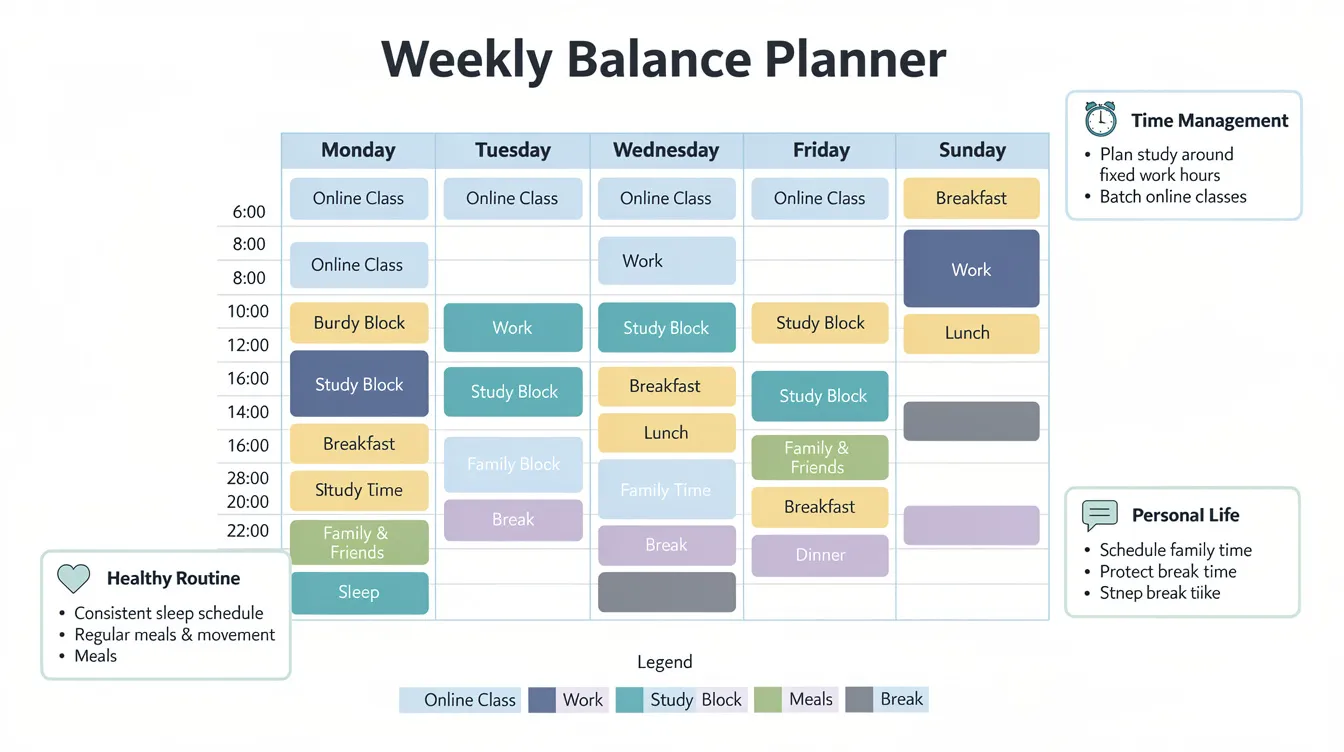
Time management is often mentioned as the solution to everything, but vague advice is not enough. Students need practical systems that work in real life. The first step is to map the full week clearly. Write down job hours, commute time if any, family obligations, meals, sleep, and study blocks. This helps students see how much time is actually available for school.
The second step is to assign every course a regular place in the schedule. Instead of hoping to study “when free,” choose a specific time for reading, lectures, and assignments. A specific time creates rhythm and reduces decision fatigue. It also makes balancing work and school more realistic because the student can see where study fits.
Third, break large tasks into smaller tasks. A research paper, project, or exam review feels less stressful when divided into steps over several days. Small tasks are easier to complete consistently, which helps students build momentum.
Fourth, protect your focus. Turn off unnecessary notifications, create a simple study space, and let family or friends know when you should not be interrupted. Even a short, focused session can be more effective than several distracted hours.
Finally, review the week before it starts. Good time management is not only about reacting. It is about planning ahead, adjusting when needed, and making sure the schedule still supports life outside the course.
Key Supporters in a Healthy Routine
No student should try to manage everything alone. Support matters in every level of education, especially in online programs where isolation can develop quietly. Key supporters may include family, friends, classmates, professors, academic advisors, or employers who understand your schedule.
Professors can help when you communicate early instead of disappearing when the course becomes difficult. Family and friends can support you by respecting study hours, helping with household tasks, or simply checking in when stress is high. Employers may also become part of your support system if they understand that you are working toward a degree or future career advancement.
Students sometimes believe they must prove they can handle everything independently. In reality, strong learners know when to connect with others. Seeking support can improve mental health, protect academic performance, and make the whole program feel more sustainable.
What to Do When You Start Feeling Overwhelmed
Feeling overwhelmed is common in online education, especially when multiple deadlines, work shifts, and personal responsibilities hit in the same week. The worst response is often silence. When students keep pushing without adjusting anything, stress usually gets worse.
Start by identifying the real source of the pressure. Is it too many hours at work? Poor sleep? Too many classes? Weak planning? Difficulty understanding the course? Once the source is clear, you can choose better strategies. You may need to reduce commitments, ask for academic support, speak with professors, or reorganize your week.
Taking care of yourself is essential at this point. Enough sleep is not optional. Sleep affects focus, memory, and emotional control. Eating regularly and maintaining a healthy diet also matter more than many students realize. When stress rises, some people skip meals, stay up too late, and keep staring at a screen. That usually makes the situation worse.
If the pressure is affecting your coursework, it may help to use structured academic support such as assignment help or targeted writing support to reduce overload while you regain control of the schedule.
Practical Ways to Build Better Balance
Students can improve balance with simple, repeatable strategies:
Set a weekly schedule and review it every weekend.
Study at a specific time instead of waiting for free moments.
Build breaks into the week, not just after burnout.
Protect sleep and aim for enough sleep most nights.
Keep a healthy diet and avoid relying only on convenience food.
Use one clear system for deadlines, tasks, and reminders.
Reach out early when a course becomes difficult.
Stay connected with friends or classmates so school does not feel isolating.
Be realistic about how many classes you can complete in one program term.
Remember that taking care of mental health is part of academic success.
These strategies are simple, but together they help students manage both school and life more effectively.
Conclusion
The impact of online classes on work-life balance depends on how the student uses the flexibility that online education provides. Online classes can make higher education more accessible, help learners study at their own pace, and support balancing work and school in ways that traditional formats often cannot. They can also create stress, isolation, poor sleep, and blurred boundaries when the course load, work hours, and personal responsibilities become too heavy.
For college students, working students, full time college students, and part time students alike, the goal is not to do everything perfectly. The goal is to build a routine that supports learning, protects mental health, and leaves enough room for the rest of life. With realistic planning, strong time management, key supporters, and a willingness to seek support when needed, students can make online classes work in a healthier and more sustainable way.
Online learning works best when it gives you more control, not when it takes over every hour of your week. The more honestly you manage your schedule, responsibilities, and needs, the better your chances of succeeding in school while still protecting your future, your health, and your life outside the screen.
If you are falling behind, struggling with coursework, or trying to balance too many responsibilities at once, homework help from AceMyHomework can make the workload more manageable while you stay focused on your broader academic goals.
Get affordable and top-notch help for your essays and homework services from our expert tutors. Ace
your homework, boost your grades, and shine in online classes—all with just a click away!
Learn how to study for the ACT in its enhanced format: what is on the test, 4-, 8- and 12-week study plans, section strategies and how to use practice tests.
Learn how to cram for a test with a smart plan: triage the material, use active recall and practice questions, protect your sleep and review on test day.
Don' have ⭐GOOD EXCUSE FOR MISSING WORK⭐ Let's find you the perfect excuse to get off work today without having any troubles with your boss or your fellow employees.