Knowing how to prepare for an online exam takes more than reviewing your notes. You also need a computer that passes the proctoring check, a room that meets the testing rules, and a plan for what to do if your Wi-Fi drops halfway through. This guide covers all of it: a study plan built around practice tests, the technical setup for proctored exams, what proctoring software actually records, how to handle problems during the test, how to arrange accommodations, and what is at stake if you break the rules.
If you have seen "hacks" for online tests, skip them. Proctoring tools, randomized question banks and instructor review make them a poor bet, and the penalties last far longer than the course. Preparation is the only approach that raises your score without putting your record at risk.
Start With the Exam Details
Before you build a study plan, find out exactly what you are preparing for. Check the syllabus, the exam announcement in your learning management system (Canvas, Blackboard, Moodle or D2L) and any practice quiz your instructor posted. Write down:
- Format: multiple choice, short answer, essay, problem sets or a mix, and whether you can go back to earlier questions.
- Timing: the length of the exam, the window in which you can start it, and whether the timer keeps running if you disconnect.
- Proctoring: whether the exam uses a lockdown browser, webcam recording, a live proctor or none of these.
- Allowed materials: calculator type, scratch paper, formula sheet, notes or textbook. "Open book" exams usually still prohibit help from other people, other websites and AI tools unless the instructor says otherwise.
- Coverage: the chapters or units included and whether the exam is cumulative.
If anything is unclear, ask early. A short, specific message works best, and our guide on how to email your professor includes templates you can adapt.
Build a Study Plan Around Practice Tests
Cramming the night before is especially risky for online exams, because a timed digital test leaves little room to look things up even when notes are allowed. Spread your preparation over one to two weeks instead.
- Map the content. List every topic on the exam and rate your confidence in each from 1 to 3. Spend most of your time on the 1s and 2s.
- Schedule short, spaced sessions. Thirty to fifty minutes of focused review on several different days beats one long session. Revisit each topic at least twice.
- Practice retrieval, not rereading. Close your notes and answer questions from memory, use flashcards or explain a concept out loud. Rereading feels productive but builds far less recall.
- Take timed practice tests. Use your instructor's practice quiz, end-of-chapter questions or old quizzes. Sit them on the same device, in the same room, with the same time limit you will have on exam day.
- Review every miss. For each wrong answer, note why: a content gap, a misread question or running out of time. Then redo similar questions until you get them right.
- Taper the night before. Do a light review, check your setup and sleep. Memory consolidation needs sleep more than it needs one more hour of notes.
For more techniques, including how to review for cumulative finals, see our exam preparation strategies.
How to Prepare for an Online Proctored Exam: Tech Setup
Most exam-day problems are technical, and most are preventable. Your school decides which proctoring tool you use, such as Respondus LockDown Browser and Monitor, Honorlock, Proctorio or a live proctoring service, so follow its specific instructions. This timeline applies to nearly all of them.
| When | What to Do |
|---|
| A week before | Install the required browser or extension, run the system check and take any practice quiz offered. Confirm your device is supported: phones are rarely allowed, and some tools don't support tablets or Chromebooks. |
| A few days before | Test your webcam, microphone and internet speed from the room you will use. If your connection is unreliable, book a campus testing room or quiet library space as a backup. |
| The day before | Install operating system and browser updates so none start mid-exam. Charge your laptop and find your photo ID. |
| One hour before | Restart your computer, close every other app, turn off notifications and plug in the charger. Use a wired ethernet connection if you can, and ask people at home to pause streaming and large downloads. |
| 15 minutes before | Clear your desk, check your lighting, keep only allowed items in reach, use the restroom and log in early. |
ID Checks and Room Scans
Expect to hold a student or government photo ID up to the camera and take a photo of your face. Many exams also require a room scan, where you slowly pan your webcam, or tilt your laptop, around the room, across the desk surface and sometimes under the desk. Choose a room with a door, a plain background and light in front of you rather than behind you. If scratch paper is allowed, you may be asked to show both sides to the camera before you start and tear it up on camera at the end.
Allowed Materials and Room Rules
Treat the exam instructions as the complete list of what is allowed. Typical rules include no phone within reach, no smartwatch, no headphones or earbuds unless approved, no second monitor connected, no other people in the room and no leaving the camera view. If your calculator, formula sheet or water bottle isn't mentioned, ask your instructor before exam day rather than guessing.
What Proctoring Software Records
Proctoring tools differ, and each school chooses which features to switch on, but according to vendor privacy policies and university help pages, most combine the same elements. A proctored session may capture:
- Webcam video of you for the whole exam, plus your ID photo and the room scan.
- Audio from your microphone.
- Screen activity, including the web pages or applications opened during the exam.
- Browser restrictions from a lockdown browser, which blocks other tabs, copy and paste, printing, screenshots and switching applications while the exam is open.
- Exam data from the learning platform, such as time spent on each question, answer changes and submission times.
Automated analysis then marks moments for review, for example when no face or more than one face is visible, when voices are detected, when you leave the frame or when the exam window loses focus. A flag is not a finding of cheating. Depending on the setup, flagged clips are reviewed by the vendor's proctors, your instructor or both, and your school's academic integrity process decides what, if anything, happens next. Recordings are kept for a period set by the school and vendor, so read the privacy notice if you have concerns. Our explainer on what LockDown Browser is and how it works covers browser restrictions in more detail.
Ordinary habits such as reading questions aloud, looking away for long stretches or having someone walk in can create flags. Following the room rules exactly is the simplest way to avoid accidental ones.
Exam-Day Strategy
- Read the instruction screen. Note whether you can return to skipped questions. If backtracking is blocked, answer each question before moving on.
- Budget your time. Divide the time by the number of questions or points, and check the clock at the quarter, half and three-quarter marks.
- Answer what you know first when navigation allows, then return to the questions you marked.
- Use process of elimination on multiple choice. Cross out options that are clearly wrong, then compare the rest against the exact wording of the question. Watch for absolutes like "always" and "never."
- Save as you go if the exam has a save button, leave a few minutes to review, and make sure you actually click Submit.
If Your Exam Uses a Scantron Sheet
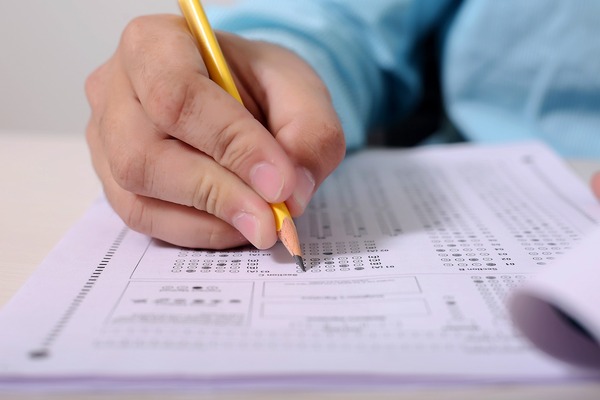
Some courses still use paper bubble sheets read by an optical mark recognition scanner, which detects dark marks and compares them with the instructor's answer key. Use a No. 2 pencil unless you are told a pen is acceptable, fill each bubble completely, erase changes cleanly and avoid stray marks, because the scanner may read them as answers. Every few questions, check that the answer number matches the question number, since one skipped line can shift every answer after it. If you have never used a bubble sheet, practice on a blank form first. The "Scantron hacks" that circulate online don't work: the scanner simply reads marks, instructors review score patterns, and many hand out several versions of the same test.
What to Do If Something Goes Wrong During the Exam
- Stay calm and stay put. Don't leave the camera view or close the exam unless the instructions tell you to.
- Use the built-in help. Most proctoring tools have a live chat or support button, and live-proctored exams let you message the proctor directly.
- Document the problem. Note the exact time, the question number and any error message. Take a photo of the screen only after the exam has closed or stopped working, so the phone use itself doesn't look like a violation.
- Try to reconnect. Many exams let you resume after a dropped connection, although the timer may keep running.
- Contact your instructor right away. Email within minutes, not days, with your name, course, exam, the time and what happened. Attach any screenshots and support ticket numbers.
- Follow the official process. If you need a reset or a makeup exam, follow the course policy and keep copies of every message.
The same steps apply to non-technical emergencies, such as sudden illness or a family member walking in. Report what happened promptly and honestly. An early, documented report is far easier to resolve than a flag you never mentioned.
Testing Accommodations for Online Exams
If you have a disability, chronic illness or other condition that affects testing, you may qualify for accommodations under the Americans with Disabilities Act and Section 504 of the Rehabilitation Act. Common accommodations for online exams include extended time, scheduled breaks, a reduced-distraction setting, screen readers or other assistive technology, permission to keep food, water or medical devices on the desk, and adjusted proctoring settings.
- Register with your campus disability services office. The name varies, such as Disability Resource Center or Accessibility Services, and you will usually need documentation.
- Request early. Approval and setup can take days or weeks, so start at the beginning of the term rather than the week of the exam.
- Send your accommodation letter to each instructor and confirm that extra time has been applied to the exam, because it often has to be entered manually in the LMS or proctoring tool.
- Ask about temporary needs too. Injuries and short-term medical conditions may qualify. Religious observances and time-zone conflicts are usually arranged directly with the instructor.
The Consequences of Academic Misconduct
Using unauthorized materials, getting help from another person, sharing exam questions or letting someone else log in to take the exam are academic integrity violations at virtually every US college. Policies vary, but common penalties include:
- A zero on the exam or a failing grade in the course, sometimes with a transcript notation such as "XF" at schools that use one.
- Disciplinary probation, suspension or expulsion, especially for repeat or serious offenses such as impersonation.
- Loss of scholarships, removal from honors or professional programs, and problems with graduate or professional school applications that ask about disciplinary history.
- For international students, a suspension that ends enrollment can affect visa status.
- In rare cases, revocation of a degree when misconduct is discovered after graduation.
There are practical risks as well. Sites that sell exam "help" or answer keys are often scams, randomized question banks mean leaked answers frequently don't match your version, and researchers have documented contract cheating services blackmailing the students who paid them.
Get Legitimate Help Before Exam Day
If a topic still isn't clicking, get help while there is time to use it. Go to office hours, use your campus tutoring center, review with a study group before the exam (never during it) and work through practice problems with a tutor. On Ace My Homework, you can post the topics or practice problems you want explained, compare tutor bids, profiles and reviews, and chat with a tutor before you choose. Tutors provide explanations and worked examples for study; they don't take quizzes or exams for you. Our online homework help page explains how tutoring works across subjects. For habits that make the whole course easier, read how to ace online classes. When you are ready, post a tutoring request and start preparing early.
Frequently Asked Questions
Do I Need to Unplug a Second Monitor for a Proctored Exam?
Usually, yes. Most proctored exams require a single display, and lockdown browsers and proctoring tools commonly detect a second connected monitor and either stop the exam from starting or flag it for review. Disconnect extra monitors, TVs and projectors before you begin, and close screen-sharing or remote desktop apps. If you need a larger external screen for an accessibility reason, arrange it with disability services and your instructor in advance.
What Happens If My Internet Disconnects During an Online Exam?
It depends on the platform and your instructor's settings. Many exams let you log back in and resume, but the timer may keep running while you are offline. Reconnect as quickly as you can, note the time and any error message, and email your instructor right away with the details. Most instructors can reset an attempt or allow extra time when a disconnection is reported promptly and documented.
Can I Use Scratch Paper During a Proctored Exam?
Only if your instructor allows it. When scratch paper is permitted, the rules often require blank sheets that you show to the webcam on both sides before the exam, and some exams require you to tear them up on camera afterward. A small whiteboard may be allowed instead. If the instructions don't mention scratch paper, ask before exam day rather than assuming it is fine.
Does a Proctoring Flag Mean I'm Accused of Cheating?
No. A flag only marks a moment for human review, such as a second voice, your face leaving the frame or the exam window losing focus. Your instructor or a proctor reviews the recording, and many flags turn out to be harmless. If something unusual happened during your exam, such as a roommate walking in, tell your instructor promptly so the context is on record.
How Far in Advance Should I Start Studying for an Online Exam?
For a midterm or final, start one to two weeks ahead with short sessions spread across several days. For a weekly quiz, two or three focused sessions are usually enough. Leave time for at least one timed practice test under exam conditions, and finish your technical setup a few days early so an installation problem doesn't eat into your study time.
How Do I Request Extra Time on an Online Exam?
Register with your college's disability services office, provide the documentation it asks for and request accommodations as early in the term as possible. Once you are approved, send your accommodation letter to each instructor and confirm that the extra time has been entered in the exam settings, because it is often set manually in the learning platform or proctoring tool. Check again a few days before each exam.
Can You Use a Pen on a Scantron Sheet?
Only if your instructor says so. Traditional optical scanners are designed to detect pencil graphite, which is why a No. 2 pencil is the standard choice. Some newer image-based scanners can read ink, but you usually can't tell which model your school uses, and ink can't be erased cleanly. When in doubt, bring two sharpened No. 2 pencils and a good eraser.
Is an Open-Book Online Exam Easier?
Not usually. Instructors who allow notes tend to write questions that test application rather than recall, and the time limit rarely leaves room to look up every answer. Prepare as you would for a closed-book exam, then organize your notes with tabs or a one-page summary so you can find a formula or definition in seconds. Open book almost never means open internet or outside help.