The best DNP project ideas start with a documented gap at your own clinical site, match a national quality priority, and can be framed as one population, one evidence-based intervention and one outcome you can measure inside your implementation window. "Improving diabetes care" is a topic. "Raising the share of adults with an HbA1c above 9% who complete diabetes self-management education within 90 days, at one primary care clinic" is a project.
This guide lists DNP project ideas by specialty, each with a measurable framing, and shows how to judge feasibility before you commit. A DNP project translates existing evidence into practice and evaluates the result; if you need the stages and chapter structure, see our DNP project coaching page.
Where Strong DNP Project Topics Come From
Committees approve topics faster when the problem is both local and nationally recognized. Three sources give you that national backing:
AHRQ: The Agency for Healthcare Research and Quality's Making Healthcare Safer IV reviews evidence on priority patient safety practices, including sepsis care, deprescribing and opioid stewardship, and AHRQ publishes free implementation toolkits on falls, pressure injuries and health literacy.
The Joint Commission: On January 1, 2026, the Joint Commission's National Performance Goals replaced the National Patient Safety Goals for its hospital program. The 14 goals cover areas such as patient identification and handoffs, infection prevention, pain management and safe prescribing, suicide risk, staffing and medication safety. Older handbooks and articles still refer to the NPSGs, so check which framework your site is surveyed against.
Healthy People 2030: The Healthy People 2030 objectives give population targets with codes you can cite, such as HDS-05 (blood pressure control), D-03 (adults with diabetes whose HbA1c is above 9%), MHMD-08 (depression screening in primary care) and OA-03 (emergency visits for falls among older adults).
Then add local evidence: quality dashboards, incident reports, chart audits, patient complaints, and what your preceptor or nurse manager says is keeping them up at night. A national priority with no local data rarely gets a site's support, and local data with no evidence base rarely gets committee approval.
How to Judge Feasibility Before You Commit
Most DNP students have a few weeks to a few months to implement and evaluate a change. Feasibility, not importance, is what usually sinks a topic. Many faculty adapt the FINER criteria from clinical research, which ask whether a question is feasible, interesting, novel, ethical and relevant, as described in Farrugia and colleagues' practical guide to research questions. For quality improvement work, the three questions in the IHI Model for Improvement are a good test: what are you trying to accomplish, how will you know a change is an improvement, and what change will you test?
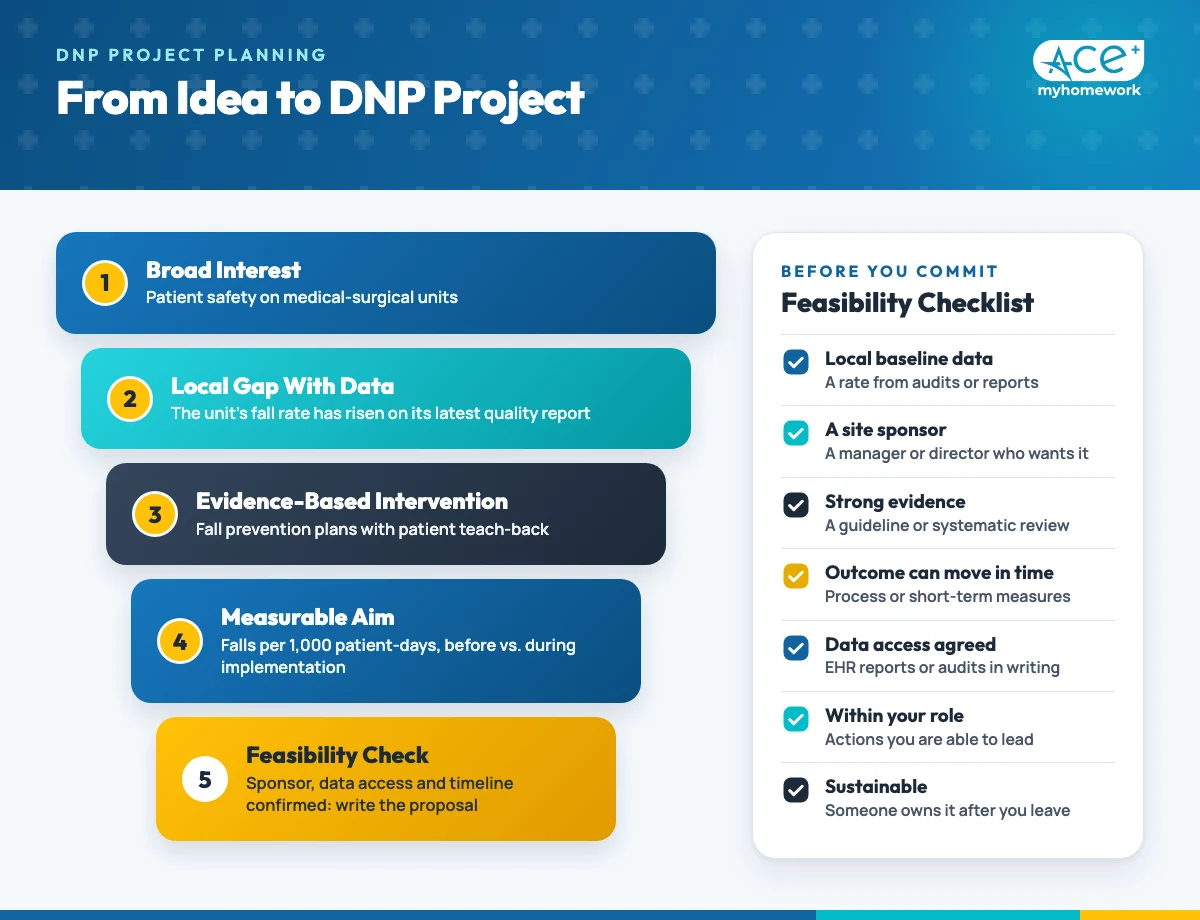
From idea to project: narrow first, then test feasibility before you write the proposal.
Run each candidate idea through these questions:
Feasibility question
What a "yes" looks like
Red flag
Is there a local gap with data?
A baseline rate from audits or reports
"Everyone knows it's a problem," but no numbers
Does the site want it?
A named sponsor, such as a manager or medical director
You are the only person who cares
Is the evidence strong enough to act on?
A guideline, systematic review or consistent studies
You would need to run an experiment to find out
Can the outcome move in your window?
Process measures or short-term outcomes
Mortality or annual rates in a 10-week project
Can you get the data?
EHR reports or audit access agreed in writing
Data owned by another department that won't share
Is it within your role and scope?
Nursing or interprofessional actions you can lead
Requires prescribing changes nobody has approved
Can it be sustained after you leave?
Built into workflow, templates or policy
Depends on you being on the unit
If an idea fails two or more of these, narrow it or change it now, before it costs you a semester. Our guide to evidence-based practice in nursing covers how to grade the evidence behind an intervention.
DNP Project Ideas by Specialty
Each idea below is framed as population, intervention and outcome measure. Most work as DNP quality improvement project ideas, because they apply an established intervention and track a rate your site already collects or can audit. Treat them as starting points. Swap in your own setting, check your site's baseline, and pick the measure your data can actually support.
Family Nurse Practitioner and Primary Care
Hypertension control: adults with uncontrolled hypertension at one clinic; self-measured blood pressure monitoring with scheduled nurse or NP follow-up; proportion of patients whose last recorded blood pressure is below the clinic's control threshold (HP2030 HDS-05).
Diabetes education referral: adults with type 2 diabetes and an HbA1c above 9%; an EHR-triggered referral pathway to diabetes self-management education; referral completion within 90 days, plus mean HbA1c change where follow-up labs exist (HP2030 D-03 and D-06).
Depression screening workflow: adults at annual or follow-up visits; PHQ-2 with reflex PHQ-9 embedded in the rooming workflow; screening rate and the share of positive screens with a documented follow-up plan (HP2030 MHMD-08).
Acute Care and Critical Care
Sepsis recognition: adults arriving at the emergency department; nurse-initiated sepsis screening at triage with an escalation pathway; time from arrival to first antibiotic and bundle compliance, measured against the Surviving Sepsis Campaign 2021 guidelines.
ICU delirium: adult ICU patients; consistent delirium screening with the CAM-ICU plus a nonpharmacological sleep bundle; screening completion per shift and the proportion of patient-days with delirium.
Clinical deterioration: adults on a medical-surgical unit; an early warning score with a defined escalation algorithm; rapid response calls and cardiac arrests outside the ICU per 1,000 patient-days. Responding to changes in a patient's condition is a named standard under the Joint Commission's first National Performance Goal.
Psychiatric-Mental Health
Suicide risk screening: patients aged 12 and older evaluated mainly for behavioral health conditions; a validated screening tool with a safety planning protocol for positive screens; screening completion and the proportion of positive screens with a documented safety plan. Screening with a validated tool for this group is required under the Joint Commission's suicide risk goal.
Measurement-based care: adults with depression in an outpatient psychiatric clinic; PHQ-9 at every medication management visit, reviewed with the patient; proportion with a repeat PHQ-9 within 12 weeks and proportion reaching remission, commonly defined as a PHQ-9 score below 5 (HP2030 MHMD-05).
Metabolic monitoring: adults starting a second-generation antipsychotic; a standing order set for baseline and follow-up weight, glucose and lipids; proportion with complete monitoring at the follow-up interval your clinic's protocol sets.
Pediatrics
Developmental screening: children attending well-child visits at the screening ages in your clinic's periodicity schedule; a standardized tool sent to parents before the visit; proportion screened with a validated tool and proportion of positive screens referred (HP2030 MICH-17).
HPV vaccination: adolescents due for HPV vaccine; standing orders plus reminder and recall messages; series initiation and completion rates (HP2030 IID-08).
Adolescent depression screening: patients aged 12 to 18 at well visits; a validated adolescent depression screen completed privately; screening rate and time to follow-up for positive screens.
Women's Health and Midwifery
Postpartum hypertension follow-up: postpartum patients with a hypertensive disorder of pregnancy; a blood pressure check scheduled before discharge, or remote monitoring, plus warning-sign teaching; proportion with a completed blood pressure check within the window your protocol sets, and postpartum readmissions for hypertension.
Quantitative blood loss: all births on a labor and delivery unit; quantitative rather than estimated blood loss measurement; proportion of births with quantitative blood loss documented and time to hemorrhage protocol activation.
Perinatal depression screening: patients at prenatal and postpartum visits; a validated perinatal depression screen with a referral pathway; screening and referral rates (HP2030 MICH-D01).
All three map to the AIM patient safety bundles, which include severe hypertension in pregnancy, obstetric hemorrhage and perinatal mental health conditions.
Gerontology
Deprescribing: adults aged 65 and older in primary care or long-term care taking at least one potentially inappropriate medication; a structured medication review using the 2023 AGS Beers Criteria; proportion of patients with a potentially inappropriate medication stopped or reduced (HP2030 OA-02).
Fall risk screening in primary care: community-dwelling adults aged 65 and older; the CDC STEADI screen, assess and intervene workflow; proportion screened yearly and proportion of at-risk patients with a documented intervention (HP2030 OA-03).
Cognitive assessment: Medicare patients at annual wellness visits; a brief validated cognitive screen with a follow-up pathway; proportion of visits with a documented screen and referrals completed for positive results (HP2030 DIA-01).
Nurse Leadership and Executive Practice
Retention and burnout: registered nurses on one or more units; a structured well-being or peer support intervention; scores on a validated burnout measure and voluntary turnover. In the NCSBN's 2024 workforce study, 39.9% of RNs reported an intent to leave or retire within five years.
Bedside shift report: nurses and patients on a medical-surgical unit; standardized bedside handoff that involves the patient; audit compliance and patient-reported communication scores. Handoff communication is a named standard under the Joint Commission's first goal.
Safety culture: staff on a unit with low event reporting; daily safety huddles with feedback on reported events; near-miss reports per month and unit scores on a validated safety culture survey.
Nursing Education and Professional Development
New graduate transition: nurses in their first year; a structured residency or preceptor development program; first-year turnover and scores on a validated transition survey.
In situ simulation: clinical nurses on a unit with infrequent emergencies; regular in situ mock codes; time to key actions in each simulation and staff self-efficacy before and after.
Clinical judgment teaching: prelicensure students in a medical-surgical course; unfolding case studies built on the NCSBN Clinical Judgment Measurement Model; scores on a validated clinical judgment rubric. This fits the first of the NLN 2024–2027 research priorities in nursing education, which centers on building the science of teaching and learning.
Nursing Informatics
Alarm management: patients on a telemetry or step-down unit; patient-specific alarm parameter review at handoff; alarms per patient-day and the proportion that were not actionable. Clinical alarm safety is a named standard under the Joint Commission's first goal.
Barcode medication administration: nurses on an inpatient unit; workflow fixes for the most common scanning workarounds; patient and medication scanning compliance and override rates.
Patient portal activation: adults at hospital discharge or a clinic visit; activation at the bedside or in the exam room with a short tutorial; activation rate and portal messages in the following 30 days.
Community and Public Health
Health-related social needs: adults at a federally qualified health center; a validated social needs screen with a closed-loop referral process; screening rate, positive screens referred and referrals confirmed as completed.
Tobacco cessation: adults who smoke at a community clinic; ask, advise and refer to a state quitline with an electronic referral; referrals per eligible patient and quitline enrollment (HP2030 TU-11 and TU-12).
Influenza vaccination: adults at a shelter, clinic or community site; nurse standing orders and on-site vaccination days; vaccination rate among eligible clients (HP2030 IID-09).
Turning a DNP Quality Improvement Project Idea Into an Aim
Once an idea passes the feasibility check, write it as one aim statement and, if your program requires it, a PICOT question. For the depression screening idea above, a draft might read:
Among adults attending follow-up visits at [clinic] (P), will a PHQ-2 with reflex PHQ-9 embedded in the rooming workflow (I), compared with current inconsistent screening (C), increase the documented screening rate from [baseline] to [target] (O) over [number] weeks of implementation (T)?
Fill the brackets with your site's real numbers. The same structure works for every idea in this list, and our guide on how to formulate PICOT questions walks through each part. Before you finalize the measures, decide how you will compare before and after; which statistical test to use depends on whether your outcome is a rate, a score or a time.
A few DNP project topics repeat because they suit most programs: screening workflows, protocol adoption, care transitions and staff education with a practice outcome. That is fine. Committees care less about novelty than about a clear local problem, a sound evidence base and an honest evaluation. If you want broader starting points outside the DNP level, our list of capstone project ideas covers other fields.
DNP Capstone Ideas That Usually Need Reworking
Outcomes that can't move in time: mortality, annual readmission rates or long-term HbA1c trends rarely change in a 10- to 16-week window. Pair them with process measures that can.
Research disguised as a project: randomizing patients to test a new intervention is research and needs full ethics review. A DNP project usually applies an intervention the evidence already supports.
Education-only projects: a staff in-service with a pre-test and post-test shows knowledge changed, not practice. Add a practice measure, such as audit compliance.
Several interventions at once: if you introduce a bundle, measure fidelity to each element so you can explain what happened.
No owner after graduation: name who will keep the audits, templates or education going once you leave.
Getting Help with Your DNP Project Topic
If your chair has sent a topic back as too broad, or you have two ideas and can't decide which is feasible, our DNP project coaching connects you with nursing writers who can give feedback on your problem statement, aim and evaluation plan. Use any outside help in line with your school's academic integrity policy, and keep your chair informed.
Frequently Asked Questions
What Is a Good DNP Project Idea?
A good idea addresses a documented problem at your site, uses an intervention backed by strong evidence, and has an outcome you can measure during your implementation window. It should also have a site sponsor and a plan for sustaining the change after you leave.
How Do I Choose Between DNP Project Topics?
Score each topic on local data, site support, strength of evidence, data access and whether the outcome can change in time. Choose the one with the fewest red flags, not the one that sounds most impressive.
Can a DNP Project Be a Quality Improvement Project?
Yes. Many DNP projects are quality improvement projects that use a framework such as the Model for Improvement with Plan-Do-Study-Act cycles. Your school and site decide whether a project counts as quality improvement or research, so check their review process early.
How Long Should a DNP Project Take to Implement?
It depends on your program. Many implementation periods last from several weeks to a few months, which is why process measures and short-term outcomes work better than long-term ones.
Where Can I Find DNP Project Topics Linked to National Priorities?
Start with AHRQ's patient safety reports and toolkits, the Joint Commission's National Performance Goals, Healthy People 2030 objectives, and professional bundles such as the AIM patient safety bundles. Then match one to a gap your site already tracks.
Does a DNP Project Have to Be Original?
Not in the research sense. A DNP project applies existing evidence to a new setting and evaluates the result. What should be original is how you adapt the evidence to your site and how you evaluate it.
Need Help With Nursing?
Post your assignment, compare tutor bids and work with an expert who explains each step.
Get affordable and top-notch help for your essays and homework services from our expert tutors. Ace
your homework, boost your grades, and shine in online classes—all with just a click away!
Do you need inspiring senior project ideas? Discover a world of innovation with our curated list of 100+ senior project ideas. Unleash your creativity and embark on a transformative experience with these exciting ideas.
166 history research topics grouped by era and region, plus how to narrow your topic with primary sources and the free archives to start your research.