Evidence-based practice (EBP) in nursing is a problem-solving approach to patient care that combines the best available research evidence with the nurse's clinical expertise and the patient's own preferences and values. The definition of evidence-based practice in nursing grew out of evidence-based medicine, which David Sackett and colleagues described as "the conscientious, explicit, and judicious use of current best evidence in making decisions about the care of individual patients." In practice, EBP means you can explain why you do what you do, and that the reason is better than "we've always done it this way."
This article explains the definition in plain terms, walks through the seven steps of evidence-based practice, shows how levels of evidence work, and describes well-documented evidence-based practice examples from real hospitals. It ends with the EBP models nurses use and a short guide to writing an EBP paper.
Definition of Evidence-Based Practice in Nursing
Most nursing programs teach two closely related definitions. The first is Sackett's, from the 1996 BMJ editorial "Evidence based medicine: what it is and what it isn't". Sackett stressed that evidence alone is never enough: it has to be combined with individual clinical expertise, and external evidence can inform, but never replace, individual clinical expertise.
The second comes from nursing scholars Bernadette Melnyk and Ellen Fineout-Overholt, whose American Journal of Nursing series introduced the seven steps of evidence-based practice. They describe EBP as a problem-solving approach that brings together evidence from well-designed studies and patient care data with clinician expertise and patient preferences and values. Their definition widens Sackett's in two useful ways: it counts internal data, such as your unit's infection or fall rates, as evidence, and it frames EBP as a process a whole organization takes part in, not only a decision one clinician makes.
Put together, evidence-based practice in nursing rests on three components:
Best available evidence: findings from research, clinical practice guidelines and reliable internal data, judged for quality.
Clinical expertise: the nurse's knowledge, skills and judgment, including assessment findings for the patient in front of you.
Patient preferences and values: what matters to the patient and family, their goals, beliefs, culture and circumstances.
All three are needed. Strong evidence for early mobility, for example, still has to be applied to a patient who may be anxious about walking, and a nurse has to judge whether today's vital signs make it safe.
Students often mix these up in papers. They overlap, but each answers a different question.
Approach
Main question
What it produces
Research
What is true? Does this intervention work?
New, generalizable knowledge, usually with ethics board approval
Evidence-based practice
What does the existing evidence say we should do here?
A practice change based on appraised evidence, adapted to the setting
Quality improvement
Is our process working, and how can we make it better?
Local improvement measured with internal data, often in rapid cycles
The Steps of Evidence-Based Practice
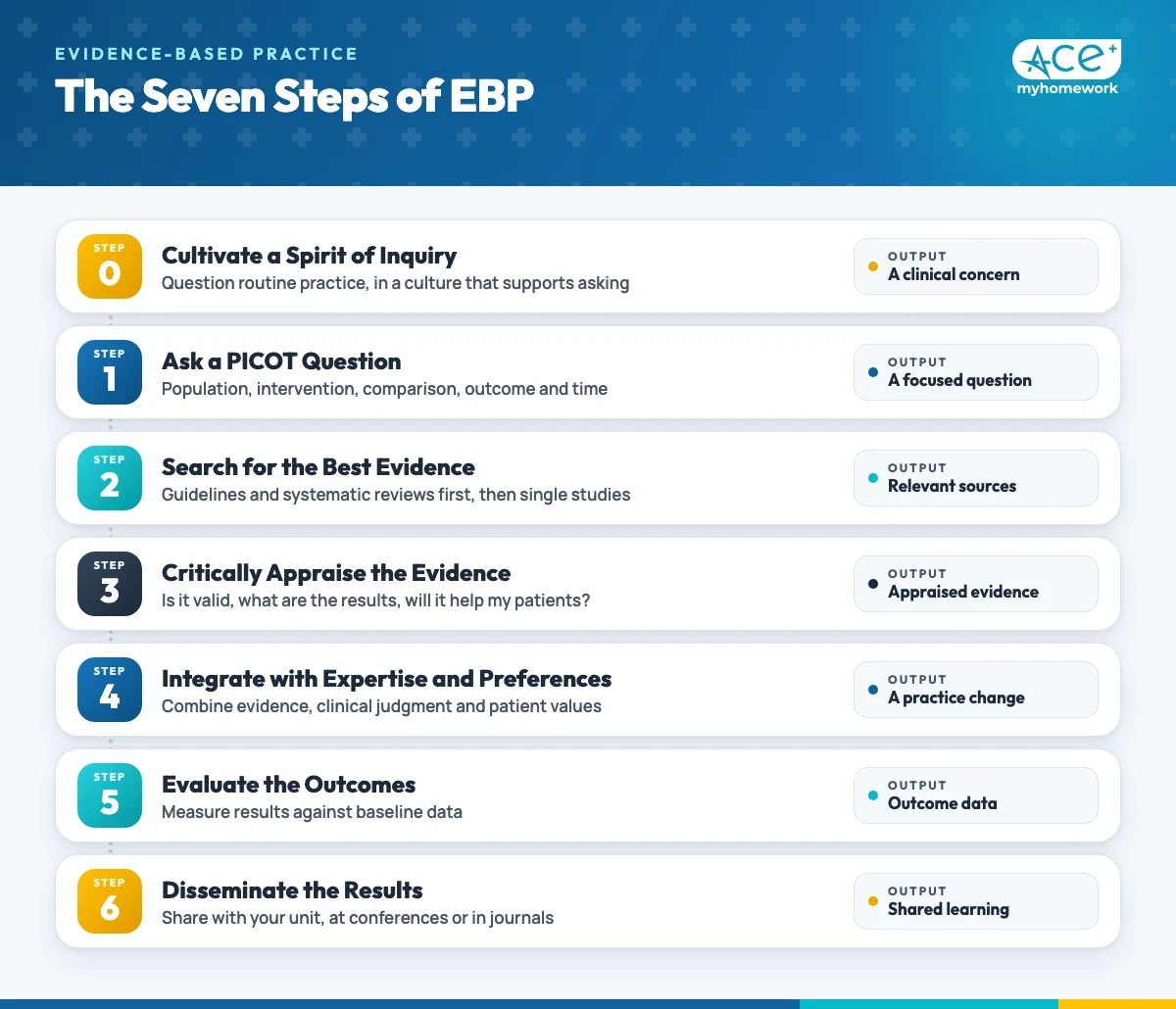
Melnyk and colleagues numbered their steps from 0 to 6. Step 0 comes first because nobody asks a clinical question without curiosity and a workplace culture that allows it.
The seven steps of EBP, adapted from Melnyk, Fineout-Overholt, Stillwell and Williamson (2010).
Step 0: Cultivate a Spirit of Inquiry
A spirit of inquiry means questioning routine practice. Why are patients woken at 4 a.m. for vital signs? Why does one unit use a different fall-prevention checklist from another? Organizations support this step with EBP mentors, journal clubs and leaders who treat questions as useful rather than disruptive.
Step 1: Ask a Clinical Question in PICOT Format
Turn the concern into a focused, searchable question that names the population, intervention, comparison, outcome and time. Our guide on how to formulate PICOT questions explains the method, and these PICOT question examples show weak drafts rewritten into strong ones.
Step 2: Search for the Best Evidence
Use your PICOT terms to search databases such as CINAHL, PubMed and the Cochrane Library. Start with the strongest, most synthesized sources: clinical practice guidelines and systematic reviews. Combine keywords and subject headings, and keep a record of your search so it can be repeated.
Step 3: Critically Appraise the Evidence
Rapid critical appraisal asks three questions of each study: Are the results valid? What are the results? Will they help me care for my patients? Rate each source's level of evidence and quality, then look across the whole body of evidence for consistency. Our guide on how to write an article critique covers appraisal of individual studies, and this literature review example shows how to synthesize several sources.
Step 4: Integrate the Evidence with Clinical Expertise and Patient Preferences
Decide what the evidence supports and how it fits your patients, your setting and your resources. This is where a practice change is designed, piloted and put into a protocol, policy or care plan. At the bedside, it is also where you check whether a specific patient agrees with and can follow the recommended approach.
Step 5: Evaluate the Outcomes
Measure whether the change produced the expected results. Pick outcomes before you start, such as infection rates per 1,000 catheter-days, falls per 1,000 patient-days or patient-reported pain scores, and compare them with baseline data.
Step 6: Disseminate the Results
Share what happened, whether or not it worked. Dissemination can be a unit presentation, a poster at a conference, a hospital newsletter or a journal article. Without this step, other units repeat the same work or never learn from it.
Levels of Evidence in Nursing
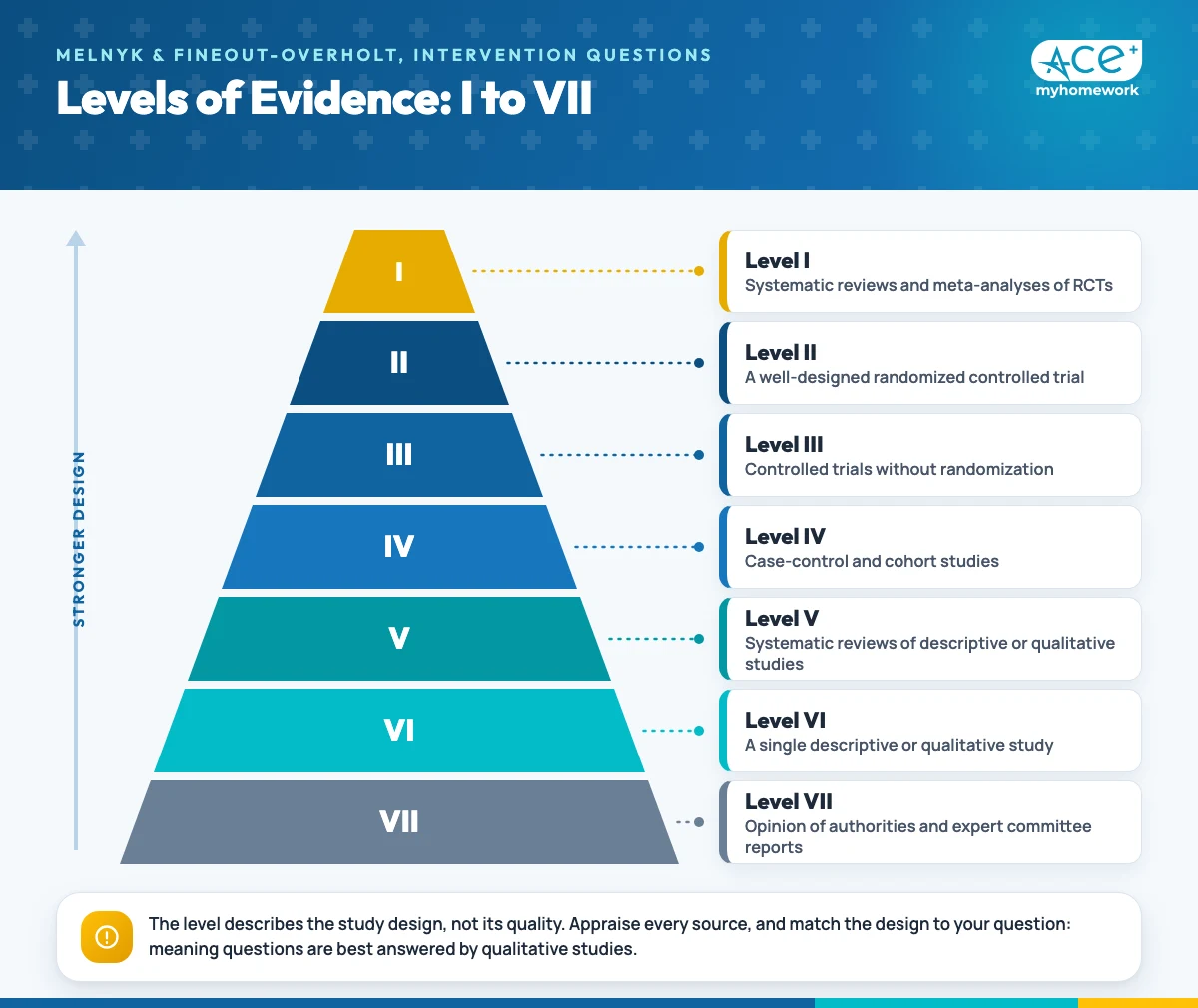
A level of evidence hierarchy ranks study designs by how well they protect against bias when answering a particular type of question. The most widely taught nursing hierarchy is Melnyk and Fineout-Overholt's seven levels for intervention (treatment) questions, reproduced in many university library guides such as the University of Colorado Anschutz levels of evidence guide.
Levels of evidence for intervention questions, based on Melnyk and Fineout-Overholt's hierarchy.
Level
Type of evidence
Example
I
Systematic review or meta-analysis of randomized controlled trials (RCTs)
A Cochrane review pooling RCTs of a fall-prevention intervention
II
Well-designed RCT
A trial randomizing ventilated ICU patients to early or usual-timing therapy
III
Controlled trial without randomization (quasi-experimental)
A before-and-after study with a comparison unit
IV
Case-control or cohort study
Following patients with and without a risk factor over time
V
Systematic review of descriptive or qualitative studies
A synthesis of interview studies on patient experience
VI
Single descriptive or qualitative study
A survey of nurses' attitudes toward bedside handoff
VII
Opinion of authorities or expert committee reports
A position statement from a professional organization
Three points help when you apply this table:
Level is not the same as quality. A poorly conducted RCT can be less trustworthy than a large, well-run cohort study. Appraise quality separately.
The best design depends on the question. The pyramid applies to intervention questions. A meaning question about patient experience is best answered by qualitative research, and a prognosis question by cohort studies.
Other hierarchies exist. The Johns Hopkins EBP model uses its own evidence levels and appraisal tools, which also rate non-research evidence such as guidelines, quality improvement reports and expert opinion. Use whichever hierarchy your course or organization specifies, and name it in your paper.
Evidence-Based Practice Examples in Nursing
The following evidence-based practice examples are well documented in the literature and in national guidelines. Each shows the same pattern: a clinical problem, evidence that a different approach works better, a change in nursing practice and measured results.
The practices in central line bundles come from the CDC Guidelines for the Prevention of Intravascular Catheter-Related Infections, which include hand hygiene, maximal sterile barrier precautions during insertion, a chlorhexidine-alcohol skin preparation, avoiding the femoral vein in adults, and promptly removing any line that is no longer essential. For nurses, the EBP lessons are the daily review of line necessity and speaking up when a step is skipped.
Evidence like this led to early mobility protocols, often combined with daily sedation interruption and delirium screening. The AHRQ early mobility training module describes how ICU teams put this into practice, with nurses screening patients for safety each day and progressing activity step by step, from sitting at the edge of the bed to walking.
Example 3: Pressure Injury Prevention
Hospital-acquired pressure injuries cause pain, infection and longer stays, and many can be prevented with consistent nursing care. The AHRQ toolkit Preventing Pressure Ulcers in Hospitals organizes best practice into a bundle: a comprehensive skin assessment, a standardized risk assessment such as the Braden Scale, and an individualized care plan that addresses each area of risk. Typical nursing actions include scheduled repositioning, pressure-redistributing support surfaces, managing moisture and incontinence, nutrition screening and offloading heels.
These practices are graded in the international pressure injury guideline published jointly by the NPIAP, EPUAP and PPPIA, whose fourth edition is being released as a living online guideline. Pressure injury prevention is a good example of how evidence, nursing judgment and patient preferences meet: a patient in pain may decline frequent turns, so the nurse adjusts the schedule, the surface and pain management together.
More Evidence-Based Practice Examples for Student Papers
Clinical problem
Evidence-based change
Outcome to measure
Catheter-associated urinary tract infection
Nurse-driven protocol to remove urinary catheters that are no longer needed
CAUTI per 1,000 catheter-days; catheter days
Heart failure readmissions
Teach-back discharge education
30-day readmission rate
Inpatient falls
Individualized fall-prevention plan based on a validated risk tool
Falls per 1,000 patient-days
Handoff errors
Structured bedside handoff using a standard tool
Missed information; patient satisfaction
Procedural pain in children
Distraction techniques during needle procedures
Self-reported pain scores
If you use one of these for an assignment, find current guidelines and studies to support it rather than relying on the table. EBP changes also feed directly into care planning; our guide on how to write a nursing care plan shows how to write evidence-based rationales for each intervention.
EBP Models Used in Nursing
EBP models give teams a structure for moving from a question to a sustained practice change. Melnyk's seven steps describe the process, while organizational models add guidance on teams, piloting and implementation. These are the EBP models students meet most often:
Model
Core structure
Often used for
Iowa Model
Triggering issue, team, evidence review, pilot, then integration and sustained change; revised by the Iowa Model Collaborative in 2017
Hospital-wide practice changes, especially ones that need a pilot
Johns Hopkins EBP Model
PET process: practice question, evidence, translation
Structured team projects that need ready-made appraisal tools
ACE Star Model
Five points: discovery, evidence summary, translation, integration, evaluation
Showing how research becomes a guideline and then practice
Stetler Model
Practitioner-oriented phases from preparation to evaluation
Individual clinicians and educators using research in decisions
ARCC Model
Assessing culture and readiness, building EBP mentors, implementing and evaluating
Building EBP culture and capacity in an organization
The 2017 Iowa Model revision is a common choice for capstone and DNP projects because its pilot stage maps neatly onto a project timeline. Whatever model you pick, explain why it fits your project rather than naming it in passing.
Common Barriers to EBP and How Nurses Address Them
Time: Busy units leave little room for reading. Journal clubs, protected project time and pre-appraised sources such as guidelines and systematic reviews help.
Search and appraisal skills: Librarians, EBP mentors and appraisal checklists make the work manageable.
Workplace culture: "We've always done it this way" is the classic barrier. Leadership support and visible results from small pilots build momentum.
Access to evidence: Students can use their library's databases; working nurses often have access through their hospital or professional organization.
How to Write an Evidence-Based Practice Paper
Most EBP assignments follow the same steps you've just read. A typical structure is:
Introduction and clinical problem: describe the issue, why it matters and any local data.
PICOT question: state it and explain each component.
Search strategy: databases, keywords, limits and how many sources you kept.
Evidence synthesis: summarize and appraise the studies, with their levels of evidence, often in an evidence table.
Recommendation and implementation plan: the practice change, the EBP model, stakeholders and barriers.
Evaluation: the outcomes you would measure and how.
Dissemination: who needs to hear the results and how you would share them.
Write it in APA format and make sure every claim about effectiveness is tied to a cited source. If this is your first EBP paper, ask your instructor which EBP model and evidence hierarchy the rubric expects before you start.
Getting Help with an EBP Assignment
EBP papers, PICOT projects and evidence tables are common in BSN and graduate courses, and the appraisal step is where many students lose marks. If you would like someone to review your PICOT question, search strategy or synthesis, our nursing homework help service offers tutoring and feedback on each section. Use any outside help in line with your school's academic integrity policy.
Frequently Asked Questions
What Is the Simplest Definition of Evidence-Based Practice in Nursing?
Evidence-based practice in nursing means making care decisions by combining the best available research evidence with your clinical expertise and the patient's preferences and values.
What Are the 7 Steps of Evidence-Based Practice?
Melnyk and colleagues list them as Step 0, cultivate a spirit of inquiry; Step 1, ask a PICOT question; Step 2, search for the best evidence; Step 3, critically appraise it; Step 4, integrate it with clinical expertise and patient preferences; Step 5, evaluate outcomes; and Step 6, disseminate the results.
What Is an Example of Evidence-Based Practice in Nursing?
Using a central line bundle is a classic example. Hand hygiene, full sterile barriers, chlorhexidine skin preparation, avoiding the femoral site in adults and removing unneeded lines are all recommended by CDC guidelines and have been linked to large reductions in bloodstream infections.
What Is the Highest Level of Evidence?
For intervention questions, Level I is a systematic review or meta-analysis of randomized controlled trials. For other types of questions, such as patient experience, a different design may provide the best evidence.
What Is the Difference Between EBP and Research?
Research generates new knowledge through studies. EBP uses existing research and other evidence to decide how to care for patients in a particular setting.
Which EBP Model Should I Use for My Project?
Use the model your program or organization requires. If you can choose, the Iowa Model suits projects that pilot a change on one unit, and the Johns Hopkins model suits team projects that need ready-made appraisal tools.
Get affordable and top-notch help for your essays and homework services from our expert tutors. Ace
your homework, boost your grades, and shine in online classes—all with just a click away!
Head to toe assessment checklist for nursing students: body-system order, normal findings, the abdomen exception, and normal vs abnormal charting examples.
Now that you have seen how writing a personal statement for nursing is made, At Acemyhomework we strive to deliver top-notch academic essays with our professional writers.