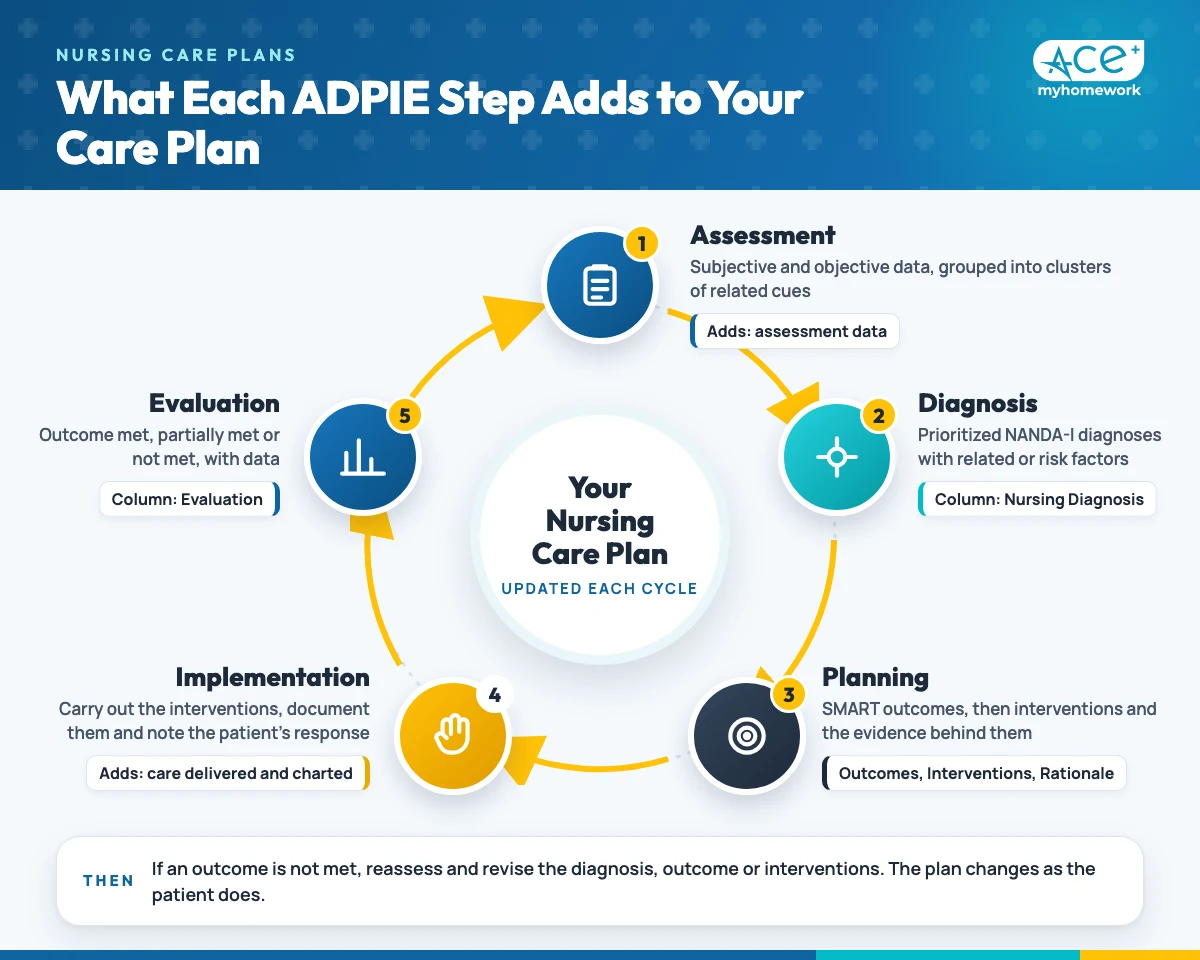
A nursing care plan is a written plan that turns your assessment of one patient into nursing diagnoses, measurable expected outcomes, nursing interventions with rationales, and an evaluation of whether the outcomes were met. Each part comes from a step of the nursing process, so a care plan is the nursing process written down. A good plan is specific to the patient, puts the most urgent problems first, and is clear enough that the nurse on the next shift can pick it up and carry on.
This guide explains what a care plan is and what goes in each column. It then walks through how to write one in six steps and gives you a blank template, a printable PDF and a completed nursing care plan example for a hypothetical patient.
What Is a Nursing Care Plan?
The American Nurses Association describes the nursing process as five connected steps: assessment, diagnosis, outcomes and planning, implementation, and evaluation. The goals set during planning are recorded in the care plan so the rest of the team can see them. That is the nursing care plan meaning in one line: the written record of the nursing process for one patient. It does three jobs:
Communication. It tells everyone caring for the patient what the nursing priorities are and what has already been tried.
Continuity. Goals and interventions carry over from shift to shift, so care doesn't start again every time staff change.
Accountability. Measurable outcomes show whether the nursing care is working.
A student care plan is longer than the one in a hospital record. Most electronic health records let nurses choose diagnoses and interventions from standardized lists, and the NANDA International (NANDA-I) 2024–2026 edition states that recording the diagnosis label alone is acceptable in practice, as long as the supporting assessment data are documented elsewhere in the chart. Student care plans spell everything out on purpose. Writing the "related to" and "as evidenced by" parts, the rationales and the evaluation shows your instructor how you reasoned. Whatever the format, the Open RN Nursing Fundamentals textbook stresses in its chapter on planning that a care plan should be individualized to the patient, even when it starts from a standardized one.
The Five Parts of a Nursing Care Plan
Most nursing programs use a five-column format. Some add a column for assessment data or split goals into short-term and long-term, so check your course rubric before you start.
Column
What goes in it
Nursing process step
Nursing Diagnosis
The NANDA-I label, the related factors (or risk factors) and the evidence from your assessment
Assessment and diagnosis
Expected Outcomes (SMART)
Measurable, patient-centered goals with a time frame
Planning
Nursing Interventions
Specific actions you will take, with frequency and detail
Planning and implementation
Rationale
Why each intervention should work, ideally supported by a source
Planning
Evaluation
Whether each outcome was met, partially met or not met, with data, and what you will change
Evaluation
Each step of the nursing process (ADPIE) fills in part of the care plan.
How to Write a Nursing Care Plan in Six Steps
Step 1: Collect and Cluster Assessment Data
Start with a full assessment. Collect subjective data, which is what the patient or family tells you, and objective data, which is what you observe and measure: vital signs, physical findings, lab and imaging results, medications and notes from other disciplines. Then group related findings into clusters. A pain score of 7 out of 10, grimacing and guarding of one knee belong together. So do an unsteady gait, a new walker and a first attempt at getting out of bed.
Diagnoses come from these clusters. The National Council of State Boards of Nursing calls this part of clinical judgment recognizing and analyzing cues in its Clinical Judgment Measurement Model, the framework behind the Next Generation NCLEX.
Step 2: Choose and Prioritize Nursing Diagnoses
A nursing diagnosis names the patient's response to a health problem, not the disease itself. "Total knee replacement" is a surgical procedure and "pneumonia" is a medical diagnosis. "Acute pain" and "Ineffective airway clearance" are nursing diagnoses, because nurses can assess and treat them.
Choose a label from the current NANDA-I list, then read its definition to make sure it fits your cluster. For student care plans, NANDA-I describes a three-part statement:
Problem-focused: [diagnosis label] related to [related factors] as evidenced by [signs and symptoms].
Risk: Risk for [diagnosis] related to [risk factors]. There are no signs and symptoms yet, because the problem hasn't happened.
Health promotion: Readiness for enhanced [diagnosis] as evidenced by [the patient's expressed wish to improve].
NANDA-I also specifies that related factors and risk factors should be things nurses can change on their own. Medical diagnoses, surgeries and medications are listed separately as "associated conditions," so they shouldn't follow "related to."
Next, put the diagnoses in priority order. Physiological instability comes first, especially problems with airway, breathing or circulation. Many programs also use Maslow's hierarchy of needs. A risk diagnosis can be the top priority: the NANDA-I text gives the example of a patient at high risk of pressure injury, where preventing the injury matters more than a minor existing problem.
Step 3: Write SMART Expected Outcomes
An expected outcome describes what the patient will achieve, not what the nurse will do. The Open RN textbook's section on outcome identification uses the SMART mnemonic: specific, measurable, attainable or action-oriented, relevant or realistic, and time-limited.
Weak outcome
Problem
SMART outcome
Patient will have less pain.
Not measurable, no time frame
Patient will report pain at or below her acceptable level of 3/10 within 1 hour of each analgesic dose during this shift.
Nurse will monitor lung sounds.
Describes a nursing action
Patient will have clear breath sounds in all lung fields within 48 hours.
Patient will understand diabetes.
"Understand" can't be observed
Before discharge, patient will demonstrate blood glucose self-testing correctly and name three symptoms of hypoglycemia.
Patient will walk more.
Vague, no time frame
By postoperative day 2, patient will walk to the bathroom and back with a walker and standby assistance.
Time frames depend on the setting. Open RN notes that in critical care a short-term goal may be reached within a shift and a long-term goal within 24 hours, while in an outpatient setting they may be one month and six months.
Step 4: Select Nursing Interventions
Choose three to five interventions for each diagnosis and aim them at the related factors or risk factors you identified. The Open RN text sorts interventions into three types:
Independent: actions you can take without a prescription, such as repositioning, teaching or assessing.
Dependent: actions that need a prescription, such as giving a medication or starting oxygen.
Collaborative: actions carried out with other team members, such as working with physical therapy or a dietitian.
Write each intervention as a specific order with what, when and how often. "Monitor pain" is too vague. "Assess pain with the 0–10 numeric rating scale and sedation level before each opioid dose and reassess after each dose per facility policy" is specific. Include at least one assessment intervention, one hands-on or therapeutic intervention and one teaching intervention. Where it matters, add an escalation point, such as when to notify the provider or call the rapid response team.
Step 5: Write a Rationale for Each Intervention
A rationale explains why an intervention works. It shouldn't simply repeat the intervention. "To reduce pain" is not a rationale. "Checking sedation before each opioid dose helps detect opioid-induced respiratory depression early, because increasing sedation usually comes before it" is one, and you can support it with the American Society for Pain Management Nursing guidelines on monitoring for opioid-induced sedation and respiratory depression. Use your textbook, clinical guidelines or peer-reviewed articles, and cite them the way your program requires. Our guide on how to cite sources in APA format covers the most common style.
Step 6: Evaluate and Revise
When the time frame in your outcome ends, compare the patient's data with the outcome. The Open RN chapter on evaluation classifies outcomes as met, partially met or not met, and says the plan should be revised if an outcome isn't fully met in time. Always write the evaluation with data, for example: "Outcome met. On postoperative day 2 at 1400, patient walked to the bathroom and back with a walker and standby assistance and reported no dizziness."
If an outcome wasn't met, ask why. The diagnosis may have been wrong, the outcome unrealistic, the time frame too short, or the interventions not carried out. Reassessment takes you back to step 1, which is why the nursing process is drawn as a cycle.
Nursing Care Plan Template
Copy this blank table into your document, or use it as a template for nursing care plan assignments that use the standard five-column format. Add a row for each diagnosis, in priority order.
Nursing Diagnosis
Expected Outcomes (SMART)
Nursing Interventions
Rationale
Evaluation
For clinical days, download the printable nursing care plan template (PDF). It includes space for patient background, subjective and objective assessment data, three prioritized diagnoses and your evaluation notes. Don't record names, dates of birth, room numbers or record numbers on student paperwork. Use initials or "Patient A," as most programs require.
Nursing Care Plan Example: After a Total Knee Replacement
This nursing care plan example uses a hypothetical patient. A 68-year-old woman is on postoperative day 1 after an elective right total knee replacement. She rates her pain 7/10 when bending the knee and 4/10 at rest, grimaces and guards the knee when repositioned, and has refused to get out of bed since surgery. When the physical therapist helped her stand at the bedside this morning, she was unsteady and needed help from one person with a walker. She is receiving prescribed opioid analgesics. Her dressing is dry and intact, her temperature is 37.2°C (99.0°F), and she says she has never looked after a surgical wound before.
Nursing Diagnosis
Expected Outcomes (SMART)
Nursing Interventions
Rationale
Evaluation
Acute pain related to tissue injury from surgery as evidenced by pain rated 7/10 with knee flexion, grimacing, guarding and refusal to get out of bed
Patient will report pain at or below her acceptable level of 3/10 at rest and 5/10 or less during physical therapy within 24 hours.
Assess pain (0–10 scale) and sedation level before each analgesic dose and reassess per facility policy.
Give prescribed multimodal analgesia; coordinate timing so it takes effect before physical therapy.
Apply cold therapy and elevate the leg as prescribed by the surgical team.
Teach her to report pain early and to use slow breathing during exercises.
Notify the provider if pain stays above her goal despite treatment, or sooner if sedation increases.
Repeated scores show whether treatment works; sedation usually increases before opioid-induced respiratory depression.
Pain that is controlled before activity makes early mobilization possible.
Cold and elevation reduce swelling and pain.
Pain is easier to control before it becomes severe.
Uncontrolled pain or rising sedation may need a change in the prescribed plan.
Partially met. Day 2: pain 2/10 at rest and 6/10 during therapy. Analgesic timing adjusted with the team; continue plan and reassess.
Risk for adult falls related to impaired mobility, decreased leg strength and an unfamiliar environment
Patient will have no falls during her hospital stay and will call for help before every transfer, starting this shift.
Screen fall risk with the facility tool every shift and when her condition changes.
Keep the bed low and locked, with the call light, walker and personal items within reach.
Assist with every transfer and walk until physical therapy clears her; use nonslip footwear.
Offer scheduled toileting and regular rounding.
Teach her and her family why to call before getting up.
Fall risk changes after surgery and as medications change.
A safe environment reduces unassisted attempts to reach items.
Weakness and a new walking aid increase the risk of falling.
Many falls happen while patients try to reach the bathroom alone.
Patients who understand the reason are more likely to ask for help.
Met. No falls on days 1 and 2; she used the call light before each transfer.
Risk for surgical wound infection related to inadequate knowledge of incision care
Incision will show no signs of infection through discharge; before discharge, patient will name four signs of infection to report and demonstrate hand hygiene.
Perform hand hygiene before and after every contact.
Assess the incision and temperature every shift for redness, warmth, swelling, drainage or fever.
Keep the dressing clean and dry; change it using aseptic technique only as the surgical team orders.
Use teach-back to review incision care, hand hygiene and when to call the surgeon.
Hand hygiene is a basic measure for preventing healthcare-associated infection.
Early signs allow early treatment.
Unnecessary dressing changes expose the wound.
Teach-back confirms she understood the instructions.
Ongoing. Incision clean and dry; she named three of four signs. Repeat teaching before discharge.
Notice what the example does. The surgery explains the tissue injury behind the pain, but "total knee replacement" is never used as a diagnosis. The risk diagnoses list risk factors and have no "as evidenced by" section. Each outcome can be checked with data, and each evaluation says what happens next. The fall precautions follow the approach in the AHRQ Preventing Falls in Hospitals toolkit, and the wound interventions are consistent with the CDC's guideline for the prevention of surgical site infection.
A Nursing Care Plan NANDA List: Diagnoses You'll Use Often
The 2024–2026 edition of NANDA-I contains 277 diagnoses, 56 of them new, and many older labels were renamed or retired. If your textbook or clinical paperwork is a few years old, the labels may not match. These are diagnoses that come up often in medical-surgical care plans, written with their current labels:
Acute pain and Chronic pain
Risk for infection and Risk for surgical wound infection (formerly Risk for surgical site infection)
Risk for adult falls (formerly Risk for falls)
Impaired physical mobility
Ineffective airway clearance and Impaired gas exchange
Inadequate health knowledge (formerly Deficient knowledge)
Impaired skin integrity and Risk for adult pressure injury
Acute confusion
Ineffective health self-management
Some familiar labels are no longer in the classification, including Constipation, Decreased cardiac output and Disturbed sleep pattern. Current alternatives include Impaired intestinal elimination, Risk for decreased cardiac output and Ineffective sleep pattern. If your instructor uses an older edition, follow the edition on your syllabus and say which one you used.
Common Care Plan Mistakes and How to Fix Them
Mistake
Fix
Using a medical diagnosis as the nursing diagnosis ("Heart failure")
Name the patient's response, such as Excessive fluid volume
Putting a medical diagnosis after "related to"
Use a factor nursing can change, such as excessive sodium intake
Writing outcomes about the nurse
Start with "Patient will..." and describe something you can observe
Vague interventions ("monitor patient")
Say what to assess, how and how often
Rationales that repeat the intervention
Explain why it works and cite a source
Too many diagnoses, none prioritized
Choose the priority problems and put physiological threats first
Evaluation with no data
Report the measurement and whether the outcome was met
Copying a standard plan unchanged
Match every row to your patient's assessment data
If you also need to write up the encounter, our SOAP note example shows how the same data fit a progress note. More guides are in our Nursing Study Hub.
Getting Help with a Nursing Care Plan
Care plan feedback usually focuses on whether the diagnosis matches the data, the outcomes are measurable and the rationales are supported. If you'd like someone to review a draft, check your NANDA-I labels or explain the reasoning behind an intervention, our nursing homework help offers tutoring and feedback on care plan assignments. Use any outside help in line with your school's academic integrity policy, and make sure the final plan reflects your own assessment of your own patient.
Frequently Asked Questions
What Are the Five Parts of a Nursing Care Plan?
The standard columns are nursing diagnosis, expected outcomes, nursing interventions, rationale and evaluation. Some programs add a column for assessment data, which feeds the diagnosis.
How Many Nursing Diagnoses Should a Care Plan Have?
It depends on the assignment and the patient. Many student care plans focus on two or three priority diagnoses, but always follow your rubric. Quality matters more than quantity: each diagnosis needs supporting data, outcomes, interventions and an evaluation.
What Is the Difference Between a Nursing Diagnosis and a Medical Diagnosis?
A medical diagnosis names a disease or injury, such as pneumonia. A nursing diagnosis names the patient's response to it, such as Ineffective airway clearance, which nurses can assess and treat with nursing interventions.
How Many Interventions Should Each Nursing Diagnosis Have?
Three to five specific interventions is typical. Include assessment, a direct nursing action and patient teaching, and make sure each one targets the related factors or risk factors in your diagnosis.
Do Nurses Still Write Care Plans After Graduation?
Yes, but usually in a shorter form. Hospitals use electronic or standardized care plans that nurses individualize, and NANDA-I accepts documenting the diagnosis label alone when the supporting data are in the record.
Which NANDA-I Edition Should I Use for My Care Plan?
Use the edition your program assigns. The current edition is NANDA-I 2024–2026, which renamed many labels, so mention the edition if your instructor expects older terms.
Need Help With Nursing?
Post your assignment, compare tutor bids and work with an expert who explains each step.
Get affordable and top-notch help for your essays and homework services from our expert tutors. Ace
your homework, boost your grades, and shine in online classes—all with just a click away!
Learn what a personal study plan is, how to build one around your courses and habits, why a template makes planning easier and how to stick to your schedule.
Now that you have seen how writing a personal statement for nursing is made, At Acemyhomework we strive to deliver top-notch academic essays with our professional writers.