A nursing diagnosis is a clinical judgment about how a patient, family or community responds to a health problem or life process, or how vulnerable they are to developing that response. Common nursing diagnoses in medical-surgical care plans include Acute pain, Risk for infection, Risk for adult falls, Impaired physical mobility, Ineffective airway clearance, Impaired gas exchange, Inadequate fluid volume, Excessive anxiety and Inadequate health knowledge. All of them come from the NANDA International (NANDA-I) classification, whose 2024–2026 edition contains 277 diagnoses grouped into 13 domains.
This guide explains the four types of nursing diagnosis and how the NANDA-I domains work. It then gives a list of commonly used diagnoses, grouped by domain, with plain-language meanings and typical examples. It also covers psychological nursing diagnoses and the label changes in the current edition.
What Is a Nursing Diagnosis?
The American Nurses Association places diagnosis second in the nursing process, after assessment, and describes it as the nurse's clinical judgment about the patient's response to actual or potential health conditions or needs. The diagnosis then guides everything else in the care plan: the outcomes you set, the interventions you choose and what you evaluate.
The key word is response. A medical diagnosis names a disease or injury. A nursing diagnosis names how the person is affected by it, in a way nurses can assess and treat on their own.
Medical diagnosis
Possible nursing diagnoses
Pneumonia
Ineffective airway clearance; Impaired gas exchange; Decreased activity tolerance
Heart failure
Excessive fluid volume; Decreased activity tolerance; Ineffective health self-management
Stroke
Impaired swallowing; Impaired physical mobility; Impaired verbal communication
Hip fracture repair
Acute pain; Risk for adult falls; Risk for adult pressure injury
Most nursing programs use NANDA for nursing diagnosis labels. The NANDA-I book gives each diagnosis a label, a definition and diagnostic indicators: defining characteristics (signs and symptoms), related factors (causes) or risk factors, and the at-risk populations and associated conditions that make a diagnosis more likely.
The Four Types of Nursing Diagnosis
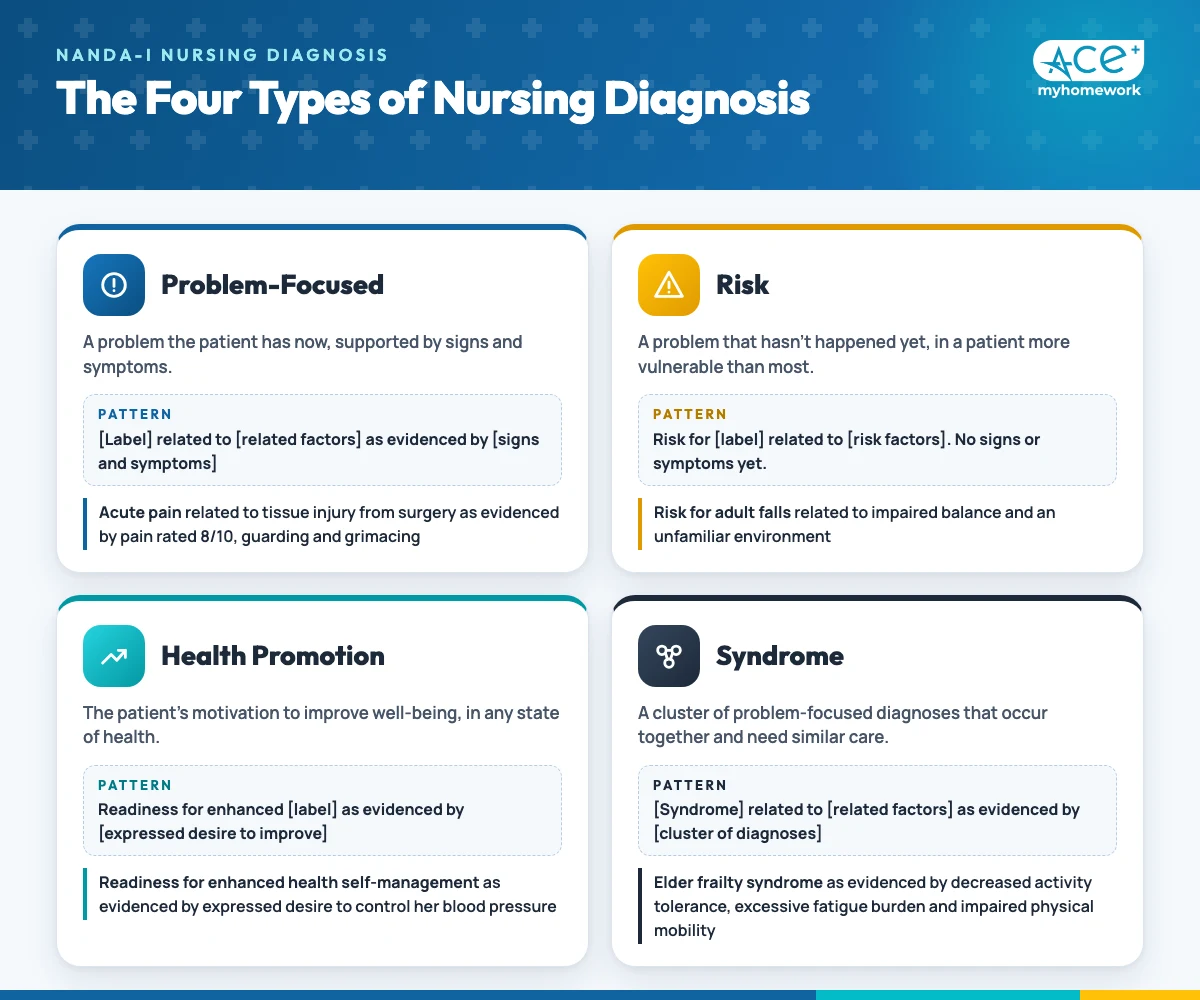
NANDA-I divides diagnoses into problem-focused diagnoses and two kinds of "potential" diagnosis, plus a smaller group of syndromes.
The four types of nursing diagnosis, with the three-part statement format NANDA-I describes for students.
Problem-focused: an undesirable response that is present now, such as Acute pain or Impaired skin integrity. You need signs and symptoms to support it.
Risk: a vulnerability to a problem that hasn't developed yet, such as Risk for infection. NANDA-I notes that a risk diagnosis is meant for patients at higher risk than the general population, not for every patient. It is supported by risk factors, not symptoms.
Health promotion: a patient's motivation to improve their health, written as "Readiness for enhanced...", such as Readiness for enhanced health self-management. It can be used in any state of health.
Syndrome: a cluster of problem-focused diagnoses that occur together and respond to similar interventions, such as Elder frailty syndrome, Post-trauma syndrome or Acute substance withdrawal syndrome.
For a full guide to writing each type as a statement, see our guide to writing a nursing care plan, which covers the "related to" and "as evidenced by" format.
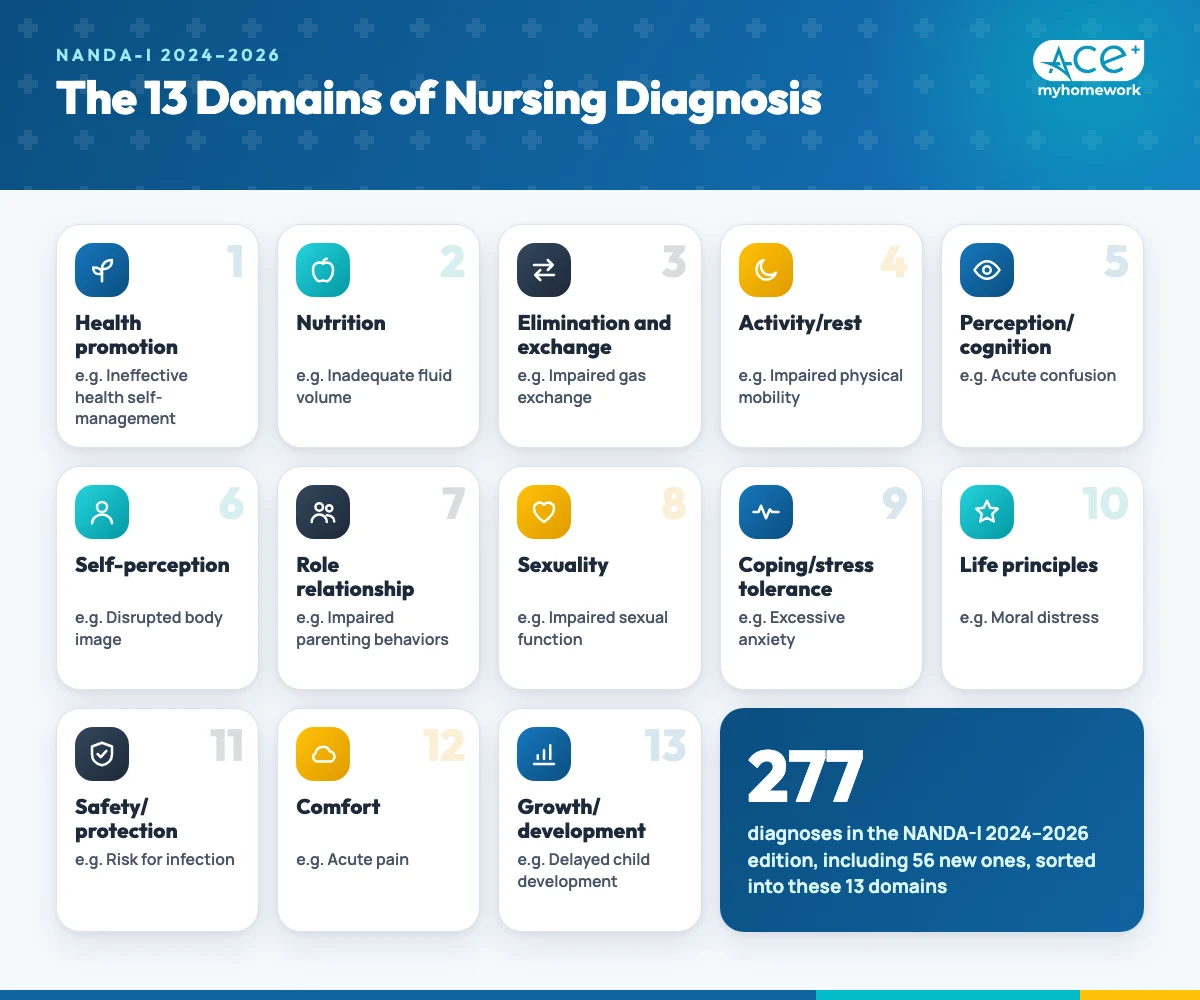
The 13 NANDA-I Domains
NANDA-I organizes its diagnoses into 13 domains, each divided into classes. The domains are broad areas of human functioning, and knowing them helps you scan for the right diagnosis once you've clustered your assessment data. Some placements surprise students. Ineffective airway clearance, for example, sits in Safety/protection rather than with the respiratory diagnoses in Elimination and exchange.
The 13 domains of the NANDA-I 2024–2026 classification, with one example diagnosis from each.
Common Nursing Diagnosis List by Domain
Use the tables below as a working nursing diagnosis list. NANDA-I 2024–2026 labels are used throughout. The meanings are short paraphrases to help you choose, not the official definitions, so always check the full definition and indicators in your NANDA-I book before you use a diagnosis. Every example describes a hypothetical patient.
Health Promotion
Diagnosis
What it means
Typical example
Ineffective health self-management
The patient isn't managing a condition and its treatment well enough to meet health goals
An adult with heart failure who often skips diuretics and finds the fluid plan hard to follow
Readiness for enhanced health self-management
The patient is managing a condition and wants to do it better
A patient with hypertension who asks how to log home blood pressure readings
Risk for ineffective blood glucose pattern self-management
The patient is vulnerable to not keeping blood glucose patterns in a healthy range
A newly diagnosed adult with type 2 diabetes who has started night shifts
An older adult who eats less than half of each meal and is losing weight
Impaired swallowing
Difficulty moving food or fluid safely from the mouth to the stomach
A patient after a stroke who coughs when drinking thin liquids
Inadequate fluid volume
Too little fluid in the body
A patient with two days of vomiting, dry mucous membranes and low urine output
Excessive fluid volume
Too much fluid retained in the body
A patient with heart failure with leg edema, crackles and rapid weight gain
Elimination and Exchange
Diagnosis
What it means
Typical example
Impaired urinary elimination
A problem with how urine is passed, such as urgency, frequency or difficulty emptying the bladder
A patient who voids small amounts often after catheter removal
Impaired intestinal elimination
A problem with bowel movements, such as hard, infrequent stools or loose, frequent ones
A patient taking opioids after surgery with no bowel movement for four days and a bloated abdomen
Impaired gas exchange
Oxygen and carbon dioxide aren't exchanged well enough in the lungs
A patient with pneumonia who has new confusion and low oxygen saturation
Activity/Rest
Diagnosis
What it means
Typical example
Impaired physical mobility
Limited ability to move the body or limbs independently
A patient after hip surgery who needs help to turn and stand
Decreased activity tolerance
Not enough physical or mental energy to complete daily activities
A patient with COPD who becomes breathless walking to the bathroom
Excessive fatigue burden
Persistent, overwhelming tiredness that rest doesn't fix and that limits function
A patient having chemotherapy who can't finish usual tasks despite sleeping more
Ineffective breathing pattern
The way the patient breathes doesn't move enough air
A patient with rib fractures taking rapid, shallow breaths to avoid pain
Risk for decreased cardiac output
Vulnerable to the heart not pumping enough blood for the body's needs
A patient admitted after a heart attack
Ineffective sleep pattern
Sleep quantity or quality is disrupted
A hospitalized patient woken repeatedly overnight who reports feeling unrested
Decreased bathing abilities
Unable to complete bathing without help
A patient with one-sided weakness after a stroke
Perception/Cognition
Diagnosis
What it means
Typical example
Acute confusion
A sudden, fluctuating change in attention, thinking or awareness
An older adult after surgery who becomes disoriented and agitated at night
Inadequate health knowledge
Missing information needed to manage health
A patient starting warfarin who doesn't know which signs of bleeding to report
Impaired verbal communication
Difficulty using or understanding spoken language
A patient with expressive aphasia after a stroke
Safety/Protection
Diagnosis
What it means
Typical example
Risk for infection
More vulnerable than usual to invasion by pathogens
A patient with a central line who is receiving chemotherapy
Ineffective airway clearance
Unable to clear secretions or obstructions to keep the airway open
A patient with pneumonia, a weak cough and coarse crackles
Risk for aspiration
Vulnerable to food, fluid or secretions entering the airway
A patient receiving tube feedings who is drowsy
Risk for adult falls
An adult more likely than usual to fall
A patient who gets dizzy on standing and has a new walker
Impaired skin integrity
Damage to the outer layers of the skin
A frail patient with a skin tear on the forearm
Risk for adult pressure injury
Vulnerable to skin and tissue damage from pressure or shear
A bedbound patient with a high-risk pressure injury screening score
Risk for excessive bleeding
Vulnerable to losing more blood than normal
A patient on an anticoagulant after surgery
Hyperthermia
Body temperature above normal because the body can't regulate heat
A worker brought in after collapsing on a very hot day
Comfort
Diagnosis
What it means
Typical example
Acute pain
Pain of recent onset that is expected to resolve, lasting less than three months
A patient on day one after abdominal surgery who rates incision pain 8/10
Chronic pain
Pain that has lasted longer than three months
A patient with low back pain for more than a year that limits work
Psychological Nursing Diagnoses
A psychological nursing diagnosis describes an emotional, mental or social response. Most sit in the Coping/stress tolerance, Self-perception and Role relationship domains, and the 2024–2026 edition renamed many of them.
Diagnosis
What it means
Typical example
Excessive anxiety
Worry or dread about a vague or expected threat that is strong enough to interfere with functioning
A patient the night before surgery who is restless, can't concentrate and keeps asking the same questions
Excessive fear
A strong response to a specific, identified threat
A patient terrified of an upcoming MRI after a bad experience in a confined space
Maladaptive coping
Ways of handling stress that don't work or cause harm
A patient who started drinking heavily and missing appointments after a new diagnosis
Impaired mood regulation
Mood changes that affect thinking, behavior and physical well-being
A patient with depression who reports persistent low mood, poor sleep and withdrawal from family
Risk for suicidal self-injurious behavior
Vulnerable to self-harm with the intent to die
A patient who has expressed hopelessness after a major loss and has stored medications at home
Situational inadequate self-esteem
A negative view of oneself that develops in response to a current situation
A patient who calls himself "useless" after an injury forced him to stop working
Disrupted body image
Distress about how the body looks or works
A patient who won't look at a new colostomy
Maladaptive grieving
Grief that is prolonged or interferes with daily life
A widowed patient who still cannot manage daily routines long after the loss
Excessive caregiving burden
Overwhelming strain from caring for someone else
A spouse caring for a partner with dementia who reports exhaustion and no support
Inadequate social connectedness
Lacking meaningful contact with other people
An older adult living alone who rarely sees or speaks to anyone
Impaired spiritual well-being
Distress about meaning, purpose or faith
A patient with advanced cancer who is questioning the meaning of their life
Risk for suicidal self-injurious behavior is a safety priority, not a paperwork exercise. Report concerns to the patient's nurse and your instructor at once, follow your unit's observation and environmental safety policies, and use the screening tool your facility has adopted, such as the NIMH Ask Suicide-Screening Questions (ASQ) toolkit. If you or someone you know is in crisis in the United States, call or text the 988 Suicide and Crisis Lifeline.
NANDA-I 2024–2026 Label Changes
According to the preface of the 2024–2026 edition, every diagnosis was revised in some way, 56 new diagnoses were added, and several labels changed. If you're using an older textbook, this table shows the current label for diagnoses you may know by an older name.
Older label
Current label
Anxiety
Excessive anxiety
Fear
Excessive fear
Deficient knowledge
Inadequate health knowledge
Deficient fluid volume
Inadequate fluid volume
Fatigue
Excessive fatigue burden
Imbalanced nutrition: less than body requirements
Inadequate nutritional intake
Bathing self-care deficit
Decreased bathing abilities
Ineffective coping
Maladaptive coping
Caregiver role strain
Excessive caregiving burden
Social isolation
Inadequate social connectedness
Situational low self-esteem
Situational inadequate self-esteem
Disturbed body image
Disrupted body image
Spiritual distress
Impaired spiritual well-being
Risk for suicidal behavior
Risk for suicidal self-injurious behavior
Risk for bleeding
Risk for excessive bleeding
Risk for injury
Risk for physical injury
Hypothermia
Decreased body temperature
Risk for surgical site infection
Risk for surgical wound infection
Two familiar changes came one edition earlier, in 2021–2023: Activity intolerance became Decreased activity tolerance, and Risk for falls was split into Risk for adult falls and Risk for child falls. Some labels were removed rather than renamed, including Constipation, Diarrhea, Decreased cardiac output, Disturbed sleep pattern, Insomnia, Urinary retention, Hopelessness, Powerlessness and Impaired comfort. The current list covers those problems with labels such as Impaired intestinal elimination, Chronic functional constipation, Risk for decreased cardiac output, Ineffective sleep pattern and Impaired urinary elimination. If your program still uses an older edition, follow your syllabus.
How to Choose the Right Nursing Diagnosis
Many diagnoses sound alike. Start from your clustered assessment data, then compare the definitions of the candidates. These are the pairs students mix up most often:
Ineffective airway clearance vs Ineffective breathing pattern vs Impaired gas exchange. Airway clearance is about secretions or obstruction. Breathing pattern is about the rate, depth or rhythm of breathing. Gas exchange is about oxygen and carbon dioxide crossing the lungs, shown by findings such as low oxygen saturation, abnormal blood gases or new confusion.
Excessive anxiety vs Excessive fear. Fear has a specific, identifiable source. Anxiety is more diffuse or anticipatory.
Decreased activity tolerance vs Excessive fatigue burden. Activity tolerance is about how the body responds to exertion. Fatigue burden persists even after rest.
Acute confusion vs Chronic confusion. Acute confusion starts suddenly and fluctuates. Treat it as a possible sign of delirium and report it promptly. Chronic confusion is long-standing.
Risk vs problem-focused. Once signs and symptoms appear, the risk diagnosis no longer fits. Switch to the problem-focused diagnosis.
Then prioritize. NANDA-I puts physiological instability first. It also points out that a risk diagnosis can outrank a problem-focused one, for example when a patient's risk of pressure injury is high. The National Council of State Boards of Nursing's Clinical Judgment Measurement Model tests the same skills on the NCLEX: recognizing cues, analyzing them and prioritizing hypotheses.
Where to Find All Nursing Diagnosis Labels
The complete classification, with all definitions and indicators, is in the NANDA-I book. Your school library may provide it. Free online lists vary in quality, and many still show retired labels, so check any list against the edition your program uses. The Open RN Nursing Fundamentals textbook has a free chapter on nursing diagnosis that explains how to cluster data and choose diagnoses, though its examples are based on an earlier NANDA-I edition. More study guides are collected in our Nursing Study Hub.
Getting Help with Nursing Diagnoses
Choosing a diagnosis that matches your data, and using the current label, is where many care plans lose points. If you'd like feedback on your diagnoses, priorities or care plan, our nursing homework help offers tutoring and review for nursing assignments. Use any outside help in line with your school's academic integrity policy, and base your diagnoses on your own patient assessment.
Frequently Asked Questions
What Are the Most Common Nursing Diagnoses?
Diagnoses that appear often in medical-surgical care plans include Acute pain, Risk for infection, Risk for adult falls, Impaired physical mobility, Ineffective airway clearance, Impaired gas exchange, Inadequate fluid volume, Excessive anxiety, Inadequate health knowledge and Impaired skin integrity.
How Many NANDA-I Nursing Diagnoses Are There?
The 2024–2026 edition contains 277 diagnoses, including 56 that are new to this edition, organized into 13 domains.
What Are the Four Types of Nursing Diagnosis?
Problem-focused, risk, health promotion and syndrome. Problem-focused diagnoses describe a current problem, risk diagnoses a vulnerability, health promotion diagnoses a readiness to improve, and syndromes a cluster of related diagnoses.
What Is the Difference Between a Nursing Diagnosis and a Medical Diagnosis?
A medical diagnosis names a disease, such as pneumonia. A nursing diagnosis names the patient's response to it, such as Ineffective airway clearance, which nurses can treat independently.
Is Anxiety Still a NANDA-I Diagnosis?
Yes, but the current label is Excessive anxiety. Fear was similarly renamed Excessive fear in the 2024–2026 edition.
Can I Use an Older NANDA-I Label in My Care Plan?
Follow your instructor's guidance. Many programs expect the current edition, so use the 2024–2026 label and mention the older one if it helps your reader.
Get affordable and top-notch help for your essays and homework services from our expert tutors. Ace
your homework, boost your grades, and shine in online classes—all with just a click away!
Now that you have seen how writing a personal statement for nursing is made, At Acemyhomework we strive to deliver top-notch academic essays with our professional writers.