A nursing care plan for high blood pressure identifies how the patient is responding to hypertension, sets measurable goals, and lists the nursing actions that help the patient lower and control their blood pressure. Most plans focus on self-management (taking medicines as prescribed, eating less sodium, measuring blood pressure at home), the risk of heart, brain and kidney damage, and teaching. The medical diagnosis is hypertension. The nursing diagnoses describe what the patient needs from you.
This guide covers the current blood pressure categories, the assessment data to collect, nursing diagnoses that use current NANDA-I labels, a filled care plan table for a hypothetical patient, patient teaching, and the red flags that need escalation.
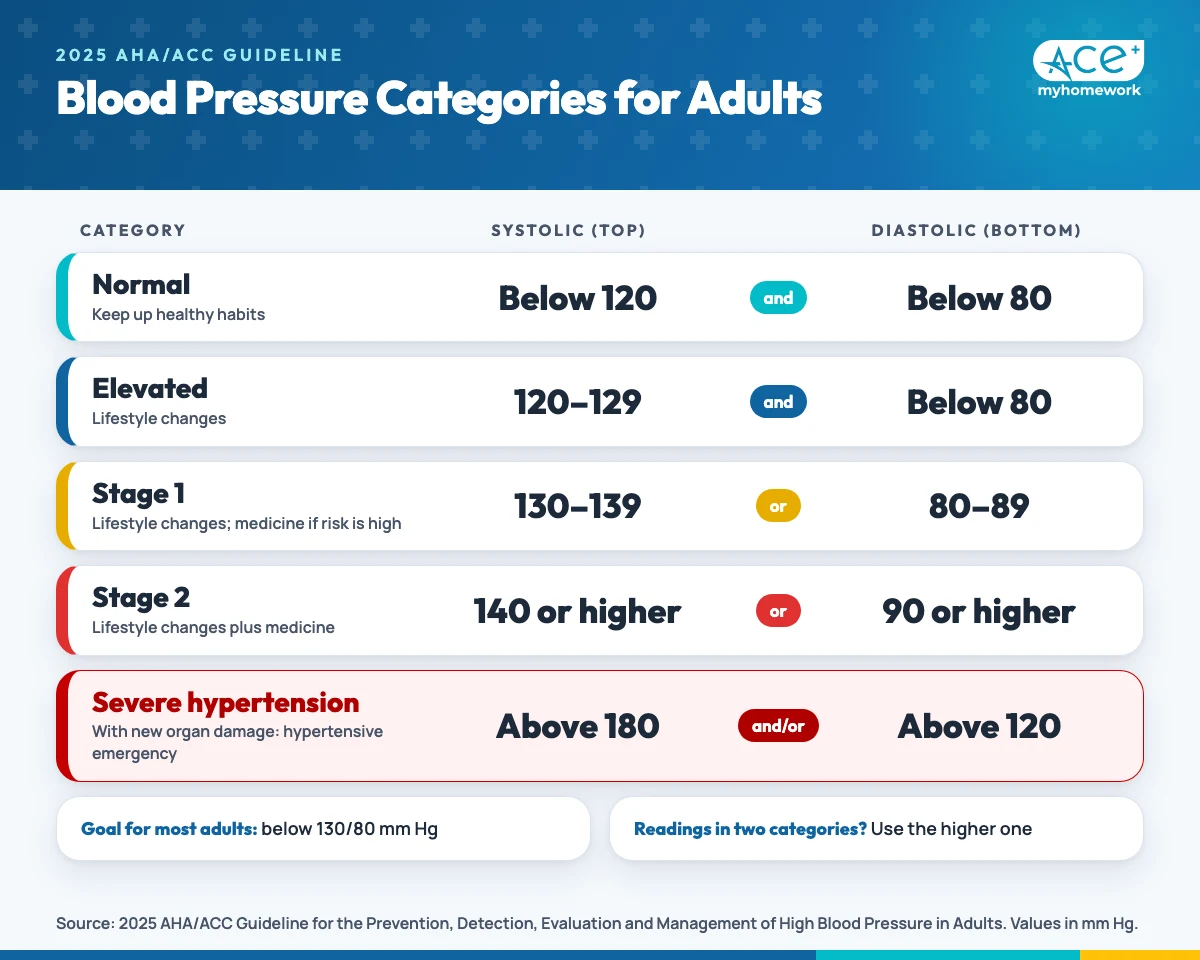
Normal: systolic below 120 mm Hg and diastolic below 80 mm Hg.
Elevated: systolic 120 to 129 and diastolic below 80.
Stage 1 hypertension: systolic 130 to 139 or diastolic 80 to 89.
Stage 2 hypertension: systolic 140 or higher or diastolic 90 or higher.
When the systolic and diastolic readings fall in different categories, the higher category applies. The guideline sets an overall treatment goal of below 130/80 mm Hg for most adults.
The terms for very high readings changed. The 2025 guideline uses severe hypertension for blood pressure above 180/120 mm Hg, replacing the older term "hypertensive urgency." Severe hypertension with signs of new or worsening damage to organs such as the heart, brain, kidneys or eyes is a hypertensive emergency. Patient handouts may still call readings above 180/120 a "hypertensive crisis," so expect to see both terms.
Adult blood pressure categories, based on the 2025 AHA/ACC high blood pressure guideline.
Nursing Assessment for Hypertension
High blood pressure usually causes no symptoms, so most of your assessment data come from measurements, history and risk factors rather than complaints. The StatPearls review of essential hypertension is a useful background read on causes and complications.
Measure Blood Pressure Correctly
A single reading taken badly is a common source of error in clinical work and in assignments. Have the patient sit with the back supported and feet flat for at least 5 minutes, use a cuff that fits the bare upper arm, support the arm at heart level, and make sure no one talks during the reading. Take at least two readings and average them. A diagnosis of hypertension is based on averaged readings on separate occasions, and the guideline supports confirming office readings with home or ambulatory monitoring.
Collect Subjective Data
Known diagnosis, how long, and current medicines, including over-the-counter drugs such as decongestants and NSAIDs that can raise blood pressure.
How the patient actually takes the medicines, missed doses, side effects and cost.
Diet, especially processed, restaurant and fast food (the main sources of sodium), alcohol intake, tobacco use and physical activity.
Sleep, stress and symptoms of sleep apnea such as loud snoring.
Family history of hypertension, heart disease, stroke or kidney disease.
Headache, vision changes, chest pain, shortness of breath or weakness, which can point to organ damage.
Collect Objective Data
Blood pressure in both arms at the first visit, heart rate and rhythm, and orthostatic readings in older adults or patients starting new medicines.
Weight, body mass index and waist circumference.
Heart sounds, peripheral pulses and edema.
Laboratory results ordered by the provider, often including electrolytes, creatinine and estimated GFR, glucose or HbA1c, lipids, urinalysis and an ECG.
If you need help documenting these findings, our head-to-toe assessment guide shows how to record a full assessment, and a SOAP note is the usual format for writing up a hypertension clinic visit.
Nursing Diagnoses for Hypertension (2024–2026 NANDA-I Labels)
Many care plan books were written for older editions, and the NANDA International 2024–2026 edition renamed or retired several labels that students used for hypertension. Before you pick a nursing diagnosis for hypertension care plan assignments, check which edition your program uses. Use the current label if it uses the current edition, and mention the older label if your textbook does.
Current label (2024–2026)
Older label you may see
When it fits
Ineffective health self-management (00276)
Same label
The patient is not managing the treatment plan well enough to control blood pressure
Inadequate health knowledge (00435)
Deficient knowledge (00126)
New diagnosis, wrong beliefs or poor home monitoring technique
Risk for impaired cardiovascular function (00311)
Risk for decreased cardiac tissue perfusion (00200)
Hypertension with other risk factors such as obesity, smoking, diabetes or inactivity
Risk for imbalanced blood pressure
Risk for unstable blood pressure (00267)
Starting or changing medicines, older adults at risk of orthostatic hypotension
Risk for ineffective cerebral tissue perfusion (00201)
Same label
Severe hypertension, or hypertension with atrial fibrillation or previous stroke
Ineffective overweight self-management (00398)
Overweight (00233)
Excess weight contributes to blood pressure and the patient is not managing it effectively
"Decreased cardiac output," a label from earlier editions, still appears in many hypertension care plans, but NANDA-I retired it in the 2024–2026 edition, describing it as outside the scope of independent nursing practice. Risk for decreased cardiac output (00240) was kept.
Is There a Nursing Diagnosis for Elevated Blood Pressure?
No label is simply called "high blood pressure." Elevated blood pressure is a medical category and a clinical finding, so in a nursing diagnosis for elevated blood pressure it usually appears as evidence ("as evidenced by an average reading of 126/78 mm Hg") or as a risk factor, not as the problem itself. For a patient in the elevated category, Risk for impaired cardiovascular function or Inadequate health knowledge usually fits better than a problem-focused label. Our guides to common nursing diagnoses and writing PES statements explain how to word each type.
Example Nursing Care Plan for High Blood Pressure
The patient below is hypothetical. A 58-year-old man is seen in a primary care clinic. Two months ago he was diagnosed with stage 2 hypertension and prescribed a single-pill combination of two antihypertensive medicines. Today his average blood pressure is 152/94 mm Hg. He says he takes the pill "most days" and does not own a home monitor. He eats takeout four or five times a week, has a body mass index of 31 and drinks three or four beers on weekend evenings. He says, "I feel fine, so I don't think it's that serious."
From these data, a high blood pressure nursing care plan could look like this:
Nursing Diagnosis
Expected Outcomes (SMART)
Nursing Interventions
Rationale
Evaluation
Ineffective health self-management related to low perceived seriousness of a symptomless condition and an unplanned medicine routine, as evidenced by missed doses and average BP 152/94 mm Hg
Within 4 weeks, the patient takes his medicine on at least 26 of 28 days, recorded in a pill organizer or phone log. Within 3 months, home BP averages trend toward the goal set by his provider.
Ask open questions about missed doses, cost, side effects and beliefs.
Link the dose to a daily habit and set up a weekly pill organizer or phone reminder.
Explain why blood pressure must be treated even without symptoms.
Refer to a pharmacist or social worker if cost is a barrier.
Arrange follow-up in 4 weeks to review his log.
Barriers must be known before they can be solved. Habit-linking and reminders support adherence. Single-pill combinations are preferred in stage 2 hypertension partly because they improve adherence.
Partially met at 4 weeks: 24 of 28 doses logged; missed doses on weekends. Plan revised to add a weekend phone alarm.
Inadequate health knowledge related to new diagnosis, as evidenced by inaccurate statements about hypertension and no experience with home BP monitoring
By the end of the visit, the patient correctly demonstrates home BP measurement and names 3 high-sodium foods he eats and 3 warning symptoms that need emergency care.
Teach measurement with a validated upper-arm monitor using his own device if possible.
Use teach-back for technique, sodium sources and warning signs.
Give a written log and the BP categories chart.
Teach him not to rely on smartwatch or other cuffless readings.
Teach-back confirms understanding rather than assuming it. Home readings guide treatment changes. The 2025 guideline advises against relying on cuffless devices until their accuracy improves.
Met: demonstrated correct technique on the second attempt and named takeout, deli meat and canned soup as sodium sources.
Risk for impaired cardiovascular function as evidenced by risk factors: stage 2 hypertension, obesity, high sodium intake and weekend alcohol use
Within 12 weeks, the patient reports at least 150 minutes of moderate activity per week, eats takeout no more than twice a week and limits alcohol as agreed with his provider.
Assess readiness to change and set one goal at a time with him.
Teach a DASH-style eating pattern and how to read sodium on food labels.
Plan walking he can build up gradually.
Discuss reducing alcohol and offer support.
Refer to a dietitian.
Weight loss, the DASH pattern, lower sodium, more potassium-rich food, activity and less alcohol all lower blood pressure. Small, chosen goals are more likely to be kept.
Ongoing: at 4 weeks, walking 20 minutes on 5 days and takeout reduced to 3 times a week.
Risk for imbalanced blood pressure as evidenced by risk factors: recent start of combination antihypertensive therapy and planned dose changes
Throughout treatment changes, the patient has no falls or fainting and reports dizziness on standing to the clinic within 24 hours.
Check orthostatic BP at each visit after a medicine change.
Teach him to rise slowly and sit if he feels lightheaded.
Teach him not to stop medicines on his own.
Review home readings for low values.
Blood pressure medicines can cause low blood pressure on standing, especially after dose increases. Stopping some agents abruptly can cause rebound hypertension.
Met: no orthostatic drop at the 4-week visit; no dizziness reported.
Notice that every outcome has a time frame and something you can measure, and that the evaluation column says whether the goal was met and what changed. For the full structure, see our guide on how to write a nursing care plan. If the patient also has diabetes, combine this plan with the priorities in our type 2 diabetes nursing diagnosis guide, since the two conditions share many risk factors.
Key Nursing Interventions for High Blood Pressure
Lifestyle Changes
The 2025 guideline strongly recommends lifestyle changes for every adult with elevated blood pressure or hypertension, whether or not they take medicine. These are a healthy weight, a heart-healthy eating pattern such as the DASH eating plan, less sodium, more dietary potassium, regular moderate activity, stress management, and reducing or stopping alcohol. The American Heart Association recommends no more than 2,300 mg of sodium a day, with an ideal limit of 1,500 mg for most adults. Potassium advice should be checked with the provider for patients with kidney disease or those taking medicines that raise potassium.
Medicines
Nurses give medicines, check their effects and teach patients about them. Common first-line classes are thiazide-type diuretics, ACE inhibitors, angiotensin receptor blockers and calcium channel blockers. According to the 2025 guideline, medicine is recommended for all adults with an average blood pressure of 140/90 mm Hg or higher, and for some adults at 130/80 or higher who have heart disease, diabetes, kidney disease or a high predicted cardiovascular risk. For stage 2 hypertension, starting two medicines of different classes in one combined pill is preferred. Nursing points to watch:
Check blood pressure and heart rate before giving a dose, and follow the hold parameters in the order.
Monitor potassium and creatinine with ACE inhibitors, angiotensin receptor blockers and diuretics.
Teach patients taking an ACE inhibitor to report a persistent dry cough and to seek emergency care for swelling of the lips, tongue or throat.
Watch for orthostatic hypotension and falls, especially in older adults.
Home Blood Pressure Monitoring
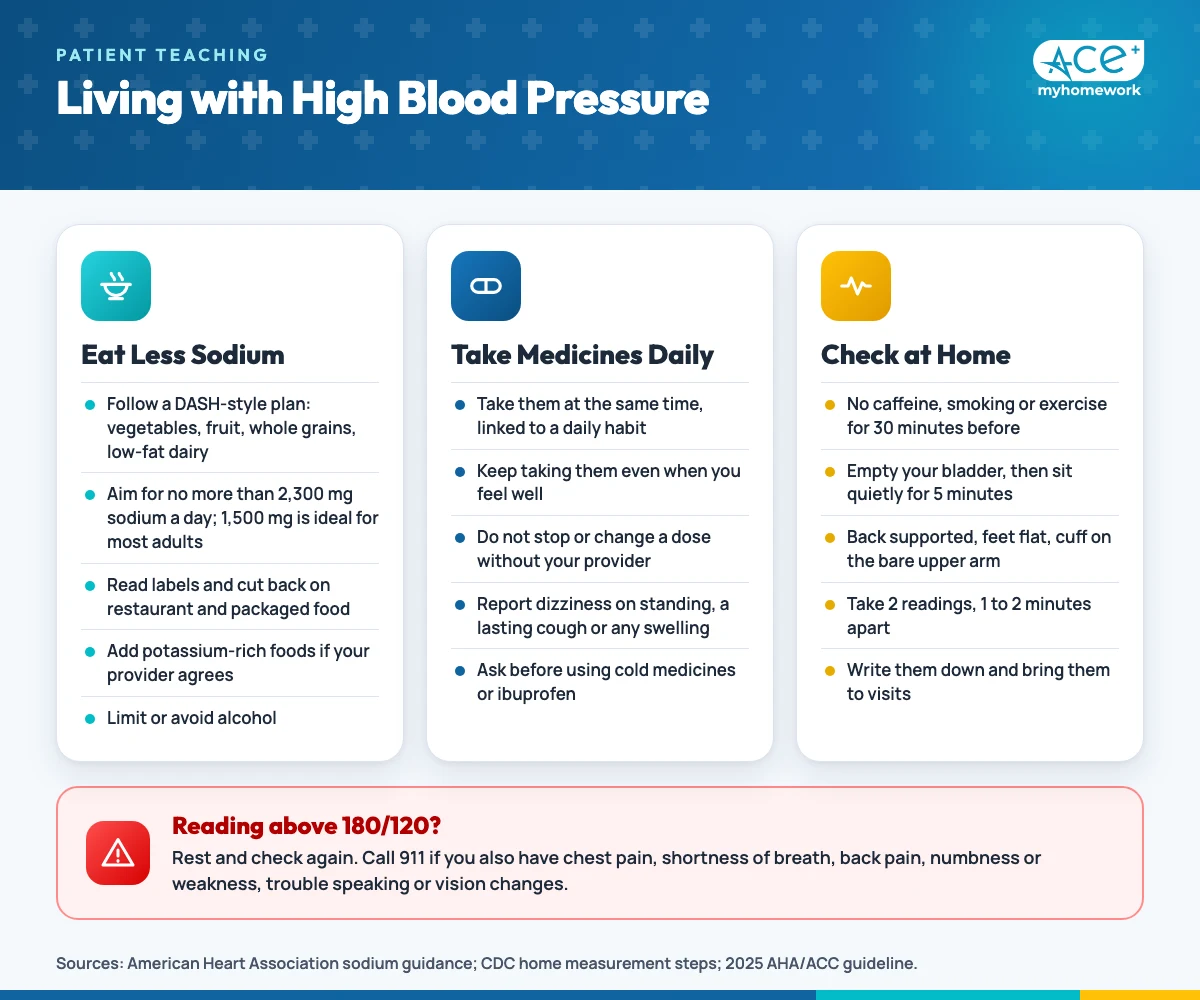
The 2025 guideline describes home monitoring, together with regular contact with the care team, as an important tool for improving control. Teach the CDC's home measurement steps: no food, caffeine, smoking, alcohol or exercise for 30 minutes beforehand, an empty bladder, five minutes of seated rest, the cuff on bare skin, and at least two readings one to two minutes apart. Encourage patients to choose a monitor from the US Validated Device Listing and to bring it to a visit so you can check their technique.
A patient-teaching summary for hypertension. Sodium limits from the American Heart Association; measurement steps from the CDC.
Red Flags: When to Escalate
Know what to do with a very high reading before you meet one in clinical practice.
Reading above 180/120 mm Hg: recheck after a few minutes of rest with the correct cuff. Assess for symptoms and report the reading to the provider promptly.
Above 180/120 with signs of organ damage: chest pain, shortness of breath, back pain, new numbness or weakness, trouble speaking, vision changes, severe headache or confusion. Treat this as a possible hypertensive emergency and call the rapid response team or emergency services according to your setting. These patients usually need intensive care monitoring and intravenous treatment.
Severe hypertension without organ damage in a hospitalized patient: the 2025 guideline advises against giving extra intermittent intravenous or oral doses just to bring the number down quickly. Report the reading and follow the provider's plan, which usually means adjusting the regular oral regimen.
Lowering blood pressure too quickly can reduce blood flow to the brain, heart and kidneys, which is why rapid "as needed" doses for a number alone are discouraged. Use SBAR to report: give the readings, the symptoms you checked for, current medicines and the last dose time.
Common Mistakes in Hypertension Care Plans
These are the problems instructors most often flag in a nursing care plan on hypertension.
Using "hypertension" as the nursing diagnosis. It is the medical diagnosis. Write the patient's response instead.
Outcomes with no number or time. "Patient will have better blood pressure" cannot be evaluated. "Home BP average below the goal set by the provider within 3 months" can.
Old category numbers. Stage 1 starts at 130/80, not 140/90.
Relying on retired labels without saying so. If your instructor accepts Decreased cardiac output, follow their rubric, but know it is not in the current edition.
Interventions that are not nursing actions. "Give medicine" is incomplete. Say what you assess before and after, and what you teach.
No rationale or a copied one. Rationales should explain why the action works for this patient, ideally with a current source.
Getting Help with a Hypertension Care Plan
Hypertension care plans come up in fundamentals, medical-surgical and community health courses, and in simulations such as the Shadow Health focused exam on hypertension. If you have drafted a plan and want feedback on your diagnoses, outcomes or rationales, our nursing homework help service offers tutoring and feedback from nursing writers. Use any outside help in line with your school's academic integrity policy.
Frequently Asked Questions
What Is the Priority Nursing Diagnosis for Hypertension?
For most stable patients, Ineffective health self-management is the priority because control depends on daily medicine use and lifestyle changes. If the reading is above 180/120 mm Hg with signs of organ damage, the priority becomes the immediate risk to the brain, heart and kidneys, and the patient needs urgent medical care.
Did the 2025 Guideline Change the Blood Pressure Categories?
No. Normal, elevated, stage 1 and stage 2 have the same numbers as in 2017. The main changes were the treatment approach, including a new risk calculator called PREVENT, the preference for single-pill combinations in stage 2, and the term "severe hypertension" for readings above 180/120 mm Hg.
Is Decreased Cardiac Output Still a Nursing Diagnosis?
Not in the NANDA-I 2024–2026 edition, which retired it. Risk for decreased cardiac output was kept. Many textbooks still use the older label, so check which edition your instructor expects.
What Should Patients with Hypertension Be Taught?
Teach what their numbers and goal mean, how to take medicines and what side effects to report, how to cut sodium and follow a DASH-style pattern, how to measure blood pressure at home correctly, and which symptoms need emergency care.
How Long Should Outcomes in a Hypertension Care Plan Take?
Knowledge and technique outcomes can be met in one visit. Adherence outcomes are often set for 2 to 4 weeks, and blood pressure outcomes usually need weeks to months, because medicines and lifestyle changes take time to work.
Can Nurses Diagnose Hypertension?
Registered nurses do not make the medical diagnosis, but they often take the readings that lead to it, and they diagnose and treat the patient's responses. Nurse practitioners can diagnose and treat hypertension within their scope of practice.
Get affordable and top-notch help for your essays and homework services from our expert tutors. Ace
your homework, boost your grades, and shine in online classes—all with just a click away!
A common nursing diagnosis list using NANDA-I 2024–2026 labels, grouped by domain, with plain-language meanings, examples and the latest label changes.