A head to toe assessment is a systematic physical assessment that a nurse performs by moving through the body from the head downward, checking each system in a set order so nothing is missed. It usually starts with a general survey and vital signs, then covers the neurological, head and neck, cardiovascular, respiratory, abdominal, genitourinary, musculoskeletal and skin findings. Nurses do it on admission and at the start of a shift to establish a baseline and spot changes early.
This guide gives you the assessment order, a system-by-system checklist with normal findings, the inspection, palpation, percussion and auscultation sequence (including the abdomen exception), and examples of how to document normal and abnormal findings.
What Is a Nursing Head-to-Toe Assessment?
A nursing head-to-toe assessment is a screening exam of every body system. It is broader than a focused assessment and shorter than a comprehensive health assessment.
Type
What It Covers
When It's Used
Comprehensive health assessment
Full health history plus a detailed physical exam of all systems
New admissions, primary care visits, advanced practice courses
Head-to-toe assessment
A systematic screening of all body systems
Start of each shift, admission to a unit, after a transfer
Focused assessment
One system or one problem in depth
A new symptom, an abnormal finding, follow-up after an intervention
The free Open RN Nursing Skills textbook frames its head-to-toe assessment checklist as the routine daily assessment an entry-level nurse performs on an inpatient, and it stresses two rules that apply everywhere: adapt your technique to the patient's age and condition, and follow any abnormal finding with a focused assessment.
Head-to-Toe Assessment Order
Programs and facilities order the body systems slightly differently, so follow the sequence your instructor or agency uses. Most versions share the same logic: safety and life threats first, then a general picture, then each body system from the head down.
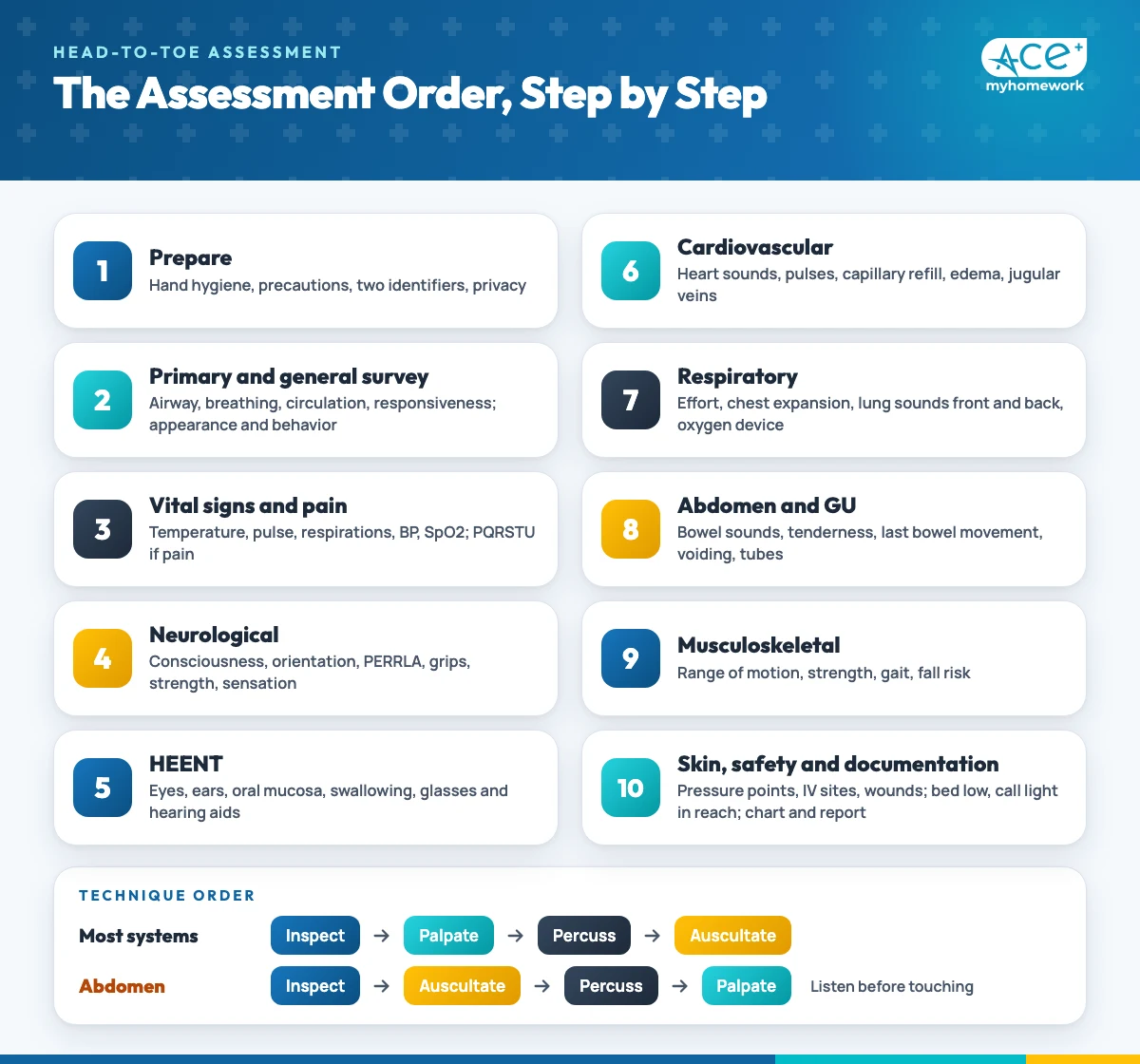
A common head-to-toe assessment order. Adapted from the Open RN Nursing Skills head-to-toe checklist.
Prepare. Gather a stethoscope, penlight, watch with a second hand and gloves. Perform hand hygiene, check for transmission-based precautions, introduce yourself and confirm the patient's identity with two identifiers.
Primary survey and general survey. Check airway, breathing, circulation and responsiveness first and call for help if any are compromised. Then note appearance, behavior, mobility, speech and nutritional status.
Vital signs and pain. Measure vital signs and assess pain, using a structured approach such as PQRSTU (provocation or palliation, quality, region or radiation, severity, timing or treatment, and understanding) if pain is present.
Neurological. Level of consciousness, orientation, pupils, grip and limb strength, sensation and speech.
Head, eyes, ears, nose and throat (HEENT). Inspect the eyes, ears and mouth; check swallowing.
Respiratory. Breathing pattern and effort, chest expansion and lung sounds, anterior and posterior.
Abdomen and genitourinary. Inspect, auscultate, then palpate; ask about bowel and bladder function; check any tubes, drains or catheters.
Musculoskeletal and extremities. Range of motion, strength, gait and fall risk.
Skin, safety and documentation. Inspect pressure points, IV sites and wounds, leave the bed and call light safe, then document and report.
Skin is often listed last, but in practice you inspect it as you go: color and moisture of the face during the general survey, the hands during the neurological check, and the sacrum and heels when you turn the patient to listen to the back of the lungs.
Inspection, Palpation, Percussion and Auscultation
Each body system is examined with up to four techniques. For most systems they are used in this order, moving from the least invasive to the most.
Order
Technique
What You Do
Example
1
Inspection
Look (and listen and smell) before touching; compare left and right
Feel with the fingers or hands, light pressure before deep
Pulses, skin temperature, edema, tenderness
3
Percussion
Tap the body surface to judge the density of underlying tissue
Lung fields, abdominal organs (more common in advanced practice exams)
4
Auscultation
Listen with a stethoscope, diaphragm for high-pitched sounds and bell for low-pitched sounds
Heart sounds, breath sounds
The Abdomen Exception
The abdomen is examined in a different order: inspection, auscultation, percussion, then palpation. The StatPearls chapter on the abdominal examination describes this sequence. The reason usually given is that pressing on or tapping the abdomen can change bowel sounds, so you listen before you touch. Palpate any area the patient reports as painful last, and stop and report rather than palpating deeply if you find a pulsating mass.
Many RN programs teach a shortened abdominal check for routine shift assessment: inspect, auscultate all four quadrants, then palpate lightly. Percussion and deep palpation are covered in more detail in advanced health assessment courses.
Head-to-Toe Assessment Checklist with Normal Findings
Use this head to toe assessment checklist as a study aid. "Expected" findings describe a typical healthy adult; always compare with the patient's own baseline and the reference ranges your facility uses.
System
What to Assess
Expected (Normal) Findings
General survey
Appearance, hygiene, behavior, mobility, speech, nutritional status
Alert, no acute distress, appropriately dressed and groomed, clear speech, moves all extremities
Adult pulse 60 to 100 and regular; respirations 12 to 20 and unlabored; BP below 120/80 mm Hg is normal; SpO2 at the patient's baseline or ordered target
Neurological
Level of consciousness, orientation, pupils, grips, strength, sensation
Alert and oriented to person, place and time; pupils equal, round and reactive to light and accommodation (PERRLA); strong, equal grips; sensation intact
No drainage from eyes or ears; oral mucosa pink and moist; swallows saliva without difficulty
Cardiovascular
Heart sounds at all five areas, pulses, capillary refill, edema, jugular veins
S1 and S2 present, regular rhythm, no extra sounds; peripheral pulses present and equal; capillary refill less than 3 seconds; no edema; no jugular vein distension with the head of the bed at 30 to 45 degrees
Even, unlabored breathing; symmetrical chest expansion; trachea midline; lungs clear to auscultation bilaterally with no crackles, wheezes or rhonchi
Abdomen and GI
Contour, bowel sounds, tenderness, appetite, nausea, last bowel movement, tubes
Soft, nondistended, nontender; bowel sounds present in all four quadrants; tolerating diet; regular bowel pattern for the patient
Genitourinary
Voiding pattern, urine color and amount, pain, catheter
Voids without pain or difficulty; clear yellow urine; catheter (if present) draining, with continued need documented
Musculoskeletal
Range of motion, strength, gait, assistive devices, fall risk
Full range of motion; equal strength bilaterally; steady gait; fall risk score per agency tool
Integumentary
Color, temperature, moisture, turgor, pressure points, IV sites, wounds
Expected color for the patient's skin tone; warm, dry and intact; no tenting; no pressure injury; IV site without redness, swelling or tenderness
Psychosocial
Mood, affect, coping, support
Calm and cooperative; mood and affect appropriate to the situation
The vital sign ranges above come from the Open RN normal ranges for vital signs and the 2025 AHA/ACC high blood pressure guideline, which keeps "normal" blood pressure at below 120/80 mm Hg. Children have different normal ranges by age, and many patients have ordered targets, for example a lower oxygen saturation target in some people with chronic lung disease.
Body System Tips and Red Flags
Neurological
Ask about headache, dizziness, numbness or weakness before you start. If your unit uses the Glasgow Coma Scale, the StatPearls Glasgow Coma Scale chapter explains how eye, verbal and motor responses are scored, with totals from 3 to 15. A new asymmetry in the face, arm strength or speech is an emergency; Open RN's checklist tells students to get emergency help, which in most hospitals means activating the stroke or rapid response team.
Cardiovascular and Respiratory
Listen in a pattern and compare sides. For lungs, move from top to bottom, side to side, front and back, and listen through a full breath at each spot. Note any oxygen device and flow rate. Report new crackles, wheezing, stridor, an irregular rhythm you had not heard before, chest pain or a drop in saturation, and follow your agency's escalation criteria.
Abdomen and Genitourinary
Ask about nausea, appetite, the date of the last bowel movement and any changes in urination before you examine. Review intake and output and weight trends when they are ordered. A rigid, distended or very tender abdomen, vomiting blood, or no urine output despite fluids are findings to report promptly.
Skin and Safety
Check the pressure points: back of the head, ears, elbows, sacrum and heels. Grade edema with the scale your agency uses and record pitting depth. Finish by leaving the bed low and locked, the call light within reach and the room free of trip hazards.
Head-to-Toe Assessment Documentation
Documentation is where many students lose points. Good assessment notes are objective, specific and measurable, so the next nurse can tell whether something has changed.
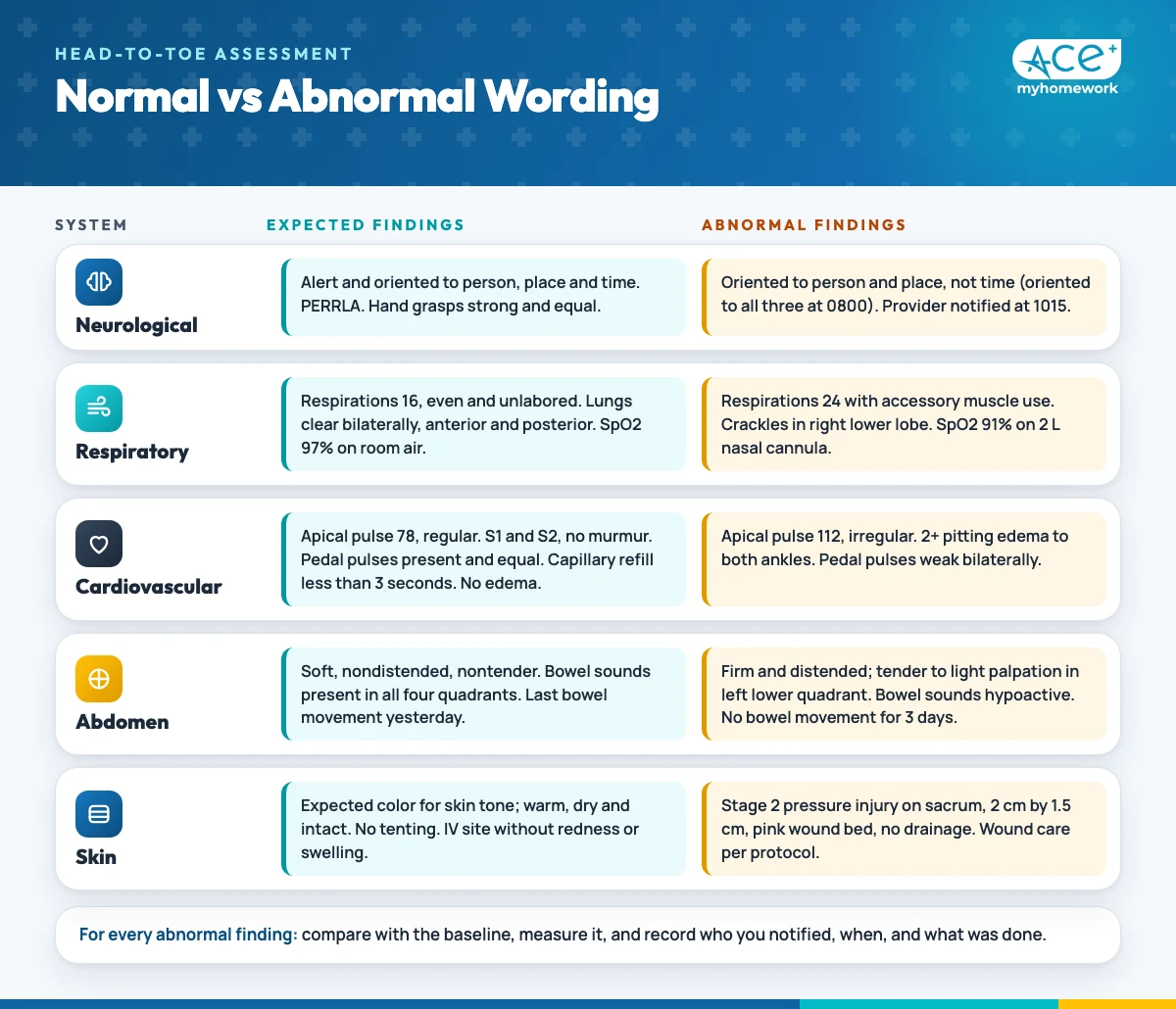
Describe what you found. "Lungs clear bilaterally" is better than "lungs normal." Avoid "WNL" (within normal limits) unless your facility defines it.
Measure. Give sizes, scores, volumes and locations, such as "2+ pitting edema to both ankles" or "stage 2 pressure injury, sacrum, 2 cm by 1.5 cm."
Compare with baseline. "Oriented to person only; oriented to person, place and time at 0800" shows a change.
Record your actions. For an abnormal finding, note who you notified, when, and what was done.
Avoid judgment words. Write what the patient said or did, not labels like "uncooperative."
Follow your agency's format. Many hospitals use flowsheets and charting by exception, where you document only findings that differ from defined normal criteria. Know your facility's criteria before you rely on it.
Normal vs abnormal wording for five systems. Example wording adapted from Open RN sample documentation.
Head to Toe Assessment Documentation Example: Expected Findings
This example is for a hypothetical 58-year-old patient on a medical unit on the second day after admission for cellulitis of the right lower leg. The wording for skin follows Open RN's sample integumentary documentation.
0800. Alert, calm and cooperative, in no acute distress. T 36.9 °C oral, P 76 regular, R 16 unlabored, BP 124/78, SpO2 97% on room air. Denies pain at rest; reports 2/10 aching in right lower leg with walking. Oriented to person, place and time. PERRLA. Hand grasps strong and equal; moves all extremities. Oral mucosa pink and moist; swallows without difficulty. S1 and S2 regular, no murmur. Radial and pedal pulses present and equal bilaterally. Capillary refill less than 3 seconds in all extremities. Lungs clear to auscultation anteriorly and posteriorly. Abdomen soft, nondistended, nontender; bowel sounds present in all four quadrants. Last bowel movement yesterday. Voiding clear yellow urine without difficulty. Steady gait without assistive device. Skin expected color for ethnicity, warm and dry. Right lower leg erythema within marked border, decreased from yesterday, no drainage. No tenting. IV site left forearm without redness or swelling, infusing as ordered. Bed low and locked, call light in reach.
Documentation Example: Abnormal Findings
Here is the same patient later in the day after a change in condition.
1430. Patient reports feeling "shaky and cold." T 38.8 °C oral, P 108 regular, R 22, BP 102/64 (124/78 at 0800), SpO2 95% on room air. Alert and oriented to person, place and time. Skin warm and flushed. Right lower leg erythema now extends 3 cm beyond the marked border on the medial calf; area warm and tender to light touch; no drainage. Lungs clear bilaterally. Urine output 150 mL since 0800. Dr. Rivera notified at 1440 of fever, tachycardia, lower blood pressure and spreading erythema; orders received and read back for blood cultures and a lactate. Will reassess vital signs in 30 minutes.
Notice what the second note does: it gives the earlier blood pressure for comparison, measures the change in redness, records who was told and when, and states the plan for reassessment. If your course asks you to write findings as a structured note, our SOAP note example shows how to separate subjective and objective data. To report a change like this by phone, use the scripts in our guide to SBAR examples for nurses.
Adapting the Assessment for Different Patients
Children. Use age-specific vital sign ranges. With infants and toddlers, count respirations and listen to the heart and lungs while the child is calm, and leave more upsetting steps, such as the ears and mouth, for last.
Older adults. Establish baseline cognition and mobility early, ask about falls, and check pressure points carefully. Skin turgor on the back of the hand is less reliable as skin loses elasticity with age.
Patients with darker skin tones. Look for pallor, cyanosis and erythema in the oral mucosa, conjunctivae, nail beds and palms, and use palpation for warmth and texture when redness is hard to see.
Patients in distress. Stabilize first. Airway, breathing and circulation come before a full assessment, which can wait until the patient is safe.
Common Head-to-Toe Assessment Mistakes
Skipping the primary survey and going straight to the checklist
Listening to lung sounds through clothing or only on the front of the chest
Palpating the abdomen before auscultating it
Documenting from memory at the end of the shift instead of right after the assessment
Copying the previous shift's findings forward without reassessing
Recording an abnormal finding without the follow-up action or the person notified
Forgetting tubes, drains, IV sites and oxygen devices, which are part of the assessment
Practicing Before Clinicals and Simulations
Practice the full sequence on a classmate or family member until the order is automatic, saying each step out loud. Then practice writing the note from memory and compare it with a checklist. Virtual simulations such as Shadow Health test the same skills; if you are working through one, our Shadow Health assessment help page explains how we support those assignments. Your assessment data also feeds directly into care planning, which our guide on how to write a nursing care plan covers step by step.
Getting Help with Assessment Assignments
Head-to-toe check-offs, documentation assignments and health assessment write-ups can be hard to self-check. If you want feedback on whether your documentation is specific enough or your findings are organized correctly, our nursing homework help service offers tutoring and draft review. Use any outside help in line with your school's academic integrity policy.
Frequently Asked Questions
What Is the Correct Order for a Head-to-Toe Assessment?
A common order is preparation and safety checks, general survey, vital signs and pain, neurological, HEENT, cardiovascular, respiratory, abdomen and genitourinary, musculoskeletal, and skin, followed by documentation. Follow the order your program or facility teaches.
Why Is the Abdomen Assessed in a Different Order?
For the abdomen, you inspect, auscultate, percuss and then palpate. Listening before touching avoids changing bowel sounds with pressure, and it leaves any painful area until the end.
How Often Do Nurses Do a Head-to-Toe Assessment?
Typically on admission and at least once per shift, with focused reassessments after any change in condition or intervention. Your facility's policy and the patient's acuity set the exact frequency.
What Is the Difference Between a Head-to-Toe and a Focused Assessment?
A head-to-toe assessment screens every body system. A focused assessment looks in depth at one system or problem, such as the lungs of a patient who has become short of breath.
Should I Write "WNL" in My Documentation?
Only if your facility defines it. Specific wording, such as "lungs clear bilaterally" or "capillary refill less than 3 seconds," is clearer and is what most instructors expect.
Do Nursing Students Need to Percuss During a Head-to-Toe Assessment?
Many RN programs focus on inspection, palpation and auscultation for routine shift assessments. Percussion is taught more fully in advanced health assessment courses, so check what your program requires for check-offs.
Get affordable and top-notch help for your essays and homework services from our expert tutors. Ace
your homework, boost your grades, and shine in online classes—all with just a click away!
Now that you have seen how writing a personal statement for nursing is made, At Acemyhomework we strive to deliver top-notch academic essays with our professional writers.
Explore 120 nursing research topics by specialty, from med-surg to informatics, plus how to narrow a topic, write a PICOT question and plan for IRB review.