Nursing SBAR is a four-part script for reporting a patient's condition: Situation, Background, Assessment and Recommendation. You state the problem in one sentence, give only the history that explains it, say what you think is happening, and ask for a specific action within a specific time. The structure works for phone calls to a provider, shift handoffs and written messages, and it keeps the listener focused on what you need.
This guide gives five worked SBAR examples for nurses, a weak vs strong comparison and a free printable SBAR template. Every patient below is hypothetical.
What Is SBAR in Nursing?
SBAR was developed by Michael Leonard, Doug Bonacum and Suzanne Graham at Kaiser Permanente of Colorado, and the Institute for Healthcare Improvement's SBAR tool describes it as a framework for conversations about a patient's condition, especially ones that need a clinician's immediate attention. In their paper on teamwork and communication in safe care, Leonard and colleagues argued that clinicians need standardized communication tools and shared "critical language" so that a concern gets heard regardless of who is speaking or who is listening.
SBAR is also one of the core communication tools in AHRQ's TeamSTEPPS program, which presents SBAR as a structured way to share information about a patient's condition, particularly when a patient is deteriorating. The evidence is encouraging but not definitive: a 2018 systematic review in BMJ Open found moderate evidence that SBAR improves patient safety, especially when it is used to structure phone calls, and noted a lack of high-quality studies.
For a one-screen overview, see the SBAR section of our Nursing Study Hub. This guide goes further, with scripts for different settings.
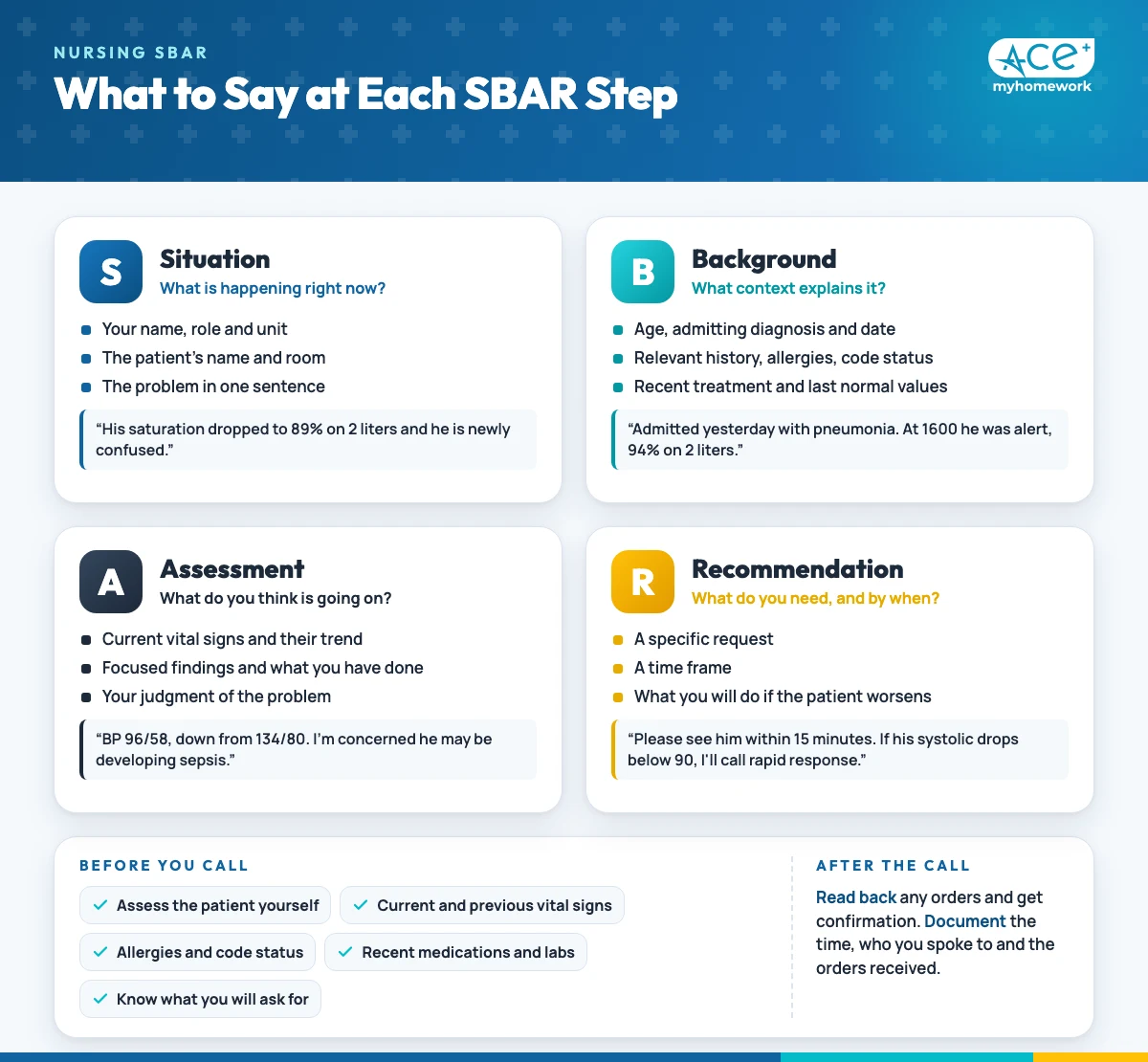
SBAR Communication: What to Say at Each Step
Aim for two or three sentences per step.
What to say at each step of SBAR. Adapted from the IHI SBAR tool and AHRQ TeamSTEPPS.
Step
Question It Answers
What to Include
Common Mistake
Situation
What is happening right now?
Your name, role and unit; the patient's name and room; the problem in one sentence, with the key abnormal finding
Starting with the patient's history instead of the problem
Background
What context explains it?
Age, admitting diagnosis and date, relevant history, recent treatments or medications, code status and allergies when they matter, the last normal values
Reading out the whole chart
Assessment
What do you think is going on?
Current vital signs and their trend, focused findings, what you have already done, and your judgment of the problem
Listing numbers without saying what concerns you
Recommendation
What do you need, and by when?
A specific request (see the patient, orders, transfer), a time frame, and what you will do if the patient gets worse
Ending with "What do you want to do?"
Before You Make the Call
A good SBAR is prepared, not improvised. IHI's tool includes a worksheet that works as a script to fill in before you contact a provider. In practice, preparing means you have:
Seen and assessed the patient yourself within the last few minutes
A full, current set of vital signs and the previous set to compare
The admitting diagnosis, relevant history, allergies and code status
Recent medications and the latest relevant results, with the times they were given or taken
A clear idea of what you are going to ask for
Keep the chart open during the call, because the provider will often ask for something you did not plan to say.
SBAR Examples for Nurses in Five Settings
Each SBAR nursing example shows the full script, followed by what makes it effective. Names, ages and values are invented for teaching. Real reports follow your facility's escalation policy and the provider's orders.
Example 1: Deterioration on a Medical-Surgical Unit
Situation: "Dr. Patel, this is Jordan, the RN on 4 West, calling about Robert Hayes in room 412. His oxygen saturation dropped to 89% on 2 liters, his respiratory rate is 28, and he is newly confused."
Background: "He is 72 and was admitted yesterday with community-acquired pneumonia. He is on IV antibiotics; the last dose was at 1400. He has type 2 diabetes and hypertension, he is full code, and he has no known drug allergies. At 1600 he was alert and oriented, with a saturation of 94% on 2 liters and a respiratory rate of 20."
Assessment: "His temperature is now 38.9, heart rate 116 and blood pressure 96/58, down from 134/80 this morning. He has crackles in both bases, worse on the right, and he is oriented to person only. His urine output was 60 mL over the last four hours. I increased his oxygen to 4 liters under the unit oxygen protocol and his saturation is now 92%. I'm concerned that he is getting worse and may be developing sepsis."
Recommendation: "I need you to see him within 15 minutes. Would you like blood cultures, a lactate and a chest x-ray? If his saturation falls below 90% on 4 liters or his systolic pressure drops below 90 before you arrive, I will call the rapid response team."
Why it works: the Situation gives the three key findings at once, the Background includes the last normal values so the trend is clear, the Assessment states a concern instead of leaving the provider to infer it, and the Recommendation has a time frame and a contingency plan. Asking about a lactate fits the Surviving Sepsis Campaign 2021 guidelines, which suggest measuring blood lactate in adults with suspected sepsis.
Example 2: Nurse-to-Nurse Shift Handoff
In a handoff, the Recommendation becomes a to-do list for the next nurse. The Joint Commission's Sentinel Event Alert on inadequate hand-off communication recommends standardized content, face-to-face handoffs where possible and time for questions. Its minimum content list (illness severity, summary, to-do list, contingency plans, allergies, code status, medications, dated labs and vital signs) is covered in this bedside handoff.
Situation: "This is Mrs. Ellen Greene in bed 7. She's 81 and on post-op day 1 after surgical repair of a left hip fracture. She is stable; tonight's priorities are pain, voiding after catheter removal and fall prevention."
Background: "She was admitted after a fall at home. She has atrial fibrillation and mild dementia and became confused last night. She is allergic to penicillin, which causes a rash. She is full code. Her daughter is the contact person and usually visits after work."
Assessment: "Vital signs at 1800 were BP 128/72, heart rate 84 and irregular, which is her baseline, respiratory rate 16, SpO2 95% on room air and temperature 37.2. Her pain is 4 out of 10; her oral analgesic was given at 1630 and the next dose is due at 2030. Dressing dry and intact; left foot warm with a palpable pulse. The urinary catheter came out at 1400 and she hasn't voided yet. This morning's hemoglobin was 9.8, down from 11.2 before surgery; the surgical team knows and has ordered a repeat at 0400. She is oriented now and uses the call light."
Recommendation: "If she hasn't voided by 2000, do a bladder scan under the post-op protocol. Check the 0400 hemoglobin and call the surgical resident if it has dropped further. Keep the bed alarm on and reorient her often overnight. What questions do you have?"
The receiving nurse then summarizes the key points back: "Void by 2000 or bladder scan, follow up the 0400 hemoglobin, watch for confusion overnight, bed alarm on." That summary is the receiver's synthesis step in I-PASS, and it catches misunderstandings before the first nurse leaves.
Example 3: Calling a Provider About a Critical Lab Value
A lab value alone is not enough. The provider needs the trend, the likely cause and the patient's current condition.
Situation: "Dr. Kim, this is Alex, the RN on the medical unit, calling about Harold Brooks in room 220. His potassium this morning is 6.1, and the lab called it through as a critical result."
Background: "He is 66 and was admitted two days ago with a heart failure exacerbation. He has stage 4 chronic kidney disease. His medications include lisinopril and spironolactone, last given yesterday at 0900, with today's doses due at 0900. Yesterday his potassium was 5.2 and his creatinine was 2.9. Today's creatinine is 3.4."
Assessment: "He is alert and denies palpitations or weakness. His heart rate is 62 and regular on the monitor, BP 118/70. The lab confirmed the sample was not hemolyzed. I'm concerned about worsening hyperkalemia related to his kidney function and these two medications."
Recommendation: "Would you like a 12-lead ECG now, and should I hold this morning's lisinopril and spironolactone? Do you want the potassium repeated, and are there any treatment orders? I'll read back whatever you order."
Why it works: the nurse links the value to its likely causes, rules out a common source of a falsely high potassium (a hemolyzed sample), and asks questions the provider can answer with yes or no. Critical-value limits and reporting time frames vary by facility, so check your policy.
Example 4: Mental Health Concern on an Inpatient Unit
In psychiatric settings the Assessment rests mostly on what the patient says and does and on structured screening. Be direct about risk.
Situation: "Dr. Owens, this is Priya, the RN on the adult inpatient psychiatric unit, calling about Dana Morris in room 9. About 20 minutes ago she told me she has a plan to end her life. I've started one-to-one observation under our policy and a staff member is with her now."
Background: "She is 34 and was admitted three days ago with major depressive disorder and suicidal thoughts. Since admission she had denied current suicidal thoughts. This afternoon she had a distressing phone call with her partner. No known allergies."
Assessment: "On our validated suicide screening tool she screens as high risk. She describes a specific plan, she is tearful and withdrawn, and she gave away her journal to another patient today. A second staff member and I checked her room and removed a belt and a charging cable. I believe she is at high risk right now."
Recommendation: "I'm asking you to evaluate her in person within the hour. Please confirm that you want one-to-one observation continued until you see her, and let me know if you want any other orders."
Why it works: the nurse leads with the safety action already taken, names the screening result instead of saying "she seems down," lists the behaviors that raised concern, and asks for an in-person evaluation within a stated time. Many units use a validated screener such as the Columbia Suicide Severity Rating Scale (C-SSRS); follow your facility's tool and observation policy.
Example 5: Pediatric Patient with Increased Work of Breathing
Pediatric reports need age-appropriate norms, the child's weight and the parent's observations.
Situation: "Dr. Shah, this is Morgan, the RN on pediatrics, calling about Leo Martin, 14 months old, in room 5. Over the last hour his breathing has become more labored and his oxygen saturation is 89% on room air."
Background: "He was admitted this morning with RSV bronchiolitis. He was born at term, has no other medical history and no known allergies, and weighs 10 kg. On admission his respiratory rate was 44 and his saturation was 94% on room air, and he was managed with nasal suctioning before feeds."
Assessment: "His respiratory rate is now 64, heart rate 168 and temperature 38.2. He has subcostal and intercostal retractions and nasal flaring, and he is taking about half of his usual bottle. He's had two wet diapers since 0700. I suctioned his nose 15 minutes ago with little change. His pediatric early warning score has gone from 2 to 5, and his mother says he is 'not himself.' I'm concerned that his breathing is getting worse and that he is at risk of dehydration."
Recommendation: "Please come and assess him now. Would you like to start supplemental oxygen, and IV or nasogastric fluids? If his saturation keeps dropping or he starts grunting or tiring, I will call the rapid response team."
Why it works: the nurse compares current findings with the admission baseline, includes intake and output, and reports the parent's concern. The requests match the American Academy of Pediatrics bronchiolitis guideline, which covers children aged 1 to 23 months. It allows clinicians to withhold supplemental oxygen when saturation stays above 90%, and it recommends nasogastric or IV fluids for infants who cannot stay hydrated by mouth.
Weak vs Strong Nursing SBAR: A Side-by-Side Comparison
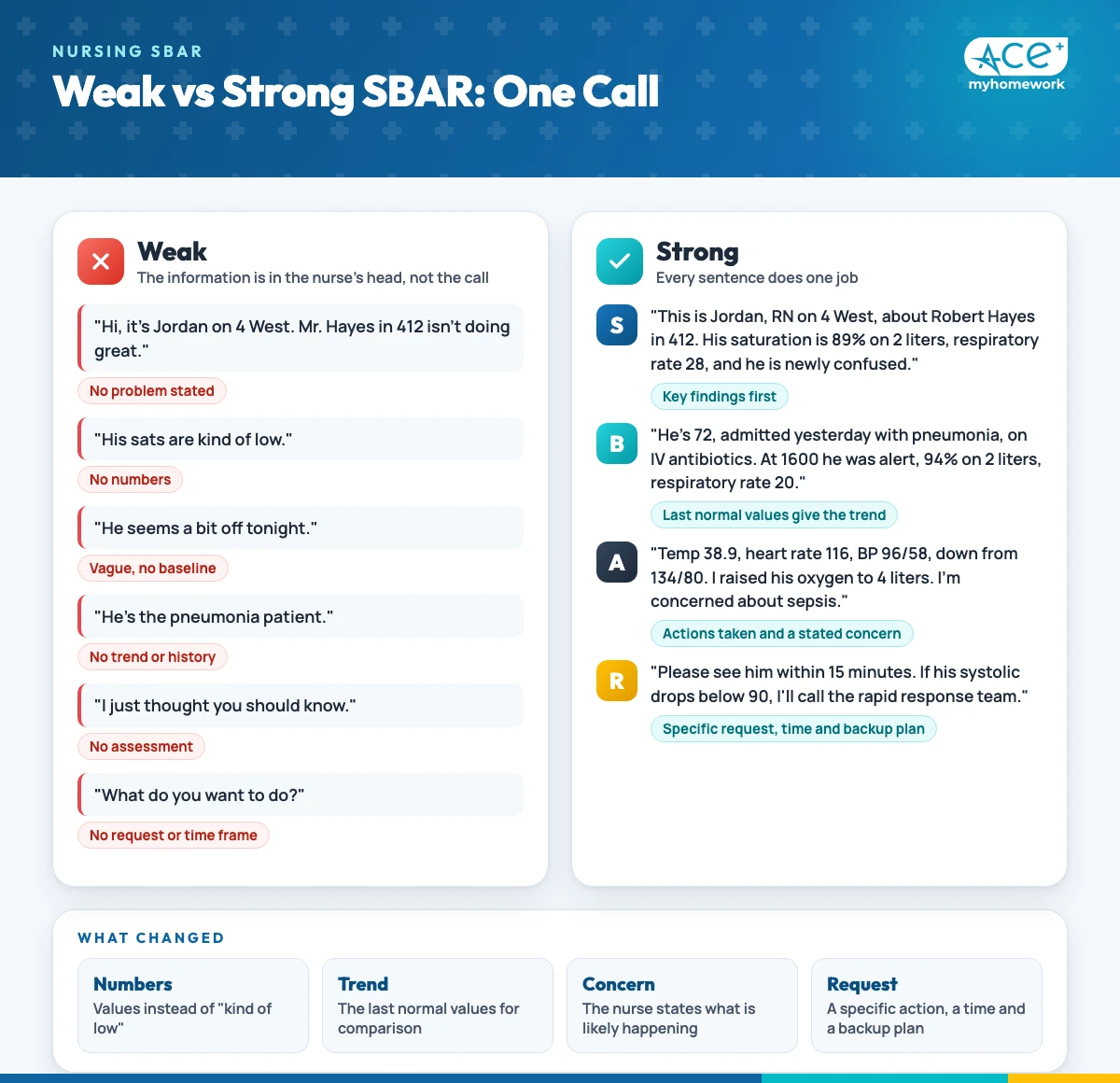
Most weak SBAR reports have the right information somewhere in the nurse's head but not in the call. Here is the same situation from Example 1, first as it is often said and then rewritten.
The same call, weak and strong. The strong version adds numbers, a trend, a stated concern and a timed request.
Weak Version
Problem
Fix
"He isn't doing great."
No problem stated
Lead with the key abnormal finding
"His sats are kind of low."
No numbers
Give the value, oxygen delivery and the earlier value
"He seems a bit off."
Vague mental status
Describe it: "oriented to person only, alert and oriented at 1600"
No assessment
The listener has to guess your concern
Say what you think is happening, even if you are unsure
"What do you want to do?"
No request, no time frame
Ask for a specific action by a specific time, and give a contingency plan
Students often skip the Assessment for fear of being wrong. You are reporting clinical judgment, not making a medical diagnosis, and "I'm not sure what's going on, but I'm worried about his breathing" still tells the provider how urgent the problem is.
Closing the Loop: Check-Back, Escalation and Documentation
Three habits make sure the call leads to action.
Check-back. TeamSTEPPS teaches check-back as closed-loop communication: the receiver repeats the information, and the sender confirms it or corrects it. When you take telephone or verbal orders, read them back and get confirmation, as your facility's policy requires.
Escalation. If the response does not match the risk, say so clearly. TeamSTEPPS uses the CUS words ("I am Concerned, I am Uncomfortable, this is a Safety issue") and the two-challenge rule, where you voice a concern at least twice and then move up the chain of command if it is still not addressed. Rapid response criteria let you call for help without waiting for permission.
Documentation. Record the time, who you spoke to, what you reported, the orders received and read back, and the patient's response. Our SOAP note example shows how a structured written note differs from a verbal report.
SBAR Variations: ISBAR, ISBARR and I-PASS
Many schools and hospitals use expanded versions of SBAR.
Tool
What the Letters Mean
Typical Use
SBAR
Situation, Background, Assessment, Recommendation
Calls to a provider, urgent concerns, written messages
ISBAR
Adds Identify (yourself, your role, the patient) at the start
Phone calls, where the listener cannot see who is speaking
ISBARR or SBAR-R
Adds Read-back (or Response) at the end
Calls where orders are given, to confirm them before acting
I-PASS
Illness severity, Patient summary, Action list, Situation awareness and contingency planning, Synthesis by receiver
Shift and service handoffs; it is the tool the Joint Commission alert highlights
Free SBAR Template (Printable PDF)
The free printable SBAR template is a one-page worksheet you can fill in before a call or use in clinical simulation. It includes:
A before-you-call checklist (vital signs, allergies, code status, recent medications and labs)
A prompted box for each SBAR step
A read-back section for orders received, with the provider's name and the time
An escalation line for what you will do if the patient deteriorates or you get no response
Do not write real patient identifiers on a copy you take off the unit.
How SBAR Fits with Care Plans and Nursing Diagnoses
SBAR assignments often sit alongside care plans, but the language differs. A care plan uses a nursing diagnosis label and related factors, as our guides on how to write a nursing care plan and nursing diagnosis examples explain. In an SBAR call you describe the problem in plain clinical terms, such as "I'm concerned about possible sepsis," using the same assessment data.
Getting Help with SBAR Assignments
SBAR shows up in simulation labs, clinical paperwork and papers on handoff quality. If you want feedback on an SBAR script, a written SBAR report or the reasoning in your Assessment, our nursing homework help service offers tutoring and draft review from people who know nursing coursework. Use any outside help in line with your school's academic integrity policy.
Frequently Asked Questions
What Is an Example of SBAR in Nursing?
"This is Jordan, RN on 4 West, calling about Robert Hayes in 412. His saturation dropped to 89% on 2 liters and he's newly confused. He's 72 with pneumonia. His heart rate is 116 and his pressure is 96/58, down from 134/80. I'm concerned about sepsis. Please see him within 15 minutes." Each part maps to one SBAR step.
What Should Be Included in the Recommendation?
A specific request (assess the patient, give orders, transfer), a time frame, and what you will do if the patient gets worse before help arrives. Avoid ending with "What do you want to do?"
Is SBAR Used for Shift Handoff?
Yes. Many units use SBAR or a variation for nurse-to-nurse handoff, with the Recommendation written as a to-do list. Some hospitals use I-PASS instead, which adds a summary by the receiving nurse.
What Is the Difference Between SBAR and ISBAR?
ISBAR adds "Identify" at the start, where you state your name, role and unit and confirm the patient's identity. ISBARR also adds "Read-back" at the end to confirm orders.
What Is the Difference Between SBAR and SOAP?
SBAR is a structure for communicating with another clinician, usually verbally and often about an urgent change. SOAP (Subjective, Objective, Assessment, Plan) is a structure for documenting a patient encounter in the record.
Get affordable and top-notch help for your essays and homework services from our expert tutors. Ace
your homework, boost your grades, and shine in online classes—all with just a click away!
Learn the definition of evidence-based practice in nursing, the 7 steps of EBP, levels of evidence, EBP models and real examples such as CLABSI bundles.
A SOAP note example for nursing students: two fully worked notes (RN and NP), a copy-ready template table and fixes for the charting mistakes that cost points.