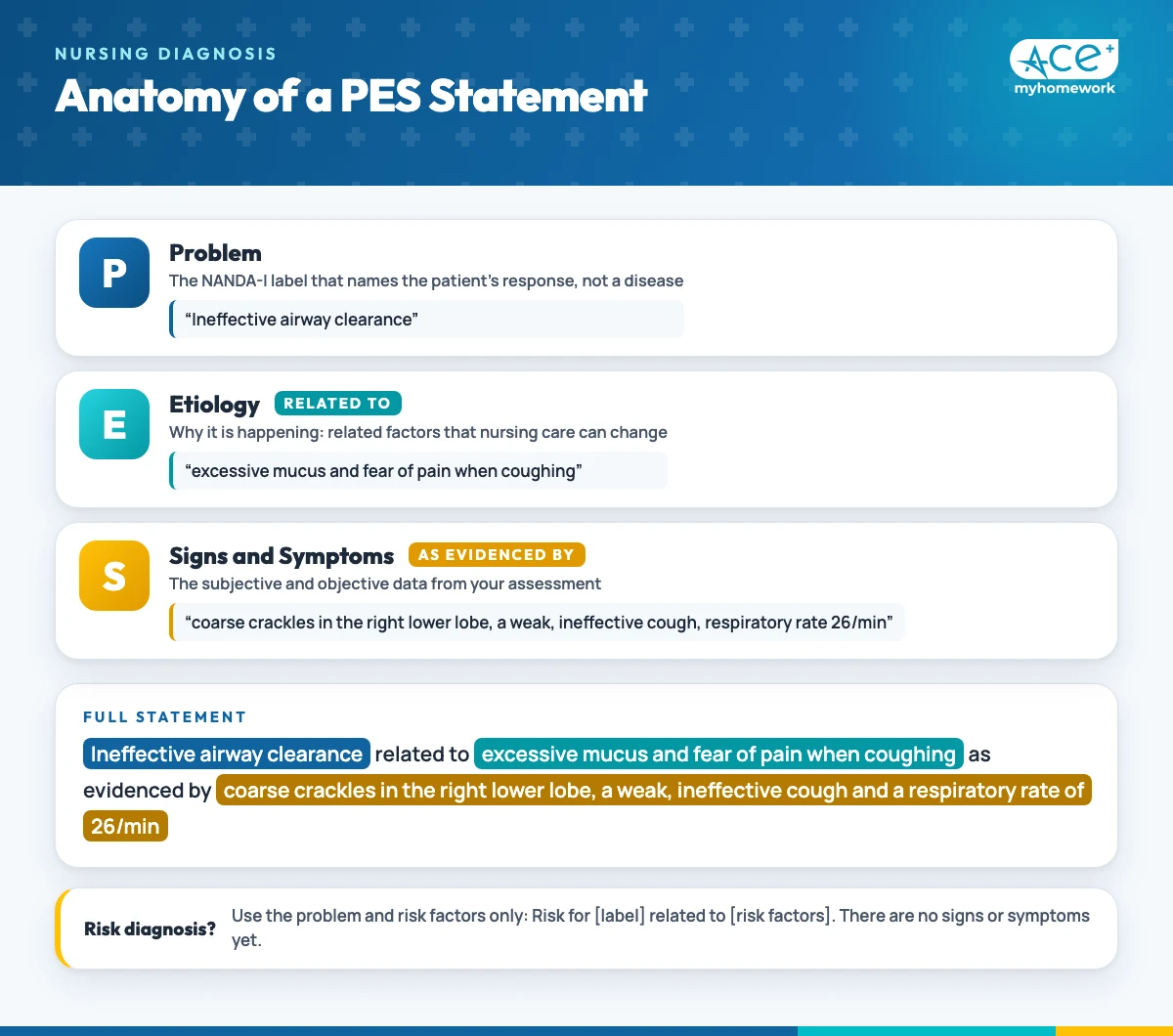
Here is a nursing diagnosis example written in PES format: "Ineffective airway clearance related to excessive mucus and fear of pain when coughing as evidenced by coarse crackles in the right lower lobe, a weak, ineffective cough and a respiratory rate of 26 breaths per minute." P is the problem (the NANDA-I label), E is the etiology, introduced by "related to," and S is the signs and symptoms, introduced by "as evidenced by." Risk diagnoses leave out the S part and list risk factors instead, because the problem hasn't happened yet.
This guide shows how to build each part of a PES statement and what belongs after "related to" and "as evidenced by." It then gives correct examples of problem-focused, risk, health promotion and syndrome diagnoses, plus care plan examples and common mistakes with fixes.
What Is the PES Format?
PES is a teaching format that turns a nursing diagnosis into a full sentence, so your instructor can see the reasoning behind it. NANDA International calls it the three-part format. The NANDA-I 2024–2026 edition supports it in nursing education and notes that in clinical practice the label alone is enough, as long as the supporting data are documented elsewhere in the record.
Each part of a PES statement does a different job. The patient in the example is hypothetical.
Part
NANDA-I term
Comes from
Linking phrase
P: Problem
Diagnosis label
The NANDA-I classification
None; it starts the statement
E: Etiology
Related factors (or risk factors)
Your analysis of why the problem is happening
"related to" (R/T)
S: Signs and symptoms
Defining characteristics
Your subjective and objective assessment data
"as evidenced by" (AEB) or "as manifested by"
The Open RN Nursing Fundamentals textbook points out in its chapter on nursing diagnosis that the PES letters don't match current NANDA-I terms exactly, but the three components still apply. Use whichever wording your program teaches.
How to Write a Nursing Diagnosis in Five Steps
Diagnosis comes straight after assessment in the nursing process as the American Nurses Association describes it, so every statement should be traceable to data you collected.
Cluster your cues. Group related findings from your assessment, such as crackles, a weak cough and a fast respiratory rate.
Match the cluster to a label. Find the NANDA-I diagnosis whose definition and defining characteristics fit the cluster best. Our list of common nursing diagnoses groups current labels by domain.
Name the etiology. Ask why the problem is happening, and choose causes a nurse can change through nursing care.
List your evidence. Add the specific data that prove the problem exists: numbers, observations and the patient's own words.
Read it back. Check that the label isn't a medical diagnosis, that the etiology isn't a disease or a fixed characteristic like age, and that every "as evidenced by" item came from your assessment.
Steps 1 and 2 match what the National Council of State Boards of Nursing calls recognizing and analyzing cues in its Clinical Judgment Measurement Model, which shapes Next Generation NCLEX questions.
"Related to" and "As Evidenced by": What Goes Where
NANDA-I specifies that related factors and risk factors must be things nurses can modify on their own, and that interventions should target them where possible. Other information is classified differently and doesn't belong after "related to":
Type of information
Examples
Where it goes
Related factors and risk factors
Excessive mucus, fear of pain, insufficient fluid intake, decreased physical activity, inadequate information
After "related to"
Associated conditions
Medical diagnoses, surgeries, medical devices, medications
Patient background, not the etiology
At-risk populations
Age group, family history, past experiences
Patient background, not the etiology
Defining characteristics
Crackles, pain rated 7/10, restlessness, statements the patient makes
After "as evidenced by"
Some programs let you mention the medical condition with "secondary to," for example "related to fear of pain when coughing secondary to rib fractures." Check your rubric before you use it. For the evidence, write what you observed or measured, not a conclusion. "Patient is anxious" is a conclusion. "Restless, asks the same question repeatedly, heart rate 104" is evidence.
Nursing Diagnosis Examples by Type
All of these examples describe hypothetical patients and use NANDA-I 2024–2026 labels. Your patient's data will differ, so treat the statements as models, not text to copy.
Problem-Focused Nursing Diagnosis Examples
Problem-focused diagnoses use all three parts.
Acute pain related to tissue injury from abdominal surgery as evidenced by pain rated 8/10, guarding of the incision and reluctance to turn in bed.
Excessive fluid volume related to excessive sodium and fluid intake as evidenced by 2+ pitting edema in both ankles, crackles in both lung bases and a 2 kg weight gain over two days.
Inadequate fluid volume related to insufficient fluid intake as evidenced by dry mucous membranes, dark concentrated urine, decreased urine output and a heart rate of 112.
Impaired physical mobility related to pain and decreased muscle strength as evidenced by needing help from one person to stand and a slow, unsteady gait.
Decreased activity tolerance related to physical deconditioning as evidenced by shortness of breath and reports of exhaustion after walking to the bathroom.
Excessive anxiety related to an unfamiliar procedure and inadequate information about recovery as evidenced by restlessness, repeated questions, difficulty concentrating and a heart rate of 104.
Inadequate health knowledge related to insufficient information about warfarin therapy as evidenced by inability to name signs of bleeding and incorrect statements about missed doses.
Impaired skin integrity related to prolonged exposure to moisture as evidenced by red, broken skin over the perineum.
Impaired intestinal elimination related to decreased physical activity and insufficient fluid intake as evidenced by no bowel movement for four days, hard stools and abdominal bloating.
Acute confusion related to a disrupted sleep-wake cycle and dehydration as evidenced by fluctuating attention, disorientation to time and place, and agitation at night.
New or worsening confusion can signal delirium with a medical cause, so report it promptly rather than only documenting it.
Risk Nursing Diagnosis Examples
A risk diagnosis describes a problem the patient is more vulnerable to than most people but doesn't have yet. There are no signs or symptoms to report, so there is no S part. The statement names the risk and the risk factors. The 2024–2026 NANDA-I edition shows the format as "Risk for [diagnosis] related to [risk factors]." Some textbooks, including Open RN, follow earlier NANDA-I guidance and write "as evidenced by" before the risk factors. Either way, what follows the label is a list of risk factors, never symptoms. Use the wording your program teaches.
Risk for infection related to impaired skin integrity and inadequate knowledge of how to avoid exposure to pathogens.
Risk for adult falls related to impaired balance, urinary urgency and an unfamiliar environment.
Risk for adult pressure injury related to decreased physical mobility, inadequate nutritional intake and moisture from incontinence.
Risk for aspiration related to an ineffective cough and inadequate knowledge of safe swallowing strategies.
Risk for inadequate fluid volume related to insufficient fluid intake and inadequate knowledge about fluid needs.
Risk for surgical wound infection related to smoking and inadequate knowledge of incision care.
Risk for excessive caregiving burden related to inadequate knowledge about community resources, difficulty prioritizing competing role commitments and impaired family processes. This one is adapted from an example in the NANDA-I book.
If signs appear, the risk diagnosis no longer fits. A wound that is red and draining doesn't fit Risk for surgical wound infection. Report it, because the patient needs assessment by the provider. Then update the care plan.
Health Promotion Nursing Diagnosis Examples
Health promotion diagnoses describe a patient's readiness to improve. They are usually written as "Readiness for enhanced..." followed by "as evidenced by" and the patient's expressed wish. A related factor is optional.
Readiness for enhanced health self-management as evidenced by expressed desire to manage blood pressure through home monitoring and diet.
Readiness for enhanced nutritional intake as evidenced by expressed desire to reduce sodium in meals.
Readiness for enhanced sleep pattern as evidenced by expressed desire to improve sleep quality.
Readiness for enhanced health knowledge as evidenced by expressed desire to learn correct inhaler technique.
Syndrome Nursing Diagnosis Examples
A syndrome diagnosis groups several problem-focused diagnoses that occur together. In the "as evidenced by" part, list those diagnoses instead of individual symptoms.
Elder frailty syndrome related to sedentary behaviors, fear of falling and muscle weakness as evidenced by decreased activity tolerance, excessive fatigue burden, impaired physical mobility and inadequate protein-energy nutritional intake.
Risk for elder frailty syndrome related to sedentary behaviors and fear of falling.
Other syndromes in the current classification include Decreased self-care ability syndrome, Post-trauma syndrome, Acute substance withdrawal syndrome and Chronic pain syndrome.
Nursing Diagnosis Care Plan Examples
A diagnosis only matters if it drives the rest of the plan. The interventions below target the etiology in each statement. The first row is a 72-year-old patient with pneumonia who avoids coughing because of chest wall pain. The second is a 45-year-old patient the morning before a first surgery. Both are hypothetical.
Nursing Diagnosis
Expected Outcomes (SMART)
Nursing Interventions
Rationale
Evaluation
Ineffective airway clearance related to excessive mucus and fear of pain when coughing as evidenced by coarse crackles in the right lower lobe, a weak cough and a respiratory rate of 26
Within 48 hours, patient will cough effectively to clear secretions, with improved breath sounds in the right lower lobe and a respiratory rate of 12–20.
Assess respiratory rate, effort, breath sounds, SpO2 and cough every 4 hours and as needed.
Position upright and help her change position or walk as tolerated.
Teach chest splinting with a pillow, deep breathing and controlled coughing; time prescribed analgesia so she can cough.
Encourage oral fluids unless restricted.
Notify the provider or rapid response team for increasing work of breathing, SpO2 below the prescribed target or new confusion.
Trends show response to treatment and early deterioration.
Upright positions help the lungs expand and make coughing more effective.
Splinting and pain control target the fear of pain that stops her coughing.
Adequate hydration helps keep secretions thin.
These are signs of respiratory deterioration that need urgent treatment.
Partially met at 48 hours: cough productive, crackles reduced, respiratory rate 22. Continue plan; reassess in 24 hours.
Excessive anxiety related to an unfamiliar procedure and inadequate information about recovery as evidenced by restlessness, repeated questions, difficulty concentrating and a heart rate of 104
Before transfer to surgery, patient will rate anxiety 3/10 or lower and describe what to expect after surgery.
Ask her to rate anxiety from 0 to 10 and describe her main worries.
Use a calm, unhurried approach and stay with her during peak anxiety.
Explain what will happen before and after surgery in plain language; use teach-back.
Coach slow breathing.
Tell the surgical team if she has questions about risks or consent.
Her own rating and worries guide the response.
A calm presence helps reduce anxiety.
Clear information addresses the knowledge gap behind her anxiety.
Slow breathing can reduce the physical symptoms of anxiety.
Explaining surgical risks and obtaining consent are the surgeon's responsibility.
Met: rated anxiety 2/10 and described early walking, pain control and drain care.
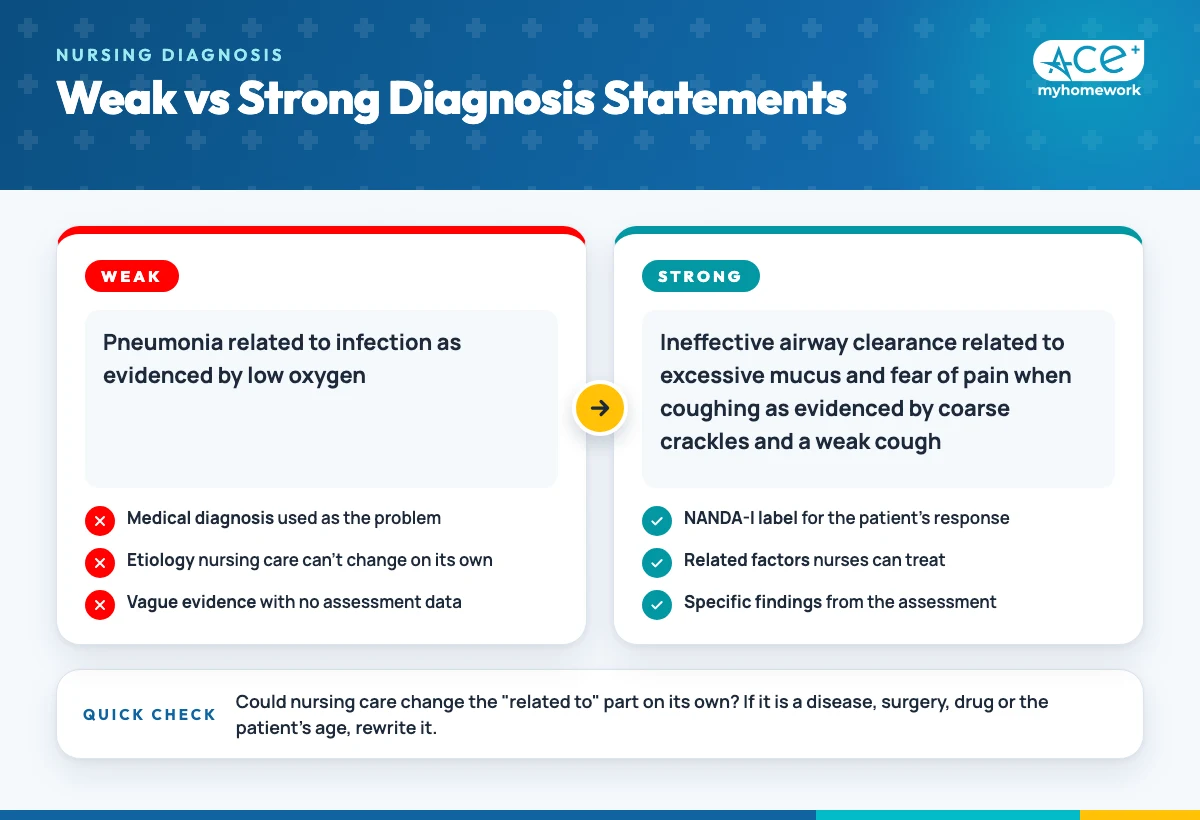
A weak diagnosis uses medical terms and vague evidence. A strong one names a nursing problem, a cause nurses can treat and specific data.
Weak statement
What's wrong
Stronger version
Pneumonia related to infection
Medical diagnosis as the problem; etiology nurses can't treat; no evidence
Ineffective airway clearance related to excessive mucus as evidenced by coarse crackles and a weak cough
Excessive fluid volume related to heart failure
A medical diagnosis after "related to"
Excessive fluid volume related to excessive sodium intake as evidenced by ankle edema and weight gain
Inadequate health knowledge related to being 82 years old
Age is an at-risk population, not a modifiable cause
Inadequate health knowledge related to insufficient information about new medications as evidenced by inability to explain their purpose
Excessive anxiety as evidenced by patient is anxious
Circular evidence; no etiology
Excessive anxiety related to an unfamiliar procedure as evidenced by restlessness, repeated questions and a heart rate of 104
Risk for infection as evidenced by redness and drainage at the incision
Signs are present, so it isn't a risk anymore
Report the findings to the provider and revise the plan for the problem that is present
Constipation related to opioid use
Retired label; a medication as the etiology
Impaired intestinal elimination related to decreased physical activity and insufficient fluid intake as evidenced by no bowel movement for four days and hard stools
If your clinical paperwork also includes progress notes, our SOAP note example shows how the same assessment data are documented.
Getting Help with Nursing Diagnosis Statements
Instructors often return diagnoses because the etiology is a medical condition or the evidence is vague. If you'd like feedback on your PES statements or care plan, our nursing homework help offers tutoring and review for nursing assignments. Use any outside help in line with your school's academic integrity policy, and build your statements from your own patient's data.
Frequently Asked Questions
What Is an Example of a Nursing Diagnosis?
"Acute pain related to tissue injury from abdominal surgery as evidenced by pain rated 8/10, guarding of the incision and reluctance to turn in bed" is a complete problem-focused nursing diagnosis in PES format.
What Does PES Stand for in Nursing?
Problem, etiology and signs and symptoms. In NANDA-I terms, these are the diagnosis label, the related factors and the defining characteristics.
Do Risk Diagnoses Use "As Evidenced by"?
Not for signs and symptoms, because a risk diagnosis describes a problem that hasn't developed. NANDA-I 2024–2026 writes risk diagnoses as "Risk for [diagnosis] related to [risk factors]." Some programs use "as evidenced by" before the risk factors instead, so follow your rubric.
Can I Use a Medical Diagnosis in a Nursing Diagnosis?
Not as the problem or the etiology. NANDA-I classifies medical diagnoses as associated conditions. Put them in the patient background, or use "secondary to" if your program allows it.
How Many Signs and Symptoms Should I Include?
Include enough specific findings to support the diagnosis, often three or four. Choose ones that match the label's defining characteristics, and use numbers where you have them.
What Is the Difference Between Related Factors and Risk Factors?
Related factors explain why a current problem exists. Risk factors explain why a patient is more vulnerable to a problem that hasn't happened yet. In both cases, they should be things nursing care can change.
Get affordable and top-notch help for your essays and homework services from our expert tutors. Ace
your homework, boost your grades, and shine in online classes—all with just a click away!
Master the nursing diagnosis for type 2 diabetes. Our guide helps students move from theory to practice with care plan examples, key concepts, and study tips.
Now that you have seen how writing a personal statement for nursing is made, At Acemyhomework we strive to deliver top-notch academic essays with our professional writers.