Acute pain is a NANDA-I nursing diagnosis (00132) for pain that starts suddenly or gradually, can be mild to severe, and is expected to end, lasting less than three months. To address pain in nursing care plan format, you assess the pain with a validated scale, write a diagnosis that names the cause and the evidence, set a goal the patient agrees with, and choose interventions you reassess after each dose or comfort measure. The patient's own report is the most reliable measure of pain.
This guide covers what the diagnosis means, how acute pain differs from chronic pain, the 0 to 10 numeric scale and PQRST assessment, how to write the PES statement, a filled care plan table for a hypothetical patient, and the safety checks that go with opioid use.
Acute Pain: What the Nursing Diagnosis Means
The International Association for the Study of Pain revised its definition in 2020, describing pain as an unpleasant sensory and emotional experience associated with, or resembling that associated with, actual or potential tissue damage (Raja and colleagues, 2020). The definition makes clear that pain is always personal and that a person's report should be respected, even when no injury can be seen.
The NANDA International 2024–2026 edition keeps Acute pain in Domain 12, Comfort. In summary, NANDA-I describes it as an unpleasant sensory and emotional experience linked to actual or potential tissue damage, with a sudden or slow onset, any intensity, an expected end and a duration of under three months. The edition's authors note that symptom-type labels such as acute pain are being reviewed for future editions, so watch for changes. Related labels in the current edition include Chronic pain (00133), Impaired physical comfort (00380) and a new label, Ineffective pain self-management (00418).
Be careful with time frames. NANDA-I uses under three months for acute pain, while the 2022 CDC clinical practice guideline on prescribing opioids for pain uses under one month for acute pain, one to three months for subacute pain and more than three months for chronic pain. Use the NANDA-I definition for your nursing diagnosis.
Acute vs Chronic Pain
Feature
Acute pain
Chronic pain
Duration
Under 3 months (NANDA-I), expected to end
3 months or longer, often with no expected end
Typical causes
Surgery, injury, procedures, acute illness
Arthritis, back pain, neuropathy, cancer, conditions where the cause may have resolved
Body response
May raise heart rate, blood pressure and breathing rate, but not always
Vital signs usually normal; fatigue, low mood and poor sleep are common
Start with the patient's own report whenever they can give one. Normal vital signs or a calm face do not rule out pain, and raised vital signs have many causes, so they support but never replace self-report. The StatPearls review of pain assessment summarizes the common tools.
The 0 to 10 Numeric Rating Scale
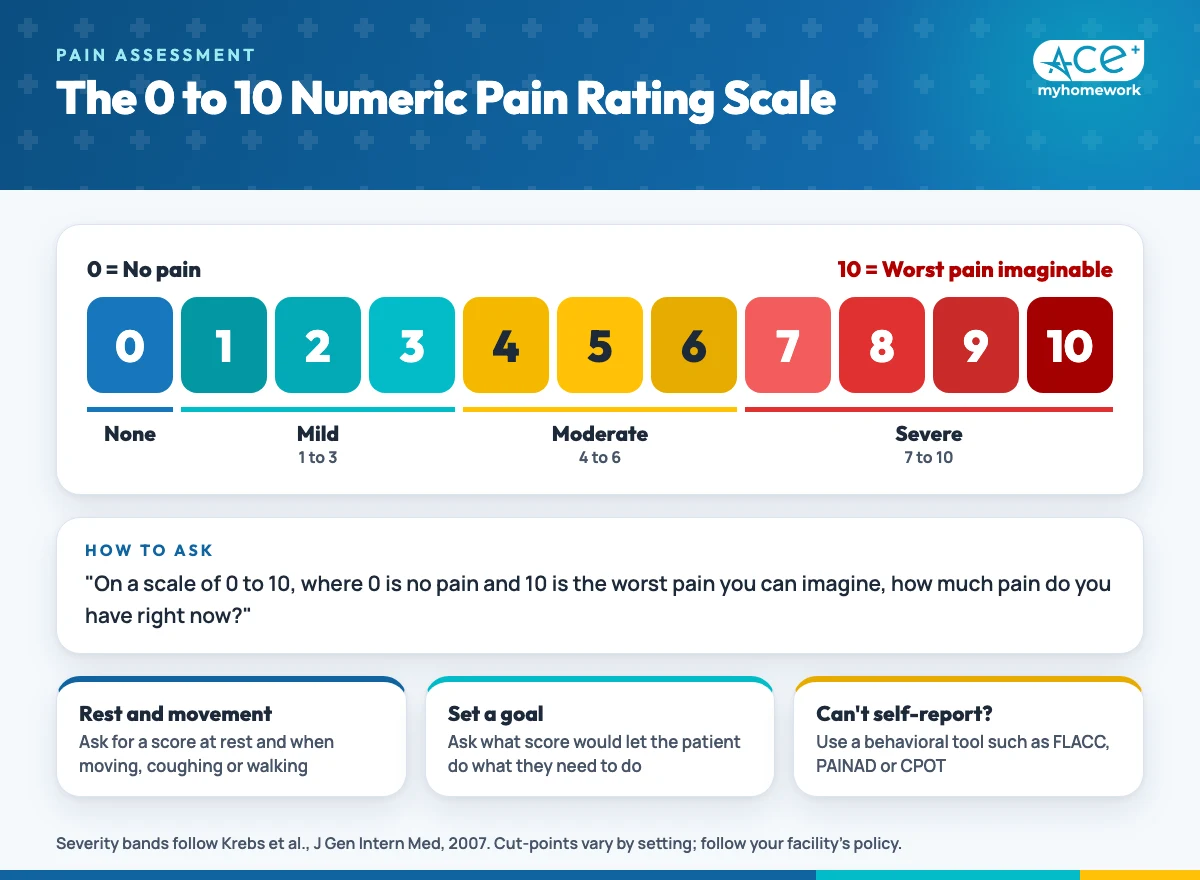
The numeric rating scale (NRS) asks the patient to rate pain from 0 (no pain) to 10 (the worst pain imaginable). It is quick, easy to repeat and works for most adults who can communicate. Many settings group scores as mild (1 to 3), moderate (4 to 6) and severe (7 to 10), the cut-points used in a primary care study by Krebs and colleagues, but cut-points vary, so check your facility's policy. Ask about pain now, at rest and with movement, because pain that stops a patient coughing, walking or sleeping matters more than one number.
The 0 to 10 numeric rating scale. Mild, moderate and severe bands follow Krebs and colleagues (2007); cut-points vary by setting.
For children, the Wong-Baker FACES Pain Rating Scale is widely used for ages 3 and up, and the FLACC scale is used for infants and young children who cannot self-report. For adults who cannot self-report, use a behavioral tool such as PAINAD for advanced dementia or the Critical-Care Pain Observation Tool (CPOT) in intensive care, and ask family members what the person's usual signs of pain are.
The PQRST Assessment
A number tells you how much it hurts. PQRST tells you what kind of pain it is, which helps you spot a new problem and choose the right intervention.
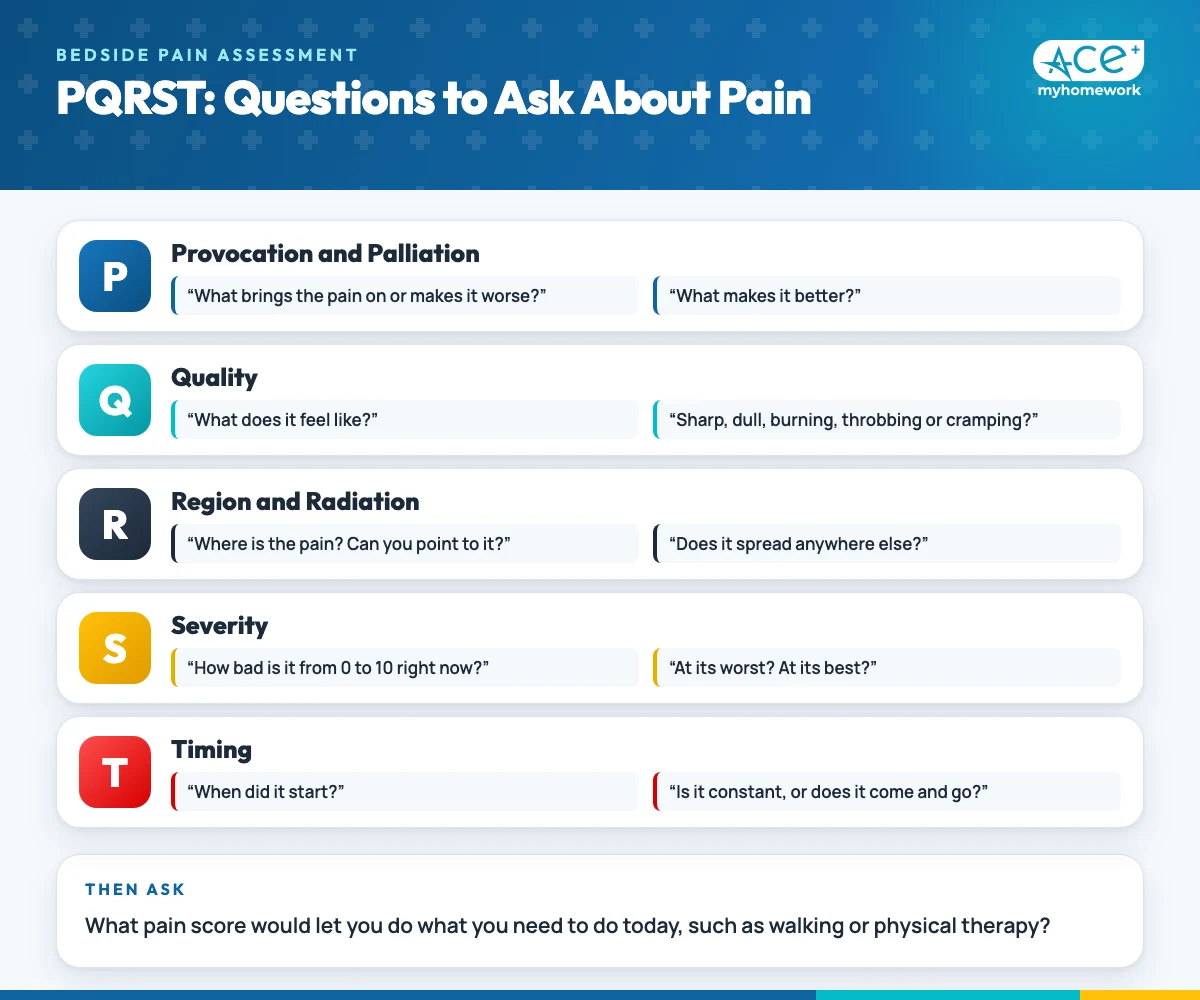
P, provocation and palliation: What brings the pain on or makes it worse? What makes it better?
Q, quality: What does it feel like: sharp, dull, burning, cramping, throbbing?
R, region and radiation: Where is it? Does it spread anywhere?
S, severity: How bad is it from 0 to 10 now, at its worst and at its best?
T, timing: When did it start? Is it constant or does it come and go? How long does it last?
Some programs add U for understanding (what the patient thinks is causing it and how it affects them). Also ask what the patient's goal is: the pain level that would let them do what they need to do, such as walk to the bathroom or do physical therapy.
PQRST pain assessment questions to use at the bedside.
Writing the Pain Nursing Diagnosis
A problem-focused pain nursing diagnosis follows the PES format: the problem (the NANDA-I label), the etiology (related to) and the signs and symptoms (as evidenced by). For example:
Acute pain related to surgical tissue trauma, as evidenced by self-reported pain of 8 out of 10 on the numeric rating scale, guarding of the right leg, grimacing on movement and refusal to get out of bed.
The "related to" part must be something nursing care can address or work around, and the evidence should include the patient's report plus what you observed. Avoid writing "related to pain" in a pain diagnosis or using a medical diagnosis alone as the cause. Our guides to nursing diagnosis examples and PES statements and common nursing diagnoses show more examples.
Writing Acute Pain in Nursing Care Plan Format: Filled Example
The patient below is hypothetical. A 45-year-old man is on post-operative day 1 after open reduction and internal fixation of a right ankle fracture. He rates his pain 8 out of 10, describes it as throbbing and worse when he moves, guards his leg and has refused physical therapy. His heart rate is 104. He has scheduled acetaminophen and an as-needed oral opioid prescribed, is allowed no weight on the right leg, and has not had a bowel movement since before surgery. He says he could manage physical therapy if his pain were 4 out of 10 or lower.
Nursing Diagnosis
Expected Outcomes (SMART)
Nursing Interventions
Rationale
Evaluation
Acute pain related to surgical tissue trauma, as evidenced by self-report of 8/10, guarding, grimacing and refusal to get out of bed
Within 1 hour of intervention, the patient reports pain at or below his goal of 4/10. By the end of the shift, he takes part in physical therapy with pain at 4/10 or less.
Assess pain with the NRS and PQRST at least every 4 hours and with any change.
Give scheduled nonopioid and as-needed opioid analgesics as prescribed, and time a dose before therapy.
Elevate the leg and apply cold as ordered.
Teach slow breathing and use distraction.
Reassess pain and sedation when each medicine is expected to peak.
Regular reassessment shows whether the plan is working. Combining analgesics that work in different ways (multimodal analgesia) can improve relief and reduce opioid needs. Elevation and cold reduce swelling.
Met: pain 3/10 one hour after the opioid dose; completed physical therapy at 4/10.
Impaired physical mobility related to pain and prescribed non-weight-bearing status, as evidenced by reluctance to move and need for help to transfer
By discharge, the patient transfers and walks 15 meters with crutches, keeping weight off the right leg, without help.
Coordinate pain medicine timing with mobility sessions.
Reinforce crutch technique taught by physical therapy.
Encourage ankle and knee exercises on the other leg and both arms as allowed.
Praise progress and set small goals each session.
Early mobility after surgery reduces complications such as blood clots and loss of strength. Reinforcing the same technique builds confidence.
Met on day 2: walked 15 meters with crutches and standby help only.
Risk for adult falls as evidenced by risk factors: opioid use, new use of crutches and an unfamiliar environment
During the stay, the patient has no falls and calls for help before getting up until cleared by physical therapy.
Complete the facility's fall risk assessment.
Keep the call light, crutches and urinal within reach.
Teach him to call before standing, especially after an opioid dose.
Use nonslip footwear and keep the path clear.
Opioids can cause dizziness and drowsiness, and new mobility aids increase fall risk until the patient is skilled with them.
Met: no falls; called for help appropriately each time.
Risk for impaired intestinal elimination as evidenced by risk factors: opioid use, reduced mobility and reduced intake after surgery
The patient has a soft bowel movement within his usual pattern, and no later than day 3 after surgery.
Ask about his usual bowel pattern and record bowel movements.
Give the bowel regimen as prescribed while he takes opioids.
Encourage fluids and fiber if allowed.
Report abdominal distention, nausea or no bowel movement by day 3.
Opioids slow bowel movement, and inactivity adds to the risk. Prevention is easier than treating constipation once it develops.
Met: bowel movement on day 2.
This nursing care plan acute pain example uses the 2024–2026 labels Risk for adult falls (00303) and Risk for impaired intestinal elimination (00344). Older books use Risk for falls and Risk for constipation. For the full care plan structure, see our guide on how to write a nursing care plan.
Nursing Interventions for Acute Pain
Use More Than One Approach
The CDC's 2022 guideline states that nonopioid therapies are at least as effective as opioids for many common types of acute pain, and that opioids should be considered only when the expected benefits outweigh the risks. When opioids are needed, it advises immediate-release forms at the lowest effective dose for no longer than the pain is expected to be severe. As the nurse, you give what is prescribed, but you also:
Give scheduled nonopioid analgesics on time, rather than waiting for pain to become severe.
Use nondrug measures: positioning, splinting incisions with a pillow when coughing, cold or heat as ordered, relaxation, breathing exercises, music and distraction.
Time doses before painful activities such as physical therapy, dressing changes or walking.
Teach the patient to report pain early and explain that pain control helps recovery.
Ask about the patient's cultural and personal preferences and past experiences with pain medicines.
Check sedation level, respiratory rate and depth, and SpO2 before and after opioid doses. Many hospitals use the Pasero Opioid-induced Sedation Scale.
Increasing sleepiness often comes before breathing slows, so a patient who keeps drifting off mid-conversation needs the opioid held and the provider notified.
Know where naloxone is and when your facility's protocol allows you to give it.
Watch for other side effects: nausea, itching, urinary retention and constipation.
Reassess and Document
Reassess pain and sedation when each medicine is expected to reach its effect, following your facility's policy. Record the score, the intervention, the reassessment and how the patient is functioning. A care plan that never shows a reassessment cannot show that the goal was met.
Red Flags: Pain That Needs Escalation
Pain is also a warning sign. Report these promptly rather than treating them with another dose:
Pain out of proportion to the injury, pain with passive stretching, tightness, numbness or pale skin in a limb in a cast or after fracture surgery. These can signal compartment syndrome.
New chest pain, sudden shortness of breath or calf pain and swelling, which can mean a heart problem or a blood clot.
Sudden severe abdominal pain, a rigid abdomen or pain with fever after surgery.
A sudden severe headache, new weakness or confusion.
Pain that does not improve after the prescribed plan, or a sudden change in the pain's location or quality.
Use SBAR when you call: give the PQRST findings, the score trend, what was given and when, and vital signs.
Getting Help with a Pain Care Plan
Pain care plans appear in fundamentals, medical-surgical, pediatric and perioperative courses, and in simulations such as Shadow Health pain management cases. If you want feedback on your nursing diagnosis for acute pain, your SMART outcomes or your rationales, our nursing homework help service offers tutoring and review from nursing writers. Use any outside help in line with your school's academic integrity policy.
Frequently Asked Questions
What Is the Nursing Diagnosis for Acute Pain?
Acute pain (00132), in Domain 12, Comfort, of NANDA-I. It applies to pain of sudden or slow onset and any intensity that is expected to end and has lasted under three months.
What Is a Good Goal for Acute Pain?
Use the patient's own goal and link it to function and time. For example: "Within 1 hour of intervention, the patient reports pain at or below 4/10 and walks to the bathroom." "Patient will be pain free" is rarely realistic after surgery.
Is Pain the Fifth Vital Sign?
Pain was promoted as a "fifth vital sign" in the late 1990s, and the phrase is still common. Whatever your facility calls it, pain is assessed regularly, and current practice focuses on function and the patient's goal rather than on driving the number to zero.
Can I Use Vital Signs to Diagnose Pain?
Not on their own. Heart rate and blood pressure may rise with acute pain, but they also change with anxiety, bleeding, fever and medicines, and they can be normal in a patient who is in severe pain. Use self-report first, then a behavioral tool if the patient cannot self-report.
What Is the Difference Between Acute Pain and Chronic Pain in NANDA-I?
Acute pain has an expected end and lasts under three months. Chronic pain (00133) is constant or recurring and lasts three months or more. Ineffective pain self-management (00418) is used when the issue is how the person manages ongoing pain.
Can I Use the Wong-Baker FACES Scale in My Care Plan?
Yes, if your patient is a child or an adult who finds faces easier than numbers. Name the scale and the score in your evidence, for example "rates pain as face 6 on the Wong-Baker FACES scale," and use the same scale each time you reassess.
Get affordable and top-notch help for your essays and homework services from our expert tutors. Ace
your homework, boost your grades, and shine in online classes—all with just a click away!