A risk to fall nursing care plan identifies why a particular patient might fall, sets measurable safety goals and lists the nursing interventions that address each risk factor. It is built on the NANDA-I diagnosis Risk for adult falls (or Risk for child falls), uses a screening tool such as the Morse Fall Scale to find risk factors, and combines universal fall precautions for every patient with targeted actions for the risks you find.
This guide explains the current fall risk nursing diagnosis labels, intrinsic and extrinsic risk factors, how to score the Morse Fall Scale, which fall prevention interventions have evidence behind them, and a complete care plan example you can adapt for clinical paperwork.
What a Fall Risk Nursing Care Plan Includes
A fall risk care plan follows the same nursing process as any other plan: assessment, diagnosis, planning, implementation and evaluation. If you need a refresher on the format, our guide on how to write a nursing care plan walks through each column. For falls, a complete plan usually contains:
A screening score from a validated tool, recorded on admission, after a change in condition, after a transfer and after any fall.
The specific risk factors you found, not just the total score. A patient who scores high because of confusion needs different interventions from one who scores high because of a walker and an IV pump.
A risk diagnosis written with its risk factors.
SMART outcomes, such as "Patient will remain free of falls during hospitalization" plus a behavior you can observe, like calling for help before getting up.
Universal precautions plus targeted interventions, each with a rationale.
Evaluation and reassessment, so the plan changes when the patient does.
The Agency for Healthcare Research and Quality (AHRQ) estimates that between 700,000 and 1,000,000 people fall in U.S. hospitals each year, and its Preventing Falls in Hospitals toolkit is the reference most hospital fall programs build on. In the community, the CDC reports that more than one in four adults aged 65 and older falls each year, and that falling once doubles the chance of falling again.
Fall Risk Nursing Diagnosis: Current NANDA-I Labels
Many textbooks and electronic health records still use the label Risk for falls. NANDA International replaced it in the 2021–2023 edition with two age-specific diagnoses, Risk for adult falls and Risk for child falls, and both remain in the 2024–2026 edition. They sit in Domain 11 (Safety/protection), Class 2 (Physical injury). In plain terms, the diagnosis describes a person who is susceptible to a fall that could harm their health, even though no fall has happened yet.
Because it is a risk diagnosis, there are no signs and symptoms to list. You write it with the risk factors that put this patient in danger, introduced by "related to." For example:
Risk for adult falls related to a history of a fall at home, use of a walker, orthostatic hypotension and nocturia.
Some programs put the risk factors after "as evidenced by" instead, so follow your instructor's format. Our guide to nursing diagnosis examples and PES statements explains the difference between problem-focused and risk diagnoses in more detail.
Fall risk rarely appears alone. Diagnoses that often sit alongside it include Impaired physical mobility, Impaired walking ability, Acute confusion or Risk for acute confusion, and Risk for physical injury (called Risk for injury in older editions). For more context on how these fit together, see our list of common nursing diagnoses.
Fall Risk Factors: Intrinsic vs. Extrinsic
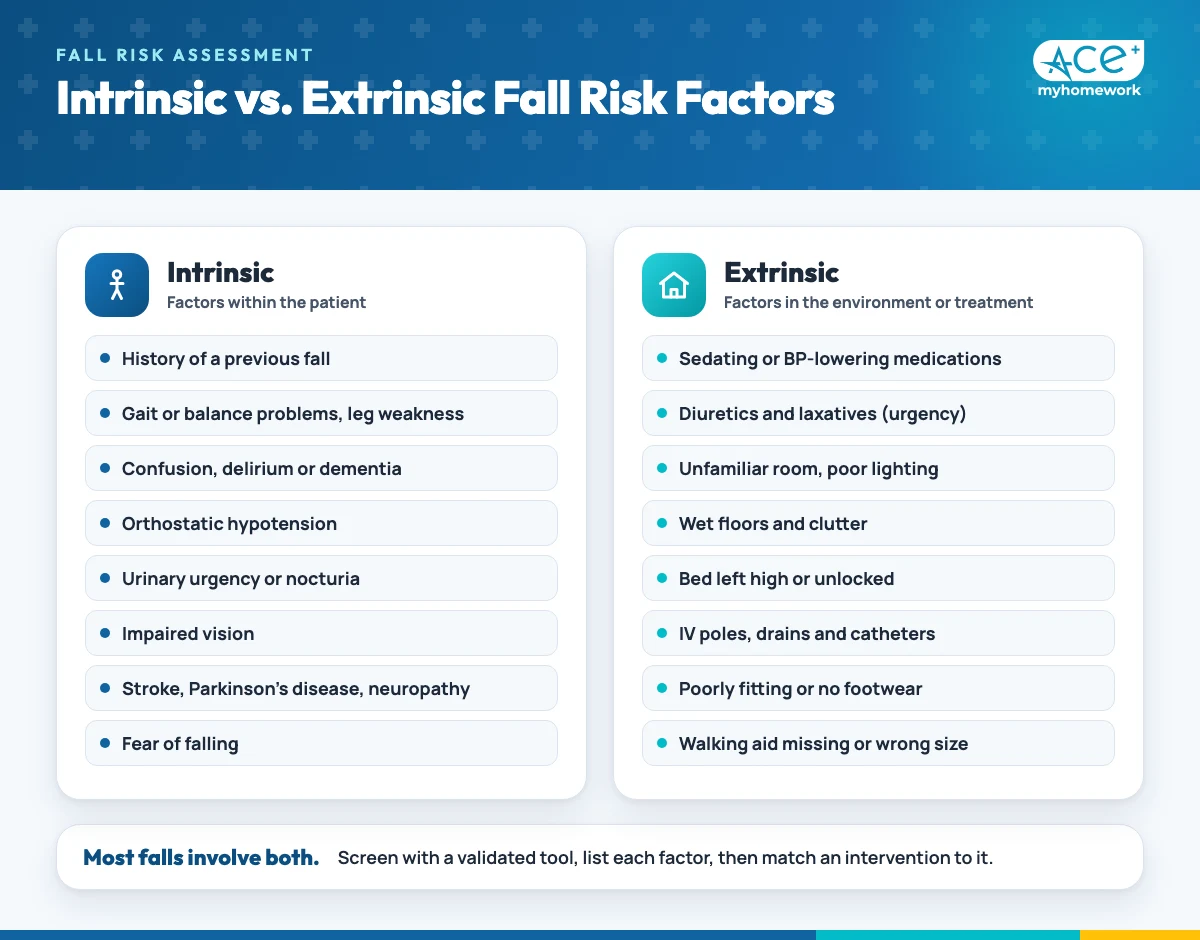
Fall risk factors are usually grouped into intrinsic factors, which come from the patient, and extrinsic factors, which come from the environment, equipment or treatment. Most falls involve both. A patient with mild weakness may manage safely at home but fall at night in an unfamiliar room with an IV pole and a diuretic running.
Common intrinsic and extrinsic fall risk factors. Based on the AHRQ fall prevention toolkit and CDC STEADI materials.
Intrinsic factors include a history of falls, gait and balance problems, lower-limb weakness, impaired vision, cognitive impairment or delirium, orthostatic hypotension, urinary urgency or nocturia, foot problems, and conditions such as stroke, Parkinson's disease or peripheral neuropathy. Fear of falling also matters, because patients who restrict their movement lose strength and confidence.
Extrinsic factors include medications that cause sedation, dizziness or urgency (for example opioids, sedative-hypnotics, antipsychotics, antihypertensives and diuretics), an unfamiliar room, poor lighting, wet or cluttered floors, a bed left high, IV poles, drains and catheters, poorly fitting footwear, and walking aids that are missing or the wrong size. AHRQ's toolkit recommends a medication review alongside any fall screening because drug effects are among the most modifiable risks.
Orthostatic hypotension is easy to miss unless you measure it. The CDC's STEADI program describes a simple method: have the patient lie down for five minutes, take blood pressure and pulse, then repeat after one and three minutes of standing. A drop of 20 mm Hg or more in systolic pressure, 10 mm Hg or more in diastolic pressure, or symptoms such as lightheadedness count as abnormal (CDC STEADI: Measuring Orthostatic Blood Pressure).
The Morse Fall Scale: Items and Scoring
The scale was developed by Janice Morse and colleagues in 1989 and is one of the most widely used fall risk tools in adult inpatient care. AHRQ reproduces it as Tool 3H in its fall prevention toolkit. It has six items, and the total ranges from 0 to 125.
Item
Response
Score
1. History of falling (immediate or previous)
No / Yes
0 / 25
2. Secondary diagnosis (two or more medical diagnoses in the chart)
No / Yes
0 / 15
3. Ambulatory aid
None, bed rest or nurse assist / Crutches, cane or walker / Furniture
0 / 15 / 30
4. IV therapy or saline (heparin) lock
No / Yes
0 / 20
5. Gait
Normal, bed rest or wheelchair / Weak / Impaired
0 / 10 / 20
6. Mental status
Oriented to own ability / Overestimates or forgets limitations
0 / 15
A weak gait means short or shuffling steps with the head able to lift, and only a light touch on furniture for reassurance. An impaired gait means shuffling, difficulty rising from a chair, head down and poor balance, so the patient needs furniture, a person or an aid to walk. Score gait and mental status by watching the patient, not from the chart alone. Asking "Can you walk to the bathroom by yourself?" and comparing the answer with what you see is a quick way to judge whether the patient overestimates their ability.
Morse Risk Levels Vary by Facility
AHRQ's version suggests these bands as an example: under 25 is low risk, 25 to 45 is moderate risk, and over 45 is high risk. However, AHRQ also notes that Morse herself recommended that each institution set its own cut-off points based on its patient population, so you will see different bands in different hospitals. Always use the risk levels in your facility's policy, and say which bands you used in a care plan assignment.
AHRQ also stresses that the individual risk factors matter more than the total. A patient with a score of 45 because of an IV line and a walker needs different interventions from a patient with the same score because of confusion and a recent fall.
Worked Example
For example, take a hypothetical 81-year-old woman admitted with a urinary tract infection. She fell at home last month (25), has heart failure and type 2 diabetes as secondary diagnoses (15), uses a walker (15), has a saline lock (20), walks with short steps and a light hand on furniture (weak gait, 10) and knows she needs help to stand (0). Her total is 85, which falls in the high-risk band of the AHRQ example. Her care plan should target her fall history, walker use, IV equipment and weakness, not just record "high risk."
Other tools you may see include the Hendrich II Fall Risk Model, the Johns Hopkins Fall Risk Assessment Tool and, for children, the Humpty Dumpty Falls Scale. The principle is the same: find the risk factors, then plan care for each one.
Fall Prevention Interventions with Rationales
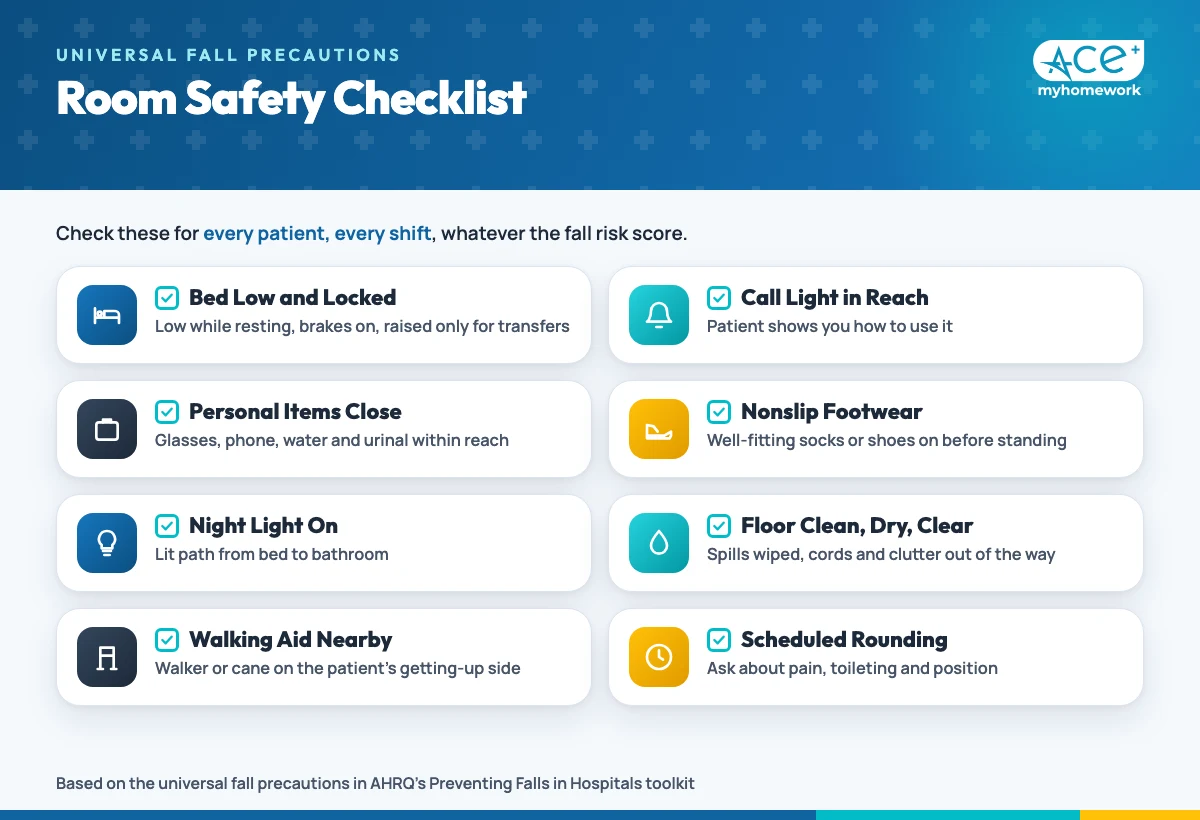
These interventions work in two layers. Universal fall precautions apply to every patient regardless of score, and targeted interventions address the risk factors you identified. AHRQ's toolkit lists universal precautions such as orienting the patient to the room, keeping the call light and personal items within reach, keeping the bed low with brakes locked, using nonslip footwear, keeping floors clean and dry and providing night lighting.
Room safety checklist based on the universal fall precautions in AHRQ's Preventing Falls in Hospitals toolkit.
Targeted Interventions by Risk Factor
Risk factor
Targeted intervention
Rationale
Previous fall
Ask how and when it happened; plan around that pattern (for example, night-time toileting)
The circumstances of a past fall often predict the next one
Urgency, nocturia or diuretics
Offer scheduled toileting, including before sleep; time diuretics with the prescriber so they are not given late in the day
Many falls happen when patients rush to the bathroom alone
Weak or impaired gait
Assist with transfers and walking; keep the walker within reach; request a physical therapy consult
Supervised mobility maintains strength while reducing unassisted attempts
Orthostatic hypotension
Measure orthostatic vital signs; teach the patient to sit on the edge of the bed before standing
Changing position slowly gives blood pressure time to adjust
Confusion or forgets limitations
Place the patient near the nurses' station; use frequent rounding; assess for delirium and its causes
Confused patients may not use the call light, so staff must anticipate needs
High-risk medications
Review the medication list with the pharmacist and prescriber; monitor sedation after opioids or sleep aids
Sedating and blood pressure-lowering drugs are a common, modifiable cause of falls
IV lines, drains or catheters
Secure tubing; show the patient how to move with the IV pole; remove devices once no longer needed
Tubing and poles are trip hazards and limit safe movement
What the Evidence Says About Bed Alarms and Side Rails
Students often list bed alarms as a key intervention. In a cluster randomized trial of 16 nursing units, Shorr and colleagues found that a program that sharply increased bed alarm use did not reduce falls, injurious falls or restraint use. Alarms can still be part of a plan, but they are not a substitute for rounding, toileting and supervised mobility. Raising all side rails to keep a patient in bed can count as a physical restraint and may lead to more serious falls if the patient climbs over them, so follow your facility's policy.
If a Fall Happens
Stay with the patient and call for help. Check airway, breathing, circulation and level of consciousness before moving them, and look for injuries, especially a head strike. Patients on anticoagulants who hit their head need prompt provider review. Notify the provider and family, document what you found, and complete an incident report according to policy. Then reassess fall risk and update the care plan. A clear handoff using a structured format such as SBAR helps the provider understand what happened.
Risk to Fall Nursing Care Plan Example
The example below continues with the hypothetical 81-year-old woman described above. Her Morse score is 85, she has orthostatic hypotension on day one, she gets up at night to urinate, and she tells you she does not like "bothering" the nurses.
Nursing Diagnosis
Expected Outcomes (SMART)
Nursing Interventions
Rationale
Evaluation
Risk for adult falls related to a fall in the past month, walker use, orthostatic hypotension, nocturia and a saline lock
Patient will remain free of falls throughout hospitalization and will call for assistance before every transfer, starting today
Implement universal fall precautions and keep the walker within reach
Round at least hourly while awake and every two hours overnight, asking about pain, toileting and position
Offer toileting before sleep and on night rounds
Measure orthostatic vital signs daily and before first ambulation
Review medications with the pharmacist for fall-risk drugs
Reduces environmental hazards
Anticipates needs that lead to unassisted getting up
Nocturia is her main reason for getting up alone
Detects blood pressure drops before she stands
Identifies modifiable drug causes
Goal met: no falls during three-day stay; patient used the call light for all observed transfers
Impaired walking ability related to muscle weakness and acute illness, as evidenced by short shuffling steps and needing furniture for support
Patient will walk 30 meters with a walker and standby assistance three times daily by day three
Assist with ambulation three times daily using a gait belt
Request a physical therapy evaluation
Encourage sitting on the edge of the bed for one to two minutes before standing
Ensure well-fitting nonslip footwear
Supervised walking maintains strength safely
Physical therapy can adjust the walker and plan exercises
Allows blood pressure to adjust to position change
Improves stability and reduces slips
Goal partly met: walked 20 meters on day two and 30 meters on day three; continue plan
Inadequate health knowledge (formerly Deficient knowledge) related to unfamiliarity with fall prevention, as evidenced by reluctance to use the call light
Patient will state three personal fall prevention strategies and demonstrate call light use before discharge
Explain why calling for help is expected, not a burden
Use teach-back for call light use and rising slowly
Include family in teaching about home hazards and night lighting
Provide written fall prevention material at discharge
Addresses the belief that stops her asking for help
Teach-back confirms understanding
Family can support changes at home
Written material reinforces teaching
Goal met: patient named night light, slow rising and walker use; demonstrated call light
If your instructor wants the plan mapped visually, the same information can be laid out as a nursing concept map with the fall risk factors around the central diagnosis.
Common Mistakes in Fall Risk Care Plans
Writing "as evidenced by" signs for a risk diagnosis. A risk diagnosis has risk factors, not defining characteristics, because the problem has not happened yet.
Listing only universal precautions. "Bed in low position" applies to everyone. Your grade and your patient depend on interventions tied to this patient's risk factors.
Vague outcomes. "Patient will be safe" cannot be evaluated. "Patient will call for help before every transfer" can.
Relying on bed alarms or restraints. Evidence does not support alarms alone, and restraints can increase injury.
Not reassessing. Rescreen after surgery, sedation, a transfer, a change in mental status or a fall, and update the plan.
Ignoring the score's limits. State the cut-off bands you used and note that facilities set their own.
Getting Help with a Fall Risk Care Plan
Fall risk care plans appear in fundamentals, medical-surgical and gerontology courses, and they often need to link a screening score, risk factors and evidence-based interventions in one document. If you would like feedback on your diagnosis statements, SMART outcomes or rationales, our nursing homework help service offers tutoring and draft review. Use any outside help in line with your school's academic integrity policy.
Frequently Asked Questions
What Is the Nursing Diagnosis for Fall Risk?
The current NANDA-I labels are Risk for adult falls and Risk for child falls, which replaced the older Risk for falls. Write it with the patient's specific risk factors, such as a previous fall, gait problems or medications that cause dizziness.
What Score on the Morse Fall Scale Is High Risk?
AHRQ's example bands treat a score over 45 as high risk, 25 to 45 as moderate and under 25 as low. Morse recommended that each facility set its own cut-offs, so use the bands in your hospital's policy.
What Are the Most Important Fall Prevention Interventions?
Universal precautions for everyone, such as a low, locked bed and a call light in reach, plus targeted actions for each risk factor, such as scheduled toileting for nocturia or orthostatic vital signs for dizziness. Regular rounding and medication review are also central.
Is Risk for Injury the Same as Risk for Falls?
No. Risk for physical injury (formerly Risk for injury) is broader and covers harm from many causes. Use the fall diagnosis when falls are the specific concern, and add the injury diagnosis only if other hazards are also present.
How Often Should Fall Risk Be Reassessed?
Most facilities require screening on admission, at set intervals such as every shift or daily, and whenever the patient's condition changes, including after surgery, a transfer, new sedating medication or a fall. Check your facility's policy for the exact schedule.
Do Bed Alarms Prevent Falls?
Not on their own. A cluster randomized trial found that increasing bed alarm use did not reduce falls or injuries. Alarms may support a plan, but rounding, toileting and supervised mobility do more of the work.
Get affordable and top-notch help for your essays and homework services from our expert tutors. Ace
your homework, boost your grades, and shine in online classes—all with just a click away!
How to write a rhetorical analysis essay: key concepts, the rhetorical situation, appeals and strategies, a step-by-step process, examples and AP Lang tips.