A nursing philosophy is a short statement of what you believe nursing is, why you practice it and how those beliefs shape the care you give. Most personal philosophies explain your view of the four core concepts of nursing (person, health, environment and nursing itself), name the values that guide you and connect them to a nursing theory. Programs ask for one as a brief statement, a section of a portfolio or a full philosophy of nursing paper.
This guide explains what a personal philosophy of nursing includes and how it relates to the metaparadigm and nursing theory. It gives you a step-by-step method, six original nursing philosophy examples from different specialties, a paper outline and the mistakes that cost students marks.
What Is a Nursing Philosophy?
A personal philosophy of nursing is your own account of the beliefs and values behind your practice. It answers questions such as: What is a person? What does it mean to be healthy? What is the nurse's role? What do I owe the people I care for? Your answers come from your life experience, your education, your clinical practice and the profession's own standards.
It's different from a nursing theory, which is a formal, published framework built to describe, explain or predict nursing phenomena. Your philosophy is personal, and it usually draws on one or more theories that fit what you already believe. It also changes over time. Many programs ask students to write one at the start of a course and revise it before graduation, because clinical experience tends to sharpen it.
Writing a philosophy has a practical purpose too. The AACN Essentials describe Domain 9: Professionalism as the formation of a professional identity that reflects nursing's characteristics and values. Putting your values into words is one of the first steps in that process.
How a Nursing Philosophy Relates to the Metaparadigm and Theory
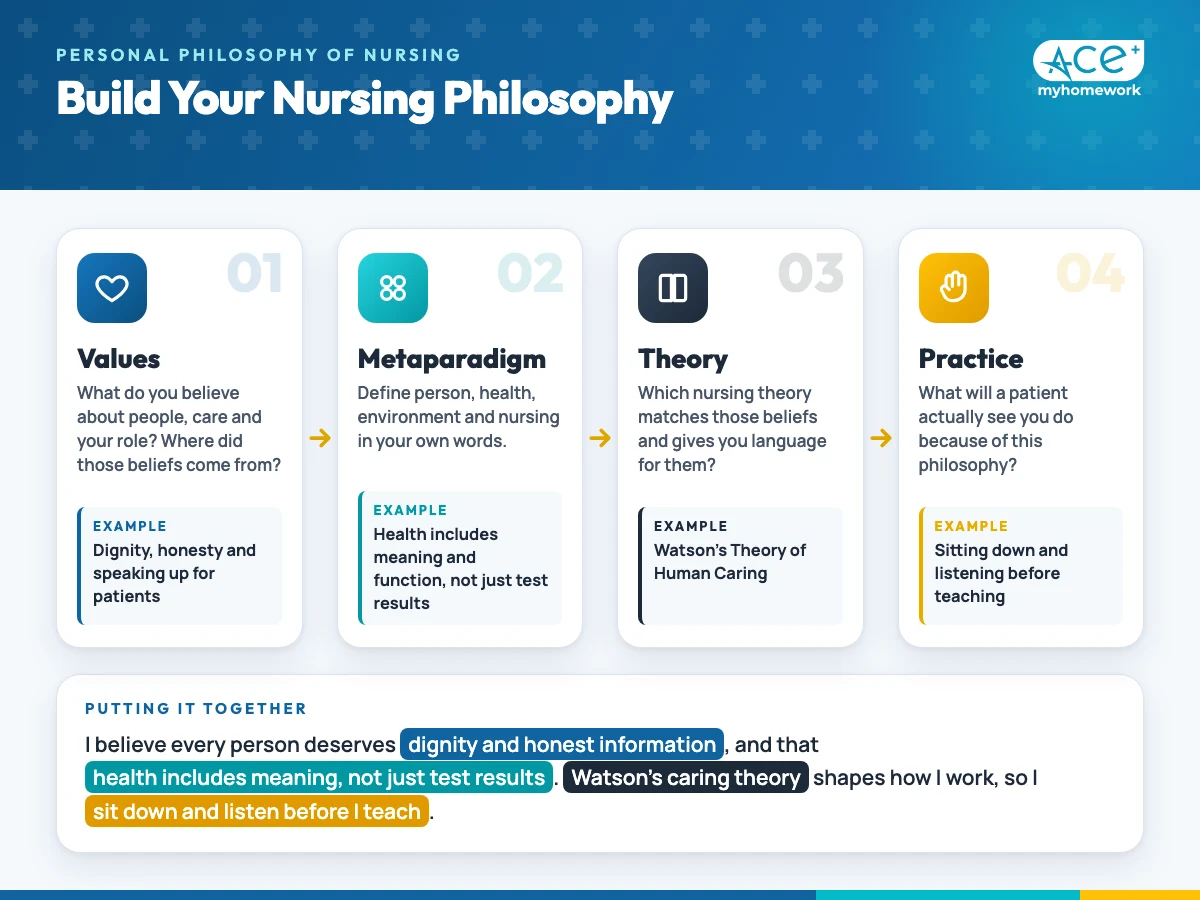
Think of a nursing philosophy as having layers. Your values sit at the bottom. Your definitions of the metaparadigm concepts build on those values. A nursing theory gives you language and structure for those definitions, and your practice is where all of it becomes visible to patients.
Building your nursing philosophy from values to practice.
The Four Metaparadigm Concepts
The nursing metaparadigm is the set of concepts that defines the discipline's focus. Jacqueline Fawcett's widely used version names four: person, environment, health and nursing. In her own account of how the metaparadigm evolved, she explains that she later replaced "person" with "human beings" and has continued to refine the wording. Most course rubrics still use the four classic terms.
Concept
What it covers
Questions to answer in your philosophy
Person
The recipient of nursing care: an individual, family, group or community
What makes someone a whole person? What do all patients deserve?
Environment
The physical, social and cultural surroundings that affect the person
How do home, culture, income or the hospital itself affect health?
Health
The person's state of well-being or illness
Is health only the absence of disease? Can a dying person be healthy in some sense?
Nursing
The actions, knowledge and relationships nurses bring to care
What is the nurse's unique role? What does good nursing look like?
Students often find these concepts abstract. In a phenomenological study of nursing students' perceptions, Deliktas and colleagues (2019) reported that students had difficulty identifying the metaparadigm concepts, and they recommended that educators help students internalize professional values. Writing your own definitions is a good way to make them concrete.
Where Nursing Theory Fits
Every nursing theory takes a position on the metaparadigm concepts. Orem focuses on self-care, Peplau on the nurse-patient relationship, Roy on adaptation and Leininger on culture. When you choose a theory for your philosophy, pick the one whose view of person, health, environment and nursing is closest to your own, not the one you know best. Our overview of nursing theories and theorists summarizes the major frameworks. If caring and presence are at the center of your values, Jean Watson's Theory of Human Caring is a common fit.
How to Write Your Nursing Philosophy in Six Steps
List your values and where they came from. Write down five to ten beliefs about people and care, such as dignity, honesty, advocacy, equity or compassion. Then note the experience behind each one: a family member's illness, a patient you cared for or a job before nursing. Reflecting on a specific experience with a structured model such as the Gibbs reflective cycle can help you uncover what you actually believe.
Define each metaparadigm concept in your own words. Write one or two sentences each for person, environment, health and nursing. Avoid copying textbook definitions. Your instructor wants your view.
Choose a theory that fits. Compare your definitions with two or three theories and select the closest match. Explain why it fits, citing the theorist's original work or a reliable summary.
Connect to professional standards. Show how your beliefs line up with the profession's own commitments. Provision 1 of the ANA's 2025 Code of Ethics for Nurses states that nurses practice with compassion and respect for the inherent dignity, worth and unique attributes of every person. The ANA's definition of nursing begins by describing nursing as integrating the art and science of caring.
Give a practice example. Describe one concrete situation where your philosophy shaped what you did, or will shape what you do. This is what separates a strong philosophy from a list of good intentions. Remove any patient identifiers.
Draft, cut and revise. Write a full draft, then cut anything generic. Read each sentence and ask whether another student could have written it. If so, make it more specific to you.
Nursing Philosophy Examples
The nursing philosophy examples below are original samples written for this guide. Each one is short, the length of the summary statement many programs ask for, and each uses a different specialty and theory. Use them to see how the parts fit together, then write your own from your own experience. Copying them won't reflect your values, and your instructor will notice.
Example 1: Medical-Surgical Nursing (Orem)
I believe every patient wants to care for themselves as much as they safely can, and that my role is to fill the gap between what a person can do and what their health requires. Health, to me, is the ability to function and take part in daily life, not only the absence of disease. On a busy medical-surgical unit, Orem's Self-Care Deficit Theory helps me decide when to act for a patient, when to assist and when to teach. Every discharge plan I contribute to should leave the patient more capable than when they arrived.
Why it works: It defines health and nursing clearly and turns the theory into a specific decision the nurse makes every day.
Example 2: Pediatric Nursing (Watson)
I believe children are whole people with their own fears, preferences and dignity, and that their families are part of the care team. A hospital is a strange and frightening environment for a child, so part of my job is to make it feel safer. Watson's Theory of Human Caring reminds me that a caring relationship can support healing in its own right. In practice, that means getting down to a child's eye level, explaining procedures in words they understand and making sure parents know what to expect.
Why it works: It addresses person and environment directly and ends with observable behaviors.
Example 3: Mental Health Nursing (Peplau)
I believe recovery happens within relationships, and that the nurse-patient relationship is a therapeutic tool in its own right. Every person I care for is the expert on their own experience, even when they are at their most unwell. Peplau's Theory of Interpersonal Relations guides how I build trust, from the orientation phase through to resolution. I aim to listen without judgment, keep boundaries clear and consistent, and help each person identify their own goals instead of imposing mine.
Why it works: The chosen theory matches the specialty, and the statement shows respect for the person's autonomy.
Example 4: Critical Care Nursing (Roy)
I believe even the sickest patient is a person adapting to enormous change, not a set of monitor readings. In the intensive care unit, alarms, lines, noise and constant interruptions are all part of the environment, and all of them affect how a patient copes. Roy's Adaptation Model helps me look beyond physiology to the patient's self-concept, roles and relationships. My goal is to give technically skilled care while protecting each patient's dignity and keeping the family informed and involved.
Why it works: It shows that a high-technology setting doesn't remove the need for a person-centered philosophy.
Example 5: Community and Public Health Nursing (Leininger)
I believe health is shaped as much by where people live, work and grow up as by the care they receive in hospitals. Communities have their own knowledge, traditions and strengths, and good nursing works with them rather than around them. Leininger's Culture Care Theory reminds me to learn what health and care mean to the people I serve before I offer advice. I want to partner with community members to plan care that fits their culture and to advocate for changes that remove barriers to health.
Why it works: It treats the community as the "person" and gives environment a central role, which suits public health.
Example 6: Hospice and Palliative Care (Kolcaba)
I believe every person deserves to live as fully as possible until the end of life, and that comfort is an active goal of nursing, not what we offer when nothing else is left. A good death looks different for each person, so I need to ask rather than assume. Kolcaba's Comfort Theory helps me consider comfort in physical, psychospiritual, sociocultural and environmental terms, for both the patient and the family. I want to manage symptoms well, be honest in hard conversations and help families feel supported.
Why it works: It takes a position on health at the end of life, which is one of the harder metaparadigm questions.
Philosophy of Nursing Paper Outline
A philosophy of nursing paper expands the short statement into an essay, usually in APA format. Length varies by course, so follow your rubric. This outline works for most assignments.
Section
What to include
Tip
Introduction
A brief opening drawn from your experience and a thesis stating your core belief about nursing
Your thesis should be a sentence only you could write
Personal values
Three or four core values and where they came from
Use one short story, not a life history
Person
Your definition and why you hold it
Say what every person deserves from a nurse
Environment
The physical, social and cultural factors you consider in care
Include the care setting as part of the environment
Health
Your definition of health and illness
Compare it with a published definition, such as the World Health Organization's
Nursing
Your view of the nurse's role and responsibilities
Link to professional standards such as the ANA Code of Ethics
Theoretical alignment
The theory that fits your beliefs and why
Cite the theorist and explain the fit, not just the theory
Philosophy in practice
A concrete example of your philosophy guiding care
Remove all patient identifiers
Conclusion
How your philosophy will guide your growth and future practice
Add one or two specific professional goals
References
All sources in APA format
Use current editions and original theorist works where possible
For the health section, the WHO Constitution defines health as "a state of complete physical, mental and social well-being and not merely the absence of disease or infirmity." Many students agree with part of that definition and challenge another part, which makes for a stronger paragraph than simply quoting it.
Mistakes to Avoid in a Nursing Philosophy
Opening with a cliché. "I have always wanted to help people" tells the reader nothing about your philosophy. Start with a specific belief or experience.
Copying textbook definitions. Quoting Fawcett's or the WHO's definitions without adding your own view leaves the "personal" out of a personal philosophy.
Skipping a metaparadigm concept. Rubrics often check that person, environment, health and nursing are each addressed. Environment is the one most often missed.
Naming a theory without explaining the fit. Saying "I follow Watson" isn't enough. Show which of your beliefs match the theory and why.
Contradictions. If you say health is holistic but describe only physical tasks in your practice example, the paper won't hold together.
No practice example. A philosophy with no concrete behavior reads as a list of good intentions.
Patient identifiers. Stories from clinical placements must be fully anonymized, with no names, initials, dates or unit names.
Confusing it with a personal statement. A philosophy explains your beliefs about nursing. A personal statement for admission explains why you are a good candidate.
Nursing Philosophy vs. Personal Statement
The two overlap, but they have different purposes. A personal statement for a nursing program application is persuasive: it shows the admissions committee your motivation, experience and fit, as explained in our guide on how to write a personal statement for nursing school. A nursing philosophy is reflective and conceptual: it explains what you believe about people, health and care, usually with reference to theory. You can reuse the same core experiences in both, but the philosophy should spend more time on what those experiences taught you about nursing itself.
Getting Help with a Nursing Philosophy Paper
If your draft reads as generic, or you are not sure which theory fits your values, it can help to talk it through with someone. Our nursing homework help service offers feedback and tutoring on philosophy papers, including how to define the metaparadigm concepts in your own words and justify your choice of theory. For longer essays, see our nursing essay help. Use any outside help in line with your school's academic integrity policy.
Frequently Asked Questions
What Should a Personal Philosophy of Nursing Include?
Your core values, your definitions of person, environment, health and nursing, a nursing theory that fits your beliefs, and at least one example of how the philosophy guides your practice.
How Long Is a Nursing Philosophy Statement?
A summary statement is often one paragraph of around 100 to 250 words. A full paper is longer and follows the length in your assignment rubric.
Do I Have to Use a Nursing Theory in My Philosophy?
Most academic assignments expect at least one. Choose the theory that best matches your beliefs and explain the connection rather than simply naming it.
Can My Nursing Philosophy Change Over Time?
Yes. Many programs ask you to revisit your philosophy as you gain clinical experience. Changes show professional growth, so it's fine to say what has shifted and why.
Should I Write My Nursing Philosophy in the First Person?
Yes. It is a personal statement of belief, so "I believe" and "I will" are appropriate. Keep the tone professional and cite any sources you use.
What Is the Difference Between a Nursing Philosophy and a Nursing Theory?
A nursing theory is a formal, published framework that describes or explains nursing phenomena. A nursing philosophy is your personal set of beliefs about nursing, which often draws on one or more theories.
Get affordable and top-notch help for your essays and homework services from our expert tutors. Ace
your homework, boost your grades, and shine in online classes—all with just a click away!
How to write a rhetorical analysis essay: key concepts, the rhetorical situation, appeals and strategies, a step-by-step process, examples and AP Lang tips.
Now that you have seen how writing a personal statement for nursing is made, At Acemyhomework we strive to deliver top-notch academic essays with our professional writers.
Explore 120 nursing research topics by specialty, from med-surg to informatics, plus how to narrow a topic, write a PICOT question and plan for IRB review.