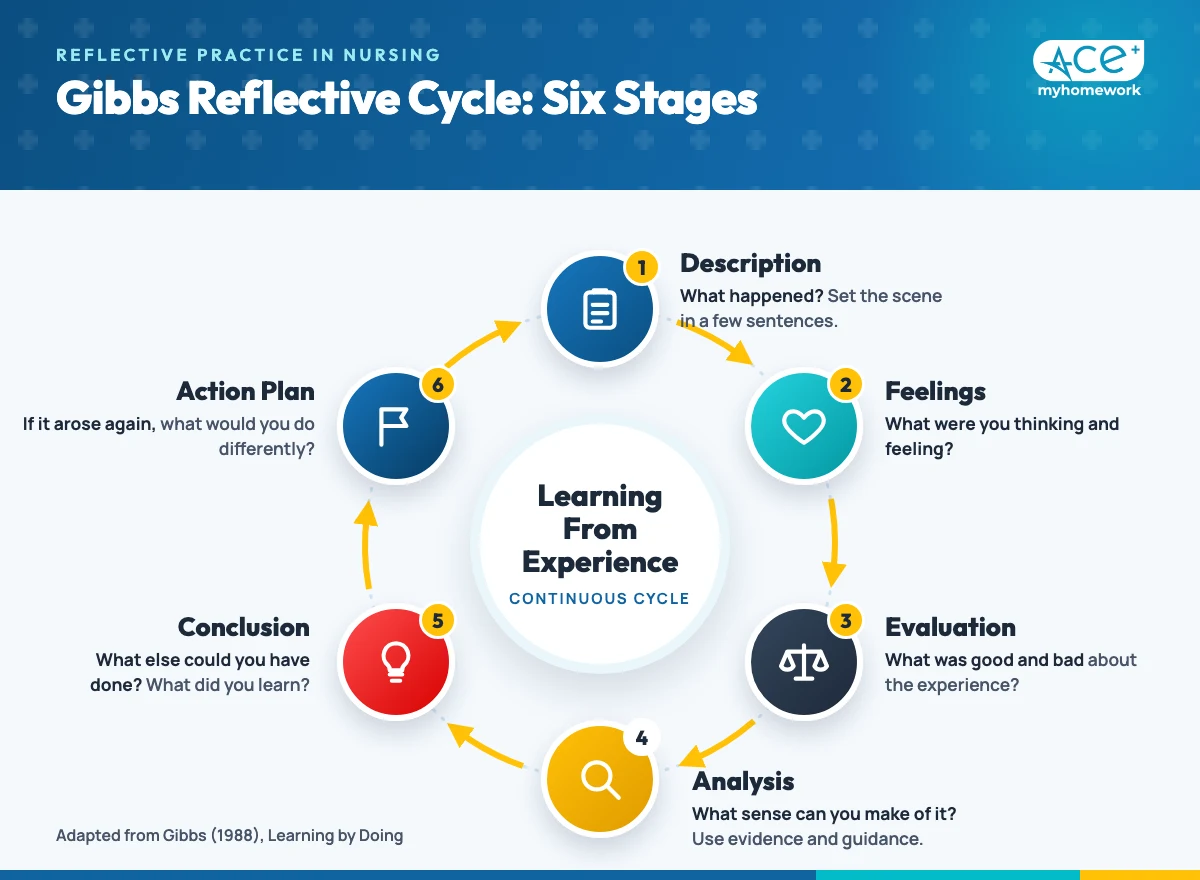
The Gibbs reflective cycle is a six-stage framework for learning from experience: Description, Feelings, Evaluation, Analysis, Conclusion and Action Plan. Graham Gibbs published it in 1988 in Learning by Doing: A Guide to Teaching and Learning Methods, and nursing programs now use it for clinical placement reflections, reflective essays and portfolios. Each stage answers one question, taking you from what happened to what you will do differently next time.
This guide explains each stage with prompt questions, gives you a fill-in template, and walks through a complete nursing example written the way a student would write it. It also covers common mistakes, confidentiality, how to cite Gibbs, and how the model compares with Johns, Driscoll and Kolb.
What Is the Gibbs Reflective Cycle?
Gibbs wrote Learning by Doing as a guide to teaching and learning methods, published by the Further Education Unit at Oxford Polytechnic. His argument was that experience alone does not produce learning: you have to think about the experience and plan how to use what you learned. Oxford Brookes University, the successor to Oxford Polytechnic, now offers the book as a free e-book, and its reflective cycle has been widely adopted in nursing and other health professions.
The cycle is often described as a development of Kolb's experiential learning cycle. What Gibbs added was a clearer writing structure, including a separate stage for feelings. That matters in nursing, where emotionally difficult events such as a deteriorating patient, a conflict with a family member or a near-miss error are often the ones you learn most from.
Why Reflective Practice in Nursing Matters
Reflective practice in nursing is the habit of examining your own actions and decisions so you can improve your care. It isn't only a classroom exercise. In the United States, the AACN Essentials name self-reflection in the descriptor for Domain 10: Personal, Professional, and Leadership Development, and the progression indicators expect students to analyze clinical experiences through structured and spontaneous reflection. In the United Kingdom, nurses must submit written reflective accounts as part of revalidation with the Nursing and Midwifery Council.
Structured models also seem to help students. In a qualitative study of master's-level nursing students who wrote reflective diaries after an internship, Zhan and colleagues (2023) concluded that Gibbs's cycle was valuable for clinical practice, with common themes including adverse events, knowledge gaps and conflict with patients. The authors also cautioned that structured templates may affect how authentic the writing is. Use the stages as a guide, not a form to fill in mechanically.
The Six Stages of the Gibbs Reflective Cycle
The six stages of the Gibbs reflective cycle. Adapted from Gibbs (1988).
The prompt questions below are based on Gibbs's original questions and the expanded version in the University of Edinburgh's Reflection Toolkit. You don't need to answer every question. Pick the ones that fit your experience.
1. Description: What Happened?
Set the scene briefly and factually. Say where you were, who was involved (by role only), what you and others did, and what the outcome was. Keep this stage short. Markers are looking for your thinking, and a long description leaves less room for it.
When and where did it happen, and why were you there?
Who was involved?
What did you do, and what did others do?
What was the outcome?
2. Feelings: What Were You Thinking and Feeling?
Describe your thoughts and emotions honestly, before, during and after the event. Students often skip or rush this stage, but your feelings frequently explain your actions. Anxiety, embarrassment or not wanting to bother a busy nurse can all shape what you do.
What were you feeling and thinking at the time?
How did you feel afterward, and how do you feel now?
How do you think the patient, family or other staff felt?
3. Evaluation: What Was Good and Bad About the Experience?
Make a balanced judgment. Name what went well as well as what went badly, including your own contribution. Evaluation says what was good or bad. Leave the why for the analysis.
What went well?
What didn't go well?
What did you and others contribute, positively or negatively?
4. Analysis: What Sense Can You Make of the Situation?
This is the most important stage and usually the longest. Explain why things happened the way they did, and bring in evidence: research, clinical guidelines, your facility's policy, professional codes or theory. This is where a reflection becomes academic writing, and it's the stage most often marked down for being thin. If you need to find and appraise sources, our guide to evidence-based practice in nursing explains how.
Why did things go well or badly?
What does the literature, guidance or policy say about situations like this?
Which personal, team or system factors played a part?
5. Conclusion: What Else Could You Have Done?
Summarize what you learned and what you could have done differently. Gibbs's original question for this stage is "What else could you have done?" A good conclusion follows directly from your analysis, not from general statements about nursing.
What did you learn from this experience?
How could it have gone better for everyone involved?
Which skills or knowledge do you need to develop?
6. Action Plan: If It Arose Again, What Would You Do?
Write specific, realistic actions with a time frame and a way to check that they worked. "I will read more about this" is too vague. "Before my next shift, I will complete the unit's online module on this topic and ask my preceptor to observe me using it" is an action you can actually carry out.
What exactly will you do differently next time?
How will you build the skills you need?
When will you do it, and how will you know it has worked?
Gibbs Reflective Cycle Template
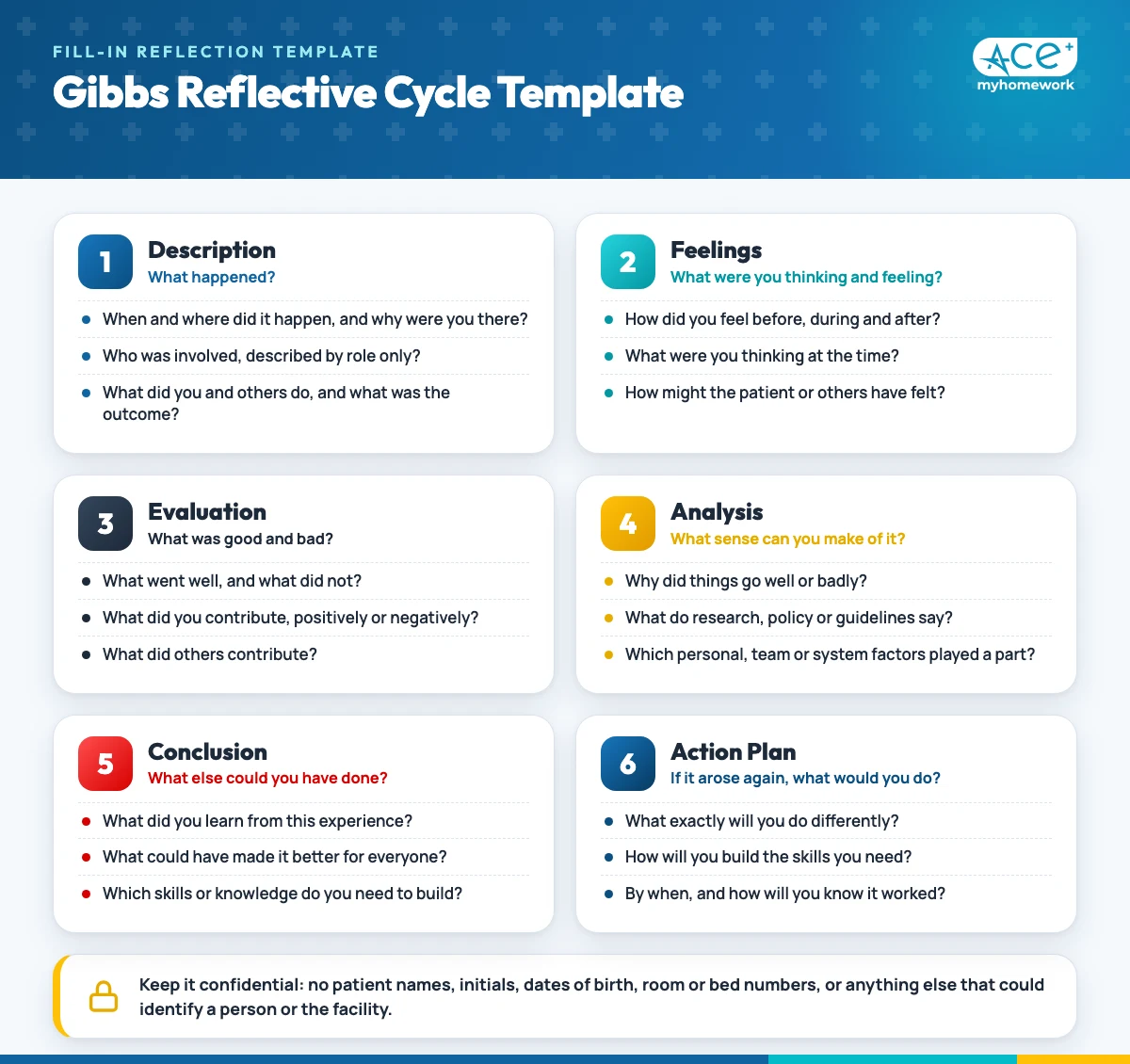
Use this Gibbs reflective cycle template to plan your reflection before you write it in paragraphs. The weighting column is a suggestion for a typical reflective essay, so check your rubric first.
Stage
Key question
Write about
Suggested weighting
Description
What happened?
Setting, roles, actions, outcome
Short
Feelings
What were you thinking and feeling?
Your emotions and thoughts before, during and after
Short
Evaluation
What was good and bad?
What went well and what didn't
Medium
Analysis
What sense can you make of it?
Reasons, supported by evidence and guidance
Longest
Conclusion
What else could you have done?
What you learned and the skills you need
Medium
Action plan
If it arose again, what would you do?
Specific actions, time frame, how you'll check
Medium
Prompt questions for each stage of a Gibbs reflection. Based on Gibbs (1988) and the University of Edinburgh Reflection Toolkit.
Gibbs Reflective Cycle Nursing Example
The following Gibbs reflective cycle nursing example is hypothetical. It describes an invented clinical placement scenario, written in the first person the way a student would write it. Notice that the patient is described only by age range and situation, and that the analysis uses evidence rather than opinion.
Example: Recognizing a Change in a Patient's Confusion
Description. During my second-year placement on a medical unit, I was caring for a man in his late 70s who had been admitted two days earlier with a chest infection. At handover, he was described as "confused, known dementia." Early in my evening shift, he was chatting with me and ate most of his dinner. Around two hours later, when I went to help him get ready for bed, he was picking at his blanket, couldn't follow what I was saying and kept trying to get out of bed. I stayed with him, reassured him and put his call light within reach. I assumed this was part of his dementia and didn't mention it to my preceptor until about an hour later, when she asked how my patients were. She went to see him straight away, compared his behavior with what his daughter had told the day staff about his usual self, and rechecked his vital signs. His temperature had risen since the previous set. She reported her findings to the covering provider, and the team began assessing him for delirium and its possible causes.
Feelings. At the time, I felt unsure. Something seemed different, but I told myself that confusion was expected in a patient with dementia. I also didn't want to interrupt my preceptor, who was busy with another patient. When she reacted so quickly, I felt embarrassed and then guilty that I had waited. Afterward I felt relieved that he was being assessed, and I wondered how frightening the evening had been for him and how worried his daughter would feel when she was called.
Evaluation. Some things went well. I noticed that his behavior had changed, I stayed with him to keep him safe, and once I spoke up, the information reached the provider quickly. My preceptor's response was a good model of how to act on a concern. What went badly was the delay. I accepted the handover label without checking his usual baseline, I didn't recheck his vital signs or compare them with earlier readings, and I waited to be asked instead of reporting the change myself.
Analysis. Looking back, I anchored on the word "dementia" from handover. Dementia is a gradual, progressive decline, while delirium is an acute confusional state that disturbs attention and fluctuates. A StatPearls review on differentiating delirium from dementia explains that the two often occur together, that delirium in a person with dementia can be missed or mistaken for the dementia itself, and that delirium may reverse with prompt treatment, which is why early recognition matters. His change was sudden and happened within a single shift, which should have prompted me to report it. I also realized I didn't know his baseline. I had never asked what he was normally like, so I had nothing to compare with. Another factor was my reluctance to interrupt. When I did speak up, my preceptor used SBAR to give the provider a clear, concise picture, and I have since practiced SBAR examples so I can report a change in condition the same way. I now understand that reporting a concern early is part of my role as a student, even if it turns out to be nothing.
Conclusion. I learned that a new or sudden change in a patient's thinking or behavior is a change in condition, and a diagnosis such as dementia doesn't explain it away. I could have asked about his usual cognition at the start of the shift, rechecked his vital signs, compared them with earlier readings and told my preceptor as soon as I noticed the change. I need to build my knowledge of delirium screening and my confidence to escalate concerns.
Action plan. Before my next shift, I will read my unit's delirium policy and practice the screening tool it uses with my preceptor. For the rest of this placement, I will ask at handover what each patient's usual level of cognition is and write it on my report sheet. If I notice any acute change, I will tell my preceptor immediately and use SBAR to structure what I say. At my mid-placement review, I will ask my preceptor for feedback on how promptly I am reporting changes.
Common Mistakes in a Gibbs Reflection
Too much description. If half your word count tells the story, the analysis is probably too thin. Cut details that don't affect what you learned.
No evidence in the analysis. Personal opinion isn't enough. Support your reasoning with guidelines, research, policy or theory, and cite them.
Feelings that go nowhere. Naming an emotion is only useful if you connect it to your actions, for example "because I felt anxious, I delayed asking for help."
Blaming others. Reflection focuses on your own practice. You can describe team or system factors, but explain what you could do differently.
A vague action plan. "I will be more confident" can't be measured. Name an action, a time frame and how you'll know it worked.
Choosing an event with nothing to learn. Pick an experience that challenged you or changed your thinking. A positive experience can work if you analyze why it went well.
Breaking confidentiality. Any detail that could identify a patient, colleague or facility should come out. See the next section.
Confidentiality in Nursing Reflections
A reflection is about your learning, not about the patient, so it should never contain identifying information. Remove names and initials, dates of birth, medical record numbers, room or bed numbers, exact dates, and the name of the unit or hospital if it could identify someone. The NMC tells nurses to be careful not to record any information that may identify another person in their reflective accounts. In the US, the HIPAA Privacy Rule lists the identifiers that must be removed for information to count as de-identified, under its Safe Harbor method, which is a useful checklist even for coursework.
Use general descriptions instead: "a woman in her 60s," "a medical-surgical unit," "during my second placement." If an unusual diagnosis or event could still identify someone, change non-essential details and say in your introduction that you have done so to protect confidentiality. Follow your school's and clinical site's policies, which may be stricter than these suggestions.
How to Cite the Gibbs Reflective Model
Cite Gibbs whenever you name or use the model, usually in your introduction. In APA 7th edition, the reference is:
Gibbs, G. (1988). Learning by doing: A guide to teaching and learning methods. Further Education Unit, Oxford Polytechnic.
The in-text citation is (Gibbs, 1988). If you read the free Oxford Brookes e-book edition, check its publication details and cite the version you actually used. APA treats a republished work as (Gibbs, 1988/2013), with "(Original work published 1988)" at the end of the reference. In Harvard style, which many UK schools use, the reference is usually written: Gibbs, G. (1988) Learning by doing: a guide to teaching and learning methods. Oxford: Further Education Unit, Oxford Polytechnic.
Write the reflection itself in the first person ("I felt," "I learned"), but keep the analysis academic. Our guide on how to cite sources in APA format covers the in-text rules for the guidelines and studies you use in your analysis.
Gibbs vs. Johns, Driscoll and Kolb
Gibbs's reflective model isn't the only option. Your instructor may specify one, or let you choose. Here is how the main alternatives compare.
Model
Structure
Best for
Watch out for
Gibbs (1988)
Six stages: Description, Feelings, Evaluation, Analysis, Conclusion, Action Plan
Reflective essays on a single event; students new to reflection
Becoming a long description with a short analysis
Johns' Model for Structured Reflection
Cue questions linked to Carper's patterns of knowing (empirical, ethical, personal, aesthetic) plus reflexivity
Deeper reflection on values, ethics and complex situations
More questions, so it takes longer and needs a higher word count
Driscoll's model
Three questions: What? So what? Now what?
Short reflections, clinical journals, supervision discussions
A theory of learning rather than a writing template; no separate feelings stage
Christopher Johns built his model on Barbara Carper's fundamental patterns of knowing in nursing. The University of Nottingham's summary of Johns' cue questions shows how each question maps to a pattern. Driscoll adapted three questions first asked by Terry Borton in 1970, as the University of Edinburgh explains in its guide to What? So what? Now what? If your assignment doesn't name a model, Gibbs is a safe choice for a typical reflective essay because its stages map neatly onto paragraphs.
Getting Help with a Reflective Essay
If your draft reads more like a story than a reflection, or your instructor has asked for a deeper analysis, it can help to have someone review it against the six stages. Our nursing homework help service offers feedback and tutoring on reflective assignments, including how to bring evidence into your analysis and tighten your action plan. For longer reflective essays, see our nursing essay help. Use any outside help in line with your school's academic integrity policy.
Frequently Asked Questions
What Are the Six Stages of the Gibbs Reflective Cycle?
Description (what happened), Feelings (what you were thinking and feeling), Evaluation (what was good and bad), Analysis (what sense you can make of it), Conclusion (what else you could have done) and Action Plan (what you would do if it arose again).
Is a Gibbs Reflection Written in the First Person?
Yes. Reflections are about your own experience, so "I" is expected. Keep the tone professional, and support the analysis with cited evidence just as you would in any academic paper.
How Long Should a Gibbs Reflection Be?
It depends on your assignment. Short placement reflections may be a few hundred words, while reflective essays are often longer. Whatever the length, give the analysis the most space and keep the description brief.
Can I Use the Gibbs Cycle for a Positive Experience?
Yes. Reflecting on something that went well is useful if you analyze why it worked and how you'll repeat it. Make sure there is still something specific to learn and act on.
What Is the Difference Between Gibbs and Driscoll?
Driscoll's model uses three questions (What? So what? Now what?), which suits short reflections. Gibbs's six stages separate feelings, evaluation and analysis, which gives more structure for a full reflective essay.
Do I Need References in a Gibbs Reflection?
Usually yes. Cite Gibbs (1988) when you introduce the model, and cite evidence such as guidelines, research or policy in your analysis. Check your rubric for the number and type of sources required.
Get affordable and top-notch help for your essays and homework services from our expert tutors. Ace
your homework, boost your grades, and shine in online classes—all with just a click away!
Nursing capstone project ideas for BSN and MSN students in nine areas, each framed as an evidence-based change with a measurable outcome you can track.
A SOAP note example for nursing students: two fully worked notes (RN and NP), a copy-ready template table and fixes for the charting mistakes that cost points.
Learn how to write a synthesis essay: the AP Lang format and 6-point rubric, a 7-step process, a synthesis matrix, outline, template and annotated example.