A sepsis nursing care plan organizes care for a patient whose response to an infection is damaging their own organs. The nursing priorities are early recognition, rapid escalation, helping the team deliver time-critical treatment, and close monitoring of perfusion, mental status and temperature. Risk for infection is the preventive side of the same plan: it covers the hand hygiene, device care and other measures that stop infections, including those that can lead to sepsis, from starting.
This guide explains current sepsis definitions and screening, the hour-1 bundle and the nurse's role in it, the nursing diagnoses related to sepsis, a full care plan table, the WHO 5 Moments for Hand Hygiene, a concept map outline and discharge teaching.
What Sepsis Is: Current Definitions
The Third International Consensus Definitions (Sepsis-3), published in 2016, define sepsis as life-threatening organ dysfunction caused by a dysregulated host response to infection. Put simply, the body's reaction to the infection starts harming the kidneys, lungs, brain, circulation or other organs. Septic shock is a subset of sepsis with profound circulatory and metabolic problems. Clinically, it is identified when a patient needs vasopressors to keep the mean arterial pressure (MAP) at 65 mm Hg or more and has a serum lactate above 2 mmol/L despite adequate fluid resuscitation. The older term "severe sepsis" was dropped as redundant, although you will still see it in older textbooks.
Sepsis is common and serious. The CDC reports that about 1.7 million adults in the United States develop sepsis each year, and at least 350,000 adults who develop it die during their hospitalization or are discharged to hospice. Most people who develop sepsis have at least one underlying medical condition or a recent hospital stay, which is why prevention and early recognition on general wards matter so much.
Recognizing Sepsis: Screening and Escalation
Nurses are usually the first to notice the early signs, because they see the patient most often and record the vital signs. The Surviving Sepsis Campaign 2021 guidelines recommend that hospitals run sepsis performance improvement programs that include screening for patients at high risk. Screening tools in common use include:
SIRS criteria: two or more of a temperature above 38 °C or below 36 °C, a heart rate above 90, a respiratory rate above 20 (or PaCO2 below 32 mm Hg), and a white cell count above 12,000 or below 4,000 per microliter (or more than 10% immature bands).
NEWS2: the Royal College of Physicians' National Early Warning Score 2 scores six routine physiological measures, with extra points if the patient needs supplemental oxygen. An aggregate score of 5 or more is the key threshold for an urgent response, and 7 or more triggers an emergency response.
MEWS: the Modified Early Warning Score, used in many US hospitals.
qSOFA: a respiratory rate of 22 or more, altered mentation and a systolic blood pressure of 100 mm Hg or less.
Be careful with qSOFA. The Surviving Sepsis Campaign 2021 guidelines make a strong recommendation against using qSOFA as a single screening tool, compared with SIRS, NEWS or MEWS, because it misses too many patients. A positive qSOFA should still raise concern, but a negative one does not rule sepsis out. Follow your facility's screening tool and protocol.
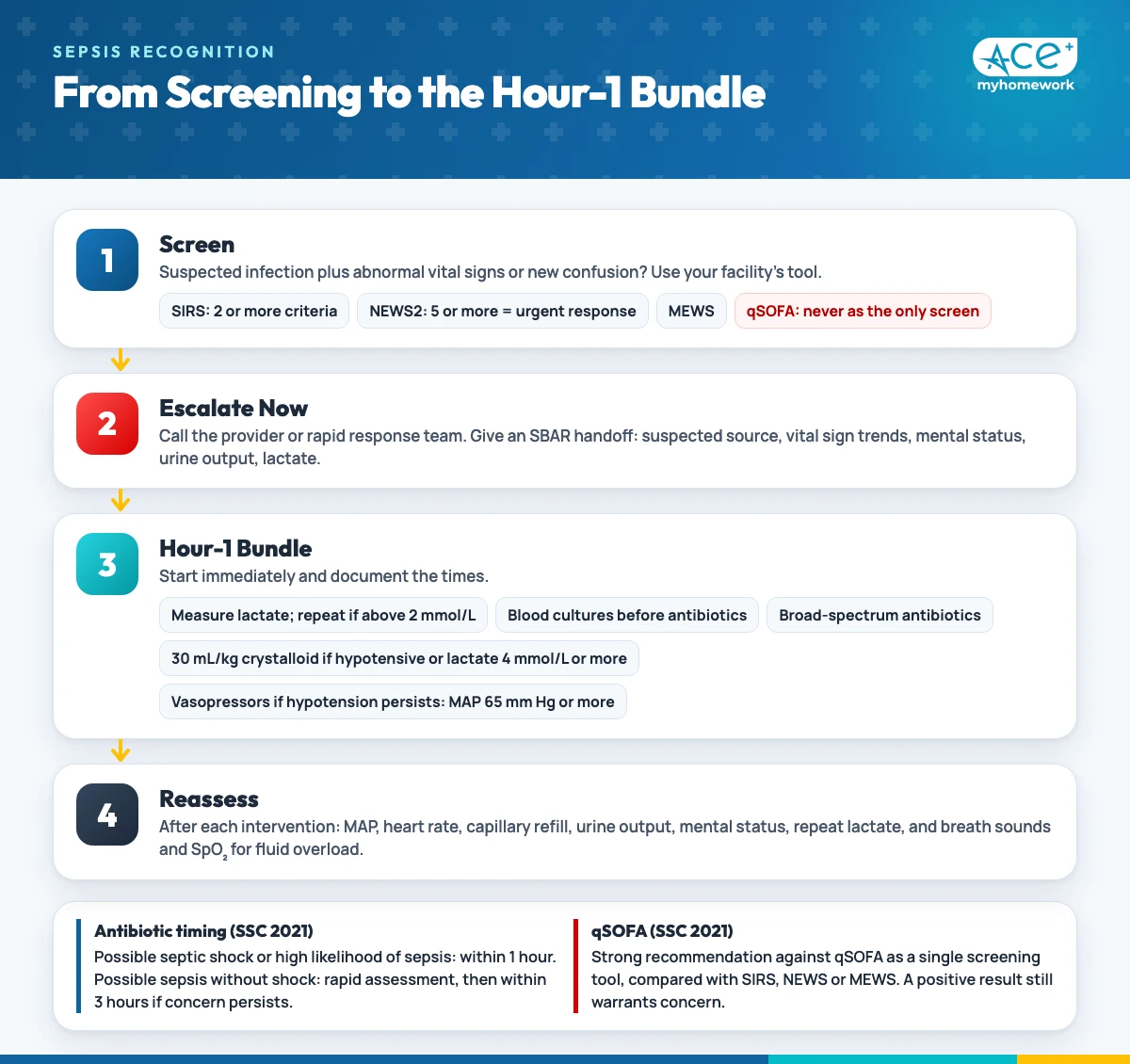
From screening to the hour-1 bundle. Based on the Surviving Sepsis Campaign 2021 guidelines and the 2018 hour-1 bundle.
When a screen is positive, or your clinical judgment says something is wrong, escalate straight away. Call the provider or rapid response team and use a structured handoff such as SBAR: the suspected source, the vital sign trends, mental status, urine output and any lactate result. A full head-to-toe assessment helps you find the source, such as a wound, a line site, the urine or the chest.
The Hour-1 Bundle and the Nurse's Role
The Surviving Sepsis Campaign's hour-1 bundle (2018 update) combined the earlier 3-hour and 6-hour bundles so that resuscitation starts immediately. Its five elements are:
Measure lactate, and measure it again if the first result is above 2 mmol/L.
Take blood cultures before giving antibiotics.
Give broad-spectrum antibiotics.
Start rapid IV crystalloid at 30 mL/kg for hypotension or a lactate of 4 mmol/L or more.
Start vasopressors if the patient stays hypotensive during or after fluid resuscitation, to keep MAP at 65 mm Hg or more.
The 2021 guidelines refined the timing. For possible septic shock or a high likelihood of sepsis, they recommend antimicrobials immediately, ideally within 1 hour of recognition. For possible sepsis without shock, they recommend a rapid assessment of infectious and non-infectious causes and, if concern for infection persists, antimicrobials within 3 hours. They suggest at least 30 mL/kg of IV crystalloid within the first 3 hours for sepsis-induced hypoperfusion or septic shock, balanced crystalloids rather than normal saline, norepinephrine as the first-line vasopressor, and an initial MAP target of 65 mm Hg. Cultures should be taken before antimicrobials only if this causes no substantial delay.
What this means for nursing care:
Secure IV access quickly, usually two peripheral lines, so fluids and antibiotics can run together.
Draw cultures and lactate as ordered, then give the first antibiotic dose without waiting for results. Document the exact times.
Give fluids as prescribed and reassess after each bolus: blood pressure, heart rate, capillary refill, urine output, breath sounds and SpO2. New crackles or falling oxygen saturation may mean fluid overload.
Monitor vital signs frequently during resuscitation, often every 15 minutes, and keep strict intake and output. A urinary catheter may be needed to measure output accurately, and it should be removed as soon as it is no longer needed.
Prepare for transfer to a higher level of care if hypotension persists or vasopressors are started.
Nursing Diagnosis Related to Sepsis
Sepsis itself is a medical diagnosis. There is no NANDA-I label called "sepsis," so a nursing diagnosis related to sepsis describes the patient's response or risk. Use the PES format for actual problems, and for risk diagnoses list the risk factors instead of signs and symptoms. Our nursing diagnosis examples show both formats. Common choices include:
Risk for shock, for a patient with infection and signs of hypoperfusion who is not yet in shock
Risk for infection, for preventing new or further infection, especially device-related
Hyperthermia, or ineffective thermoregulation when temperature swings or drops; a low temperature in sepsis is a worrying sign
Acute confusion, for new delirium, which can be an early sign of organ dysfunction
Impaired gas exchange, when the source is pneumonia or the lungs are affected; see our pneumonia nursing care plan
For example, a hypothetical 74-year-old patient admitted with a urinary tract infection has an indwelling urinary catheter and a peripheral IV. On day 2 the patient has a temperature of 38.6 °C (101.5 °F), heart rate 118, respiratory rate 24, blood pressure 92/54 (MAP 67) and is newly disoriented to time and place. The lactate is 3.1 mmol/L. The care plan below uses this example.
Sepsis Nursing Care Plan Table
This table combines a risk of infection nursing care plan with the actual sepsis-related problems. Adapt the outcomes to your patient's orders. For the method behind each column, see how to write a nursing care plan.
Nursing Diagnosis
Expected Outcomes (SMART)
Nursing Interventions
Rationale
Evaluation
Risk for shock related to infection-driven vasodilation and capillary leak (risk factors: hypotension, lactate 3.1 mmol/L, tachycardia)
Within 3 hours, MAP stays at 65 mm Hg or more and urine output is at least 0.5 mL/kg/hour. On repeat testing, lactate is falling.
Escalate a positive screen immediately using SBAR.
Draw cultures and lactate as ordered, then give antibiotics on time.
Give IV fluids as prescribed and reassess after each bolus.
Monitor BP, HR, capillary refill, mental status and urine output at least every 15 minutes during resuscitation.
Prepare for vasopressors and transfer if hypotension persists.
Sepsis is a medical emergency; guidelines call for treatment to begin immediately.
Cultures before antibiotics improve the chance of identifying the organism.
Persistent hypotension after fluids defines the need for vasopressors.
Met if MAP, urine output and lactate meet targets. If MAP stays below 65 mm Hg after fluids, the goal is not met and care escalates.
Risk for infection related to invasive devices (indwelling urinary catheter, peripheral IV), advanced age and reduced mobility
Throughout the stay, device sites show no redness, swelling or drainage, and each device's need is reviewed and documented daily.
Perform hand hygiene at each of the WHO 5 Moments.
Use aseptic technique when accessing lines; scrub the hub before each access.
Assess device sites every shift.
Ask daily whether each device is still needed and request removal when it is not.
Support nutrition, mobility, skin care and oral care.
Hands are the main route for spreading germs in health care.
Prevents organisms entering the bloodstream.
Detects early local infection.
The risk of device-related infection rises the longer a device stays in.
These support the body's defenses and skin barrier.
Met if no new infection develops. Document device days and removal dates.
Hyperthermia related to infectious process as evidenced by temperature 38.6 °C, warm flushed skin and HR 118
Within 24 hours of starting antibiotics, temperature is below 38 °C and HR is below 100.
Monitor temperature at least every 4 hours and with chills.
Give prescribed antipyretics and recheck within 1 hour.
Use light covers and avoid causing shivering.
Report a temperature below 36 °C promptly.
Tracks response to treatment.
Reduces metabolic and oxygen demand.
Shivering raises oxygen use.
A low temperature can signal more severe sepsis.
Met if temperature and HR normalize. Persistent fever may mean an uncontrolled source.
Acute confusion related to infection-related changes in brain function and perfusion as evidenced by new disorientation to time and place
Within 48 hours, the patient is oriented to person, place and time, with no falls or injuries.
Assess orientation and attention every shift with a validated tool, such as the Confusion Assessment Method.
Report new or worsening confusion immediately.
Reorient often and use glasses, hearing aids, a clock and family visits.
Keep the bed low, the call light in reach and avoid restraints.
Review sedating medications with the provider and protect sleep.
Delirium fluctuates and is easily missed without a tool.
New confusion can signal worsening organ dysfunction.
Familiar cues reduce disorientation.
Confused patients are at high risk of falls.
Sedatives and poor sleep can worsen delirium.
Met if the patient is oriented and no injury occurred. If confusion persists, review causes with the team.
Risk for Infection Nursing Care Plan Essentials
Risk for infection is one of the most widely used nursing diagnoses, and it remains in the NANDA-I 2024–2026 classification. It applies to any patient whose defenses or exposures put them at higher risk, such as those with invasive devices, surgical wounds, broken skin, malnutrition, diabetes, immunosuppression or older age. For surgical patients, the 2024–2026 edition adds a more specific label, risk for surgical wound infection, which replaced risk for surgical site infection.
Because it is a risk diagnosis, there are no signs and symptoms. Write it as: risk for infection related to [risk factors]. The outcomes describe what you are preventing, such as no fever, clean device sites and a healing wound. An infection nursing care plan for a patient who already has an infection usually shifts to actual problems such as hyperthermia, risk for shock or impaired skin integrity, while keeping risk for infection to prevent new healthcare-associated infections.
Core interventions in a risk of infection nursing care plan include:
Hand hygiene at the right moments (see below)
Aseptic technique for IV access, wound care and catheter care
Device stewardship: assess sites and remove urinary catheters and IV lines as soon as they are not needed
Skin and wound care: keep skin clean and intact, and reposition to prevent pressure injuries
Respiratory measures: early mobility, deep breathing and oral care
Nutrition and glucose control to support healing
Teaching: hand hygiene for patients and visitors, and vaccination review
The WHO 5 Moments for Hand Hygiene
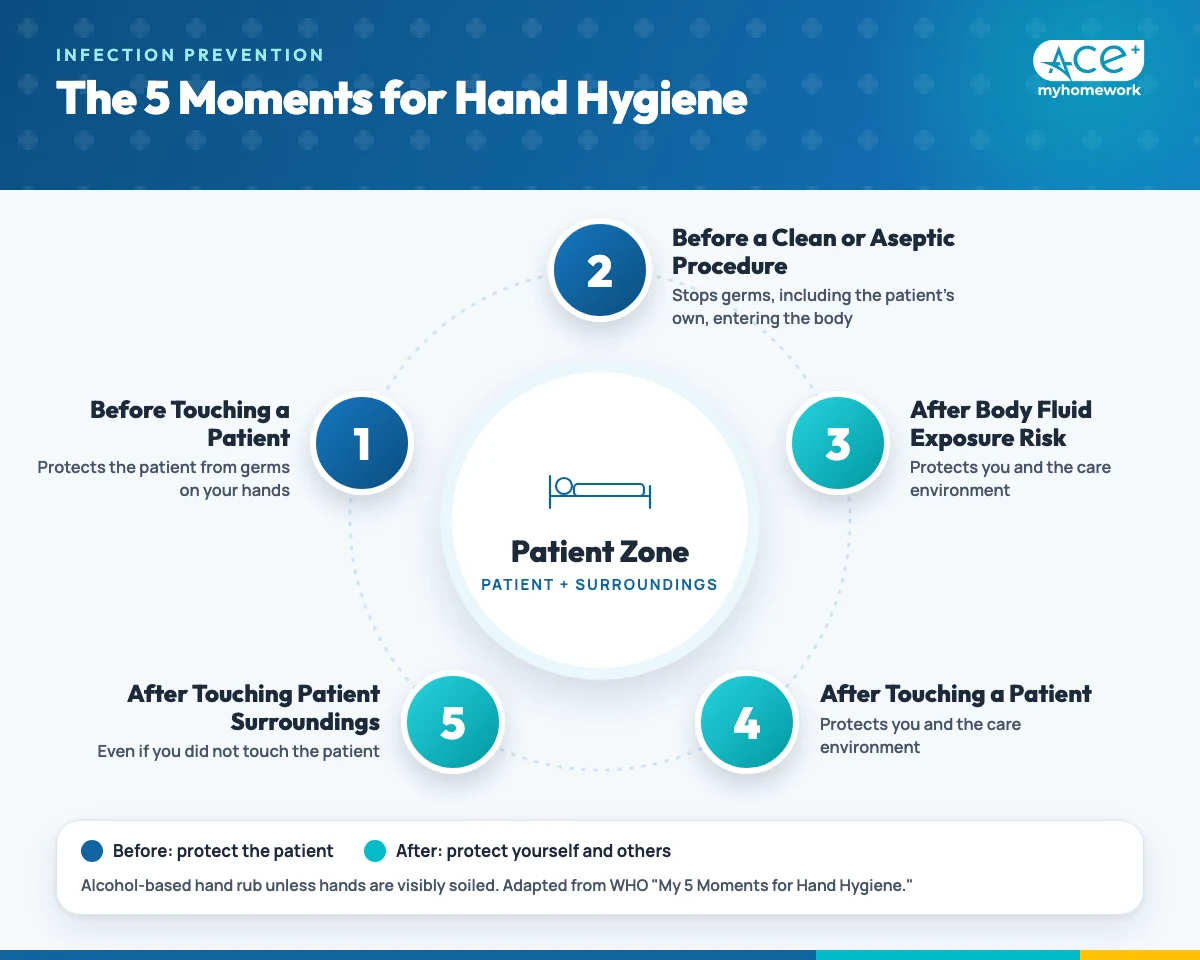
The World Health Organization's "My 5 Moments for Hand Hygiene" approach, from the WHO guidelines on hand hygiene in health care, defines when health workers should clean their hands during care. The WHO 5 Moments resources show them around the patient zone, which is the patient and their immediate surroundings.
The 5 Moments for Hand Hygiene, redrawn from the World Health Organization's "My 5 Moments for Hand Hygiene."
Before touching a patient, to protect the patient from germs carried on your hands.
Before a clean or aseptic procedure, such as accessing an IV line or inserting a catheter, to stop germs, including the patient's own, from entering their body.
After a body fluid exposure risk, to protect yourself and the environment.
After touching a patient, to protect yourself and the environment.
After touching the patient's surroundings, such as the bed rails or monitor, even if you did not touch the patient.
The CDC's hand hygiene guidance for healthcare workers says alcohol-based hand sanitizer is preferred in most clinical situations unless hands are visibly soiled. Use soap and water when hands are visibly dirty and, as an added precaution, after caring for patients with known or suspected C. difficile during outbreaks. Gloves are not a substitute for hand hygiene: clean your hands before putting gloves on and after taking them off.
Sepsis Concept Map Nursing Outline
A sepsis concept map helps you show how the infection, the body's response and your interventions connect. Our guide to nursing concept maps explains layout and links. For the example patient:
Center: sepsis from a urinary source; age 74; indwelling urinary catheter.
Pathophysiology box: infection triggers widespread inflammation, vasodilation and capillary leak, leading to low blood pressure, poor tissue perfusion and rising lactate.
Assessment data: T 38.6 °C, HR 118, RR 24, BP 92/54, MAP 67, new disorientation, lactate 3.1 mmol/L, cloudy urine.
Nursing diagnoses (ranked): risk for shock, acute confusion, hyperthermia, risk for infection.
Connections: hypoperfusion causes both rising lactate and confusion; fever raises oxygen demand; the catheter is both a likely source and an ongoing risk.
Interventions and outcomes: the bundle actions, monitoring, delirium care and device removal, each with a measurable goal.
Discharge Teaching for Sepsis Survivors
The Surviving Sepsis Campaign 2021 guidelines include recommendations for life after sepsis. They suggest offering written and verbal sepsis education before discharge, recommend reconciling medications at ICU and hospital discharge, and recommend assessment and follow-up for physical, cognitive and emotional problems after discharge. Teaching points include:
Finish the full course of any antibiotics as prescribed.
Know the warning signs that the CDC lists: clammy or sweaty skin, confusion or disorientation, extreme pain or discomfort, fever, shivering or feeling very cold, a fast heartbeat or weak pulse, and difficulty breathing.
Seek care urgently if those signs appear, and ask the clinician, "Could this be sepsis?"
Clean hands often and care for any wounds or devices as taught.
Keep vaccinations up to date and manage long-term conditions such as diabetes.
Expect recovery to take time, and report ongoing weakness, poor sleep, low mood or memory problems at follow-up.
Getting Help With a Sepsis Care Plan
Sepsis care plans and concept maps ask you to connect pathophysiology, guidelines and nursing actions, which takes practice. If you want feedback on your diagnoses, rationales or concept map, our nursing homework help service offers tutoring and draft review for nursing assignments. Use any outside help in line with your school's academic integrity policy.
Frequently Asked Questions
What Is the Priority Nursing Diagnosis for Sepsis?
Risk for shock is usually the priority for a patient with sepsis and signs of hypoperfusion, because circulation and organ perfusion are at stake. Once shock has developed, care is directed by the critical care team's protocols.
Is Sepsis a Nursing Diagnosis?
No. Sepsis is a medical diagnosis. Nurses write diagnoses about the patient's responses or risks, such as risk for shock, hyperthermia, acute confusion and risk for infection.
What Is in the Sepsis Hour-1 Bundle?
Measure lactate and repeat it if it is above 2 mmol/L, take blood cultures before antibiotics, give broad-spectrum antibiotics, give 30 mL/kg of crystalloid for hypotension or a lactate of 4 mmol/L or more, and start vasopressors to keep MAP at 65 mm Hg or more if hypotension persists.
Why Is qSOFA Not Recommended as a Single Screening Tool?
The Surviving Sepsis Campaign 2021 guidelines found that qSOFA has poor sensitivity, so it misses many patients who have sepsis. They recommend against using it alone, compared with SIRS, NEWS or MEWS.
How Do You Write a Risk for Infection Nursing Diagnosis?
Write "risk for infection related to" followed by the patient's risk factors, such as an indwelling urinary catheter, a surgical wound or diabetes. Risk diagnoses have no "as evidenced by" section because the problem has not happened yet.
What Are the WHO 5 Moments for Hand Hygiene?
Before touching a patient, before a clean or aseptic procedure, after a body fluid exposure risk, after touching a patient, and after touching the patient's surroundings.
Get affordable and top-notch help for your essays and homework services from our expert tutors. Ace
your homework, boost your grades, and shine in online classes—all with just a click away!
Nursing capstone project ideas for BSN and MSN students in nine areas, each framed as an evidence-based change with a measurable outcome you can track.