A nursing capstone project is the final project in many BSN and MSN programs, in which you identify a practice problem, appraise the evidence and propose, and sometimes pilot, an evidence-based change with a measurable outcome. The best capstone ideas are small and specific: one unit, one patient group, one change and one number you can track. "Reducing infections" is too broad; "a nurse-driven protocol to remove unneeded urinary catheters on a medical-surgical unit, measured by catheter days" is a capstone.
This guide gives nursing capstone project ideas grouped by clinical area, each framed as a practice change with a measurable outcome, and shows how to choose and narrow your topic. If your course asks for a research question rather than a change project, our list of nursing research topics is the better starting point.
What Makes a Strong Nursing Capstone Project
A capstone change project applies existing evidence to a real problem. It doesn't try to discover something new, which is what separates it from a research study. Strong projects share four features:
A local problem: something you've seen in clinical practice and can describe with unit data, audits or policy gaps.
Strong evidence: a clinical guideline, systematic review or consistent body of studies that supports the change. Our guide to evidence-based practice in nursing explains how to find and grade it.
A measurable outcome: a rate, score, time or audit result, not "better care."
A realistic scope: something a student can propose, or pilot, within one term with the unit's support.
Many programs use an EBP model to structure the work, such as the revised Iowa Model, which moves from a triggering issue through evidence review and a pilot to integrating and sustaining the change.
Even a small change project needs permission. If you plan to pilot anything, collect data from charts or survey staff, ask your instructor and clinical site what approval you need first. Some schools treat capstone pilots as quality improvement, while others send them to an ethics review board. Proposal-only capstones usually avoid this step, but you should still describe how patient data would be protected.
BSN vs MSN Capstone Projects
Expectations differ by program, but this pattern is common:
Feature
BSN capstone
MSN capstone
Scope
One unit or patient group
A unit, service line, program or population
Typical output
Proposal, poster or small pilot
Proposal with implementation plan, often with a pilot and evaluation
Focus
Bedside practice change and patient education
Leadership, education, informatics or advanced practice, depending on the track
Evidence
A focused review of key studies and guidelines
A fuller synthesis with an evidence table
Measures
One main outcome, often a process measure
Process and outcome measures, sometimes cost
The AACN Essentials set the competencies both levels build toward, including scholarship for the nursing discipline and quality and safety. Your syllabus and rubric decide the details.
How to Choose and Narrow Your Nursing Capstone Project
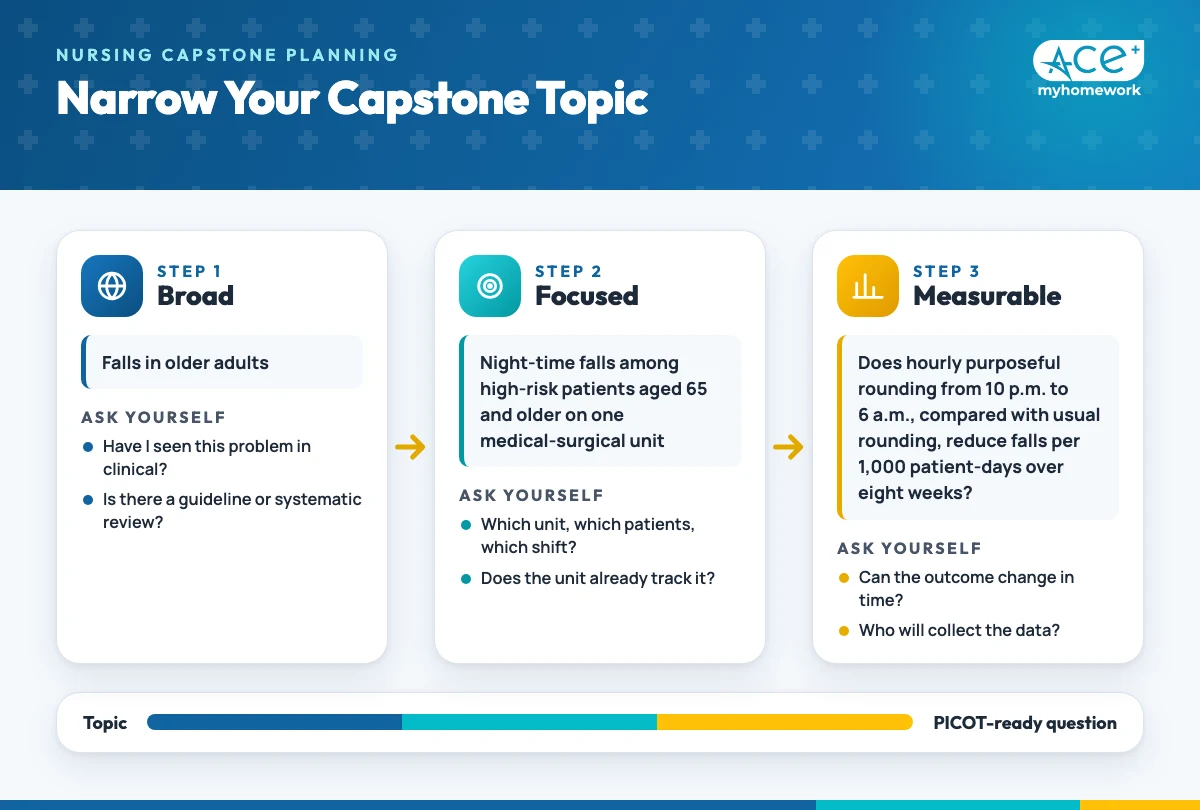
Most weak capstones fail at the narrowing stage. Move from a broad interest to a focused problem, then to a question with a measure and a time frame.
Narrow your capstone topic from broad to focused to measurable.
Start with what you've seen. List three problems from your clinical rotations or job: falls, missed reassessments, confused discharge instructions.
Check for evidence. Search for a guideline or systematic review on each. Drop any topic where the evidence is thin or conflicting.
Ask for data. Ask your preceptor or manager whether the unit tracks the problem. A baseline makes your proposal far stronger.
Pick one change. Choose a single intervention you can describe in a sentence.
Name the measure and time frame. Pick an outcome that can change within your project period.
Using the falls example in the graphic, a finished question might read: "On a medical-surgical unit, does hourly purposeful rounding between 10 p.m. and 6 a.m. for patients aged 65 and older at high fall risk, compared with usual rounding, reduce falls per 1,000 patient-days over eight weeks?"
Nursing Capstone Project Ideas by Area
Each idea names the change and a measure. Most work as BSN capstone project ideas at the unit level; ideas marked MSN suit a program, system or advanced role focus. Adjust the setting and measure to what your site can support. If your clinical placement doesn't fit any of these areas, use the same pattern: one population, one evidence-based change and one measure your unit can supply.
Medical-Surgical Nursing
Nurse-driven urinary catheter removal: a protocol letting nurses remove catheters that no longer meet indications, which the CDC's CAUTI prevention guideline lists as a quality improvement strategy. Measure: catheter days per 1,000 patient-days or catheter-associated urinary tract infections per 1,000 catheter-days.
Timely pain reassessment: a reminder in the medication administration workflow to reassess pain after PRN analgesics. Measure: proportion of PRN doses with a documented reassessment within the unit's policy window.
Early mobility after surgery: a nurse-led mobility schedule beginning on the day after surgery. Measure: time to first ambulation and proportion of patients ambulating three times a day.
Pressure injury prevention (MSN): a risk-triggered prevention bundle with skin champions on each shift. Measure: hospital-acquired pressure injuries per 1,000 patient-days.
Pediatrics
Procedural comfort: distraction and comfort positioning during IV starts and blood draws. Measure: self-reported pain scores on an age-appropriate scale.
Asthma discharge teaching: a written asthma action plan with inhaler technique checked by teach-back before discharge. Measure: proportion discharged with a completed plan and correct inhaler demonstration.
Maternal and Newborn Nursing
Quantitative blood loss: weighing and measuring blood loss at every birth, as in the obstetric hemorrhage bundle from the Alliance for Innovation on Maternal Health. Measure: proportion of births with quantitative blood loss documented.
Postpartum warning signs teaching: standardized teaching of postpartum warning signs with teach-back before discharge. Measure: proportion of patients who correctly name the signs that need emergency care.
Skin-to-skin contact: uninterrupted skin-to-skin contact after vaginal and cesarean births when mother and baby are stable. Measure: proportion of eligible dyads with skin-to-skin documented in the first hour and exclusive breast milk feeding at discharge.
Mental Health Nursing
De-escalation training: staff training and a structured de-escalation checklist on an inpatient psychiatric unit. Measure: restraint and seclusion events per 1,000 patient-days.
Suicide risk screening: a validated screening tool for patients 12 and older seen for behavioral health concerns, a requirement under the Joint Commission's National Performance Goals for hospitals. Measure: screening completion rate.
Post-discharge follow-up calls (MSN): nurse phone calls after psychiatric discharge to confirm the first outpatient appointment. Measure: proportion attending a follow-up visit within seven days.
Community and Public Health Nursing
Home blood pressure monitoring: teaching home blood pressure technique and logging at a community clinic. Measure: proportion returning with a completed log and proportion with blood pressure at goal (Healthy People 2030 HDS-05).
Influenza vaccination: standing orders so nurses can offer flu vaccine at every eligible visit. Measure: vaccination rate among eligible patients (HP2030 IID-09).
Naloxone education: overdose response teaching with naloxone distribution for people at risk and their families. Measure: kits distributed and correct responses on a short knowledge check.
Nursing Leadership and Management
Bedside shift report: a standardized bedside handoff that includes the patient, using a structured format such as SBAR. Measure: audit compliance and patient-reported communication.
Protected breaks (MSN): a break-relief nurse or buddy system on a high-acuity unit. Measure: proportion of shifts on which nurses report an uninterrupted break.
Safety huddles: brief start-of-shift huddles reviewing high-risk patients. Measure: near-miss reports per month and staff perceptions on a validated safety culture survey.
Nursing Education
Teach-back for discharge education: training nurses to use teach-back from the AHRQ Health Literacy Universal Precautions Toolkit. Measure: proportion of discharges with documented teach-back and patient understanding scores.
Preceptor development (MSN): a preceptor workshop with follow-up coaching. Measure: new graduate retention at 12 months and preceptor self-efficacy scores.
Just-in-time skills refreshers: short simulation sessions before shifts for low-frequency skills. Measure: performance on a competency checklist.
Nursing Informatics
Barcode scanning compliance: fixing the top causes of scanning workarounds on one unit. Measure: patient and medication scan rates.
Sepsis screening prompt (MSN): an EHR prompt for nurse sepsis screening each shift. Measure: screening completion and time from positive screen to provider notification.
Patient portal sign-up: bedside portal enrollment with a short tutorial before discharge. Measure: activation rate and portal use within 30 days.
Gerontological Nursing
Individualized fall prevention: fall plans tailored to each patient's risk factors, as the Joint Commission's falls standard requires, using tools from the AHRQ fall prevention toolkit. Measure: falls and injury falls per 1,000 patient-days.
Delirium screening: routine screening with a validated tool and nonpharmacological prevention for patients 65 and older. Measure: screening completion and delirium incidence.
Hospital walking program: nurse- and aide-supported walks for older inpatients. Measure: walks per patient-day and ability to perform activities of daily living at discharge.
Choosing a Measure for Your Capstone
Every idea above pairs a change with a measure, and the measure is where many proposals lose marks. Instructors usually want to see that you understand what kind of measure you've chosen and why it fits your time frame.
Type of measure
What it tells you
Capstone example
Process
Whether the change actually happened as planned
Proportion of PRN pain doses with a timely reassessment
Outcome
Whether patients or staff are better off
Falls per 1,000 patient-days
Balancing
Whether the change caused a new problem elsewhere
Extra minutes spent on discharge teaching per patient
Knowledge or confidence
Whether teaching worked, before practice changes
Staff scores before and after teach-back training
For a BSN proposal, one process measure and one outcome measure are usually enough. Explain where the data will come from, such as chart audits, unit dashboards or observation checklists, and how often you will collect it. If you will compare results before and after the change, say how, even if the comparison is as simple as a percentage change or a run chart.
MSN Capstone Project Ideas by Track
MSN programs often tie the capstone to a role. A few patterns work well:
Nurse educator track: design, deliver and evaluate a staff or student education program with a practice measure, not just a test score.
Leadership track: a unit-level change with a cost, staffing or retention measure and a stakeholder plan.
Informatics track: a workflow or EHR change with usage data, error rates or time measures.
Nurse practitioner track: a screening or chronic disease protocol in primary care. If you are heading for a DNP later, our list of DNP project ideas shows how these scale up.
Common Capstone Mistakes to Avoid
Choosing a research question: "What causes nurse burnout?" is research. "Does a peer support program reduce burnout scores on our unit?" is a change project.
Measuring only knowledge: a pre-test and post-test show learning, not practice change. Add an audit or patient outcome.
Picking an outcome that won't move: mortality and annual infection rates rarely change in one term. Use process measures and short-term outcomes.
Ignoring the unit: without a manager or preceptor who supports the idea, even a proposal can stall.
Getting Help with Your Capstone
If you're stuck choosing between topics or your instructor has asked you to narrow your proposal, our capstone project writing services connect you with writers who can give feedback on your topic, PICOT question, literature review and outline. Use any outside help in line with your school's academic integrity policy.
Frequently Asked Questions
What Is a Nursing Capstone Project?
It is a final course project in which you identify a practice problem, review the evidence and propose, or pilot, an evidence-based change with a measurable outcome. Many programs also ask for a poster or presentation.
What Are Good Nursing Capstone Project Ideas for BSN Students?
Unit-level changes work best, such as nurse-driven catheter removal, teach-back for discharge education, pain reassessment reminders, safe sleep audits or bedside shift report.
How Is a Capstone Different From a Research Paper?
A research paper asks a question that needs new data to answer. A capstone change project applies evidence that already exists and measures whether the change worked in a specific setting.
How Do I Narrow My Capstone Topic?
Move from a broad interest to one population, one setting and one change, then choose an outcome you can measure within your project period. Write it as a PICOT question to check that every part is specific.
Do I Have to Implement My Capstone Project?
Not always. Many BSN capstones are proposals or small pilots, while MSN programs more often expect implementation and evaluation. Check your syllabus and rubric.
Can My Capstone Topic Come From My Job?
Yes, and that often makes it stronger, because you understand the workflow and can get access to data. Make sure your manager agrees and that you follow your organization's rules on data and approvals.
Need Help With Research Papers & Dissertations?
Post your assignment, compare tutor bids and work with an expert who explains each step.
Get affordable and top-notch help for your essays and homework services from our expert tutors. Ace
your homework, boost your grades, and shine in online classes—all with just a click away!
Term Paper: • Definition • Outline • Example • Format. Perfect for college, or university students, this post covers everything from structure and tips to examples, helping you achieve academic excellence.
Explore 120 nursing research topics by specialty, from med-surg to informatics, plus how to narrow a topic, write a PICOT question and plan for IRB review.
Discover 50 innovative capstone project ideas tailored for early childhood education to inspire creativity and engagement. Read the article for insights!