The nursing diagnosis of impaired gas exchange describes a patient whose lungs are not moving enough oxygen into the blood, or enough carbon dioxide out of it, across the alveolar-capillary membrane. In pneumonia, infected alveoli fill with fluid, white blood cells and debris, so air cannot reach the blood in those parts of the lung. That is why impaired gas exchange is usually the priority diagnosis in a pneumonia nursing care plan, with the assessment data showing low oxygen saturation, fast breathing, crackles and sometimes new confusion.
This guide explains what the diagnosis means, how pneumonia causes it, how to write the PES statement, and what a complete care plan table looks like. It also covers positioning for breathing, red flags that need escalation, and a simple concept map outline you can adapt for clinical paperwork.
What Is the Nursing Diagnosis of Impaired Gas Exchange?
Impaired gas exchange is a NANDA International (NANDA-I) diagnosis in Domain 3, Elimination and Exchange, under the class for respiratory function. In plain terms, it applies when oxygenation, carbon dioxide removal or both are abnormal at the level of the alveoli and pulmonary capillaries. The label remains in the current NANDA-I 2024–2026 classification, so you can use it as written.
The data that support this diagnosis (its defining characteristics) usually include:
Low oxygen saturation (SpO2) or low arterial oxygen (PaO2) on an arterial blood gas
Abnormal carbon dioxide levels: often low early on from fast breathing, rising later if the patient tires
Shortness of breath, a fast respiratory rate and use of accessory muscles
Restlessness, irritability, confusion or drowsiness
A fast heart rate
Pale, dusky or cyanotic skin and mucous membranes (a late sign)
Nasal flaring or an abnormal breathing pattern
The usual related factor is ventilation-perfusion imbalance, meaning blood is flowing past alveoli that are not being ventilated. Changes to the alveolar-capillary membrane, such as inflammation and fluid, are listed as associated conditions. Nurses cannot treat the infection itself, but they can treat the patient's response to it by optimizing oxygen delivery, ventilation and oxygen demand.
Impaired Gas Exchange vs. Related Respiratory Diagnoses
Students often mix up the three main respiratory diagnoses. The difference is where the problem sits:
Diagnosis
Where the problem is
Key evidence in pneumonia
Impaired gas exchange
The alveolar-capillary membrane: oxygen and carbon dioxide are not crossing well
Low SpO2 or PaO2, abnormal ABG, restlessness or confusion
Ineffective airway clearance
The airways: secretions are blocking the flow of air
Weak or ineffective cough, rhonchi, thick sputum
Ineffective breathing pattern
The mechanics of breathing: rate, depth or rhythm
Shallow, rapid breathing, often from pleuritic pain or fatigue
Many patients with pneumonia meet criteria for more than one. Choose the diagnoses your data actually support, and rank them using airway, breathing and circulation priorities.
How Pneumonia Impairs Gas Exchange
Pneumonia is an infection of the lung tissue. When organisms reach the alveoli, the immune response brings fluid, neutrophils and inflammatory debris into the air spaces. Areas of lung that fill this way are described as consolidated, which is what appears as an opacity on a chest X-ray. The StatPearls review of community-acquired pneumonia describes this inflammatory process and the range of severity, from mild illness managed at home to cases needing intensive care.
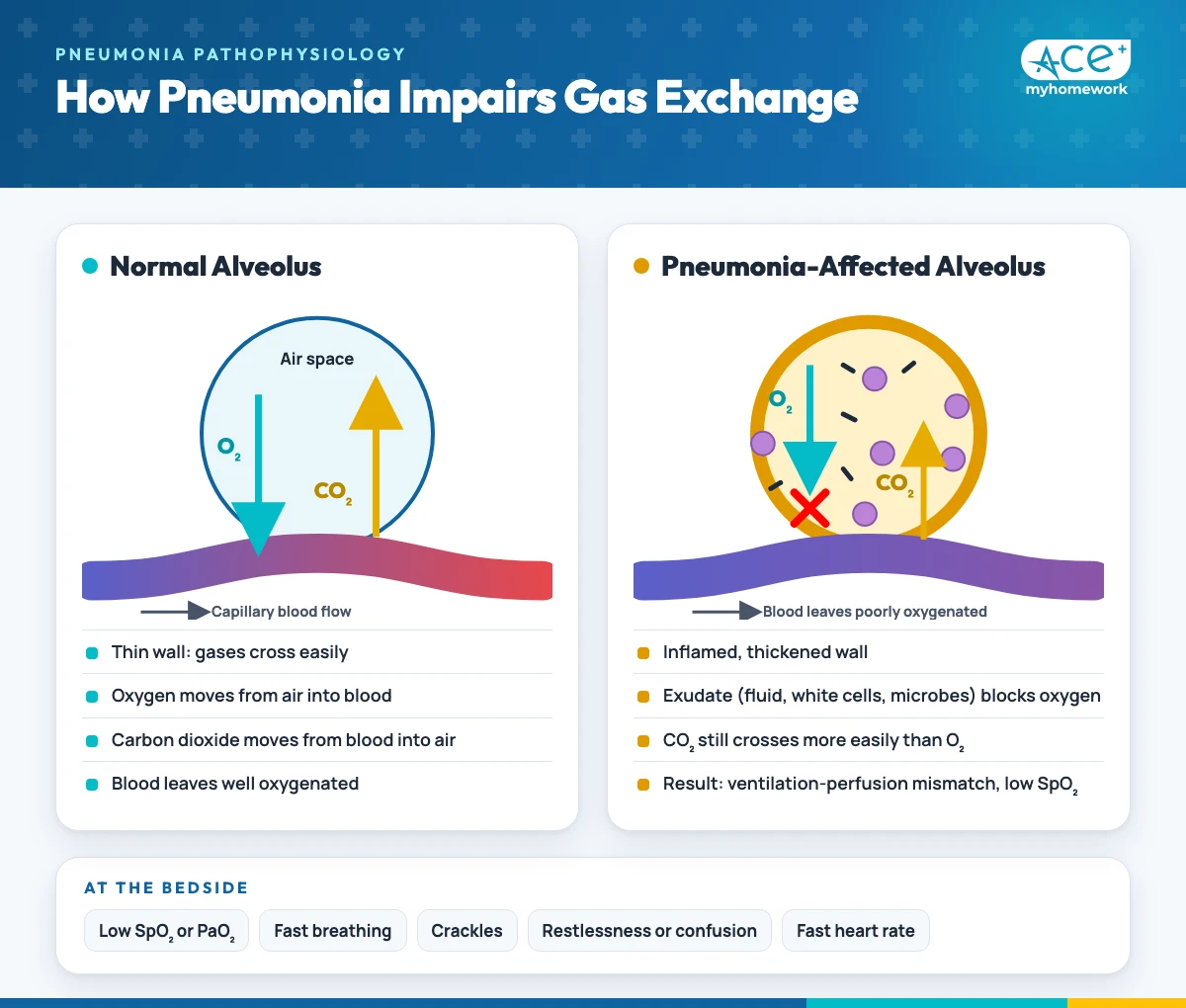
Normal versus pneumonia-affected alveolus. Exudate in the air space blocks oxygen transfer, so blood leaves that area poorly oxygenated.
Three things happen that matter for nursing care:
Ventilation-perfusion mismatch: blood still flows past alveoli that contain fluid instead of air, so it leaves the lung without picking up enough oxygen.
A longer diffusion path: inflammation and fluid thicken the barrier between air and blood.
Higher oxygen demand: fever, fast breathing and coughing all raise the body's oxygen use at the same time that supply is falling.
Carbon dioxide crosses the membrane more easily than oxygen, so early pneumonia usually lowers oxygen first, and the fast breathing often pushes carbon dioxide below normal. A rising carbon dioxide level in a patient who was breathing fast is a warning sign that they are tiring.
Types of Pneumonia You Will See in Care Plans
Community-acquired pneumonia (CAP): develops outside hospital or is present on admission.
Hospital-acquired pneumonia (HAP): develops 48 hours or more after admission and was not incubating at the time.
Ventilator-associated pneumonia (VAP): develops 48 hours or more after intubation.
Aspiration pneumonia: follows inhalation of oral or gastric contents, often in patients with swallowing problems or reduced consciousness.
Nursing Assessment for Pneumonia
A strong care plan starts with focused assessment data. Use your head-to-toe assessment as the frame and go deeper on the respiratory system.
Respiratory: rate, depth and effort; SpO2 and the oxygen device and flow rate; accessory muscle use; ability to speak in full sentences; cough and sputum (amount, color, consistency); crackles, bronchial breath sounds or diminished sounds over the affected area; dullness to percussion.
Neurological: new restlessness, anxiety, confusion or drowsiness, which can be early signs of low oxygen, especially in older adults.
Cardiovascular: heart rate, blood pressure, capillary refill and skin color.
Temperature and hydration: fever or low temperature, chills, mucous membranes, urine output and oral intake.
Pain: sharp chest pain on breathing (pleuritic pain) that makes the patient breathe shallowly.
Diagnostics: chest imaging, complete blood count, chemistry, arterial blood gas if ordered, and cultures where indicated.
The 2019 ATS/IDSA guideline for community-acquired pneumonia recommends sputum and blood cultures for hospitalized adults with severe pneumonia or risk factors for resistant organisms, rather than for every patient, so check your orders. The same guideline lists the criteria for severe pneumonia. Minor criteria include a respiratory rate of 30 breaths per minute or more, confusion, multilobar infiltrates, low blood pressure needing aggressive fluids, and a low temperature. These are useful red flags to watch for at the bedside.
Writing a Nursing Diagnosis for Pneumonia
A complete nursing diagnosis for pneumonia follows the PES format: problem, etiology (related to) and signs and symptoms (as evidenced by). If you need a refresher on the structure, our nursing diagnosis examples walk through PES statements step by step.
For example, a hypothetical 72-year-old patient is admitted with right lower lobe community-acquired pneumonia. Temperature is 38.9 °C (102 °F), heart rate 112, respiratory rate 28, blood pressure 118/70 and SpO2 89% on room air. There are crackles over the right base, a productive cough with rust-colored sputum, and new restlessness. A PES statement could be:
Impaired gas exchange related to ventilation-perfusion imbalance as evidenced by SpO2 89% on room air, respiratory rate 28, restlessness and crackles in the right lower lobe.
Other diagnoses that commonly appear in a pneumonia care plan, depending on the data:
Ineffective airway clearance related to excessive and thick secretions
Ineffective breathing pattern related to pleuritic pain or respiratory muscle fatigue
Hyperthermia related to the infectious process
Risk for inadequate fluid volume (called risk for deficient fluid volume in older editions) related to fever, fast breathing and poor oral intake
Decreased activity tolerance (formerly activity intolerance) related to an imbalance between oxygen supply and demand
The table below is a model nursing care plan for pneumonia using the example patient above. Adjust the targets to your patient's orders and baseline, especially the oxygen saturation target. For the full method behind each column, see how to write a nursing care plan.
Nursing Diagnosis
Expected Outcomes (SMART)
Nursing Interventions
Rationale
Evaluation
Impaired gas exchange related to ventilation-perfusion imbalance as evidenced by SpO2 89% on room air, RR 28, restlessness and right basal crackles
Within 1 hour, SpO2 is within the prescribed target range. Within 48 hours, RR is 12–20 at rest and the patient is calm and oriented.
Assess RR, work of breathing, SpO2 and mental status at least every 1–2 hours and after any change.
Give oxygen as prescribed and titrate to the ordered target.
Position in high Fowler's, or side-lying with the unaffected lung down if ordered and tolerated.
Cluster care and plan rest periods.
Monitor ABGs and report a rising CO2, falling SpO2 or new confusion promptly.
Restlessness and tachypnea are early signs of hypoxemia.
Supplemental oxygen raises the oxygen available for diffusion.
Upright positions let the diaphragm descend; gravity sends more blood to the dependent lung.
Rest lowers oxygen demand.
Rising CO2 suggests fatigue and possible respiratory failure.
Goal met if SpO2 stays in range on the same or lower oxygen, RR is within 12–20 and mentation is at baseline. Revise if oxygen needs are increasing.
Ineffective airway clearance related to excessive, thick secretions as evidenced by weak cough, rhonchi and purulent sputum
By the end of the shift, the patient coughs up secretions independently. Within 48 hours, breath sounds are clearer after coughing.
Auscultate before and after coughing.
Teach deep breathing and the huff cough; splint the chest with a pillow.
Encourage oral fluids unless restricted.
Mobilize early: sitting out of bed, then walking.
Suction only if the patient cannot clear secretions.
Shows whether secretions are moving.
Deep breaths and huffing move mucus toward larger airways; splinting reduces pain.
Hydration helps keep secretions thin.
Movement improves lung expansion and drainage.
Suctioning can cause trauma and drop oxygen levels.
Met if the cough is effective, sputum is cleared and rhonchi reduce. If not, review hydration, pain control and the need for respiratory therapy.
Hyperthermia related to infectious process as evidenced by temperature 38.9 °C, flushed warm skin and HR 112
Within 48 hours of starting treatment, temperature is below 38 °C and HR is below 100.
Monitor temperature at least every 4 hours and with chills.
Give prescribed antibiotics on time, after cultures when ordered.
Give prescribed antipyretics and recheck temperature.
Use light bedding and avoid inducing shivering.
Watch for signs of sepsis: hypotension, confusion, low urine output.
Trends show response to treatment.
Timely antibiotics treat the cause; cultures taken first are more accurate.
Lowering fever reduces oxygen demand and discomfort.
Shivering raises oxygen use.
Pneumonia is a common source of sepsis.
Met if the fever resolves and HR normalizes. Persistent fever after 48–72 hours should be reported.
Risk for inadequate fluid volume related to fever, tachypnea and poor oral intake
Throughout admission, urine output is at least 0.5 mL/kg/hour, mucous membranes are moist and BP stays at baseline.
Keep strict intake and output; weigh daily.
Offer oral fluids regularly unless restricted.
Give IV fluids as prescribed, watching for crackles or edema.
Monitor BUN, creatinine and electrolytes.
Check orthostatic BP before first mobilization.
Detects losses early.
Replaces insensible losses from fever and fast breathing.
Patients with heart or kidney disease can be overloaded.
Shows hydration and kidney function.
Dehydration increases fall risk on standing.
Met if intake balances output and labs stay in range. Report oliguria or a rising creatinine.
Decreased activity tolerance related to imbalance between oxygen supply and demand as evidenced by dyspnea and SpO2 falling with exertion
Within 72 hours, the patient walks to the bathroom with SpO2 staying in the target range and recovers to baseline RR within 3 minutes.
Monitor SpO2, HR and RR before, during and after activity.
Progress activity in steps: sitting, standing, short walks.
Schedule rest between care activities.
Teach pursed-lip breathing during exertion.
Refer to physical therapy if progress stalls.
Shows the safe level of activity.
Gradual progression builds tolerance without exhaustion.
Prevents excessive oxygen debt.
Slows breathing and reduces breathlessness.
Supports safe mobility and discharge planning.
Met if the patient completes the activity within target ranges. If desaturation persists, discuss oxygen needs with the provider.
Positioning to Improve Breathing
Positioning is one of the simplest, lowest-risk nursing interventions for impaired gas exchange, and it is something you can change right away.
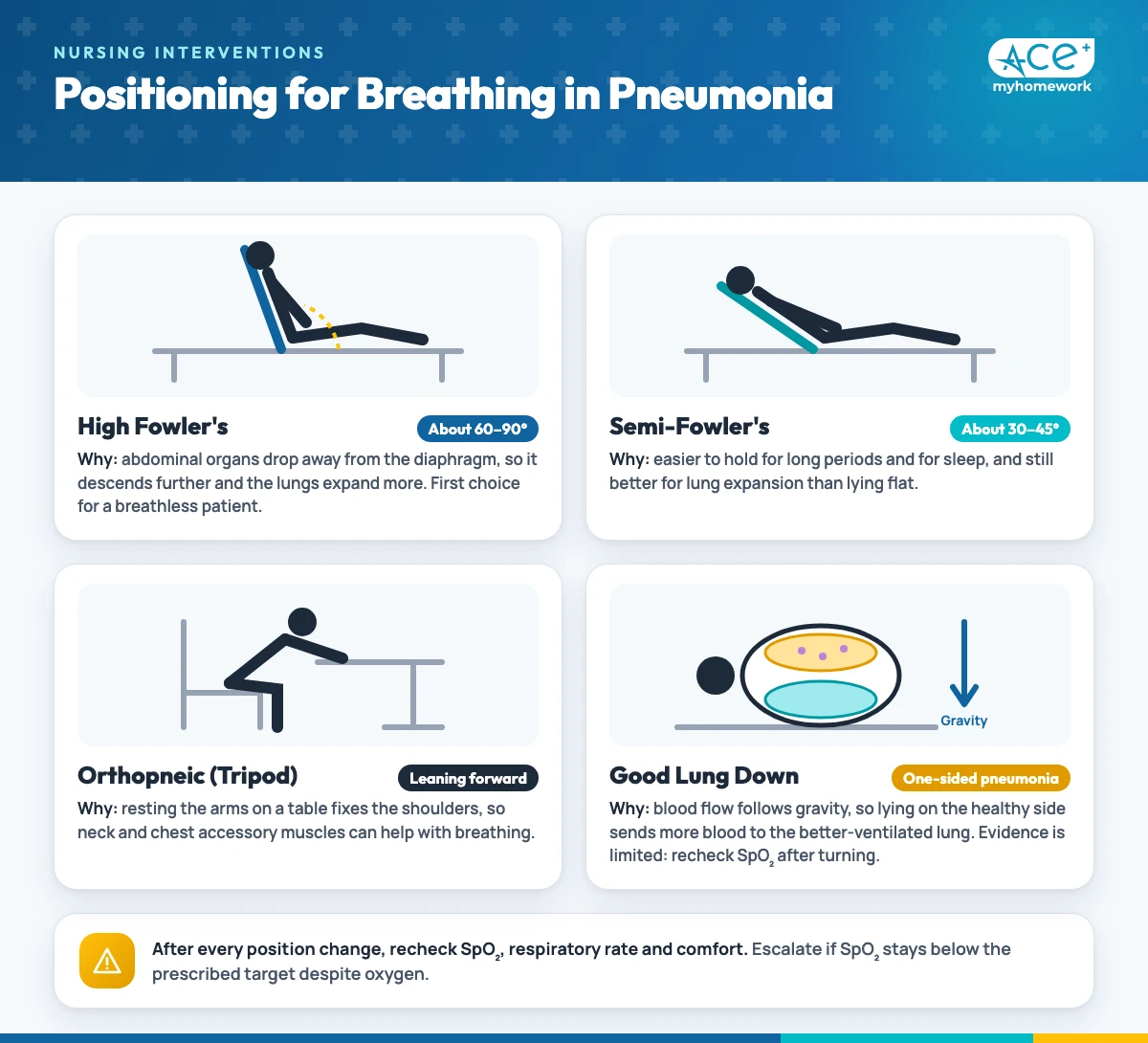
Positions that support breathing and gas exchange, with the reason each one helps. Check oxygen saturation after every change.
High Fowler's (head of bed about 60 to 90 degrees): gravity moves the abdominal organs down, so the diaphragm can descend further and the lungs can expand more fully. This is usually the first position to try for a patient who is short of breath.
Semi-Fowler's (about 30 to 45 degrees): easier to tolerate for long periods and for sleep, and still better for breathing than lying flat.
Orthopneic or tripod position: sitting up and leaning forward onto an overbed table or the knees. Fixing the arms helps the accessory muscles of the neck and chest assist with breathing.
Side-lying with the good lung down: for pneumonia on one side, lying on the unaffected side places the healthier lung in the dependent position, where gravity sends more blood flow, which can improve ventilation-perfusion matching. A Cochrane review of lateral positioning in critically ill adults found the evidence limited and noted that some patients respond the opposite way, so always recheck SpO2 after turning. Avoid this position when secretions or blood could drain into the healthy lung, such as with a lung abscess, unless the provider directs otherwise.
Prone positioning is used for moderate to severe acute respiratory distress syndrome (ARDS) in intensive care under specific protocols. It is not part of routine ward care for pneumonia, so do not include it in a student care plan unless your patient is in that situation.
Oxygen Therapy and When to Escalate
Oxygen is a prescribed therapy with a target range, not a set flow rate. The British Thoracic Society oxygen guideline, widely used for teaching, recommends a target SpO2 of 94–98% for most acutely ill adults and 88–92% for those at risk of hypercapnic respiratory failure, such as some patients with COPD. Your facility's protocol and the provider's order set the target for your patient. Document the device, flow rate and SpO2 together each time.
Call the provider or rapid response team promptly, using a structured handoff such as SBAR, if you see:
SpO2 below the target range despite increasing oxygen
Respiratory rate of 30 or more, or a patient too breathless to speak in sentences
New or worsening confusion or drowsiness
Falling blood pressure, a heart rate rising above its trend, cool mottled skin or low urine output, which can signal sepsis
A rising PaCO2 or falling pH on the blood gas
Chest pain, coughing up blood or a sudden change in breath sounds
Pneumonia Concept Map Nursing Outline
Many programs ask for a concept map alongside the written care plan. A pneumonia concept map links the medical diagnosis to assessment data, nursing diagnoses and interventions so your instructor can see your clinical reasoning. Our guide to nursing concept maps covers layout and grading. A simple outline for the example patient:
Center: community-acquired pneumonia, right lower lobe; age 72; relevant history.
Assessment data cluster: SpO2 89% on room air, RR 28, HR 112, T 38.9 °C, right basal crackles, rust-colored sputum, restlessness, chest X-ray showing right lower lobe consolidation.
Nursing diagnoses (ranked): impaired gas exchange; ineffective airway clearance; hyperthermia; risk for inadequate fluid volume; decreased activity tolerance.
Links: draw lines showing how one problem worsens another, for example fever raising oxygen demand, and thick secretions worsening gas exchange.
Interventions: two or three for each diagnosis, taken from your care plan table.
Outcomes and evaluation: one measurable goal per diagnosis and whether it was met.
Patient Teaching and Discharge Planning
Take the full antibiotic course exactly as prescribed, even after feeling better.
Keep doing deep breathing and coughing exercises, and use the incentive spirometer if one was given.
Rest, increase activity gradually, and expect fatigue to last for some weeks.
Drink fluids unless told to limit them.
Stop smoking and avoid secondhand smoke; offer cessation support.
Check vaccination status. The CDC's pneumococcal vaccine recommendations set out who should receive pneumococcal vaccine, and influenza and COVID-19 vaccination are also relevant.
Return or seek urgent care for worsening shortness of breath, chest pain, confusion, a fever that returns, or bluish lips.
Use teach-back to confirm understanding: ask the patient to explain in their own words when to take each medicine and which symptoms mean they should get help.
Getting Help With a Pneumonia Care Plan
Care plans for pneumonia are a common clinical assignment, and instructors often return them for vague outcomes or interventions without rationales. If you would like feedback on your diagnoses, SMART goals or concept map, our nursing homework help service offers tutoring and draft review from people with nursing backgrounds. Use any outside help in line with your school's academic integrity policy.
Frequently Asked Questions
What Is the Priority Nursing Diagnosis for Pneumonia?
Impaired gas exchange is usually the priority when the patient has low oxygen saturation, because oxygenation comes first in airway, breathing and circulation ranking. If thick secretions are the main problem and oxygenation is adequate, ineffective airway clearance may come first.
Is Impaired Gas Exchange Still a NANDA-I Diagnosis?
Yes. Impaired gas exchange remains in the NANDA-I 2024–2026 classification in Domain 3, Elimination and Exchange. Some other labels changed in that edition, so check older care plan books against the current list.
What Is the Difference Between Impaired Gas Exchange and Ineffective Airway Clearance?
Impaired gas exchange is a problem at the alveolar-capillary membrane, shown by low oxygen or abnormal carbon dioxide. Ineffective airway clearance is a problem in the airways, shown by an ineffective cough and secretions that block airflow.
Why Is High Fowler's Position Used for Pneumonia?
Sitting upright lets the diaphragm move down more easily, which allows deeper breaths and better lung expansion. It also makes coughing more effective and reduces the work of breathing.
What Are the Expected Outcomes for Impaired Gas Exchange?
Typical outcomes are SpO2 within the prescribed target range, a respiratory rate within normal limits, mental status at baseline and arterial blood gases near the patient's normal. Each should have a time frame so you can evaluate it.
Which Pneumonia Signs Should a Nurse Report Immediately?
Report falling oxygen saturation despite oxygen, a respiratory rate of 30 or more, new confusion, low blood pressure, low urine output and a rising carbon dioxide level. These can indicate severe pneumonia, sepsis or respiratory failure.
Get affordable and top-notch help for your essays and homework services from our expert tutors. Ace
your homework, boost your grades, and shine in online classes—all with just a click away!