The most useful DNP project examples are real, completed projects you can open and read: a published paper or abstract that names the setting, the intervention, the measures and the results, including results that fell short. University repositories and the Journal of Doctoral Nursing Practice publish many of them for free. Reading a few in your specialty shows you what a finished project looks like far better than any template.
Below are eight published DNP project examples summarized from their public abstracts, followed by an annotated proposal outline, a map of what changes between the proposal and the final paper, and a poster layout. For what a DNP project is and the stages it moves through, see our DNP project coaching page.
Where to Find Real DNP Project Examples
University repositories: Many nursing schools post final DNP papers in a Digital Commons or ScholarWorks repository. Search the repository for "DNP project" plus your topic, then filter by year.
The DNP, Inc. repository: Doctors of Nursing Practice, Inc. runs a national Doctoral Project Repository where graduates list completed projects, often with an abstract or presentation file.
Journals: The Journal of Doctoral Nursing Practice publishes peer-reviewed quality improvement and practice projects. Search PubMed with the journal name and your topic to see abstracts.
Keep in mind that most repository papers are student work approved by a faculty committee, not peer-reviewed articles. They are excellent models of structure and scope. They are weaker as evidence for your literature review, where systematic reviews and guidelines carry more weight.
DNP Project Paper Examples From Published Projects
Each summary below reports what the authors' abstract says. Follow the link to read the full paper or abstract, and check the original before citing any figure.
1. Fall Prevention on a Medical-Surgical Unit
Haskell (2022), Boise State University. Setting: a 36-bed adult medical-surgical unit. Intervention: staff education and a standardized fall prevention plan-of-care toolkit. Measures: audits of 863 admissions over three months, falls per 1,000 patient days and patient knowledge of their fall risks. Reported results: 96% of admitted patients had a personalized fall prevention plan, and falls fell from 5.26 per 1,000 patient days in the previous year to 1.78 during the project. 94% of patients could name at least one of their fall risk factors.
What to notice: the project reports a process measure (plans created), an outcome measure (fall rate) and a patient measure (knowledge), and the conclusion calls for ongoing monitoring rather than claiming permanent success.
2. Depression Screening at Primary Care Follow-Up Visits
Bailey and Philpott (2025), University of Tennessee, Knoxville. Setting: a rural primary care clinic in East Tennessee that screened new patients but not follow-up patients consistently. Framework: the Johns Hopkins Evidence-Based Practice Model with PDSA cycles. Intervention: PHQ-9 forms throughout the clinic and a staff education session, later moved into the electronic medical record after low early compliance. Reported results: screening compliance rose from 49% to 93.5% (p < 0.001), and there were 29 referrals during implementation compared with 3 in the retrospective data.
What to notice: the authors describe changing the intervention mid-project when it wasn't working. That is what PDSA cycles are for, and committees expect you to report those changes rather than hide them.
3. Sepsis Bundle Adherence in the Emergency Department
Bernards (2025), University of Texas at Tyler. Setting: an emergency department working to improve adherence to the CMS SEP-1 sepsis bundle. PICOT: among ED physicians and nursing staff, how does a multimodal approach (education, visual reminders, audit and feedback) compared with education alone affect sepsis protocol adherence within six months? Reported results: adherence rose from 62% before implementation to 76% during and 82% after implementation.
What to notice: the full PICOT question appears in the abstract, and results are reported at three time points, which shows whether gains held after the active phase ended.
4. Perioperative Normothermia Bundle
Salisbury (2026), UTHealth Houston Cizik School of Nursing. Setting: adult colorectal and hysterectomy surgical patients at a community hospital. Framework: the Iowa Model, with an interdisciplinary team. Intervention: a bundle of multimodal warming, temperature monitoring and staff education. Reported results: perioperative normothermia improved from 3.7% to 70%, and no surgical site infections were identified during implementation. The author names the single site and limited patient population as limitations.
5. Literacy Promotion in Rural Pediatric Primary Care
Longino (2026), UTHealth Houston Cizik School of Nursing. Setting: a rural pediatric primary care clinic in Northeast Texas. Intervention: the Reach Out and Read program, which gives a book and anticipatory guidance at well-child visits from birth to age 5. Measures: books distributed and EHR documentation (process), no-show rates compared with the same period a year earlier, and clinician morale on the Mini Z 2.0. Reported results: over eight weeks, 93% of eligible visits received the intervention (1,236 books), no-show rates declined by 3% compared with the prior year, and morale scores were stable apart from an improved perception of the workplace atmosphere.
6. Heart Failure Transitional Care
Tran (2026), UTHealth Houston Cizik School of Nursing. Setting: a large healthcare organization in Northwest Houston. Intervention: a standardized heart failure education pathway starting at ICU downgrade, with bedside patient portal activation and a 7-day follow-up appointment. Reported results: of 77 eligible patients, nine received the interventions. Among them, 88.9% activated the portal, 44.4% had a 7-day follow-up scheduled and 33.3% attended. Two of the nine were readmitted within 30 days, and the author states that the readmission target was not achieved.
What to notice: this is an honest example of a project that reached far fewer patients than planned. It still passes as a DNP project because it reports reach, fidelity and feasibility clearly and draws realistic conclusions.
7. Postpartum Hypertension and Preeclampsia Readmissions
Saziru, Alatrash and Sarff (2026), Journal of Doctoral Nursing Practice. Setting: postpartum nurses and patients at a hospital, with readmission data analyzed for 12 weeks before and after the intervention. Intervention: nurse education on postpartum assessment and the Joint Commission's perinatal standards, plus a standardized patient education protocol. Reported results: nurse knowledge rose by 25%, self-efficacy scores rose from 73.5 to 84.4 (p < .001), and readmissions declined from 3 to 4 per month to 1 per month.
8. Blood Culture Diversion Tubes in the Emergency Department
Meginniss, Sharp and Phelps (2026), Journal of Doctoral Nursing Practice. Setting: a community hospital emergency department. Intervention: an initial specimen diversion tube used at IV insertion, with trained nursing superusers, over nine weeks (27 specimens). Reported results: the overall contamination rate was 3.70% with the diversion protocol and 2.92% with the standard protocol, although the diversion group had a lower mean rate and fewer pathogens.
What to notice: the headline comparison did not favor the intervention, and the authors say so. With small samples, a difference of a fraction of a percentage point can come down to one or two specimens.
DNP Project Examples Compared
Project
Setting
Framework or design
Main measure
Reported direction
Fall prevention plan
Medical-surgical unit
Quality improvement
Falls per 1,000 patient days
Improved
PHQ-9 at follow-up visits
Rural primary care
Johns Hopkins model, PDSA
Screening compliance
Improved
Multimodal SEP-1 support
Emergency department
Evidence-based practice project
Bundle adherence
Improved
Normothermia bundle
Perioperative
Iowa Model
Patients kept normothermic
Improved
Reach Out and Read
Pediatric primary care
Program implementation
Intervention fidelity, no-shows
Improved
Heart failure pathway
ICU to discharge
Pre- and post-design, PDSA
30-day readmissions
Target not met
Postpartum education
Postpartum unit
Pre- and post-comparison
Readmissions, nurse knowledge
Improved
Diversion tubes
Emergency department
Comparison with standard protocol
Contamination rate
Mixed
Notice the pattern: each project measures something that can change within weeks, and most report a process measure alongside the outcome. If you are still choosing a topic, our list of DNP project ideas by specialty frames ideas the same way.
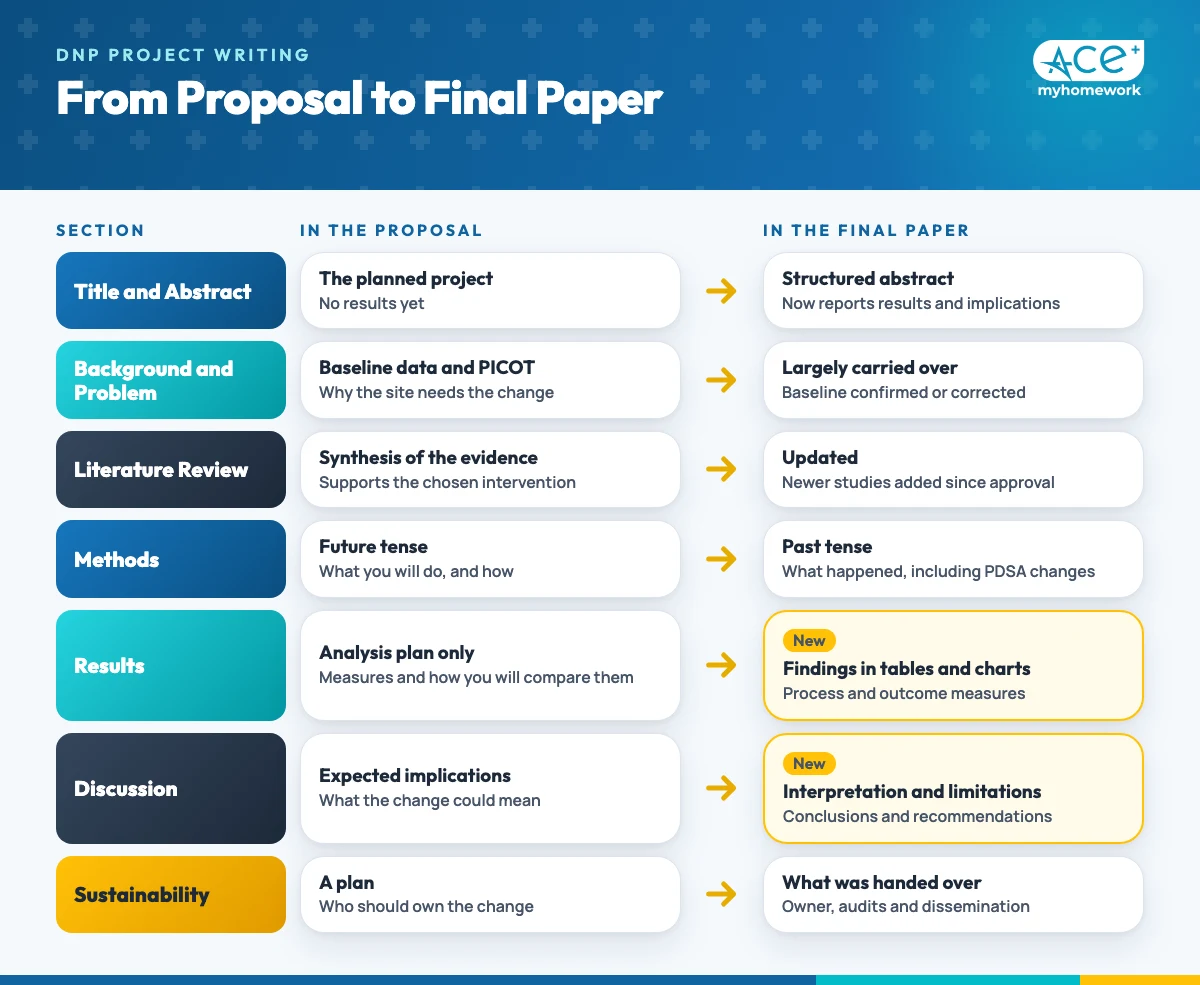
A DNP project paper example in a repository is usually the final paper, which is longer and differently focused than the proposal you write first. Much of the proposal carries over, but every section changes.
What changes between the DNP proposal and the final paper. Section names vary by program.
Tense and accuracy: the methods move from future to past tense and describe what actually happened, including changes made during PDSA cycles.
New sections: results, discussion, limitations and conclusions are added. The UNMC handbook's final report format, for example, asks for a structured abstract of no more than 300 words with background, purpose, method, results and implications.
Updated literature: add relevant studies published since your proposal was approved.
Reporting standard: quality improvement projects are often reported using SQUIRE 2.0, which asks you to describe the context, the intervention and how you studied whether it worked.
DNP Poster Example: Layout and What Goes Where
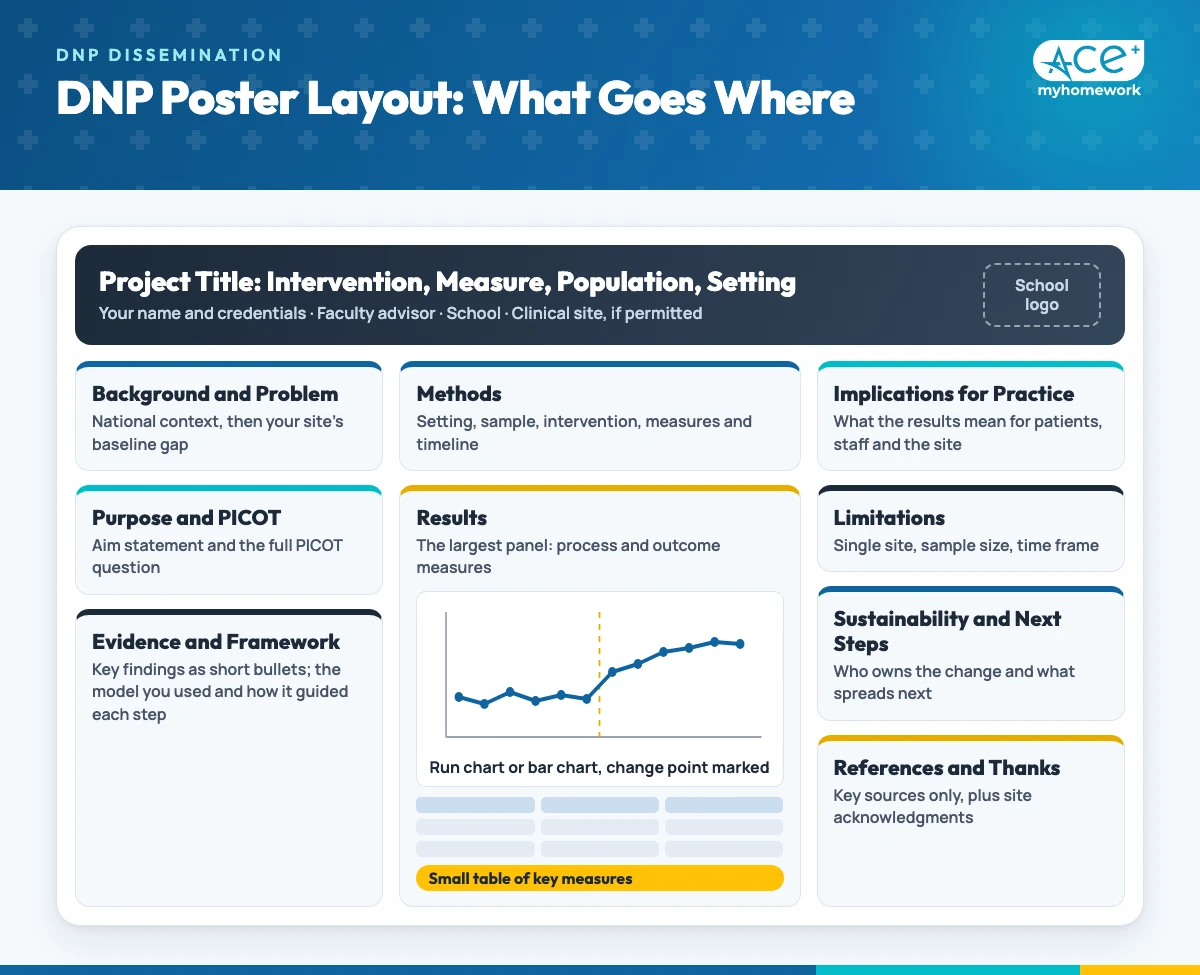
Most programs require a poster or podium presentation for dissemination. A poster is a visual summary, not the paper pasted onto a board. The layout below works for the common landscape format.
A three-column DNP poster layout. Use your school's template, colors and logo rules.
Title banner: project title, your name and credentials, faculty advisor, school and site, if the site permits naming.
Left column: background and local problem, purpose and PICOT question, and the evidence and framework in a few bullet points.
Center column: methods (setting, sample, intervention, measures) and results. Results should be the largest element, ideally one run chart or bar chart and one small table.
Right column: discussion and implications for practice, limitations, sustainability and next steps, then key references and acknowledgments.
To see real posters, browse collections such as the University of South Alabama's DNP Project Posters, which includes a 2025 poster on implementing Inlow's 60-second diabetic foot screen for patients with type 2 diabetes in an outpatient clinic. The UTHealth Cizik School of Nursing abstracts cited above use the headings Purpose, Background, Methodology, Results and Implications, which map neatly onto poster panels.
How to Read a DNP Project Example Critically
Use published examples as models of structure, and read them with the same care you'd give any source. Our guide on how to write an article critique explains the general approach. For DNP projects, ask:
Was a local baseline reported, and is the comparison period the same length?
Are process measures reported, so you can tell whether the intervention actually happened?
How many patients or staff were included, and how many eligible people were missed?
Did the authors report statistical tests, and are they appropriate for the data?
Do the conclusions stay within what a single-site, short project can show?
Getting Help with Your DNP Proposal, Paper or Poster
If you are turning a proposal into a final paper or condensing results onto a poster, our DNP project coaching pairs you with nursing writers who can review your structure, give feedback on how you present results, and check APA formatting. Use any outside help in line with your school's academic integrity policy, and keep your chair informed.
Frequently Asked Questions
Where Can I Find DNP Project Examples?
Search university repositories, such as Digital Commons and ScholarWorks sites, for "DNP project" and your topic. The DNP, Inc. Doctoral Project Repository and PubMed searches of the Journal of Doctoral Nursing Practice are also useful.
Can I Copy the Structure of a DNP Project Paper Example?
You can follow its structure, but your program's handbook overrides any example. Never copy wording, and cite a project if you use its findings or ideas.
What Should a DNP Project Proposal Example Include?
Most include background and significance, a problem statement and PICOT question, a literature review, an organizational assessment, aims, a framework, methods, ethical considerations, an analysis plan and a sustainability plan.
What Goes on a DNP Poster?
A title banner, background and problem, purpose and PICOT, evidence and framework, methods, results, implications, sustainability and key references. Results should take the most space.
Do DNP Projects Have to Show Positive Results?
No. Committees expect an honest evaluation. Several published examples, including the heart failure and diversion tube projects above, report targets that weren't met and still explain what was learned.
Are DNP Project Examples Good Sources for a Literature Review?
They can show how other sites implemented an intervention, but most are single-site student projects without peer review. Base your evidence on guidelines, systematic reviews and peer-reviewed studies first.
Need Help With Nursing?
Post your assignment, compare tutor bids and work with an expert who explains each step.
Get affordable and top-notch help for your essays and homework services from our expert tutors. Ace
your homework, boost your grades, and shine in online classes—all with just a click away!
Nursing capstone project ideas for BSN and MSN students in nine areas, each framed as an evidence-based change with a measurable outcome you can track.