A nursing care plan on COPD (chronic obstructive pulmonary disease) sets out the patient's breathing-related problems, measurable goals, nursing interventions with rationales and how you will evaluate progress. The usual priority diagnoses are ineffective airway clearance, impaired gas exchange and ineffective breathing pattern, followed by decreased activity tolerance and self-management needs such as inhaler technique. Good COPD care plans pair bedside interventions, like positioning and controlled oxygen, with teaching that keeps the patient out of hospital.
This guide covers the COPD facts you need from the current GOLD report, focused assessment, how to choose and write each nursing diagnosis, a complete care plan table, pursed-lip breathing and inhaler teaching, red flags, a concept map outline and discharge priorities.
COPD Basics for Care Planning
The Global Initiative for Chronic Obstructive Lung Disease (GOLD) publishes the international strategy most nursing programs follow. The GOLD 2026 report describes COPD as a varied lung condition with long-term symptoms (breathlessness, cough, sputum and flare-ups) caused by changes in the airways, such as bronchitis, and in the alveoli, such as emphysema. These changes cause airflow obstruction that persists and often gets worse over time. The main causes are tobacco smoke and inhaled particles and gases from household and outdoor air pollution.
Key points that shape a care plan:
Diagnosis needs spirometry. A post-bronchodilator FEV1/FVC ratio below 0.7, in the right clinical context, confirms COPD.
Exacerbations matter most. GOLD defines an exacerbation as an acute worsening of breathlessness and/or cough and sputum over up to 14 days, often with fast breathing or a fast heart rate. Infections and air pollution are common triggers.
The ABE assessment tool groups patients by symptoms and exacerbation history to guide initial medication. The GOLD 2026 summary of changes explains that group E now includes people with even one moderate exacerbation in the previous year, because a single exacerbation raises the risk of more.
Inhaler technique and adherence should be checked regularly, and pulmonary rehabilitation improves exercise capacity, symptoms and quality of life at all levels of severity.
For nurses, the practical message is that every admission for a COPD exacerbation is a chance to fix inhaler technique, refer to pulmonary rehabilitation and set up a written action plan.
Nursing Assessment for COPD
Collect data that will support specific nursing diagnoses rather than a general list of symptoms.
History: smoking history in pack-years, occupational or household smoke exposure, number of exacerbations and hospital stays in the past year, current inhalers and how the patient uses them, home oxygen, and baseline activity level.
Symptoms: breathlessness at rest and on exertion, cough, and sputum volume, color and thickness compared with the patient's usual. GOLD uses the modified Medical Research Council (mMRC) dyspnea scale and the COPD Assessment Test (CAT) to rate symptom burden.
Inspection: respiratory rate and depth, accessory muscle use, pursed-lip breathing, tripod positioning, ability to speak in full sentences, and color of lips and nail beds.
Auscultation: wheezes, rhonchi that change with coughing, diminished breath sounds, and a prolonged expiratory phase.
Measurements: SpO2 with the oxygen device and flow rate, heart rate, temperature, weight and body mass index, and arterial blood gases when ordered.
Other: ankle edema (which may signal right-sided heart strain), sleep, anxiety and low mood, nutrition, and observed inhaler technique.
For example, a hypothetical 67-year-old patient with a 45 pack-year smoking history is admitted with a COPD exacerbation. Respiratory rate is 26, SpO2 is 87% on room air, and heart rate is 104. The patient speaks in short phrases, sits leaning forward on the overbed table, has scattered wheezes and rhonchi, and is coughing thick yellow sputum. When asked to show how they use their inhaler, they press the canister before starting to breathe in and do not hold their breath. The care plan below is built on this example.
Choosing a Nursing Diagnosis With COPD
A nursing diagnosis with COPD should describe the patient's response, not the disease. Write each one in PES format (problem, etiology, signs and symptoms). Our nursing diagnosis examples show how to build these statements.
Ineffective airway clearance related to excessive, thick secretions and airway inflammation as evidenced by rhonchi, an ineffective cough and thick yellow sputum. This is often the first diagnosis in an exacerbation, because secretions block the airways that are already narrowed.
Impaired gas exchange related to ventilation-perfusion imbalance and alveolar destruction as evidenced by SpO2 87% on room air and tachypnea.
Ineffective breathing pattern related to airflow obstruction and respiratory muscle fatigue as evidenced by tachypnea, accessory muscle use and a prolonged expiratory phase.
Decreased activity tolerance (formerly activity intolerance) related to imbalance between oxygen supply and demand as evidenced by breathlessness when walking short distances.
Ineffective health self-management related to insufficient knowledge of the treatment regimen as evidenced by incorrect inhaler technique.
Other diagnoses that may apply include excessive anxiety (the 2024–2026 label that replaced anxiety), which is common when breathlessness is frightening, and inadequate protein-energy nutritional intake (which replaced imbalanced nutrition: less than body requirements) for patients who are losing weight because eating makes them breathless. Use the labels your program requires, and check older care plan books against the current NANDA-I list.
Sample Nursing Care Plan on COPD
The table below follows the five-column format most programs use. For more on writing SMART goals and evaluation statements, see how to write a nursing care plan. Oxygen targets must come from the provider's order or your facility protocol.
Nursing Diagnosis
Expected Outcomes (SMART)
Nursing Interventions
Rationale
Evaluation
Ineffective airway clearance related to excessive, thick secretions as evidenced by rhonchi, ineffective cough and thick yellow sputum
By the end of the shift, the patient clears secretions with a huff cough. Within 48 hours, rhonchi are reduced on auscultation.
Auscultate lungs before and after coughing.
Teach controlled coughing and the huff cough while sitting upright.
Give prescribed bronchodilators and assess the response.
Encourage fluids unless restricted.
Record sputum amount, color and thickness each shift.
Shows whether secretions are moving.
Huffing clears mucus with less airway collapse than forceful coughing.
Opening the airways helps mucus move out.
Adequate hydration helps keep secretions thinner.
A change toward purulent sputum can signal infection.
Met if the cough is productive and effective and breath sounds improve. If not, consult respiratory therapy about airway clearance devices.
Impaired gas exchange related to ventilation-perfusion imbalance as evidenced by SpO2 87% on room air and RR 26
Within 1 hour, SpO2 is within the prescribed target range (often 88–92%). Within 48 hours, the patient is alert with no rise in PaCO2.
Give controlled oxygen as prescribed and titrate to the ordered target.
Monitor SpO2, RR, mental status and work of breathing at least every 1–2 hours.
Review ABGs and report a rising PaCO2 or falling pH.
Position upright or in the tripod position.
Avoid sedating medications unless prescribed and monitored.
Corrects hypoxemia while avoiding excess oxygen in patients at risk of carbon dioxide retention.
Detects deterioration early.
These suggest worsening respiratory failure and may need noninvasive ventilation.
Improves diaphragm movement and lung expansion.
Sedation can depress breathing.
Met if SpO2 stays in range, mentation is at baseline and ABGs are stable. Escalate if oxygen needs rise or drowsiness develops.
Ineffective breathing pattern related to airflow obstruction and respiratory muscle fatigue as evidenced by tachypnea, accessory muscle use and prolonged expiration
Within 24 hours, the patient uses pursed-lip breathing without prompting and RR falls toward baseline.
Teach and coach pursed-lip breathing.
Support the tripod or high Fowler's position.
Stay with the patient during episodes of acute breathlessness and use a calm voice.
Schedule rest periods between activities.
Slower, longer exhalation reduces air trapping and slows breathing.
Fixing the shoulders lets accessory muscles assist.
Anxiety increases breathing rate and breathlessness.
Reduces respiratory muscle fatigue.
Met if the patient uses the technique independently and RR and accessory muscle use decrease.
Decreased activity tolerance related to imbalance between oxygen supply and demand as evidenced by breathlessness walking 10 meters
Before discharge, the patient walks to the bathroom and back using pursed-lip breathing, with SpO2 staying in the target range.
Measure SpO2, HR and RR before, during and after activity.
Increase activity in stages.
Teach energy conservation: sit to wash and dress, keep items within reach.
Refer to pulmonary rehabilitation.
Sets a safe level of activity.
Gradual increases build tolerance.
Reduces oxygen demand during daily tasks.
Rehabilitation improves exercise capacity, symptoms and quality of life.
Met if the patient completes the activity within targets. Document the referral and any barriers to attending.
Ineffective health self-management related to insufficient knowledge of inhaler use as evidenced by incorrect metered-dose inhaler technique
Before discharge, the patient demonstrates all inhaler steps correctly using teach-back and states when to use each inhaler.
Watch the patient use their own device.
Teach one step at a time with a demonstration.
Ask for a return demonstration (teach-back).
Discuss a spacer with the prescriber if coordination is poor.
Provide a written action plan.
Shows actual errors.
Smaller steps are easier to learn.
Confirms understanding rather than assuming it.
A spacer removes the need to press and breathe at the same moment.
Helps the patient act early when symptoms worsen.
Met if the technique is correct on return demonstration. If not, reteach and involve pharmacy or respiratory therapy.
Pursed-Lip Breathing: Steps and Rationale
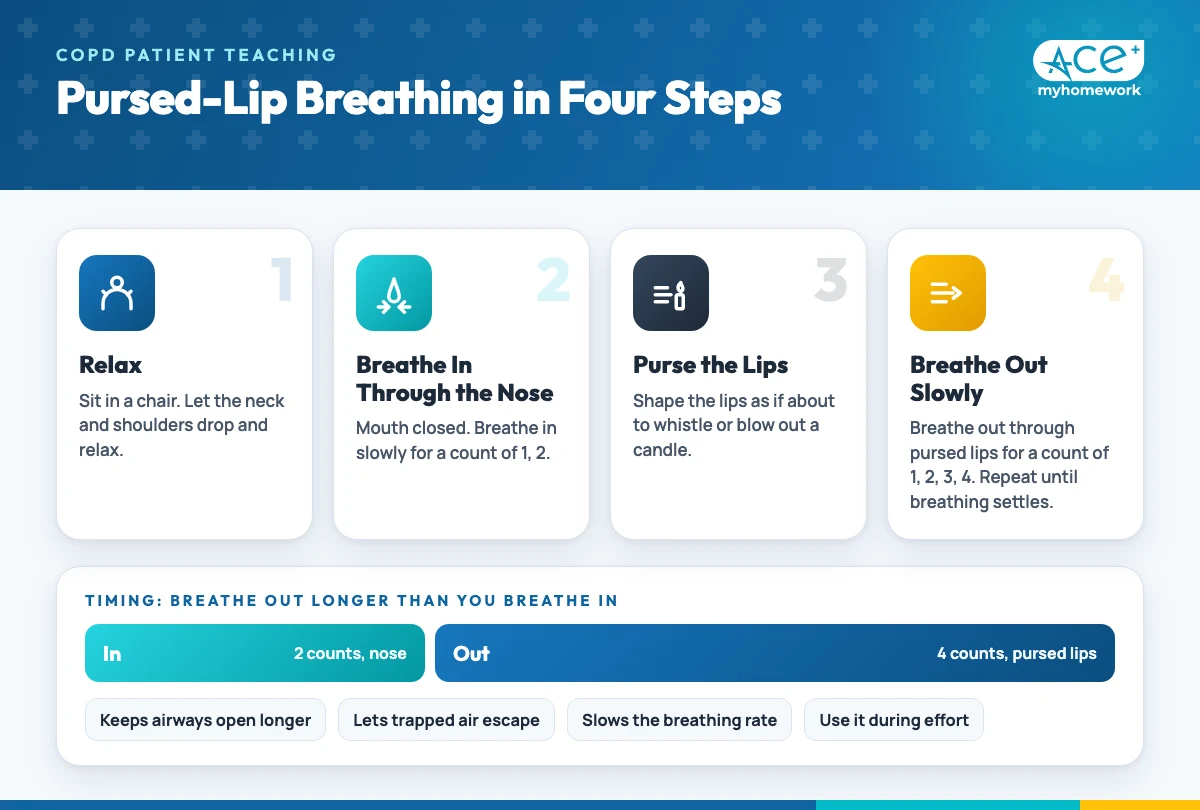
Pursed-lip breathing is one of the most useful things you can teach a patient with COPD. Breathing out slowly against pursed lips keeps the airways open longer, which lets trapped air escape and slows the breathing rate. The American Lung Association's breathing exercise guide describes the technique below, and the GOLD 2026 report notes that pursed-lip and diaphragmatic breathing have been shown to improve lung function and exercise capacity.
Pursed-lip breathing in four steps. Adapted from the American Lung Association.
Sit and relax the neck and shoulders.
Breathe in slowly through the nose with the mouth closed for a count of two.
Purse the lips as if about to whistle or blow out a candle.
Breathe out slowly through pursed lips for a count of four, making the out-breath longer than the in-breath.
Repeat until breathing feels more controlled.
Teach it when the patient is calm, then coach it during activity, such as walking to the bathroom or climbing stairs. Patients should breathe out during the hardest part of an effort, for example while standing up.
Teaching Metered-Dose Inhaler Technique
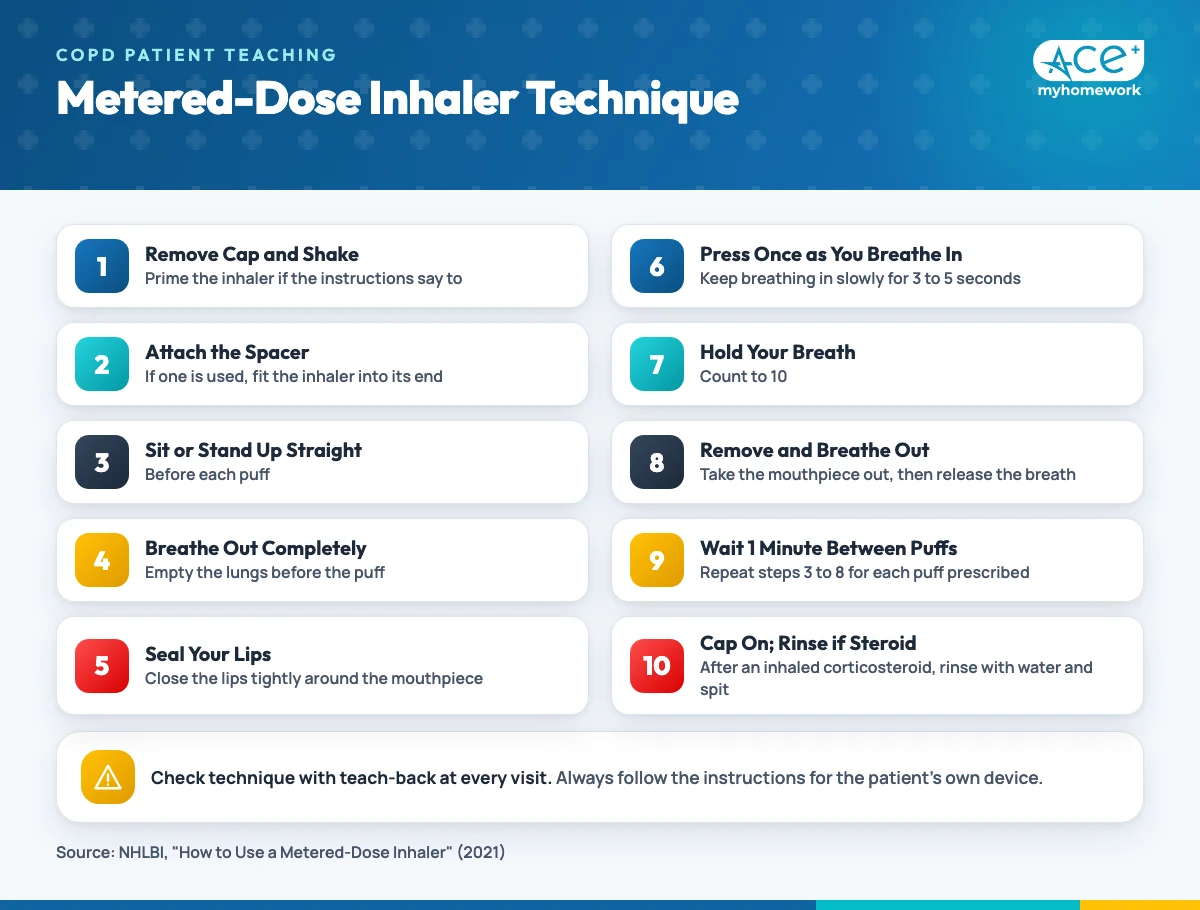
Inhaler errors are common, and GOLD notes that package leaflets alone are not enough. The report recommends a physical demonstration, checking that the patient can do it, and reviewing technique at each visit. It singles out the teach-back approach, where the patient shows you how they use the device, as particularly effective. The National Heart, Lung, and Blood Institute's metered-dose inhaler fact sheet gives the general steps used in the figure below. Always check the instructions for the patient's specific device.
Metered-dose inhaler technique. Adapted from the NHLBI "How to Use a Metered-Dose Inhaler" fact sheet (2021).
The errors to look for most often are not breathing out first, pressing the canister before or after starting to breathe in, breathing in too fast, and not holding the breath. If the patient cannot coordinate pressing and breathing in, discuss a spacer with the prescriber. GOLD notes that spacers also reduce the amount of medicine left in the mouth and throat, which matters for inhaled corticosteroids. Remind patients using a corticosteroid inhaler to rinse with water and spit afterward.
Oxygen Therapy and Red Flags
Some people with COPD retain carbon dioxide, and giving too much oxygen can make that worse. The British Thoracic Society oxygen guideline recommends a target SpO2 of 88–92% for patients at risk of hypercapnic respiratory failure until blood gas results are known, and GOLD advises controlled oxygen for hypoxemic patients during an exacerbation. Never withhold oxygen from a hypoxemic patient; instead, give it to the prescribed target and monitor closely.
Escalate promptly, using a structured SBAR handoff, if you notice:
SpO2 below the target range despite prescribed oxygen
New drowsiness, confusion or headache, which can signal rising carbon dioxide
Inability to speak more than a few words, or exhaustion
A rising PaCO2 with a falling pH on the blood gas
Very quiet breath sounds in a patient who is working hard to breathe
Chest pain, new fever with chest signs, or one-sided changes, which may mean pneumonia or pneumothorax
GOLD notes that pneumonia can mimic or worsen an exacerbation. If your patient's picture fits, our pneumonia nursing care plan covers impaired gas exchange in more depth.
COPD Concept Map for Nursing Students
A COPD concept map shows how the patient's data, problems and interventions connect. Our guide to nursing concept maps explains the format. For the example patient, a simple outline is:
Center: COPD exacerbation; age 67; 45 pack-year smoking history.
Pathophysiology box: airway inflammation and mucus, air trapping, alveolar damage, ventilation-perfusion mismatch.
Nursing diagnoses (ranked): ineffective airway clearance, impaired gas exchange, ineffective breathing pattern, decreased activity tolerance, ineffective health self-management.
Connections: secretions worsen gas exchange; breathlessness drives anxiety, which drives faster breathing; poor technique leads to more exacerbations.
Interventions and outcomes: two or three interventions and one measurable outcome per diagnosis.
Discharge Teaching and Self-Management
Stop smoking: GOLD strongly encourages supporting every person who smokes to quit, with counseling plus nicotine replacement or other medication.
Vaccinations: GOLD recommends all vaccinations in line with local guidance, including influenza, pneumococcal, RSV and COVID-19 vaccines, Tdap for those not vaccinated in adolescence, and shingles vaccine.
Written action plan: what to do when symptoms worsen and when to call for help.
Pulmonary rehabilitation: GOLD reports that starting rehabilitation during the hospital stay or within 4 weeks of discharge is linked with fewer readmissions.
Inhalers: correct technique, the difference between rescue and maintenance inhalers, and bringing the inhalers to every appointment.
Nutrition and energy: small, frequent meals if eating causes breathlessness.
Home oxygen safety: no smoking or open flames near oxygen, and use only at the prescribed flow.
Getting Help With a COPD Care Plan
COPD care plans often come back with comments about vague goals or missing rationales. If you would like a second set of eyes on your diagnoses, SMART outcomes or concept map, our nursing homework help service offers feedback and tutoring for nursing assignments. Use any outside help in line with your school's academic integrity policy.
Frequently Asked Questions
What Is the Priority Nursing Diagnosis for COPD?
During an exacerbation, ineffective airway clearance or impaired gas exchange usually comes first, depending on whether secretions or low oxygen are the bigger problem. In stable COPD, decreased activity tolerance and self-management needs often take priority.
What Oxygen Saturation Is the Target for a Patient With COPD?
Many patients with COPD at risk of carbon dioxide retention have a target of 88–92% until blood gases are known, as recommended by the British Thoracic Society. The provider's order sets the target for each patient.
Why Is Pursed-Lip Breathing Used in COPD?
Breathing out slowly through pursed lips keeps the airways open longer, which lets trapped air escape, slows the breathing rate and reduces breathlessness.
What Changed in the GOLD 2026 Report?
Among other changes, GOLD 2026 adjusted the ABE groups so that one moderate exacerbation in the previous year places a patient in group E, updated vaccination advice for RSV and influenza, and fully revised the chapters on exacerbations and multimorbidity.
How Do You Write a Nursing Diagnosis With COPD?
Use the PES format: the NANDA-I label, the related factor and the evidence. For example: ineffective airway clearance related to excessive, thick secretions as evidenced by rhonchi and an ineffective cough.
What Should a COPD Concept Map Include?
Put the medical diagnosis at the center, then add assessment data, ranked nursing diagnoses, interventions and outcomes, with lines showing how the problems affect one another.
Get affordable and top-notch help for your essays and homework services from our expert tutors. Ace
your homework, boost your grades, and shine in online classes—all with just a click away!
Nursing capstone project ideas for BSN and MSN students in nine areas, each framed as an evidence-based change with a measurable outcome you can track.