A nursing concept map is a diagram of how one patient's assessment data, nursing diagnoses, interventions and outcomes connect. The patient's main health problem sits in the center, the nursing diagnoses branch out from it, and each branch links the supporting data to the goals and nursing actions that address it. Concept map nursing assignments ask you to show your clinical reasoning as a picture instead of a list, so the instructor can see why each intervention belongs there.
This guide explains the parts of a concept map, how to build one in five steps, and three worked examples (pneumonia, hypertension and type 2 diabetes). All patients are hypothetical.
What Is a Concept Map in Nursing?
Concept maps come from education research, not nursing. Joseph Novak and his team at Cornell University developed them, and the paper by Novak and Cañas on the theory underlying concept maps sets out the core rules. Concepts sit in boxes, lines join related concepts, and each line carries linking words that turn the two concepts into a meaningful statement, or proposition. Every map answers a focus question, and good maps also include cross-links between different parts of the map.
Nursing education adapted the method for care planning, where it supports the diagnosis and planning phases of the nursing process. Instead of general concepts, a nursing concept map uses one patient's data, and the focus question becomes something like "What are this patient's priority problems today, and what will I do about them?" A 2025 systematic review and meta-analysis in BMC Medical Education pooled 44 studies and found that groups taught with concept maps scored higher on educational performance than comparison groups. The authors also noted that the benefit appeared larger for nursing students than for working nurses, though that difference was not statistically significant.
Concept Map vs Care Plan vs Mind Map
Format
Structure
What It Shows Best
Nursing concept map
A web of boxes with labeled links and cross-links, built around one patient
How problems relate to each other, and why each action fits the data
Nursing care plan
A table organized by nursing diagnosis
Detailed outcomes, interventions, rationales and evaluation for each problem
Mind map
A single topic with radiating branches, usually without labeled links
Brainstorming and note-taking on a topic
Many programs ask for both: a concept map to show the big picture, and a care plan table for the priority diagnoses. If you need the table format, see our guide on how to write a nursing care plan.
Parts of a Nursing Concept Map
Part
What It Contains
Example (Pneumonia)
Central concept
The reason for care: medical diagnosis or chief complaint, with brief patient details
68-year-old admitted with community-acquired pneumonia
Assessment data
Subjective and objective findings, labs, imaging, medications, history
Crackles in the right lower lobe, SpO2 90% on room air, temperature 38.7 °C
Nursing diagnoses
Current labels from NANDA-I or your program's list, each supported by data
Ineffective airway clearance; Impaired gas exchange
Outcomes
A measurable goal for each diagnosis
SpO2 at or above the ordered target on room air by discharge
Interventions and rationales
Nursing actions, each with a reason
Elevate the head of the bed to ease breathing
Links and linking words
Lines with a word or phrase that names the relationship
Pneumonia "leads to" thick secretions
Cross-links
Connections between separate branches
Fever "increases" fluid loss, which "thickens" secretions
Evaluation
Whether each outcome was met, and what changes
Goal partly met; continue the plan and reassess in 24 hours
How to Make a Concept Map in Nursing
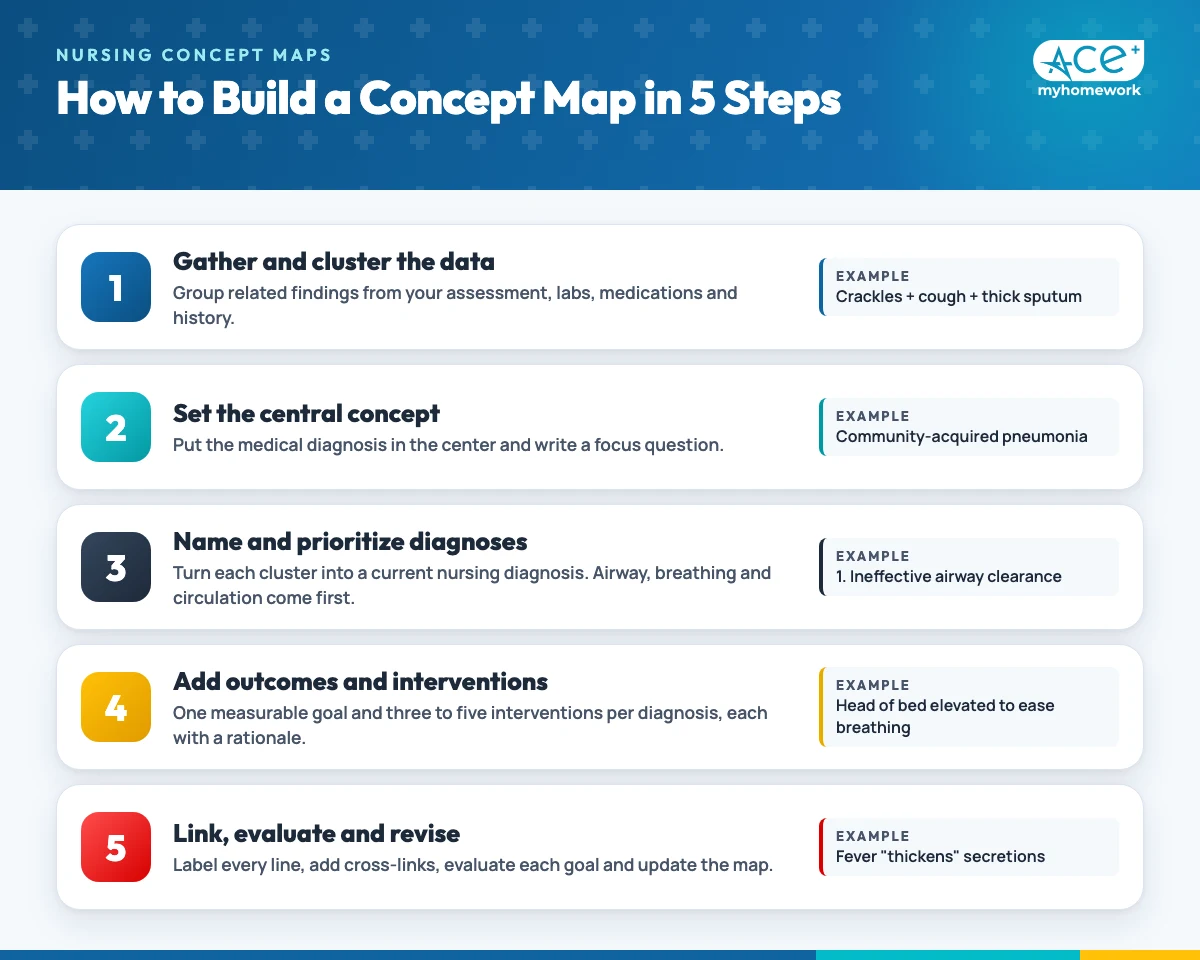
Novak and Cañas suggest identifying the key concepts first, placing them in a "parking lot" list until you know where they fit, and expecting to revise a map several times. Applied to a nursing concept map, the process has five steps.
Five steps to build a nursing concept map. Adapted from Novak and Cañas's construction method.
Step 1: Gather and Cluster the Assessment Data
Start with a complete set of data: the health history, your physical assessment, vital signs, labs, imaging, medications and what the patient tells you. A systematic head-to-toe assessment makes this step easier. Then group findings that seem to belong together. Crackles, a productive cough and thick sputum form one cluster; low saturation, fast breathing and breathlessness form another. These clusters become your diagnoses.
Step 2: Place the Central Concept and Write a Focus Question
Put the medical diagnosis or reason for admission in the center, with the patient's age and any key history. Write your focus question at the top of the page. Every box you add should help answer it.
Step 3: Name and Prioritize the Nursing Diagnoses
Turn each cluster into a nursing diagnosis, using current labels. Our guides to common nursing diagnoses and nursing diagnosis examples explain how to choose a label and write the related factors and defining characteristics. Number the diagnoses by priority. Airway, breathing and circulation problems come first, then other physiological needs, then safety, then psychosocial needs. Actual problems usually rank above risk diagnoses unless the risk is immediate.
Step 4: Add Outcomes, Interventions and Rationales
Under each diagnosis, write one or two measurable outcomes and three to five interventions. Each intervention needs a rationale, either on the map or in an attached table if space is tight. Include assessment interventions (what you will monitor), therapeutic interventions (what you will do) and teaching.
Step 5: Draw and Label the Links, Then Evaluate and Revise
Connect boxes with lines and write a linking word or phrase on each one, such as "causes," "is evidenced by," "worsens" or "is treated by." Then look for cross-links between branches. A map with good cross-links shows that you see the patient as a whole, not as a list of separate problems. After your shift, add an evaluation to each diagnosis and revise the map.
Concept Map Nursing Example: Pneumonia
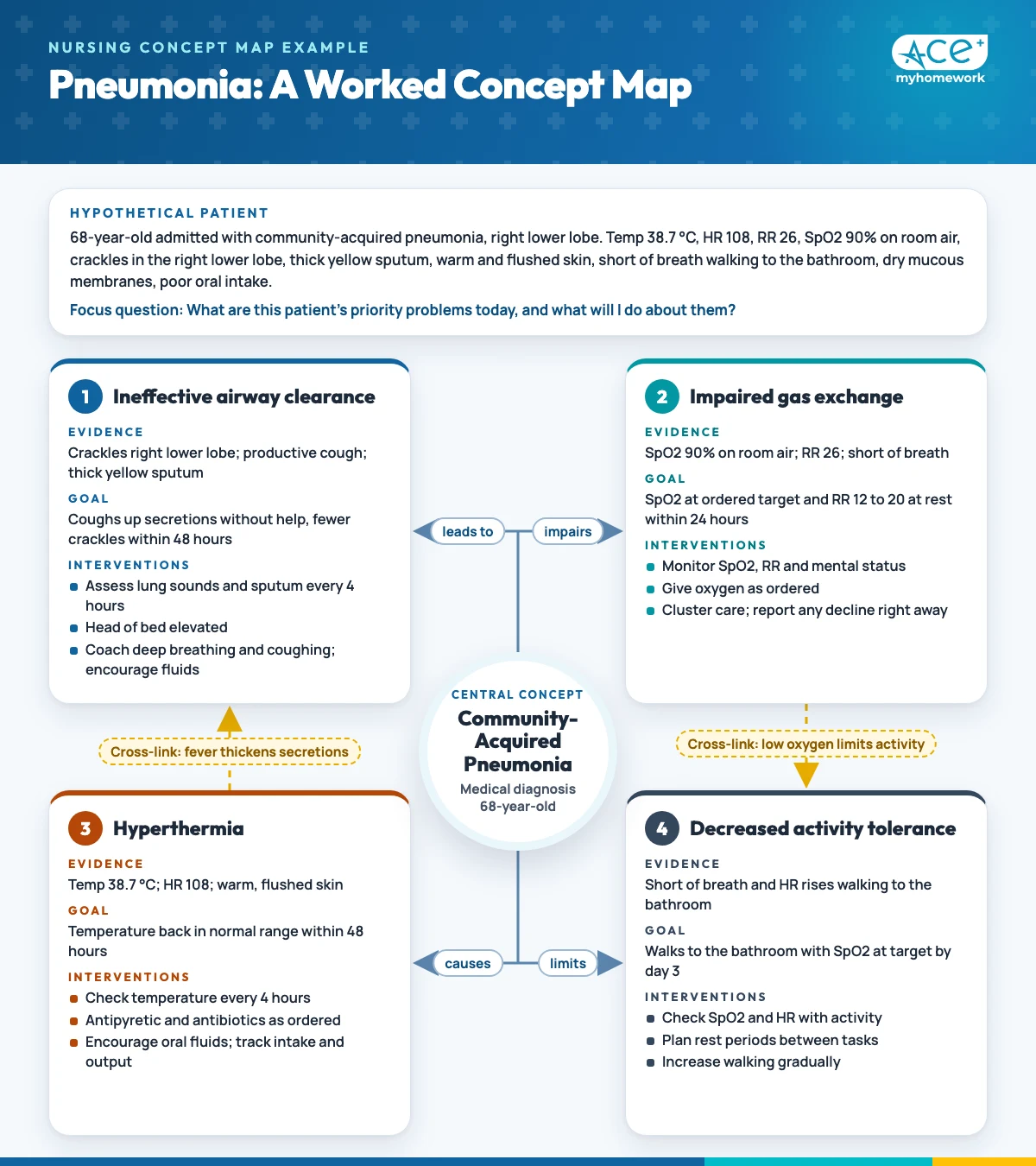
This example is for a hypothetical 68-year-old patient admitted with community-acquired pneumonia in the right lower lobe. On assessment: temperature 38.7 °C, heart rate 108, respiratory rate 26, SpO2 90% on room air, crackles in the right lower lobe, a productive cough with thick yellow sputum, warm and flushed skin, shortness of breath when walking to the bathroom, dry mucous membranes and poor oral intake.
A worked nursing concept map for a hypothetical patient with community-acquired pneumonia. Diagnosis labels follow NANDA-I 2024–2026.
The map has four nursing diagnoses, numbered by priority:
Ineffective airway clearance, supported by crackles, a productive cough and thick sputum
Impaired gas exchange, supported by SpO2 of 90% on room air, a respiratory rate of 26 and breathlessness
Hyperthermia, supported by a temperature of 38.7 °C, a heart rate of 108 and flushed, warm skin
Decreased activity tolerance, supported by breathlessness and a rising heart rate when walking short distances
Two cross-links tie the branches together. Fever increases fluid loss, which makes secretions thicker and harder to clear, so encouraging fluids helps both the hyperthermia branch and the airway branch. Low oxygen levels limit activity, so oxygen and rest periods support both gas exchange and activity tolerance. These are the connections instructors look for, because they show reasoning a list cannot.
Here are the two priority diagnoses expanded into a care plan table, which many programs ask you to attach to the map.
Nursing Diagnosis
Expected Outcomes (SMART)
Nursing Interventions
Rationale
Evaluation
Ineffective airway clearance related to thick, retained secretions, as evidenced by crackles in the right lower lobe and a productive cough with thick yellow sputum
Within 48 hours, the patient will cough up secretions without help and have fewer crackles in the right lower lobe on auscultation.
1. Assess lung sounds, cough and sputum every 4 hours and as needed. 2. Position with the head of the bed elevated. 3. Teach and coach deep breathing, coughing and incentive spirometer use as ordered. 4. Encourage oral fluids unless restricted. 5. Give prescribed antibiotics on schedule.
1. Tracks whether secretions are clearing or worsening. 2. Upright positioning improves lung expansion. 3. Deep breaths and effective coughs move secretions up the airways. 4. Adequate hydration helps keep secretions thin. 5. Treats the infection that is producing the secretions.
Goal partly met at 48 hours: cough productive and effective; crackles still present at the right base. Continue plan; reassess daily.
Impaired gas exchange associated with ventilation-perfusion imbalance from pneumonia, as evidenced by SpO2 90% on room air, respiratory rate 26 and shortness of breath
Within 24 hours, the patient will maintain SpO2 at or above the ordered target with a respiratory rate of 12 to 20 at rest.
1. Monitor SpO2, respiratory rate, work of breathing and mental status at the ordered frequency. 2. Give oxygen as ordered and adjust within the ordered range. 3. Cluster care and plan rest periods. 4. Report a falling SpO2, rising work of breathing or new confusion right away.
1. Detects early deterioration; confusion can be a sign of low oxygen. 2. Supplemental oxygen raises arterial oxygen levels. 3. Reduces oxygen demand. 4. Allows prompt escalation, including the rapid response team when criteria are met.
Goal met at 24 hours: SpO2 within target on 2 liters by nasal cannula, respiratory rate 18 at rest. Continue plan and begin weaning oxygen as ordered.
Nursing Concept Map Example: Hypertension
This hypothetical 56-year-old patient attends a clinic follow-up. Office blood pressure is 152/96 mm Hg, which falls in stage 2 hypertension under the 2025 AHA/ACC blood pressure guideline. The patient reports missing medication doses "when I feel fine," eats takeout most days and is unsure what the readings on a home monitor mean. Laid out as a map, it looks like this:
Central concept: 56-year-old with stage 2 hypertension, on one antihypertensive medication
Diagnosis 1: Ineffective health self-management, linked to missed doses and a high-sodium diet. Interventions: review the medication schedule and link doses to a daily routine, set one diet goal the patient chooses, and arrange follow-up.
Diagnosis 2: Inadequate health knowledge about high blood pressure, linked to "I only take it when I feel bad" and uncertainty about home readings. Interventions: explain that high blood pressure usually causes no symptoms, teach home monitoring technique, and confirm understanding with teach-back.
Cross-link: better knowledge "supports" self-management, so the teaching branch points to the self-management branch.
This hypothetical 61-year-old patient is admitted with a foot wound and blood glucose readings that have been running high at home. The patient checks glucose "a few times a week" and reports numbness in both feet.
Central concept: 61-year-old with type 2 diabetes and an infected wound on the left foot
Diagnosis 1: Risk for ineffective blood glucose pattern self-management, linked to infrequent glucose checks and high home readings. (This is the 2024–2026 label; many textbooks still use the older "Risk for unstable blood glucose level," so check which edition your program follows.) Interventions: monitor glucose as ordered, review the meal plan, teach self-monitoring and when to call the provider.
Diagnosis 2: Impaired skin integrity, linked to the open wound. Interventions: wound care as ordered, assess and measure the wound daily, and keep pressure off the foot.
Diagnosis 3: Risk for adult falls, linked to reduced sensation in the feet. Interventions: fall precautions, proper footwear and a clear path to the bathroom.
Cross-links: high glucose "slows" wound healing, and reduced sensation "contributes to" both the wound and the fall risk.
Instructors grading a concept map for nursing students usually look for the same things: diagnoses supported by data, labeled links and a clear order of priority.
Use one patient. A concept map built around a textbook disease, instead of your patient, reads like a summary of the chapter.
Make every diagnosis earn its place. Each one needs data on the map that supports it.
Label every line. A line without a linking word does not say how the two boxes relate.
Keep interventions specific. "Monitor vital signs" is weak; "monitor SpO2 and respiratory rate every 4 hours and with activity" is strong.
Check your labels. NANDA-I labels change between editions. The NANDA International 2024–2026 edition uses "Inadequate health knowledge" where earlier editions used "Deficient knowledge," and the older "Activity intolerance" is now "Decreased activity tolerance." Use the edition your program requires.
Leave space. Start in pencil or a digital tool, because you will move boxes. IHMC offers a free concept mapping program, CmapTools, and general diagram tools work too.
Common Concept Map Mistakes
Listing data in a separate column with no lines to the diagnoses it supports
Including medical treatments, such as "start antibiotics," as nursing interventions without the nursing action (giving them on time and monitoring the response)
Writing interventions without rationales
Forgetting the evaluation step, so the map never shows whether the plan worked
No priority order, which leaves the reader unsure which problem matters most
Copying a sample map without changing it to fit your patient, which also raises academic integrity concerns
Getting Help with a Concept Map Assignment
Concept maps are often graded on reasoning, which is hard to judge in your own work. If you want feedback on whether your diagnoses are supported, your links make sense or your care plan table matches your map, our nursing homework help service offers tutoring and draft review. Use any outside help in line with your school's academic integrity policy.
Frequently Asked Questions
What Goes in the Center of a Nursing Concept Map?
Usually the patient's medical diagnosis or reason for admission, with age and key history. Some programs put the priority nursing diagnosis in the center instead, so check your template.
How Many Nursing Diagnoses Should a Concept Map Have?
Most student maps include three to five, numbered by priority. Including every possible diagnosis makes the map harder to read and the reasoning harder to follow.
What Is the Difference Between a Concept Map and a Care Plan?
A concept map shows how the patient's problems connect, using boxes and labeled links. A care plan is a table that sets out the outcomes, interventions, rationales and evaluation for each diagnosis in detail.
Do Concept Maps Need Rationales?
Most nursing programs require a rationale for each intervention, either on the map or in an attached table. Check your rubric.
Can I Make a Nursing Concept Map Online?
Yes. Free tools such as CmapTools, or any diagram program, work well and make revisions easier. Hand-drawn maps are fine if your instructor accepts them.
What Are Cross-Links in a Concept Map?
Cross-links connect boxes in different branches, for example showing that a fever makes secretions thicker. They show that you see how the patient's problems affect each other.
Get affordable and top-notch help for your essays and homework services from our expert tutors. Ace
your homework, boost your grades, and shine in online classes—all with just a click away!
Learn what a personal study plan is, how to build one around your courses and habits, why a template makes planning easier and how to stick to your schedule.
Now that you have seen how writing a personal statement for nursing is made, At Acemyhomework we strive to deliver top-notch academic essays with our professional writers.