Nursing theories are organized sets of concepts, definitions and propositions that explain what nursing is, what nurses do and why. They range from broad grand theories, such as Dorothea Orem's self-care deficit theory, to narrow middle-range and situation-specific theories that address one problem, such as comfort or uncertainty in illness. Every nursing theory describes, in its own way, four core concepts known as the metaparadigm: the person, the environment, health and nursing.
This guide explains the levels of nursing theory, the metaparadigm and the major nursing theorists, with a summary table, nursing theory examples from practice and advice on choosing a theory for a paper or project.
What Are Nursing Theories?
A theory is a structured way of looking at something so that you can describe it, explain it, predict it or change it. In nursing, theories give a shared language for care and help nurses explain the reasons behind their actions. They also give research and quality projects a framework, which is why most capstone, MSN and DNP assignments ask you to name one.
Every nursing theory is built from the same parts:
Concepts: the ideas the theory is about, such as self-care, adaptation or comfort.
Definitions: what each concept means in this theory, which may differ from everyday use.
Propositions: statements about how the concepts relate, for example that comfort measures increase a patient's comfort.
Assumptions: the beliefs the theory takes for granted, such as the view that people want to care for themselves.
You will also see the terms philosophy, conceptual model and theory. A philosophy states beliefs and values about nursing. A conceptual model, such as Roy's Adaptation Model, offers a broad frame of reference. A theory is more specific and its relationships can be studied. Textbooks don't always agree on which label fits which work, so check the term your course uses.
The Four Metaparadigm Concepts of Nursing
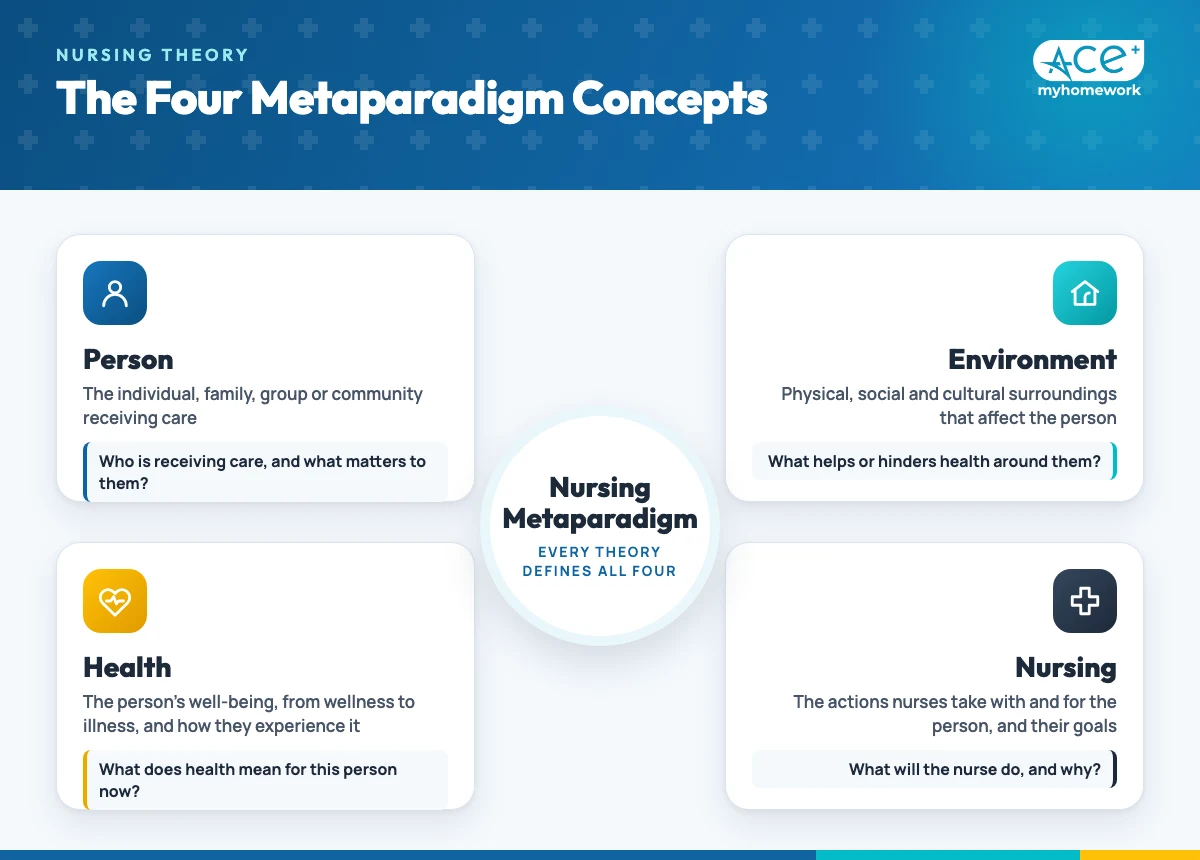
The metaparadigm is the most abstract level of nursing knowledge: the four concepts that define the discipline and that every nursing theory addresses. Jacqueline Fawcett proposed the best-known version in the late 1970s, adapting earlier terms, and her own account of the metaparadigm's evolution explains how she later changed "person" to "human beings" and has continued to revise the wording. Most nursing textbooks still teach the four concepts as person, environment, health and nursing.
The four metaparadigm concepts of nursing, based on Fawcett's metaparadigm.
Person (human beings): the recipient of nursing care, which can be an individual, family, group or community.
Environment: the surroundings and conditions that affect the person, from the physical setting to social and cultural influences.
Health: the person's state of well-being, which may include wellness, illness and how the person experiences them.
Nursing: the actions nurses take with and on behalf of the person, and the goals of those actions.
Comparing how theorists define the same four concepts is a quick way to see how their theories differ:
Concept
Nightingale
Orem
Roy
Person
A patient whose natural healing is helped or blocked by surroundings
A person who can learn to meet their own self-care needs
An adaptive system responding to change
Environment
Ventilation, light, warmth, cleanliness, quiet and diet
Conditions that affect self-care ability and demands
Focal, contextual and residual stimuli
Health
Being well and able to use one's powers fully
Structural and functional wholeness
Being and becoming an integrated, whole person
Nursing
Putting the patient in the best condition for nature to act
Helping when self-care demands exceed a person's ability
Promoting adaptation in the four adaptive modes
Levels of Nursing Theory
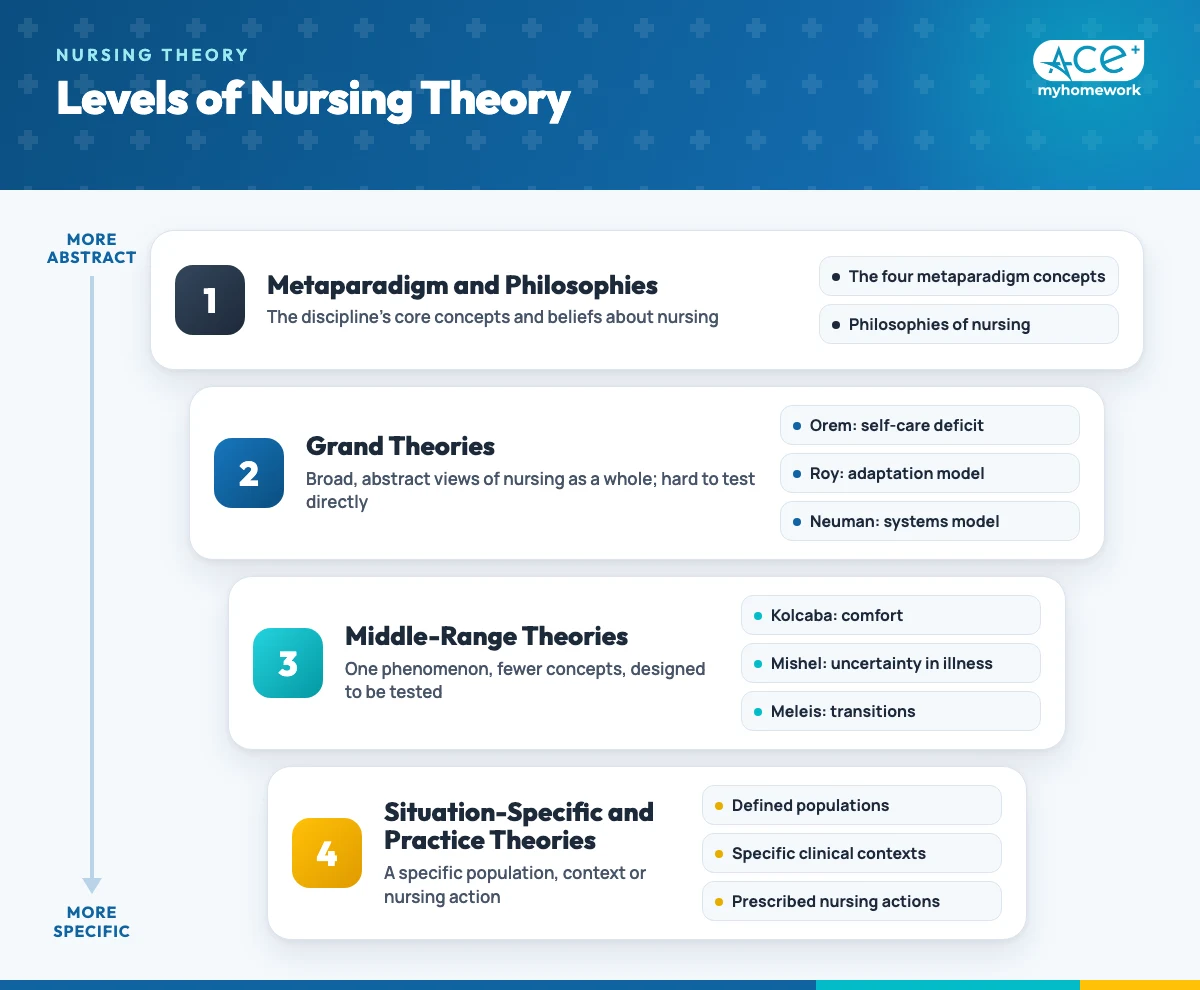
Nursing theories are usually grouped by their level of abstraction and scope. Broad theories explain nursing as a whole, while narrower theories address one phenomenon and are easier to test.
Levels of nursing theory, from the most abstract to the most specific.
Grand Theories
Grand theories are broad, abstract frameworks that try to explain nursing as a whole. They shaped the discipline in the 1960s to 1980s, when nursing was building its own body of knowledge. Because they are so broad, they are hard to test directly, but they offer a lens for any setting. Works often classed as grand theories or conceptual models include Orem's self-care deficit theory, Roy's Adaptation Model, Neuman's Systems Model, Rogers' Science of Unitary Human Beings, King's conceptual system and Leininger's Culture Care Diversity and Universality theory.
Middle-Range Theories
Middle-range theories focus on a specific phenomenon, such as pain, comfort, uncertainty, transitions or health promotion. They have fewer concepts, are closer to practice and can be tested in research. Examples include Kolcaba's comfort theory, Mishel's uncertainty in illness theory and Meleis's transitions theory. Many student projects and DNP projects use a middle-range theory because its concepts translate directly into interventions and outcomes.
Situation-Specific and Practice Theories
The narrowest level addresses a particular population or clinical situation. Eun-Ok Im and Afaf Meleis introduced the term situation-specific theories in 1999 to describe theories with a low level of abstraction that reflect a specific context and population, such as the menopausal transition in a particular immigrant group. Practice-level (or prescriptive) theories guide specific nursing actions and are often developed from a middle-range theory.
Classifications vary. Pender's Health Promotion Model, for instance, is called a grand theory in some sources and a middle-range theory in many textbooks, and Watson's and Benner's work are often grouped as philosophies. If your assignment asks you to classify a theory, cite the source you used.
Major Nursing Theorists and Their Theories
The table below summarizes the nursing theorists students meet most often. Dates refer to the first major publication of each theory; most were revised later.
Theorist and theory
Core idea
Practice application
Florence Nightingale, Environmental Theory (Notes on Nursing, 1859)
The nurse manages the environment so the body's natural healing can work
Infection control, fresh air, light, noise reduction, sleep and nutrition
Hildegard Peplau, Interpersonal Relations (1952)
The nurse-patient relationship is therapeutic and moves through orientation, working and resolution phases
Therapeutic communication, especially in mental health nursing
Virginia Henderson, Need Theory (The Nature of Nursing, 1966)
The nurse helps the person with activities they would do unaided if they had the strength, will or knowledge, described as 14 basic needs
Assessment of basic needs and promoting independence
Martha Rogers, Science of Unitary Human Beings (1970)
People are irreducible energy fields in constant interaction with the environment
Holistic and complementary approaches, such as therapeutic touch research
Comfort has three types (relief, ease and transcendence) across physical, psychospiritual, sociocultural and environmental contexts
Palliative, hospice and perioperative care
Leininger founded transcultural nursing decades before her 1991 theory book, and King first published her conceptual system in 1971, so you may see earlier dates for both. The primary sources and later editions for each theory are listed on Nursology's index of nursing theories, which is maintained by nurse scholars and is a good starting point for finding original works.
Grand Theories vs. Middle-Range Theories at a Glance
Feature
Grand theories
Middle-range theories
Scope
Nursing as a whole
One phenomenon or problem
Abstraction
High
Moderate
Testability
Difficult to test directly
Designed to be tested
Examples
Orem, Roy, Neuman, Rogers
Kolcaba, Mishel, Meleis's transitions theory
Typical use
Philosophy of care, curriculum, organizational models
Research frameworks, interventions, outcome measures
Nursing Theory Examples in Practice
Theories become easier to understand when you apply them to a patient. These hypothetical examples show how the same theory shapes assessment, interventions and evaluation.
Orem: A Patient Newly Diagnosed with Type 2 Diabetes
For example, a 52-year-old patient with new type 2 diabetes cannot yet check blood glucose or plan meals. Using Orem's theory, the nurse assesses the gap between the patient's self-care demands and self-care ability, then uses a supportive-educative approach: teaching glucose monitoring, using teach-back and gradually handing over responsibility. Evaluation asks whether the patient can now meet those demands alone.
Kolcaba: Comfort in Hospice Care
For example, a 78-year-old patient with advanced cancer has pain, anxiety and worries about family. The nurse uses Kolcaba's taxonomy to plan for relief (pain management), ease (a calm room, music the patient chooses) and transcendence (time with family and spiritual support), then evaluates comfort with the patient's own rating.
Peplau: Building Trust in Mental Health Care
For example, a 30-year-old patient admitted with depression avoids staff. In the orientation phase, the nurse introduces themselves, explains the plan and sets expectations. In the working phase, the patient uses the relationship to explore problems and practise coping. In the resolution phase, the nurse prepares the patient for discharge and ending the relationship.
Mishel: Uncertainty After a Cancer Diagnosis
For example, a 45-year-old patient awaiting staging results cannot sleep and keeps asking the same questions. Mishel's theory explains this as uncertainty, and the nurse acts as a structure provider: giving clear, consistent information, explaining what will happen next and connecting the patient with support.
To see how a theory can organize assessment data into a visual plan, try mapping one of these cases using our guide to nursing concept maps, or build it into a full plan with our guide on how to write a nursing care plan.
How to Choose a Nursing Theory for a Paper or Project
Start with your problem. Name the phenomenon you're addressing: self-management, comfort, adaptation, cultural care, uncertainty, health behavior.
Match the level to the task. A philosophy-of-nursing paper may suit a grand theory. A capstone or DNP project that measures an outcome, like many of these capstone project ideas, usually suits a middle-range theory whose concepts you can measure.
Check fit with your variables. If your project tests teach-back education for diabetes, Orem's supportive-educative system and Pender's self-efficacy concept both connect clearly to the intervention and outcome.
Read the original work. Cite the theorist's own book or article, not only a textbook summary, and use the most recent edition you can access.
Don't confuse a nursing theory with an EBP model. Many projects need both: a theory to explain why the intervention should work, and an implementation model such as the Iowa Model to guide the change. Our guide to evidence-based practice in nursing covers the EBP models.
How to Write About a Nursing Theory
Assignments on nursing theories usually follow this structure:
Introduction: the theorist, the theory and why you chose it.
Background: the theorist's career and influences, and when and where the theory was published.
Major concepts and the metaparadigm: how the theory defines person, environment, health and nursing, plus its key concepts.
Assumptions and propositions: what the theory takes for granted and how its concepts relate.
Application: a clinical example, research study or project that uses the theory.
Evaluation: strengths and limitations, such as clarity, testability and usefulness in your setting.
Keep the theorist's terms exact. Orem's "supportive-educative system" or Roy's "focal stimulus" have specific meanings, and paraphrasing them loosely can change what they mean. Cite every definition in APA format, and use the original publication year when you discuss the history of a theory.
Getting Help with a Nursing Theory Assignment
Theory papers are common in BSN, RN-to-BSN and MSN courses, and choosing a theoretical framework is often the hardest part of a capstone or DNP proposal. If you want feedback on which theory fits your project, or on how clearly you've applied its concepts, our nursing homework help service offers tutoring and review. Use any outside help in line with your school's academic integrity policy.
Frequently Asked Questions
What Are the Four Main Nursing Theories?
There isn't an official list of four. Students often mean the four metaparadigm concepts (person, environment, health and nursing) or a short list of influential theorists such as Nightingale, Orem, Roy and Watson. Check which your instructor means.
What Is the Difference Between Grand and Middle-Range Theories?
Grand theories are broad and abstract and try to explain nursing as a whole. Middle-range theories focus on one phenomenon, such as comfort or uncertainty, and can be tested in research.
Who Is Considered the First Nursing Theorist?
Florence Nightingale is usually described as the first nursing theorist. Her Notes on Nursing, published in 1859, set out her view that nursing should put the patient in the best condition for nature to act.
What Is the Most Commonly Used Nursing Theory?
No single theory is used everywhere. Orem's self-care deficit theory, Roy's Adaptation Model, Watson's caring theory and Benner's novice-to-expert model are among the most widely taught and applied.
Why Are Nursing Theories Important?
They give nurses a shared language, explain why interventions should work, guide assessment and care planning, and provide frameworks for research and evidence-based practice projects.
Can I Use More Than One Nursing Theory in a Paper?
Yes, if each has a clear role. A project might use a middle-range theory to explain the intervention and a separate EBP or change model to guide implementation. Avoid listing several theories without explaining how each is applied.
Get affordable and top-notch help for your essays and homework services from our expert tutors. Ace
your homework, boost your grades, and shine in online classes—all with just a click away!
Now that you have seen how writing a personal statement for nursing is made, At Acemyhomework we strive to deliver top-notch academic essays with our professional writers.
Explore 120 nursing research topics by specialty, from med-surg to informatics, plus how to narrow a topic, write a PICOT question and plan for IRB review.