A nursing care plan for congestive cardiac failure (CCF, also called congestive heart failure or CHF) addresses the problems heart failure causes: fluid overload, breathlessness and low oxygen levels, limited activity, and difficulty managing a complicated treatment plan at home. A typical plan includes the nursing diagnoses Excessive fluid volume, Impaired gas exchange, Decreased activity tolerance and Ineffective health self-management, each with measurable outcomes and nursing interventions. Daily weights, lung assessment, diuretic monitoring and discharge teaching are at the center of the plan.
This guide explains the heart failure basics you need for care planning, the signs of left- and right-sided failure, current NANDA-I labels, a filled care plan table, a daily weight tracking sheet and the red flags that need escalation. It follows the 2022 AHA/ACC/HFSA guideline for the management of heart failure where it applies to nursing care.
Heart Failure Basics for Care Planning
Heart failure is a clinical syndrome in which the heart cannot fill or pump well enough to meet the body's needs at normal filling pressures. Blood and fluid back up behind the weakened side of the heart, which causes congestion, and organs receive less blood flow, which causes fatigue and low exercise tolerance. The StatPearls review of heart failure covers the causes, the most common being coronary artery disease and hypertension.
Classification by Ejection Fraction
The 2022 guideline classifies heart failure by left ventricular ejection fraction (LVEF), as summarized by the American College of Cardiology:
Type
LVEF
What it means
HFrEF (reduced ejection fraction)
40% or less
The ventricle does not squeeze well
HFimpEF (improved ejection fraction)
Previously 40% or less, now above 40%
Function has improved, but treatment continues
HFmrEF (mildly reduced ejection fraction)
41% to 49%
In between
HFpEF (preserved ejection fraction)
50% or more
The ventricle squeezes but is stiff and fills poorly
Stages and Functional Class
The guideline uses four stages. Stage A is "at risk" (for example, hypertension or diabetes without heart changes), Stage B is "pre-heart failure" (structural heart disease without symptoms), Stage C is symptomatic heart failure, and Stage D is advanced heart failure. The New York Heart Association (NYHA) class describes symptoms with activity: class I has no limitation, class II has slight limitation, class III has marked limitation with less than ordinary activity, and class IV has symptoms at rest. Stages only move forward, but NYHA class can improve with treatment, so the NYHA class is the one to record when you evaluate activity outcomes.
Left vs Right Heart Failure: Signs to Assess
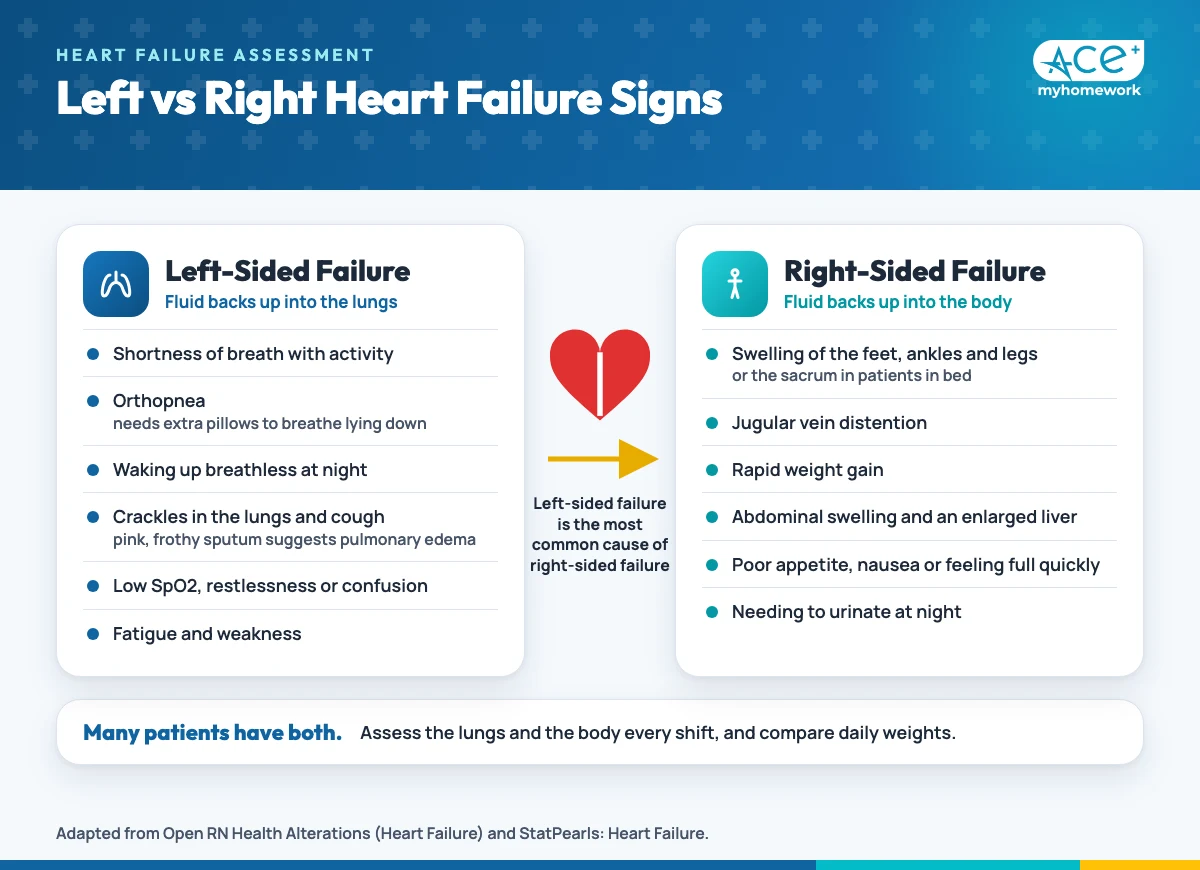
Where the fluid backs up depends on which side of the heart is failing. Left-sided failure congests the lungs. Right-sided failure congests the veins of the body. Left-sided failure is the most common cause of right-sided failure, so many patients show both patterns. The Open RN Health Alterations chapter on heart failure includes a comparison table you can use for revision.
Common signs of left-sided and right-sided heart failure. Adapted from Open RN Health Alterations and StatPearls.
Nursing Assessment for Heart Failure
Daily weight: same scale, same time (usually morning after voiding and before breakfast), similar clothing. Weight is the most practical measure of fluid change.
Intake and output: strict measurement during diuresis, including urine output after each diuretic dose.
Breathing: rate, effort, SpO2, lung sounds (crackles), cough, and how many pillows the patient needs to sleep (orthopnea). Ask about waking up breathless at night.
Circulation and fluid: blood pressure, heart rate and rhythm, extra heart sounds, jugular vein distention, edema in the legs or sacrum, capillary refill and skin temperature.
Perfusion: mental status, fatigue, dizziness and urine output, which can fall when cardiac output drops.
Laboratory data: sodium, potassium, magnesium, creatinine and BUN, and natriuretic peptide (BNP or NT-proBNP) if ordered.
Self-care: how the patient takes medicines, weighs themselves, limits sodium, and recognizes symptoms, and who helps at home.
Record these findings in the same order every shift so that trends are easy to compare.
Nursing Diagnosis for Heart Failure: Current NANDA-I Labels
The NANDA International 2024–2026 edition changed several labels used in heart failure care plans. The most important change is that Decreased cardiac output (00029), a label used in earlier editions, was retired, because experts judged it to be outside the scope of independent nursing practice. Risk for decreased cardiac output (00240) remains. Many textbooks and instructors still use Decreased cardiac output, so follow your course rubric and note the edition you used.
Current label (2024–2026)
Older label
Typical evidence in heart failure
Excessive fluid volume (00026)
Excess fluid volume
Weight gain, edema, crackles, jugular vein distention
Impaired gas exchange (00030)
Same label
Low SpO2, dyspnea, restlessness or confusion
Decreased activity tolerance (00298)
Activity intolerance (00092)
Breathlessness or fatigue with activity, abnormal heart rate response
Ineffective health self-management (00276)
Same label
Missed medicines, high-sodium diet, no daily weights
Excessive fatigue burden (00477)
Fatigue (00093)
Persistent tiredness that limits usual roles
Excessive anxiety (00400)
Anxiety (00146)
Fear about breathlessness, restlessness, poor sleep
There is no single nursing diagnosis heart failure care plans must use; choose the labels your assessment data support. For a hospitalized patient with congestion, Excessive fluid volume and Impaired gas exchange usually come first, because breathing and fluid overload are the immediate threats. For help writing the full statements, see our guides to common nursing diagnoses and nursing diagnosis examples with PES statements.
Nursing Care Plan for Congestive Cardiac Failure: Filled Example
The patient below is hypothetical. A 74-year-old woman with HFrEF (LVEF 30%) and NYHA class III symptoms is admitted with acute decompensated heart failure. She has gained 2.5 kg (about 5.5 lb) in five days after several salty restaurant meals and has run out of her diuretic. She has 2+ pitting edema to the knees, crackles in both lung bases and an SpO2 of 89% on room air, and she sleeps on three pillows. She becomes breathless walking to the bathroom. She lives with her husband and does not weigh herself at home.
Nursing Diagnosis
Expected Outcomes (SMART)
Nursing Interventions
Rationale
Evaluation
Excessive fluid volume related to excess sodium intake and reduced cardiac function, as evidenced by a 2.5 kg weight gain in 5 days, 2+ edema, crackles and orthopnea
Within 72 hours, weight falls toward the dry weight set by the provider, edema is 1+ or less, and crackles are reduced on auscultation.
Weigh daily before breakfast on the same scale.
Keep strict intake and output.
Give diuretics as prescribed; check urine output, blood pressure and orthostatic symptoms.
Monitor potassium, magnesium and creatinine and report abnormal results.
Maintain sodium and fluid limits as ordered.
Daily weight is the most reliable measure of fluid change. Diuretics relieve congestion but can cause low potassium and magnesium, kidney injury and hypotension, so effects must be monitored.
Partially met at 72 hours: down 1.8 kg, edema 1+, fine crackles at right base only. Continue diuretic plan.
Impaired gas exchange related to pulmonary congestion, as evidenced by SpO2 89% on room air, dyspnea and bilateral crackles
Within 24 hours, SpO2 stays within the target range ordered by the provider, respiratory rate is 12 to 20, and the patient reports easier breathing.
Place in high Fowler's position with legs supported.
Give oxygen as prescribed and titrate to the ordered target.
Monitor SpO2, respiratory rate, work of breathing and mental status at least every 4 hours and as needed.
Cluster care to allow rest.
Call the rapid response team for rising work of breathing, falling SpO2 or new confusion.
Upright positioning reduces venous return and helps the lungs expand. Oxygen corrects hypoxemia. Confusion or restlessness can be an early sign of worsening hypoxemia.
Met: SpO2 94% on 2 L/min by 24 hours, respiratory rate 18, sleeping on two pillows.
Decreased activity tolerance related to imbalance between oxygen supply and demand, as evidenced by dyspnea and fatigue walking to the bathroom
By discharge, the patient walks 50 meters in the hallway with heart rate and blood pressure within ordered limits and SpO2 within target.
Check vital signs before, during and after activity.
Increase activity step by step: sitting, standing, short walks.
Teach energy conservation, such as sitting to wash and planning rest periods.
Ask the provider about cardiac rehabilitation referral before discharge.
Gradual progression avoids overloading the heart while preventing deconditioning. The 2022 guideline recommends exercise training or regular activity for patients who are able, and cardiac rehabilitation can be useful.
Met on day 4: walked 50 meters with one rest; heart rate rose from 82 to 98; SpO2 93%.
Ineffective health self-management related to complex regimen and limited knowledge of sodium sources, as evidenced by running out of diuretic, high-sodium meals and no home weights
Before discharge, the patient and her husband use teach-back to explain daily weights, when to call, each medicine's purpose and 3 high-sodium foods to limit. A follow-up visit is booked within 7 days.
Use teach-back for daily weights, the weight-gain alert numbers and symptoms.
Give a daily weight and symptom log.
Reconcile medicines with the pharmacist and confirm she can obtain refills.
Include her husband in teaching.
Schedule follow-up within 7 days of discharge.
The 2022 guideline gives a strong recommendation for multidisciplinary self-care education. Early follow-up, generally within 7 days, is considered reasonable after a heart failure hospitalization.
Met: both used teach-back correctly; follow-up booked for day 5 after discharge; refills arranged.
Use this as a model for the structure, not as a template to copy. Your assessment data, goals and evaluation must match your own patient. A typical nursing care plan CHF assignment also asks for the pathophysiology in your own words and a rationale for each intervention with a source. Our guide on how to write a nursing care plan explains each column, and the guide to nursing concept maps shows how to link these diagnoses visually.
Key Nursing Interventions Explained
Monitoring Diuretic Therapy
Loop diuretics are the main treatment for congestion. After each dose, record the urine output and watch for dizziness, low blood pressure, muscle cramps and changes in potassium, magnesium and creatinine. Weigh the patient before breakfast each day so the provider can judge the response and adjust the dose.
Supporting Guideline-Directed Medical Therapy
For HFrEF, the 2022 guideline recommends four medicine classes together: a renin-angiotensin system inhibitor (preferably an angiotensin receptor-neprilysin inhibitor, or ARNi), an evidence-based beta-blocker, a mineralocorticoid receptor antagonist and an SGLT2 inhibitor. Nursing responsibilities include:
Checking blood pressure and heart rate before each dose and following hold parameters.
Monitoring potassium and kidney function, especially with mineralocorticoid receptor antagonists and renin-angiotensin system inhibitors.
Flagging an ACE inhibitor and an ARNi on the same medication list, since an ARNi must not be started within 36 hours of the last ACE inhibitor dose.
Teaching patients not to stop beta-blockers abruptly and that some tiredness can occur when doses are increased.
Teaching patients to avoid NSAIDs such as ibuprofen and naproxen unless the provider approves, because the American Heart Association lists them among drugs that can cause or worsen heart failure.
Sodium and Fluid Limits
The 2022 guideline says that, for patients with symptomatic heart failure, avoiding excessive sodium intake is reasonable to reduce congestion, but it does not set one number for everyone. Fluid restriction is not routine for every patient, and the guideline describes its benefit as uncertain even in advanced heart failure with low blood sodium. Follow the provider's order and teach the specific limits the patient has been given, rather than generic numbers.
Daily Weight and Fluid Tracking
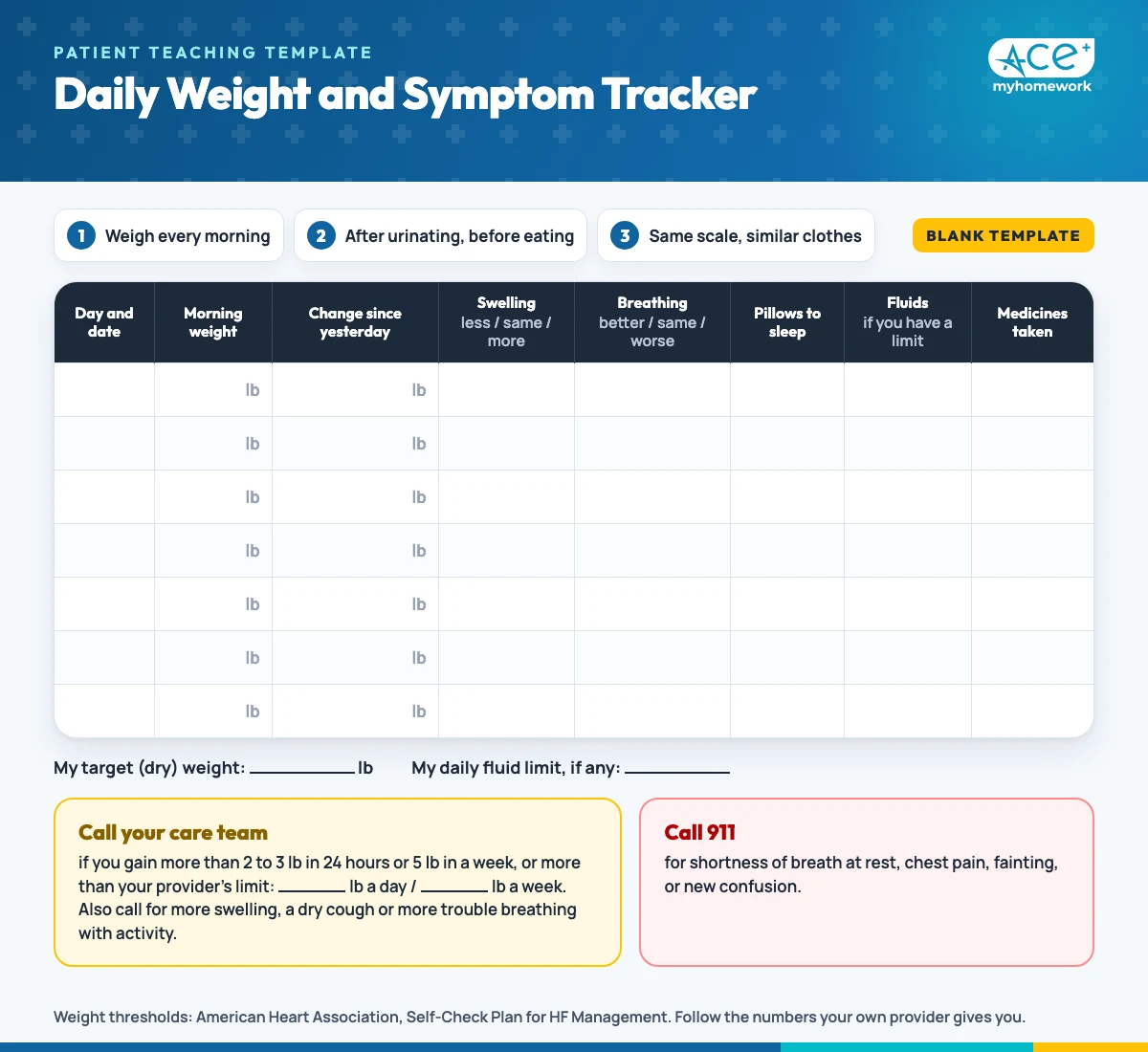
Teaching patients to weigh themselves every day and act on changes is one of the most useful nursing interventions in heart failure, because weight often rises before breathlessness gets worse. The American Heart Association's Self-Check Plan for HF Management tells patients to contact their care team for a sudden weight gain of more than 2 to 3 pounds in 24 hours or 5 pounds in a week. Some programs use different numbers, so always teach the thresholds the patient's own provider sets.
A blank daily weight and symptom tracking template for patient teaching. Alert thresholds from the American Heart Association Self-Check Plan for HF Management.
When you teach the sheet, ask the patient to show you how they would fill in a day and what they would do if the weight rose by 3 pounds overnight. This is the teach-back method, which is also a popular topic for evidence-based practice projects. See the heart failure readmission question in our PICOT question examples.
Red Flags in Heart Failure
Escalate promptly, and use SBAR when you call, for any of the following:
Increasing shortness of breath at rest, inability to lie flat, or falling SpO2 despite oxygen.
Pink, frothy sputum or rapidly worsening crackles, which can signal acute pulmonary edema.
Chest pain, new irregular heart rhythm, fainting or a heart rate outside ordered limits.
New confusion, cool clammy skin, low blood pressure or falling urine output, which can mean poor perfusion.
Potassium or creatinine results outside the normal range after diuretic or medicine changes.
Getting Help with a Heart Failure Care Plan
Heart failure care plans are common in medical-surgical and critical care courses and in clinical paperwork. If you would like feedback on a nursing care plan for heart failure, including your diagnoses, SMART outcomes or rationales, our nursing homework help service provides tutoring and review from nursing writers. Use any outside help in line with your school's academic integrity policy.
Frequently Asked Questions
What Is the Priority Nursing Diagnosis for Heart Failure?
In acute decompensated heart failure, Impaired gas exchange and Excessive fluid volume are usually the priorities because breathing and fluid overload are the immediate threats. Once the patient is stable, Ineffective health self-management becomes the focus for preventing readmission.
Is Decreased Cardiac Output Still a NANDA-I Diagnosis?
It was retired in the 2024–2026 edition. Risk for decreased cardiac output (00240) remains. If your instructor or textbook still uses Decreased cardiac output, follow the rubric and mention which edition you used.
What Should a Nursing Care Plan for CHF Include?
It should include assessment data, three to five prioritized nursing diagnoses, SMART outcomes, nursing interventions with rationales, and an evaluation of each outcome. Most heart failure plans cover fluid balance, breathing, activity and self-management teaching.
How Much Weight Gain Should Patients with Heart Failure Report?
The American Heart Association's patient self-check plan uses more than 2 to 3 pounds in 24 hours or 5 pounds in a week. The patient's own provider may set different numbers, and those take priority.
What Is the Difference Between Left- and Right-Sided Heart Failure?
Left-sided failure backs fluid into the lungs, causing breathlessness, orthopnea and crackles. Right-sided failure backs fluid into the body, causing leg edema, jugular vein distention, weight gain and abdominal swelling. Many patients have both.
Should Every Heart Failure Patient Be on a Fluid Restriction?
No. The 2022 guideline does not recommend routine fluid restriction, and its benefit is uncertain even in advanced heart failure. Teach patients the limit their own provider has ordered, if any.
Get affordable and top-notch help for your essays and homework services from our expert tutors. Ace
your homework, boost your grades, and shine in online classes—all with just a click away!