Among nursing theories, Jean Watson's Theory of Human Caring holds that caring is the core of nursing and that the relationship between nurse and patient can itself be healing. Watson first set out the theory in 1979 as ten carative factors, which she later reworded as the 10 Caritas Processes. At the center of the theory is the transpersonal caring relationship, in which the nurse connects with the whole person, not only with the disease.
This article explains the theory's main concepts, compares the carative factors with the Caritas Processes, traces how the theory evolved, and shows how to apply it in clinical practice and in student papers.
Where Jean Watson Fits Among Nursing Theories
Nursing theories range from broad grand theories to narrow middle-range theories, and Watson's work sits at the abstract end. Nursology describes Watson's theory as both a philosophy and a grand view of nursing, and some textbooks group it with nursing philosophies. Its stated aim is to protect, enhance and preserve human dignity. If you're new to the levels of theory, our complete guide to nursing theories and theorists explains grand, middle-range and situation-specific theories and the four metaparadigm concepts.
Watson defines the metaparadigm in caring terms:
Person: a unity of mind, body and spirit, valued and cared for as a whole.
Environment: includes the caring-healing environment the nurse helps to create, physical and non-physical.
Health: harmony within the mind, body and spirit, not merely the absence of disease.
Nursing: a human science of caring, practiced through caring relationships and caring actions.
Who Is Jean Watson?
Jean Watson was born in West Virginia in 1940. She trained as a nurse, then completed a bachelor's degree and a master's in psychiatric-mental health nursing at the University of Colorado, followed by a PhD in educational psychology and counseling. According to the Watson Caring Science Institute, she developed the theory between 1975 and 1979 while teaching at the University of Colorado, drawing on her doctoral studies. She later served as dean of the university's school of nursing and founded the Watson Caring Science Institute, a nonprofit that promotes caring science in education and practice.
Core Concepts of the Theory of Human Caring
Caring Science
Watson describes nursing as a caring science that draws on both science and the humanities. Caring science treats caring as a moral ideal and a way of being with people, not just a set of tasks. It complements the curing focus of medicine rather than competing with it.
The Transpersonal Caring Relationship
"Transpersonal" means going beyond the nurse's own ego and beyond the immediate moment to connect with the other person's inner life and meaning. In a transpersonal caring relationship, the nurse sees the patient as a whole person, is genuinely present and treats the relationship as a source of healing for both people. In her own overview of the theory in Texto & Contexto Enfermagem (2007), Watson describes this relationship as intersubjective, honoring the dignity of the whole person.
The Caring Moment (Caring Occasion)
A caring occasion happens when a nurse and another person come together with their own histories and fields of experience. It becomes a caring moment when both are present to each other in a way that creates a genuine human connection. Watson writes that a caring moment can extend beyond the encounter itself, becoming part of the life history of both people. In practice, a caring moment can be brief: a few minutes of full attention during a dressing change can still be one.
Caritas Consciousness
Watson stresses the nurse's intention and awareness. A nurse who approaches a patient with a caring, healing intention, focused on wholeness rather than only on the disease, shapes the whole encounter. This is why the theory also asks nurses to care for themselves: caring for others is hard to sustain without self-care.
The 10 Carative Factors vs. the 10 Caritas Processes
Watson's 1979 book Nursing: The Philosophy and Science of Caring introduced ten carative factors. She chose "carative" to contrast with "curative." Over the following decades, she reworded them as the Caritas Processes, using "caritas," a Latin word she links with cherishing, appreciating and giving loving attention. In the 2007 overview cited above, she explains that the Caritas Processes offer a more fluid language for the same core, and the 2008 revised edition of her first book presents them as an extension of the original factors rather than a replacement.
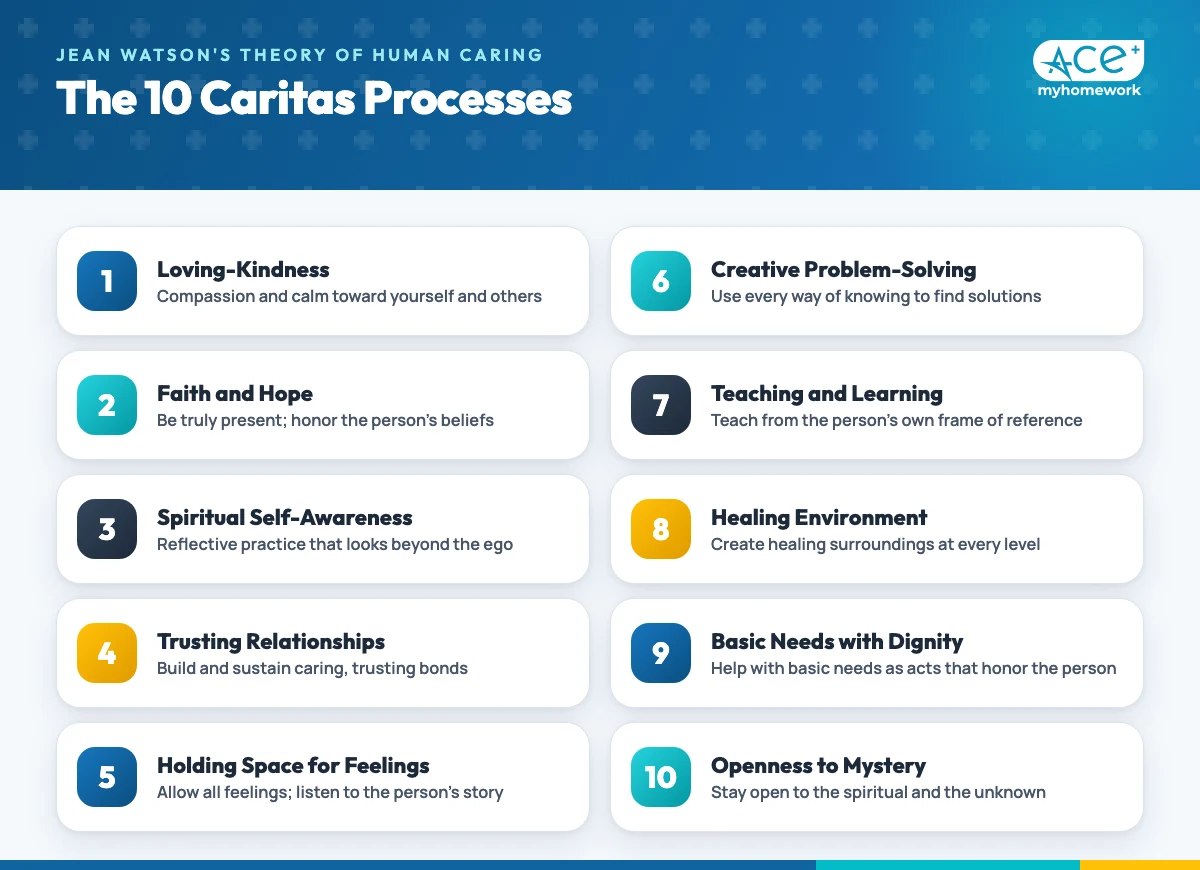
The 10 Caritas Processes, paraphrased from the Watson Caring Science Institute.
Practicing loving-kindness, compassion and calm toward yourself and others
Treating every patient with the same respect, whatever their behavior or background
2
Instilling faith and hope
Being authentically present and honoring the person's beliefs and sources of hope
Asking what gives the patient strength and supporting it
3
Cultivating sensitivity to self and others
Developing your own reflective or spiritual practices and looking beyond your ego
Reflecting after a difficult shift instead of carrying it into the next patient's room
4
Developing a helping-trust relationship
Building and sustaining trusting, caring relationships
Introducing yourself, keeping promises, following up when you said you would
5
Expressing positive and negative feelings
Making space for all feelings and truly listening to the person's story
Staying with a patient who is crying or angry instead of rushing to fix it
6
Systematic use of scientific problem-solving
Using creative, whole-person problem-solving as part of caring
Combining assessment data with the patient's ideas to adapt a plan
7
Interpersonal teaching-learning
Teaching and learning within the caring relationship, starting from the person's own frame of reference
Tailoring discharge teaching to what the patient already knows and wants to know
8
Supportive, protective and corrective environment
Creating a healing environment at every level, physical and non-physical
Reducing noise, protecting privacy, clustering care so the patient can rest
9
Assisting with gratification of human needs
Helping with basic needs as sacred acts that protect dignity
Bathing, feeding or toileting with attention and respect, not as a rushed task
10
Allowing for existential-phenomenological forces
Staying open to the spiritual, the unknown and the unexpected
Respecting a dying patient's search for meaning, even when it differs from yours
What Changed and What Stayed the Same
The structure stayed: there are still ten, and each caritas process maps to its original factor.
The language softened: "systematic use of the scientific problem-solving method" became creative problem-solving, reflecting Watson's view that caring uses all ways of knowing, including intuition and aesthetics.
Love became explicit: in her 2007 overview, Watson explains that caritas makes the connection between caring and love explicit.
Self-care moved forward: the first process applies loving-kindness to the nurse as well as the patient.
How Watson's Theory Evolved
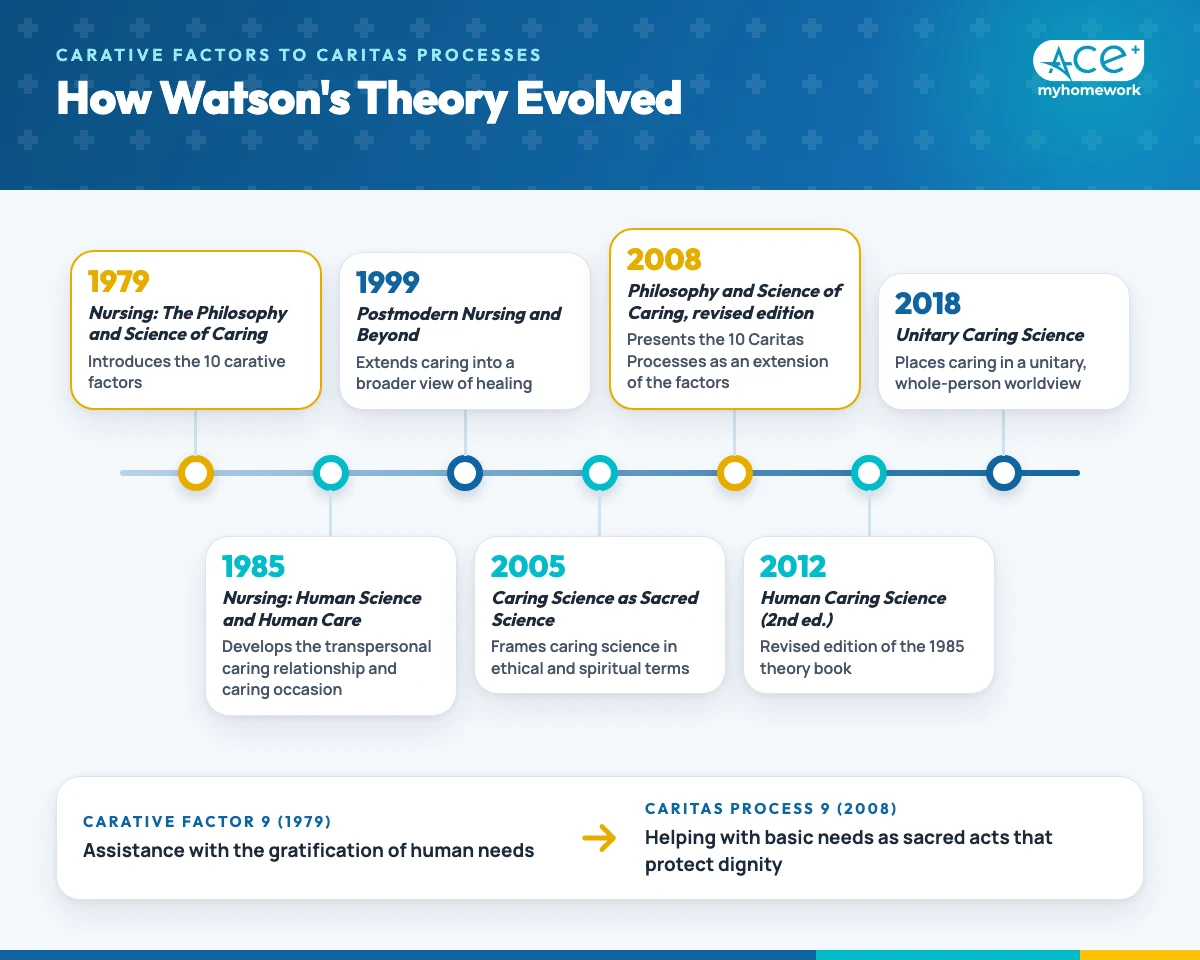
Watson has revised and extended the theory throughout her career. The main milestones are below.
Major publications in the evolution of Watson's theory, from carative factors to Caritas Processes.
Year
Publication
Significance
1979
Nursing: The Philosophy and Science of Caring
Introduced the ten carative factors
1985
Nursing: Human Science and Human Care: A Theory of Nursing
Developed the transpersonal caring relationship and the caring occasion; reprinted by the National League for Nursing in 1988
1999
Postmodern Nursing and Beyond
Extended caring into a broader view of healing practice
2005
Caring Science as Sacred Science
Framed caring science in ethical and spiritual terms
2008
Nursing: The Philosophy and Science of Caring, revised edition
Presented the Caritas Processes as an extension of the carative factors
2012
Human Caring Science: A Theory of Nursing (2nd ed.)
Revised edition of the 1985 theory book
2018
Unitary Caring Science: The Philosophy and Praxis of Nursing
Placed the theory within a unitary, whole-person worldview
When you cite the carative factors, use the 1979 or 1985 sources. When you cite the Caritas Processes, use 2008 or later, or the Watson Caring Science Institute's current wording.
Applying Watson's Theory in Nursing Practice
Watson's theory doesn't prescribe specific procedures. It changes how nurses carry out the care they already give. These hypothetical examples show how.
Example: A Patient Receiving a New Cancer Diagnosis
For example, a 56-year-old patient has just heard that a biopsy shows cancer. Using the theory, the nurse sits down rather than standing at the door, gives the patient time to react (Caritas Process 5), asks what gives them strength (Process 2) and arranges for a family member to be present for the next conversation with the oncologist (Process 8). The clinical tasks are the same; the presence is different.
Example: End-of-Life Care
For example, an 84-year-old patient is dying in a busy medical unit. The nurse lowers the lights, limits interruptions, supports the family's rituals and provides mouth care slowly and gently, treating it as an act that honors the person (Processes 8, 9 and 10).
Example: Nurse Self-Care and Burnout
Because the first Caritas Process includes loving-kindness toward oneself, many organizations use Watson's theory in programs on nurse well-being, such as brief centering practices before shifts or structured reflection after a patient death.
Hospitals That Use the Theory
Some health systems adopt Watson's theory as the basis of their professional practice model. Wake Forest's nursing model of care, for example, names individual Caritas Processes as part of how its nurses practice. The Watson Caring Science Institute also offers the Watson Caritas Patient Score, a short tool that asks patients how they experienced caring, which lets organizations study caring as a measurable outcome.
Using Watson's Theory in Student Papers
Watson's theory is a popular choice for nursing philosophy papers, theory analyses and capstone projects about patient experience, compassion, end-of-life care or nurse burnout. Use these steps to apply it well.
Choose the right version. Decide whether you're discussing the 1979 carative factors or the Caritas Processes, and cite the matching source.
Link concepts to actions. Don't just list the ten processes. Show how two or three of them shape specific nursing actions in your case or project.
Define the metaparadigm. Explain how Watson defines person, environment, health and nursing, and how those definitions shape your argument.
Connect to outcomes. If your project measures something, explain how the theory predicts the outcome, such as patient-perceived caring or nurse compassion fatigue.
Evaluate it honestly. Note both strengths and limitations.
A sample thesis for a theory application paper might read: "Applying Watson's Caritas Processes 4, 5 and 8 to the care of patients receiving palliative chemotherapy can guide nurses to build trusting relationships, make space for patients' fears and create a calmer treatment environment." If your paper includes a care plan, our guide on how to write a nursing care plan shows how to write interventions with rationales, and you can draw on the theory in those rationales. For projects that pair the theory with a practice change, see our overview of evidence-based practice in nursing.
Common Mistakes to Avoid
Copying the Caritas Processes word for word without quotation marks and a citation.
Mixing 1979 and 2008 wording in the same list.
Citing only a website or textbook summary when the assignment asks for primary sources.
Describing the theory in general terms without applying it to a patient, population or setting.
Strengths and Limitations of Watson's Theory
Strengths
Limitations
Puts the patient's experience and dignity at the center of care
Concepts are abstract and can be hard to define and measure
Recognizes the nurse's own well-being
Spiritual language may feel unfamiliar in some settings
Applies across settings, from ICU to hospice
Gives less direct guidance on physical and technical care
Supported by measurement tools such as the Watson Caritas Patient Score
Caring moments take time that short-staffed units may lack
Getting Help with a Watson Theory Assignment
Theory papers ask you to explain abstract ideas clearly and then apply them, which is where many drafts fall short. If you'd like feedback on how you've applied the Caritas Processes or structured your theory analysis, our nursing homework help service offers tutoring and review. Use any outside help in line with your school's academic integrity policy.
Frequently Asked Questions
What Is Jean Watson's Theory of Caring in Simple Terms?
It says that caring is the heart of nursing and that a genuine, respectful relationship between nurse and patient supports healing of the whole person, mind, body and spirit.
What Are the 10 Caritas Processes?
They are ten guidelines for caring practice, covering loving-kindness, faith and hope, self-awareness, trusting relationships, expressing feelings, creative problem-solving, teaching and learning, a healing environment, help with basic needs and openness to the spiritual. The official wording is published by the Watson Caring Science Institute.
What Is the Difference Between Carative Factors and Caritas Processes?
Carative factors are the original 1979 version. Caritas Processes are Watson's later wording of the same ten ideas, making love, compassion and self-care more explicit. Watson presents them as an extension of the factors, not a different theory.
What Is a Transpersonal Caring Relationship?
It is a relationship in which the nurse connects with the patient as a whole person, beyond the illness and beyond the nurse's own ego, with the aim of protecting the patient's dignity and supporting healing.
Is Watson's Theory a Grand or Middle-Range Theory?
It is usually described as a philosophy or grand theory because its concepts are broad and abstract. Some authors use it in a more focused, middle-range way in research on specific caring behaviors.
How Do I Use Watson's Theory in a Nursing Paper?
Choose the version you're citing, explain the key concepts and metaparadigm, then apply two or three Caritas Processes to a specific patient, population or project and evaluate the theory's strengths and limitations.
Get affordable and top-notch help for your essays and homework services from our expert tutors. Ace
your homework, boost your grades, and shine in online classes—all with just a click away!
Struggling with human sexuality essays? Discover 100+ top topics on psychology, ethics, and society, plus guidance for writing the best academic papers.
What is the molecular mass of C6H6 (benzene)? Learn how to calculate it step by step, understand the key concepts, and see its role in scientific history.