Get A+ Homework Help Fast. Getting started with our homework help service is easy. In these
simple steps, Submit your order, choose the best writer, track progress in real-time,
and download a plagiarism-free essay tailored to your requirements. Fast, reliable, and trusted
by students worldwide.
Submit your Order
On our specially designed order form input all the details about your piece of work.
Choose the Writer
Check various bids from writers and evaluate writers based on reviews from their previous
work and choose the best.
Track Work
Each paper written is unique, and we always aim to cater to your specific needs. We never
re-use or re-sell any essay we have created.
Download Your Paper
Download your highly written paper. If the solution is not up to standard (rarely happens),
request a revision
DNP and Capstone Coaching: DNP Capstone Project Help
A DNP project asks you to do something most nurses have never done: find a problem in your own clinical practice, build an evidence-based fix, put it in place with real staff and patients, and show whether it worked, all while writing it up to doctoral standards. DNP capstone project help from AceMyHomework pairs you with an experienced nursing writer who coaches you through each of those stages, from your first problem statement to the final DNP project paper and defense.
This page explains what a DNP capstone involves, where DNP students most often get stuck, and how our coaching and writing support fits around the work only you can do.
Every DNP capstone project is different, but the support a DNP student asks for usually falls into a few groups:
Topic and problem statement: narrowing a broad area of interest into a local, measurable problem your clinical site cares about.
PICOT question and literature: developing a searchable question, a search strategy, an evidence table and a synthesis of the literature.
Capstone proposal writing: structuring each chapter, choosing a framework, and writing objectives and an evaluation plan your committee can approve.
Implementation planning: timelines, stakeholder analysis, developing staff education materials and data collection tools.
Evaluation: choosing measures, setting up run charts or pre- and post-intervention comparisons, and reporting results honestly.
Final paper, poster and defense: editing for clarity and APA style, turning findings into a poster, and rehearsing committee questions.
You can ask for help with a single task, such as one proposal chapter, or work with the same writer through all the stages of your DNP project to completion.
What Makes a DNP Project Different From a Research Thesis
The DNP is a practice doctorate. A PhD dissertation generates new knowledge through original research; a DNP project translates existing evidence into healthcare practice and measures the result. Confusing the two is one of the most common reasons a capstone proposal comes back for revision.
Feature
DNP Project
PhD Dissertation
Purpose
Apply evidence to improve practice and outcomes
Generate new knowledge through original research
Typical design
Quality improvement, evidence-based practice change, program evaluation
Experimental, observational or qualitative research
Setting
A real clinical site or organization
Any setting the research question needs
Ethics review
Often a quality improvement or "not research" determination
Full IRB review as human subjects research
Key output
A practice change with a sustainability plan
Generalizable findings
The American Association of Colleges of Nursing (AACN) set out minimum expectations in its 2015 white paper on the DNP. A DNP project should focus on a change that affects healthcare outcomes, have a systems or population focus, be implemented in a practice setting, include a plan for sustainability, include an evaluation of processes or outcomes, and provide a foundation for future practice scholarship. Most DNP programs still build their handbooks around these elements, now mapped to the 2021 AACN Essentials, so we use them as a checklist when we review your DNP project.
Those expectations are not always met. A 2023 national review in the Journal of Professional Nursing examined 214 DNP projects from 120 schools and found that most evidence-based practice and quality improvement elements appeared in fewer than half of the projects. Getting those elements right is where coaching adds the most value.
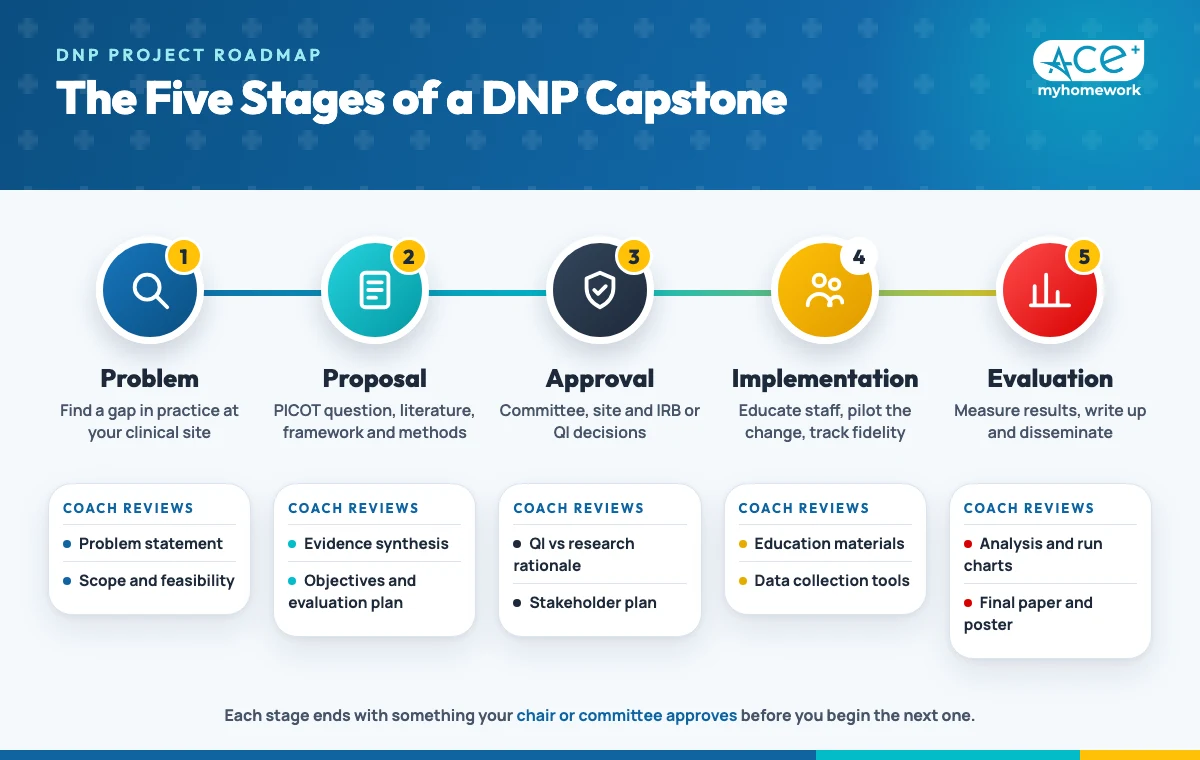
The Five Stages of a DNP Capstone
Programs name and divide the work differently, but most DNP capstone projects move through the following stages. Each one ends with something your faculty chair or committee has to sign off before you begin the next one.
The five stages of a DNP capstone and what a coach reviews at each one.
Stage 1: Finding a Problem Worth Solving in Nursing Practice
Good DNP projects begin with a focus on a gap between current nursing practice and the best available evidence at your own site: falls on a medical unit, missed sepsis screens, or low uptake of a diabetes education program. To identify areas worth pursuing, look at your organization's quality reports, incident reports and patient feedback, and talk to managers about their priorities and the challenges they want solved. Your own practice experience is often the best guide, because you already know where care breaks down. A DNP student who works nights, for example, may identify handoff or staffing problems that day-shift managers never see.
A strong problem statement names the population, shows the size of the gap with local figures, and explains why it matters to patients and the organization. We help you evaluate a topic for scope and feasibility: can you implement it in the time your program allows, will the site give you access to the records you need, and is there enough evidence to support an intervention?
Stage 2: Developing the Capstone Proposal
The capstone proposal is usually the longest piece of writing before the final paper. Most proposals include:
an introduction with the problem statement, purpose and a PICOT question;
a review of the literature with an evidence table and a synthesis of findings;
a theoretical or improvement framework, such as the Iowa Model, the Johns Hopkins Evidence-Based Practice Model or the Model for Improvement with Plan-Do-Study-Act cycles;
methods: setting, population, intervention, timeline, measures, data collection and analysis;
a budget, a sustainability plan and an evaluation plan.
Developing a proposal takes most students a full semester. Some programs ask for at least 20 scholarly sources, mostly from the last five years, and for SMART objectives tied to each aim. Your handbook sets the rules, so we start by reading it with you. If you are still shaping your question, our guide on how to formulate PICOT questions is a good first step.
Stage 3: Approval and Planning
Before implementing anything you will usually need sign-off from your committee and your site, plus an ethics decision. Many DNP projects qualify as quality improvement rather than research, but only your institution's IRB can determine that, and the forms vary from school to school. Planning at this stage also means mapping stakeholders, including unit managers, educators, physicians, informatics staff and patients, and agreeing on who does what and when. Stakeholders who help design the change are far more likely to support it. Good planning also covers the resources you need, such as staff time for education sessions and help from informatics to pull reports.
Stage 4: Implementing the Practice Change
Implementation is where clinical expertise meets project management, and it is the stage a DNP student is least likely to have practiced before. Typical tasks include developing and running staff education sessions, updating documentation templates in the electronic health record, piloting the intervention, tracking whether it is delivered as planned, and adjusting the plan when barriers appear. Keeping a weekly log of what happened, and why, makes the final paper much easier to write.
Stage 5: Evaluation, the Final Paper and Dissemination
Evaluation shows whether the intervention worked and whether it was delivered as intended. Many DNP projects compare measures before and after the intervention, or track a measure over time with a run chart. Our article on which statistical test to use covers the comparisons most projects need. Quality improvement projects are often reported using the SQUIRE 2.0 guidelines.
Dissemination is required for every DNP project. Options include a poster or podium presentation, a manuscript for publication, a briefing for your organization's leadership, or a submission to a repository such as the Doctors of Nursing Practice, Inc. Doctoral Project Repository.
Common DNP Capstone Project Types and Examples
Project Type
Example
Quality improvement
A standardized diabetic foot care protocol in a primary care clinic
Evidence-based practice change
Staff education to improve adherence to a sedation protocol
Program development and evaluation
A caregiver education program to reduce avoidable pediatric emergency visits
Clinical guideline development
A treatment guideline for neonatal abstinence syndrome
Patient education intervention
A stress management module based on a patient anxiety survey
For more starting points, browse our nursing research topics, which include ideas for DNP and capstone projects. Whatever you choose, the DNP capstone has to fit your site, your role and your program's timeline.
Writing the DNP Project Paper Chapter by Chapter
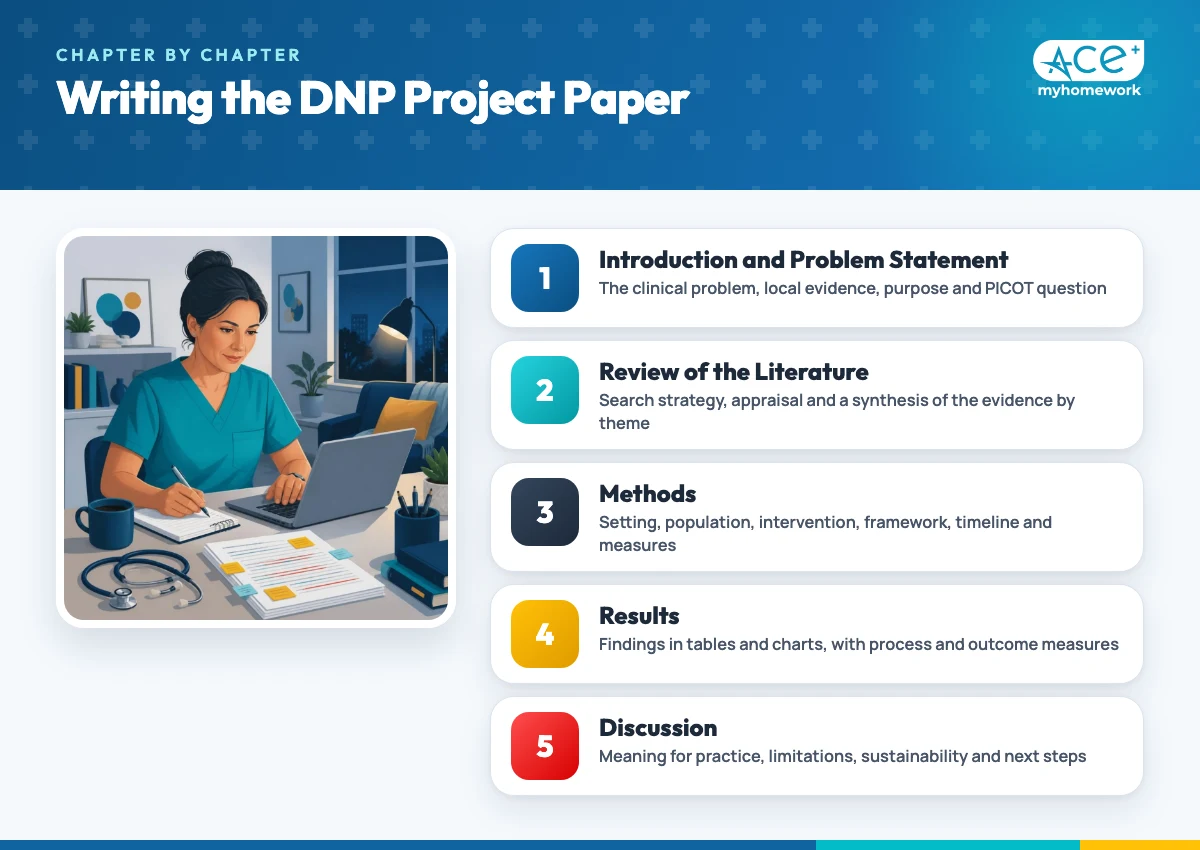
Most DNP project papers follow a five-chapter structure, and writing them well takes as much planning as the project itself, although some programs use a single manuscript-style paper or a SQUIRE 2.0 report instead, and some split the work into separate proposal and final papers. Here is what each chapter needs to do and what we look for when reviewing your writing.
The five-chapter structure most DNP project papers follow.
Chapter 1: Introduction and Problem Statement
Set out the clinical problem, the local evidence that it exists, the purpose of the DNP project and the PICOT question. Keep the focus narrow and identify the gap clearly. Reviewers want to know exactly which patients, which setting and which outcomes you will measure.
Chapter 2: Review of the Literature
Explain how you searched (databases, terms, inclusion criteria), appraise the evidence, and synthesize the findings by theme rather than summarizing one study after another. End by showing how the literature supports your chosen intervention. Our APA formatting guide covers headings, tables and references.
Chapter 3: Methods
Describe the setting, the population, the intervention, the framework, the timeline, the measures and how you will analyze them. Many students create a project charter at this point to keep the focus on agreed tasks. A logic model or a timeline table often makes this chapter easier for your committee to follow.
Chapter 4: Results
Report what happened, including what did not go to plan. Present results in tables or charts, and report process measures (such as education completion rates) alongside outcome measures.
Chapter 5: Discussion
Discuss what the results mean for nursing practice, the factors that helped or hindered implementation, the limitations, the plan for sustainability, and recommendations for the organization. This is where you show the influence your work can have beyond a single unit.
How to Evaluate Your DNP Project's Effectiveness
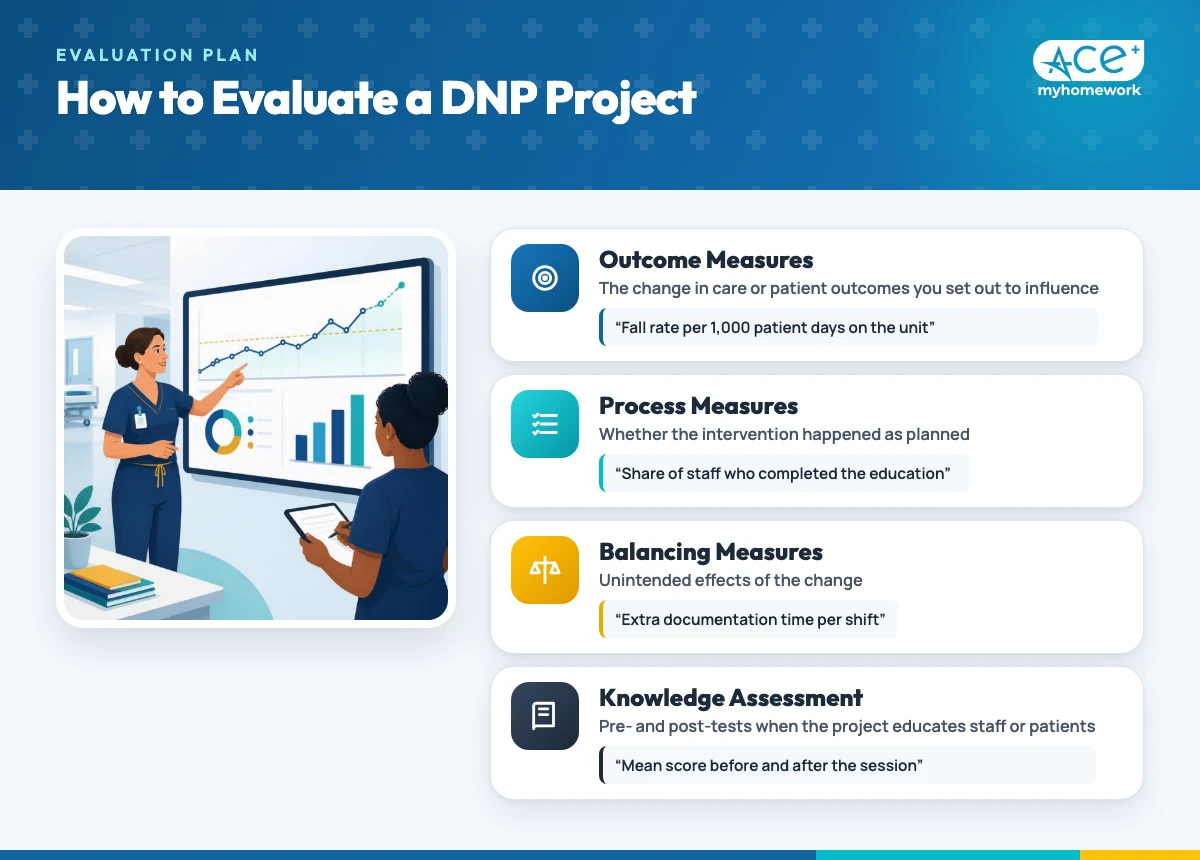
Your committee will want to see that you can evaluate a change honestly and determine whether it made a difference, not just report that it went well. A sound evaluation plan usually includes:
The four kinds of measures in a DNP project evaluation plan.
Outcome measures: the change in patient outcomes or care quality you set out to influence, such as fall rates or HbA1c results.
Process measures: whether the intervention happened as planned, such as the share of staff who completed education or the share of eligible patients screened.
Balancing measures: unintended effects, such as added documentation time.
Knowledge or confidence assessment: pre- and post-tests when the intervention is designed to educate staff or patients, a common design in nursing education projects.
Short projects rarely change long-term outcomes, so choose measures that can realistically move in the weeks you have. Our writers help you create an evaluation plan that matches your timeline and your site's records, and help you identify which measures are worth the effort to collect.
Where DNP Students Most Often Get Stuck
The challenges DNP students describe are remarkably consistent:
A topic that is too big for the project's stages and timeline. "Reducing readmissions" is a field of research; "improving discharge teaching for heart failure patients on one unit" is a DNP project.
A literature review that summarizes instead of synthesizing. Committees want to see how the evidence fits together and why it supports your intervention.
Outcomes that cannot be measured in time. Mortality rarely changes in 12 weeks; process measures and intermediate outcomes often do.
Weak stakeholder support. Without a champion on the unit, implementing the change stalls.
Writing while working. Most DNP students work in clinical practice while completing their practice hours. AACN and accreditors expect a minimum of 1,000 post-baccalaureate practice hours, and many programs credit up to 500 of those from an MSN.
A writer who has seen these challenges before can help you identify them early, before they cost you a semester. Planning your writing around your shifts, with a small task for each week, also helps.
Our DNP Capstone Writing and Editing Services
Our writing services are built around the stage you are at, so you only pay for the support you need. Each one draws on the expertise of writers who focus on nursing:
Topic development services: developing and testing two or three ideas for scope, evidence and feasibility.
Proposal coaching services: feedback on each chapter, with comments that explain what to change and why.
Literature review services: search strategies, evidence tables and synthesis outlines built from evidence-based resources such as CINAHL, PubMed and the Cochrane Library.
Data analysis services: choosing tests, building run charts and interpreting results.
Editing and APA services: clarity, flow, headings, tables and references for proposals and final papers.
Poster and defense preparation services: condensing your project into a poster or slides, and practicing the questions your committee is likely to ask.
We also help with the other papers in a DNP program, from health policy papers and leadership papers to patient education materials, reflective journals and practicum logs. Many DNP projects also call for continuing education content for staff, and we can help you plan and review it.
How DNP Project Coaching Works on AceMyHomework
Post your task. Describe the stage you are at, upload your handbook, rubric and any drafts, and set your deadline.
Compare writer bids. Writers who work in nursing bid on your task. You can compare their offers along with their ratings, reviews and completed orders before you choose a writer.
Work together in the order chat. Share feedback from your chair, ask questions and request revisions in one place.
Review and learn from the work. Use the feedback, outlines, edits and examples to strengthen your own writing and your next submission.
Choosing a Writer for Your Nursing Capstone
Look for a writer who understands the difference between quality improvement and research, knows APA style, and can explain the reasoning behind every suggestion. Ask how they would approach your DNP project before you accept a bid. A good writer asks about your site, your program's template and your committee's feedback, not just your word count.
Using Capstone Project Help Responsibly
A DNP capstone project is your work in a way few assignments are. You hold the clinical relationships, you implement the intervention, you collect the data and you defend the project in front of your committee. No DNP writing service can do those parts for you, and you would not want one to.
Where outside support fits is in the knowledge and skills behind the writing: understanding the evidence, structuring a chapter, analyzing results correctly and presenting findings clearly. Check your program's academic integrity policy, tell your chair if you work with an editor, and use what we provide as a guide for your own work rather than something to submit as it stands. The DNP is meant to prepare you for innovation and leadership in advanced nursing practice, and the skills you build on your DNP project are the essential ones you will use after graduation.
Support for Every Kind of Nursing Capstone
We also support MSN and BSN students with nursing capstone papers, evidence-based practice proposals, change projects and reflective journals. For broader capstone help outside nursing, see our capstone project writing services. For coursework across advanced nursing practice, from pathophysiology to health policy, visit our nursing homework help page, and for free guides on care plans, SBAR and PICOT, browse the Nursing Study Hub.
Start Your DNP Capstone Project With the Right Support
Whether you are choosing a topic, revising a capstone proposal or preparing to present your findings at your defense, the right support at the right stage saves time and leads to a stronger DNP project. Post your project, compare bids from nursing writers, and get help with the DNP project writing you are working on today.
What Customers Are Saying About AceMyHomework
We take pride in having assisted thousands of students, and we're confident in our
ability to provide the help you need as well.
Order #24210:
Module 2 Assignment International Manage...
(10/10)
Excellent job on assignment
Business
Order #24209:
Criminal justice
(10/10)
Outstanding writing service! Exceeded my expectations with top-notch content and prompt deliver.
Criminal justice
Order #24201:
International Management Module 1
(10/10)
Completed before the deadline with perfect accuracy.
Business
Order #24204:
Email Portfolio (three emails)
(10/10)
Creative approach to problem-solving, very innovative.
Communications
Order #24203:
Criminal Justice
(10/10)
Superb work, thank you!
Criminal justice
Order #24181:
Unit VI PowerPoint Presentation
(10/10)
Great work, very professional and delivered on time.
Business
Order #24187:
Unit VII Scholarly Activity Research
(10/10)
Thank you, I appreciate the work and punctuality
Business
Order #24188:
Unit VIII Scholarly Activity Research
(10/10)
Thank you for the assistance!
Business
Order #24199:
The Skills Approach
(10/10)
Great job!
Business
Order #24197:
Criminal justice
(10/10)
Excellent service
Criminal justice
Order #24197:
Criminal justice
(10/10)
Excellent service
Criminal justice
Order #24197:
Criminal justice
(10/10)
Excellent service
Criminal justice
Order #24197:
Criminal justice
(10/10)
Excellent service
Criminal justice
Order #24191:
Final Project
(10/10)
Friendly and professional, a pleasure to work with.
Business
Order #24193:
Criminal Justice
(10/10)
I am thrilled to share my exceptional experience, top-notch writing services. Thank you.
Criminal justice
Order #24186:
Marketing Module 4 Assignment
(10/10)
The essay was well-written and delivered on time. Thank you!
Business
Order #24179:
Unit V Discussion RE
(10/10)
Outstanding analysis and in-depth research. Highly recommended!
Business
Order #24178:
Unit IV Scholarly Activity
(10/10)
Clear communication and understanding of the project. Well done!
Business
Order #24190:
Criminal Justice
(10/10)
Excellent work. Meet my expectations. Thanks!
Criminal justice
Order #24190:
Criminal Justice
(10/10)
Excellent work. Meet my expectations. Thanks!
Criminal justice
Popular Subjects We Cover
Get Expert Homework Help Across Key Disciplines. Our expert tutors who specialize in all major
academic areas. From mathematics, finance, and computer science to nursing, psychology, and
literature,
we ensure accurate, plagiarism-free solutions across high school, college, and university
levels.
We use a transparent bidding system so you always get the best value.
Set your budget, receive competitive bids from expert writers, and pay only when you're satisfied.
1. Set Your Budget
Tell us what you can afford. Our budget ranges start from
$10
to $2,000+,
so there's an option for every student.
2. Get Bids from Writers
Expert writers compete for your order by placing bids. Compare their profiles,
reviews, and prices to choose the perfect match for your assignment.
3. Pay When Satisfied
Your payment is held securely until the work meets your expectations.
Not happy? Request free revisions or get your money back.
Frequently Asked Questions About DNP and Capstone Coaching for Every Stage of Your DNP Project
Stick With The #1 Ace My Homework Service! More Details About Our Professional Homework Help
<p>No one else can complete a DNP capstone project for you, because the project depends on work only you can do: building relationships at your clinical site, implementing the change, collecting the data and defending it before your committee. What a writer can do is coach you through each stage, give feedback on your drafts, help you plan your analysis, edit your writing and provide examples that show what a strong chapter looks like.</p>
<p>Most programs spread the DNP project across several courses, often three to five semesters, from topic approval to final defense. The timeline depends on your program, how quickly you get site and IRB decisions, and how long the intervention runs. Many students run their intervention for 8 to 12 weeks.</p>
<p>Most DNP projects need some form of ethics review, even when they are quality improvement rather than research. Many institutions ask you to submit a determination request so the IRB can decide whether your project counts as human subjects research. Check your school's and your clinical site's process early, because a decision can take several weeks.</p>
<p>Most schools use the terms interchangeably. Some call it a DNP scholarly project, a doctoral project or a DNP capstone project. In each case it is the final practice-focused project that shows you can translate evidence into improved outcomes.</p>
<p>Yes. A writer with statistics expertise can help you choose measures, set up a spreadsheet, select the right statistical test, build run charts and explain what your results mean. You collect the data at your site; we help you analyze and present it correctly.</p>
<p>The price depends on the task, its length and your deadline. When you post your task, writers bid on it, and you choose the offer that suits your budget and needs. Coaching on a single chapter costs less than support across the whole DNP project, and a DNP student can add help with more stages at any time.</p>
Expert Tutors - A Clicks Away!
Get affordable and top-notch help for your essays and homework services from our expert tutors. Ace
your homework, boost your grades, and shine in online classes—all with just a click away!

 Client Reviews