In a nursing care plan, constipation is addressed by identifying why the patient's bowel movements have become infrequent, hard or difficult to pass, setting measurable goals for bowel elimination and choosing interventions such as increasing fiber and fluids, getting the patient moving, building a toileting routine and giving laxatives as prescribed. The plan rests on a thorough bowel assessment, including stool form on the Bristol Stool Form Scale, and on finding the cause, which in hospital is often opioids, immobility and low intake.
This guide explains which constipation nursing diagnosis label to use under NANDA-I 2024–2026, how to assess bowel function, which bowel elimination interventions have guideline support, the red flags that need escalation, and a complete care plan example.
What Counts as Constipation
The National Institute of Diabetes and Digestive and Kidney Diseases (NIDDK) describes constipation as having fewer than three bowel movements a week, stools that are hard, dry or lumpy, stools that are difficult or painful to pass, or a feeling that not all stool has passed. NIDDK estimates that about 16 in 100 U.S. adults have symptoms, rising to about 1 in 3 adults aged 60 and older. It also notes that constipation is a symptom, not a disease, so your plan should look for the cause.
For chronic functional constipation, clinicians use the Rome IV criteria (Mearin and colleagues, 2016). The patient must have at least two of the following: straining, lumpy or hard stools, a sense of incomplete emptying, a sense of blockage, or the need for manual maneuvers in more than a quarter of bowel movements, or fewer than three spontaneous bowel movements a week. Symptoms must be present for the last three months, starting at least six months before diagnosis, and the patient should not meet the criteria for irritable bowel syndrome. Most constipation you see on a hospital unit is acute rather than chronic, but knowing the criteria helps you describe what you find.
Constipation Nursing Diagnosis: Which NANDA-I Label to Use
For years the standard label was Constipation, with Risk for constipation for patients who had not yet developed it. In the NANDA-I 2024–2026 edition, the gastrointestinal function class (Domain 3, Elimination and exchange) lists Impaired intestinal elimination and Risk for impaired intestinal elimination as the general labels, alongside Chronic functional constipation, Risk for chronic functional constipation and Impaired gastrointestinal motility. The older Constipation label does not appear as a separate diagnosis in that edition.
Many nursing programs, textbooks and electronic health records still use Constipation, so check which edition your instructor expects. Whichever label you use, the logic is the same:
Problem-focused: the patient already has constipation. Write it with the related factors and the evidence. For example: "Impaired intestinal elimination related to opioid use and reduced mobility, as evidenced by no bowel movement for four days, hard lumpy stool (Bristol type 1) and straining."
Risk: the patient does not have it yet but is likely to. For example: "Risk for impaired intestinal elimination related to new opioid therapy, bed rest and poor oral intake after surgery."
Chronic functional constipation: long-standing symptoms that meet criteria like Rome IV, usually in outpatient or long-term care settings.
A good care plan starts with a bowel history and a focused abdominal exam. Ask about and record:
The patient's usual bowel pattern and the date of the last bowel movement
Stool form using the Bristol Stool Form Scale, plus straining, pain or a sense of incomplete emptying
Fluid and fiber intake, appetite and any nausea
Mobility and whether the patient can reach the toilet independently
Medications, including opioids, iron, calcium channel blockers, anticholinergics, some antidepressants and aluminum or calcium antacids, all of which NIDDK lists as possible causes
Laxative use at home, since long-term users may need a planned approach
On examination, inspect the abdomen for distension, listen for bowel sounds, percuss for dullness over stool-filled bowel and palpate gently for tenderness or masses. Record intake and output. A digital rectal exam to check for impaction is performed only within your scope and facility policy, usually on a provider's order. If you are building the assessment into a larger exam, see our head-to-toe assessment guide.
Using the Bristol Stool Form Scale
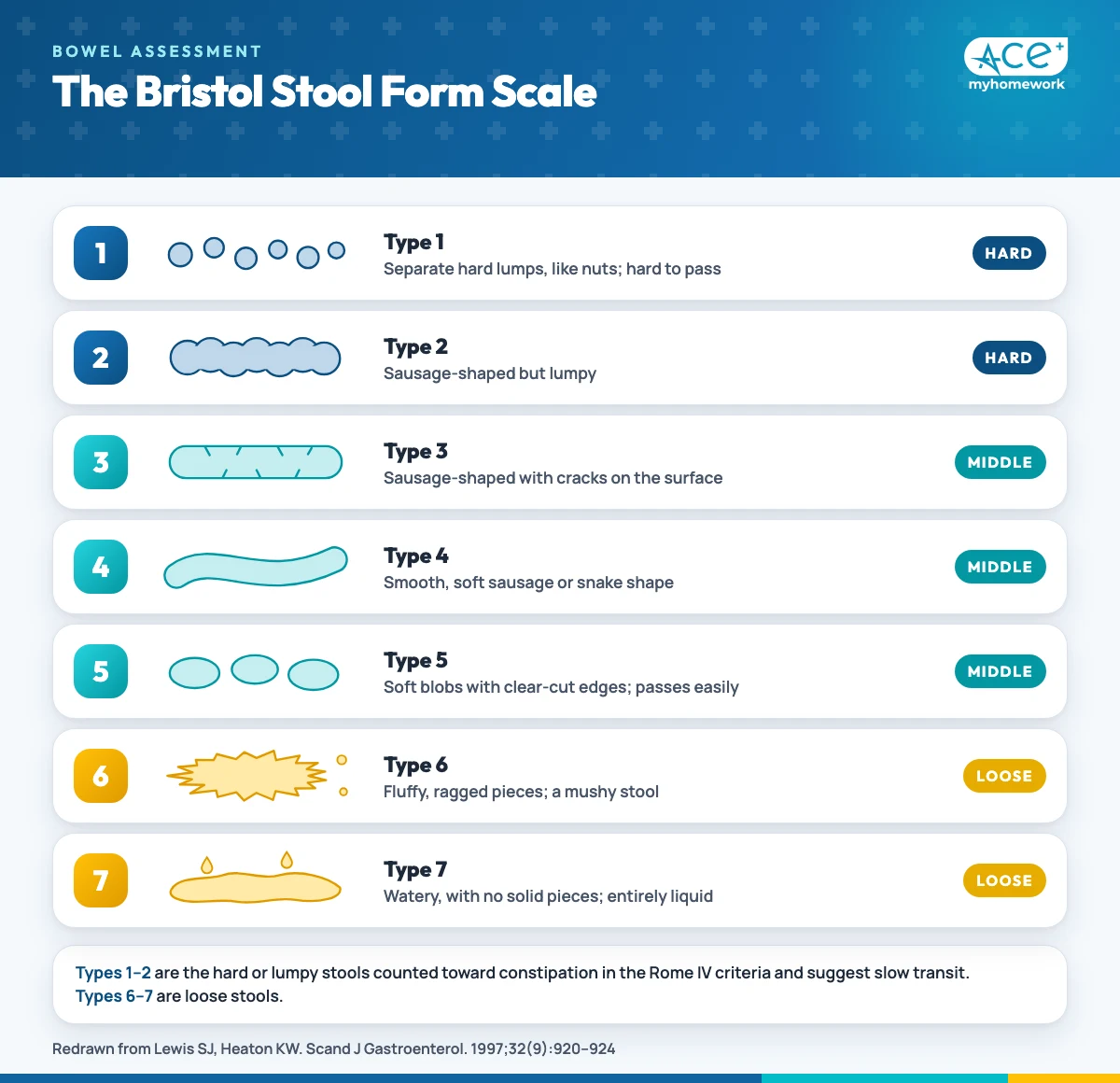
The Bristol Stool Form Scale describes stool in seven types. Lewis and Heaton showed in a 1997 study of 66 volunteers that stool form tracked whole-gut transit time better than bowel movement frequency did, and that it changed in the expected direction when transit was sped up with senna or slowed with loperamide. That makes it a practical way to monitor whether your interventions are working.
Bristol Stool Form Scale, redrawn from Lewis and Heaton (1997). Types 1–2 indicate hard stool and types 6–7 loose stool.
Types 1 and 2 are the hard or lumpy stools that the Rome IV criteria count toward constipation and suggest slow transit. Types 6 and 7 are loose. Types 3 to 5 sit between them. Documenting the type at each bowel movement is more useful than writing "small BM," because it shows whether stool is softening over time.
Causes and Risk Factors in Hospitalized Patients
NIDDK groups causes into diet and lifestyle, medications, changes in routine and underlying conditions. In hospital, several usually stack up at once:
Opioids and other constipating drugs, especially after surgery
Immobility from bed rest, pain, weakness or attached equipment
Low intake of food, fiber and fluid, including periods of fasting before procedures
Loss of routine and privacy, such as using a bedpan in a shared room or delaying when the urge comes
Underlying conditions such as hypothyroidism, diabetes, Parkinson's disease, spinal cord injury or dehydration
Age, since older adults are more likely to have several of these factors together
Bowel Elimination Interventions with Rationales
Fiber, Fluids and Food
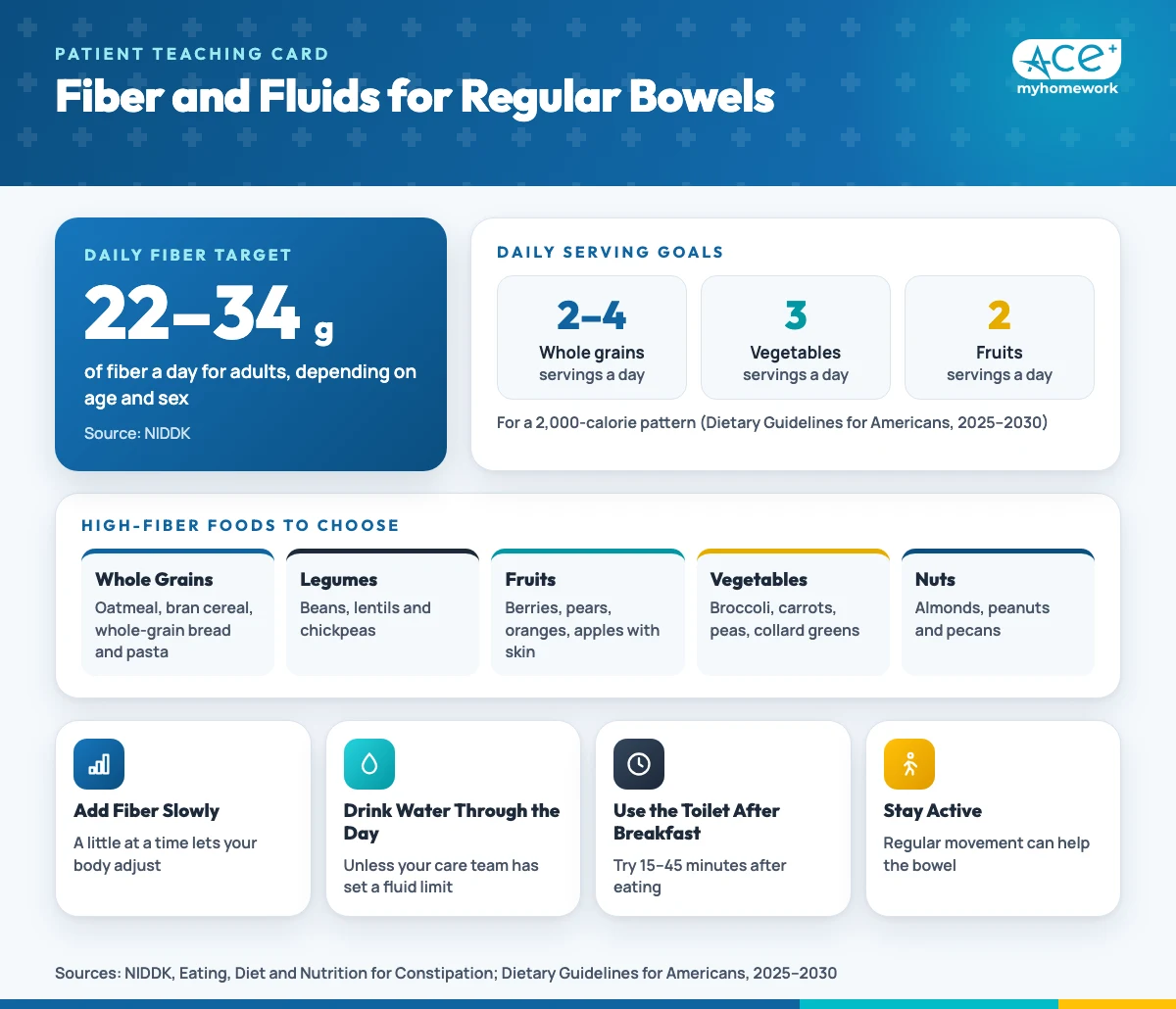
NIDDK advises that adults get 22 to 34 grams of fiber a day, depending on age and sex, and that fiber be added a little at a time so the body can adjust. It also recommends drinking plenty of liquids so the fiber can work. The Dietary Guidelines for Americans, 2025–2030 give serving goals of 2 to 4 servings of whole grains, 3 servings of vegetables and 2 servings of fruit a day for a 2,000-calorie pattern, and name water (still or sparkling) and unsweetened drinks as the preferred beverages.
Fiber and fluid teaching card. Fiber range from NIDDK; serving goals from the Dietary Guidelines for Americans, 2025–2030.
Always check for fluid restrictions before encouraging fluids. Patients with heart failure or advanced kidney disease may have a daily limit, and fiber works best when fluid intake is adequate. A dietitian referral helps when intake is poor or restrictions are complex.
Mobility, Routine and Positioning
Encourage activity as tolerated, from walking in the hallway to bed exercises. NIDDK notes that regular physical activity may help relieve symptoms.
Use the gastrocolic reflex. NIDDK suggests trying to have a bowel movement 15 to 45 minutes after breakfast, when eating stimulates colon activity. Offer the toilet or commode at that time.
Respond to the urge. Answer call lights promptly so patients do not have to delay.
Position for success. A bedside commode or toilet is easier than a bedpan. Resting the feet on a footstool can make emptying easier, as NIDDK's treatment guidance suggests.
Provide privacy and enough time.
Medications
Laxatives are given on a provider's order or according to an approved protocol. The 2023 AGA-ACG guideline on chronic idiopathic constipation made strong recommendations for polyethylene glycol and sodium picosulfate, and conditional recommendations for fiber, senna, magnesium oxide and lactulose, with prescription options for patients who do not respond. In practice, your role is to give what is ordered, monitor the effect using stool type and frequency, watch for cramping, diarrhea and electrolyte problems, and report when the regimen is not working. When a patient starts regular opioids, ask the prescriber whether a preventive bowel regimen should be ordered rather than waiting for constipation to develop. Magnesium-based laxatives need caution in kidney impairment, so flag that history to the prescriber.
Red Flags That Need Escalation
Constipation is common, but it can also signal something serious. NIDDK advises urgent medical review when constipation comes with rectal bleeding or blood in the stool, constant abdominal pain, inability to pass gas, vomiting, fever, lower back pain or unintentional weight loss. On a hospital unit, also report promptly:
A distended, firm or tender abdomen with absent or high-pitched bowel sounds, which may point to obstruction or ileus
Liquid stool leaking around hard stool, which can be overflow from fecal impaction rather than diarrhea
New confusion, agitation or urinary retention in an older adult who has not had a bowel movement
No bowel movement despite the ordered regimen, especially on opioids
When you call the provider, a structured report such as SBAR keeps the key findings clear: last bowel movement, stool type, abdominal findings, vital signs and what has been given.
Nursing Care Plan Constipation Example
For example, take a hypothetical 72-year-old man on day three after a total hip replacement. He takes oxycodone every four to six hours for pain, has not had a bowel movement for four days (his usual pattern is daily), reports a full, uncomfortable abdomen and passed a small type 1 stool with straining this morning. Bowel sounds are present but hypoactive, his abdomen is mildly distended and soft, and he is drinking about 1 liter a day. He has no fluid restriction.
Nursing Diagnosis
Expected Outcomes (SMART)
Nursing Interventions
Rationale
Evaluation
Impaired intestinal elimination (Constipation in earlier editions) related to opioid use, reduced mobility and low fluid intake, as evidenced by no bowel movement for four days, Bristol type 1 stool, straining and abdominal distension
Patient will pass a soft, formed stool (Bristol type 3 or 4) without straining within 48 hours
Assess bowel sounds, distension and stool type every shift
Give the ordered bowel regimen and record the effect
Offer the commode 15–45 minutes after breakfast with privacy
Notify the provider if no bowel movement in 24 hours or if red flags appear
Tracks progress and detects obstruction early
Opioid-related constipation usually needs medication, not diet alone
Uses the gastrocolic reflex and supports normal posture
Allows the regimen to be adjusted before impaction develops
Goal met: Bristol type 4 stool on day four after an evening laxative dose; abdomen soft, not distended
Impaired physical mobility related to postoperative pain and hip precautions, as evidenced by reluctance to walk and need for assistance with transfers
Patient will walk in the hallway with a walker and assistance three times daily by tomorrow
Time walks for when pain medication is working
Assist with ambulation following the surgeon's hip precautions
Coordinate with physical therapy on mobility goals
Pain control makes activity possible
Movement stimulates bowel motility
Shared goals keep progress consistent
Goal met: walked three times on day four with standby assistance
Inadequate health knowledge related to new opioid use, as evidenced by the question "Why can't I go?"
Patient will state three ways to prevent constipation at home before discharge
Explain how opioids slow the bowel
Teach fiber sources and gradual increase, plus regular fluids
Review the discharge bowel regimen and when to call the provider
Use teach-back
Understanding the cause improves adherence
Diet and fluids support the bowel regimen
Early action prevents a repeat episode
Confirms understanding
Goal met: patient named fruit and whole grains, water through the day and taking the laxative while on opioids
Compare this with our acute pain nursing care plan. Postoperative patients often need both, and the two plans should not work against each other: good pain control helps mobility, while the opioids that provide it slow the bowel.
Tips for Writing a Strong Constipation Care Plan
Name the cause. "Related to opioid use and immobility" leads to specific interventions. "Related to constipation" does not.
Use measurable evidence. Days since the last bowel movement, Bristol type and abdominal findings are better than "patient is constipated."
Make outcomes time-bound. Give a time frame such as 24 or 48 hours and a target stool type.
Check restrictions before you write "increase fluids." State the target amount and confirm it fits the patient's orders.
Include red flags and when you will escalate, not just comfort measures.
Evaluate with the same measures you used in the assessment, so your instructor can see whether the goal was met.
Getting Help with Your Care Plan
Elimination care plans are common in fundamentals and medical-surgical courses, and instructors often look for a clear link between the cause, the interventions and the evaluation. If you want feedback on your diagnosis statement, outcomes or rationales, our nursing homework help service offers tutoring and draft review. Use any outside help in line with your school's academic integrity policy.
Frequently Asked Questions
What Is the Nursing Diagnosis for Constipation?
Many programs still use the NANDA-I label Constipation. In the 2024–2026 edition, the general labels are Impaired intestinal elimination and Risk for impaired intestinal elimination, with Chronic functional constipation for long-standing cases. Ask which edition your instructor follows.
What Are the Main Nursing Interventions for Constipation?
Assess bowel pattern and stool type, increase fiber gradually, encourage fluids unless restricted, promote mobility, offer the toilet after meals with privacy, give ordered laxatives and monitor their effect, and teach the patient how to prevent a recurrence.
How Much Fiber Should Adults Eat for Constipation?
NIDDK recommends 22 to 34 grams of fiber a day for adults, depending on age and sex. Increase it slowly and drink enough fluid so the fiber can soften the stool.
What Bristol Stool Type Means Constipation?
Types 1 and 2, separate hard lumps or a lumpy sausage shape, are the hard stools associated with constipation and slow transit. Types 6 and 7 are loose.
When Should a Nurse Escalate Constipation?
Report promptly if the patient has vomiting, severe or constant abdominal pain, a distended firm abdomen, cannot pass gas, has blood in the stool, fever or liquid stool leaking around hard stool, or if the ordered regimen has not worked.
Should Every Patient on Opioids Have a Constipation Care Plan?
Opioids commonly cause constipation, so many patients on regular opioids benefit from a risk diagnosis and a preventive bowel regimen discussed with the prescriber. Base the decision on your assessment and your facility's protocols.
Get affordable and top-notch help for your essays and homework services from our expert tutors. Ace
your homework, boost your grades, and shine in online classes—all with just a click away!
How to write a rhetorical analysis essay: key concepts, the rhetorical situation, appeals and strategies, a step-by-step process, examples and AP Lang tips.
Write a risk to fall nursing care plan: current NANDA-I fall diagnosis, Morse Fall Scale scoring, fall prevention interventions and a care plan example.